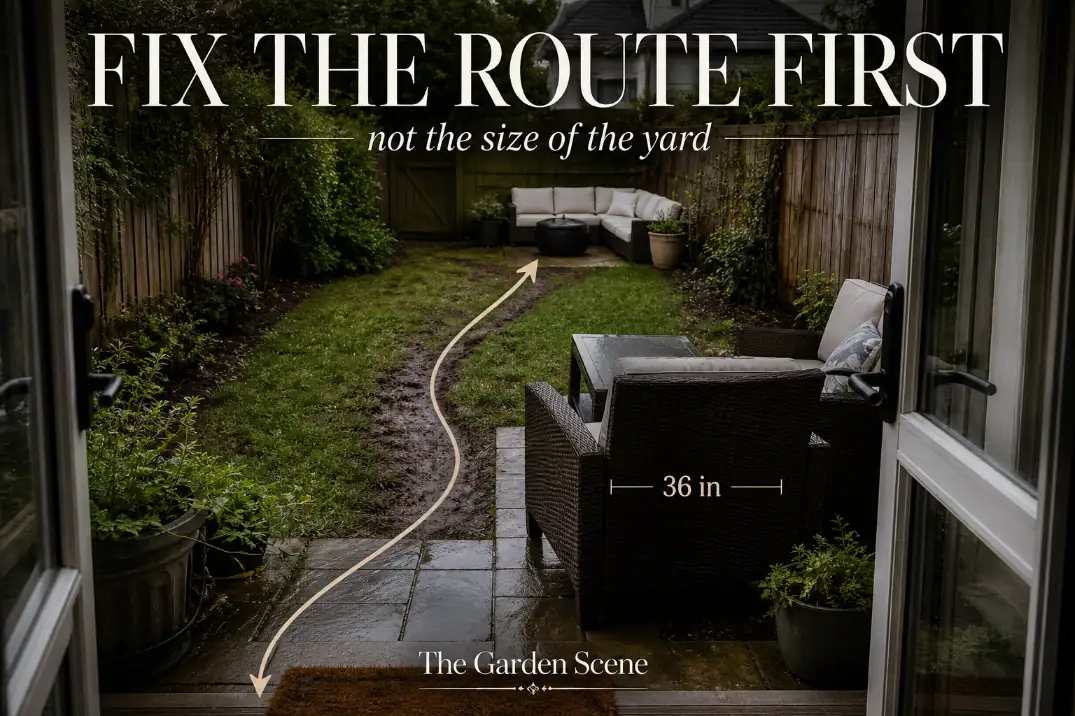
Fix water and safety first, circulation second, the main usable surface third, and comfort or appearance after that. A backyard usually feels hard to use because people cannot move through it cleanly, the ground does not support daily traffic, or too many activities are fighting for the same small area.
Start with three checks: whether water stands near the house or main route for more than 24 hours, whether the path from the back door to the main zone stays at least 36 inches wide, and whether chairs, grill legs, or tables sit on a stable surface without rocking or sinking.
A yard that looks plain is different from a yard that fails. Empty planting beds are cosmetic. A soft route, blocked door, slick patio edge, or dining chair that has nowhere to pull back changes whether the space works at all.
The Fix-First Decision Table
Use this order before buying furniture, building beds, adding screens, or expanding a patio.
| What You Notice | What It Usually Means | Fix First | What Can Wait |
|---|---|---|---|
| Water stands near the house, patio edge, or main walking route for 24+ hours | Drainage or grading is controlling use | Water movement, slope, downspouts, or base conditions | Furniture, decor, planting |
| The main route narrows below 30–36 inches | Circulation is broken | Clear or relocate the route | Extra seating, planters, storage |
| Chairs sink, wobble, or catch on uneven edges | The surface is not dependable | Stable patio, path, or compacted base | Style upgrades |
| The yard works only when furniture is moved first | The layout is overfilled | Reduce or reposition furniture | New accessories |
| The space works physically but nobody stays there | Comfort is the limiter | Shade, wind control, privacy, lighting | Major layout changes |
| The yard functions well but feels unfinished | Mostly cosmetic | Planting, edging, lighting, styling | Heavy construction |
This table matters because many backyard projects start in the wrong place. A privacy screen cannot fix a wet route. A larger table cannot fix a narrow patio. New mulch cannot fix foot traffic that naturally cuts across the lawn every day.
The First Place to Check Is the Back Door
The first 6–8 feet outside the back door often decides whether the rest of the yard feels usable. That space is not just empty patio. It is the transition zone where people step out, pause, turn, carry food, let dogs through, move trash, or redirect guests.
The Landing Zone Should Not Be Fully Occupied
If the grill, dining set, storage box, planter, or lounge chair fills the landing zone, the yard starts with friction. People step outside and immediately have to angle around something. That small annoyance repeats every time the yard is used.
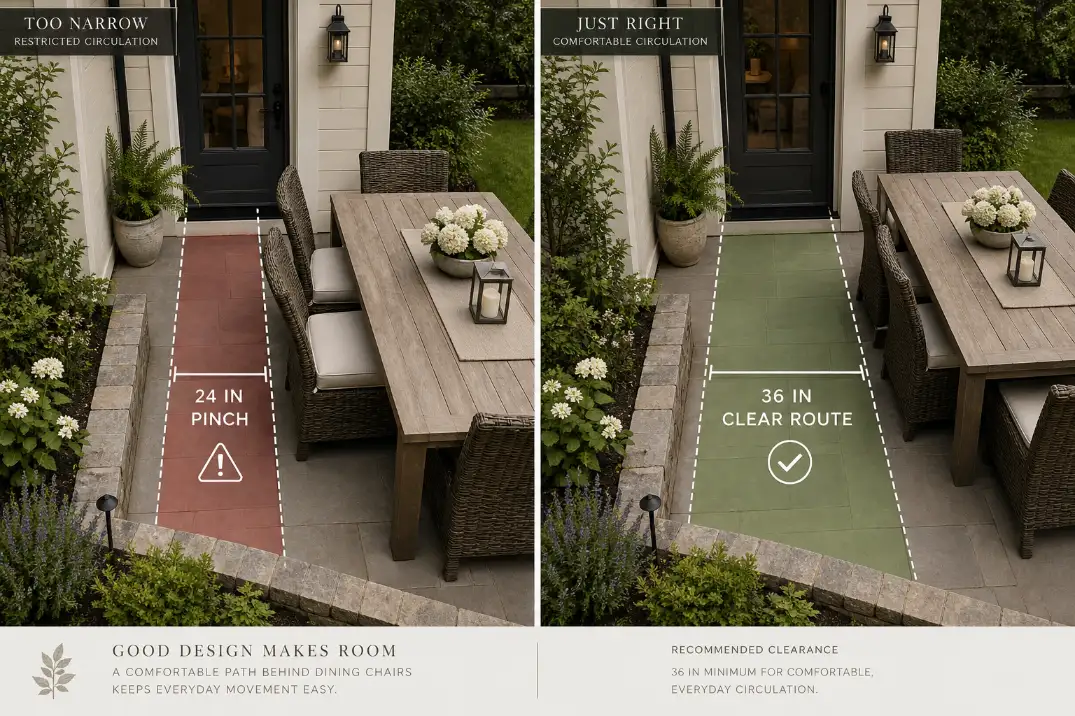
A 36-inch clear path is the preferred target from the door to the main activity area. A 30-inch pinch point can work briefly, but if the tightest part of the route is also where people carry plates, open the door, or pass behind chairs, it will feel cramped in daily use.
This is why narrow spaces often need less furniture, not more clever furniture. In a long or tight patio, the best layout usually preserves one clean lane instead of centering every piece. The same principle applies in Long Narrow Patio Furniture Layout Ideas, where the open route matters more than visual symmetry.
Door Swing and Chair Pullback Are Real Space
A dining chair typically needs about 30–36 inches behind it to pull out comfortably. A door needs swing or sliding clearance. A person carrying a tray needs room to turn without stepping into a planter or off the patio edge.
This is where a backyard can look fine in photos but fail in use. The furniture fits when nobody is sitting in it. The problem appears when people stand up, pull chairs out, open the door, or walk behind someone else.
Decide Which Kind of Failure You Have
A hard-to-use backyard usually falls into one of four categories. Do not treat them equally. Some can wait. Some will keep ruining every other improvement.
Access Failure
Access failure means people cannot move naturally. The route from the house to the seating area, grill, gate, lawn, shed, or garden cuts through furniture, mud, or planting beds.
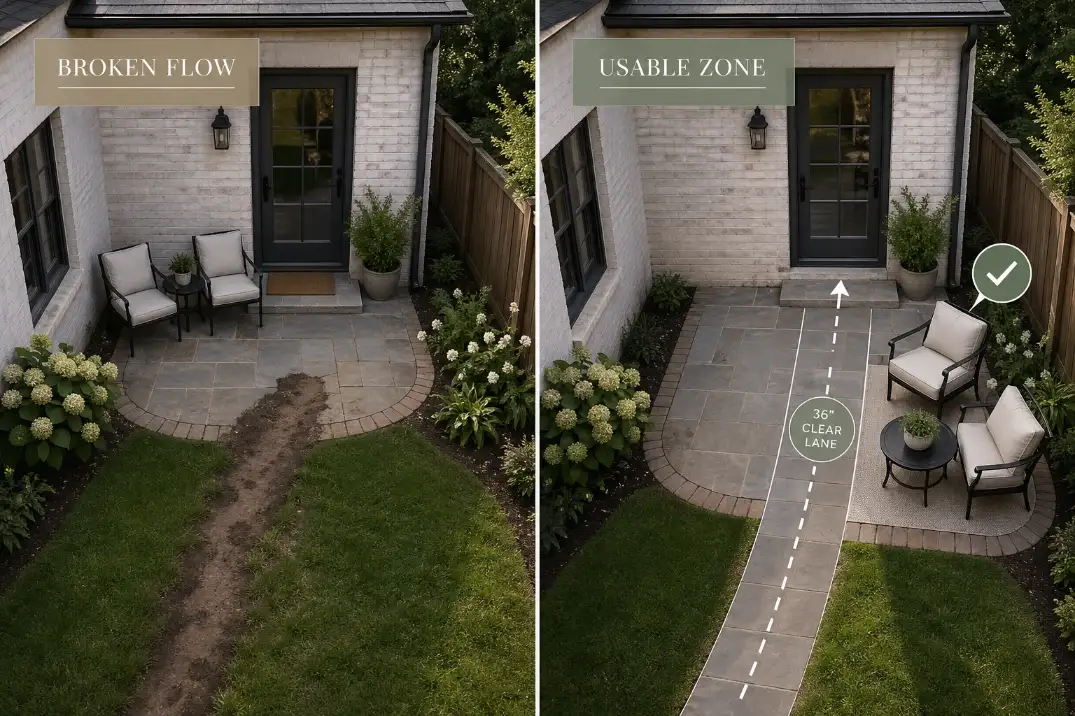
The strongest signal is a desire path: a worn strip through grass or mulch. That path is not just a lawn problem. It shows where people, kids, pets, or guests actually want to walk. If the official path and the real path are different, the layout is arguing with use.
Surface Failure
Surface failure means the ground cannot support the activity. Chairs sink. Gravel spreads. Pavers rock. A patio edge stays slick. A step catches toes. The yard may be attractive, but people do not trust it underfoot.
For high-use areas, stability matters more than texture. A surface that varies more than about 1/4 inch across a chair or walking area can become annoying or unsafe, especially near the back door or in evening light. In heavy-use zones, Backyard Surface Choice and Usability is a functional decision, not just a design preference.
Zone Failure
Zone failure happens when the yard is asked to do too much in the same strip of space. Dining, grilling, lounging, dog traffic, kid play, storage, and garden access can all work in one backyard, but not if they all need the same 4-foot lane.
This is the failure people often misread as “my yard is too small.” Sometimes the yard is not too small. The jobs are colliding.
Comfort Failure
Comfort failure means the layout works, but nobody wants to stay there. The patio may be too hot from 2–6 p.m., too exposed to neighbors, too windy for cooking, too dark after dinner, or too buggy near damp planting.
Comfort matters, but it usually comes after access, water, and surface stability. The exception is a predictable comfort problem that blocks use every day. In Arizona or inland California heat, shade may outrank new furniture. In humid Florida or coastal areas, airflow and drainage may matter more than another cleaning product.
When Drainage Must Move to the Top
Drainage outranks almost everything when water affects the house, the patio edge, or the main route. A damp back corner may be tolerable. A muddy entrance path changes whether the yard gets used.
Standing Water Is Not Just an Eyesore
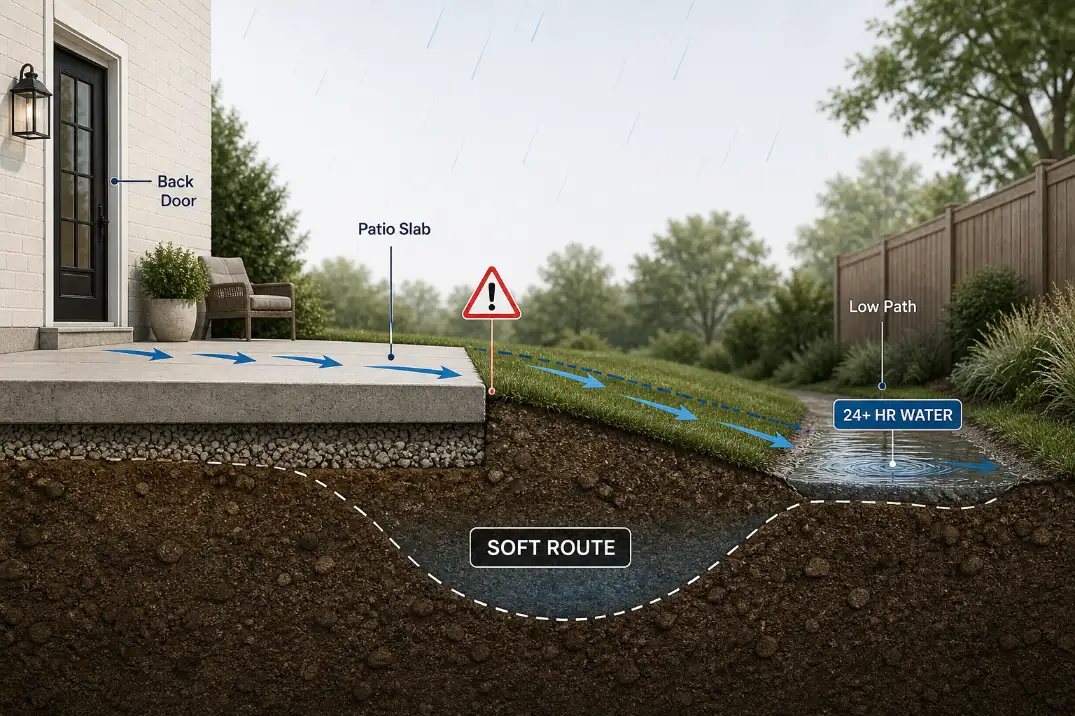
If water stands for more than 24 hours in a main-use area, treat it as a problem. If the route stays soft or muddy for 48 hours in mild weather, do not cover it with mulch and call it fixed. The issue is water movement, soil compaction, low grade, or an unsuitable surface.
A patio or walkway should generally move water away from the house. A common drainage target is roughly 1/8 to 1/4 inch of slope per foot, depending on the surface and site. If water moves toward the foundation, collects against the slab, or repeatedly crosses the walking route, the first fix is not styling. It is drainage or grading.
For yards where water pools at the patio edge or near the house, a deeper look at Patio Water Pooling Against the House can help separate a surface nuisance from a problem that deserves faster attention.
Why Mulch and Stepping Stones Often Fail
Mulch over a muddy shortcut usually looks better for a few weeks, then ruts again. Stepping stones laid over soft soil often wobble. Gravel without edge restraint spreads into lawn or beds.
These fixes fail because they treat the symptom — the ugly path — instead of the mechanism: repeated traffic over a wet or unstable route.
The right fix depends on the pattern. A small low spot may need regrading. Water from a downspout may need to be extended or redirected. Water crossing a patio may call for a swale, channel drain, or rebuilt transition.
Waterlogged soil may need a more permeable surface, dry well, rain garden, or French drain. The point is not to overbuild every wet spot. The point is to stop improving a route that cannot stay usable.
Fixes That Usually Come Too Early
Some upgrades feel productive because they are visible. They are not always wrong, but they often come too soon.
Buying New Furniture Before Measuring
Smaller furniture can help, but only if furniture is the blockage. Measure the route, chair pullback, and door clearance first. If removing one chair restores the 36-inch lane, the fix may be editing, not shopping. If the patio surface is unstable, new furniture just sits on the same bad base.
This is common in compact yards where deep seating consumes the only flexible edge. Before replacing everything, check whether one oversized piece is forcing the rest of the yard to behave badly. Many Patio Furniture Mistakes in Small Backyards come from ignoring circulation, not from choosing the wrong color or style.
Expanding the Patio Without Changing the Route
A bigger patio helps only if it creates usable clear space. Adding 2 feet of depth does little if the walking route still runs behind dining chairs or the grill still blocks the door.
Before expanding, ask one question: after the change, can someone walk from the back door to the lawn, gate, or grill without entering the chair pullback zone? If not, the expansion preserves the same failure in a larger footprint.
Adding Privacy Before Preserving Space
Privacy can make a backyard more comfortable, but screens, planters, and hedges also take room. A 24-inch-deep planter along a narrow patio may remove the exact space needed for circulation. A hedge that grows 3 feet wider than expected can crowd seating within two seasons.
Privacy should move up the list only when exposure is the main reason people avoid an otherwise functional space. If the yard is wet, cramped, or unstable, screening is not the first fix.
The 90-Minute Backyard Reset Test
Before spending real money, run a simple reset. This is the fastest way to separate a layout problem from a construction problem.
- Remove extra chairs, loose planters, hoses, toys, storage bins, and side tables.
- Mark the real walking route with a garden hose, painter’s tape, or landscape flags.
- Measure the narrowest point on that route.
- Pull dining chairs out 30–36 inches and see what space remains.
- Walk from the back door to the main zone while carrying a tray, trash bag, or watering can.
- Check the same route after the next rain and note whether it is dry, soft, slick, or muddy after 24 and 48 hours.
Pro Tip: The item people walk around most often deserves the most suspicion. It may not be ugly, broken, or expensive, but it may be controlling the whole layout.
If the yard feels dramatically better after removing clutter and shifting furniture, start with layout. If it still feels awkward because the route is wet, sloped, slick, or unstable, start with surface and drainage. If everything works physically but people still avoid the space, then comfort upgrades are justified.
What to Fix Based on the Result
If the Route Is the Problem
Create one clear path before adding zones. In small or rectangular yards, keep the main path along one edge when possible instead of splitting the usable center. Avoid placing the largest furniture piece where everyone has to pass around it.
For narrow patios, alignment matters more than symmetry. A centered table may look balanced but block movement on both sides. A table shifted slightly to preserve one open lane often works better.
If the Surface Is the Problem
Upgrade the surface where feet and furniture actually go. You do not always need to hardscape the whole yard. A stable landing, a reliable path, or a properly built seating pad may change daily use more than a large decorative patio.
For heavy-use areas, compare materials by stability, cleaning, heat, drainage, and repair — not just price. Concrete, pavers, gravel, and decomposed granite behave differently under chairs, rain, pets, and freeze-thaw cycles. If the main need is a dependable patio, Concrete vs Pavers for a Stable Patio is a more useful comparison than choosing by appearance alone.
If Zones Are Colliding
Cut one function or move it. A grill does not need to sit beside the dining table if that placement blocks the cook, guests, and door at the same time. A lounge area does not need a full sofa if a bench or two chairs preserve the route.
This is where people commonly overestimate how many “destinations” a small backyard needs. One comfortable, usable zone beats three cramped ones.
If Comfort Is the Problem
Solve the specific comfort issue, not the general feeling. Afternoon heat may need shade cloth, a tree canopy plan, umbrella placement, or a lighter surface. Wind near a cooking area may need grill relocation, not a privacy wall. Exposure from a second-story window may need overhead or angled screening rather than a tall fence at the property line.
Comfort upgrades work best after the yard has a dependable place to stand, sit, and move.
What Changes by Climate and Yard Type
The same priority order applies across most US backyards, but the warning signs change.
In humid climates such as Florida or the Gulf Coast, damp shade can keep patio edges slick and algae-prone. If a surface needs cleaning every few weeks during wet seasons, the issue may be drainage, airflow, or shade density rather than simple dirt.
In dry desert regions, the yard may fail because the main seating area is unusable during peak afternoon heat. If a patio is avoided for 2–4 predictable hours every day, shade and surface temperature become functional fixes, not decorative upgrades.
In northern states, small drainage issues can become surface issues after freeze-thaw cycles. Water that settles under pavers, along patio edges, or beside steps can contribute to heaving, rocking, and uneven transitions over winter.
In Midwest yards with seasonal storms, the key test is repeatability. One wet day does not define the yard. The same muddy route after normal rainfall does.
Questions People Usually Ask
Should I fix the patio or the lawn first?
Fix whichever one controls access. A patchy lawn in a back corner can wait. A muddy lawn that everyone crosses from the door to the gate should move up the list. A patio where chairs wobble, water collects, or traffic jams near the door should be handled before planting or decor.
Is furniture replacement enough?
Only if furniture is the cause of the blockage. If removing one chair, swapping a deep sofa for a bench, or shifting the table restores the route, furniture was the right fix. If the ground is wet, sloped, slick, or unstable, new furniture will only make the same problem look cleaner.
When does a simple cleanup stop making sense?
When the same failure returns within a few weeks of normal use. Re-spreading gravel, adding mulch, washing algae, or reseeding a worn path can be reasonable once. If the same spot fails again, the real cause is layout, water, surface choice, or repeated traffic.
The best first backyard fix is rarely the prettiest upgrade. Start with the thing that controls whether people can enter, move, sit, and stay: water, route, surface, then comfort. For broader official guidance on managing residential landscape runoff, see the University of Minnesota Extension.