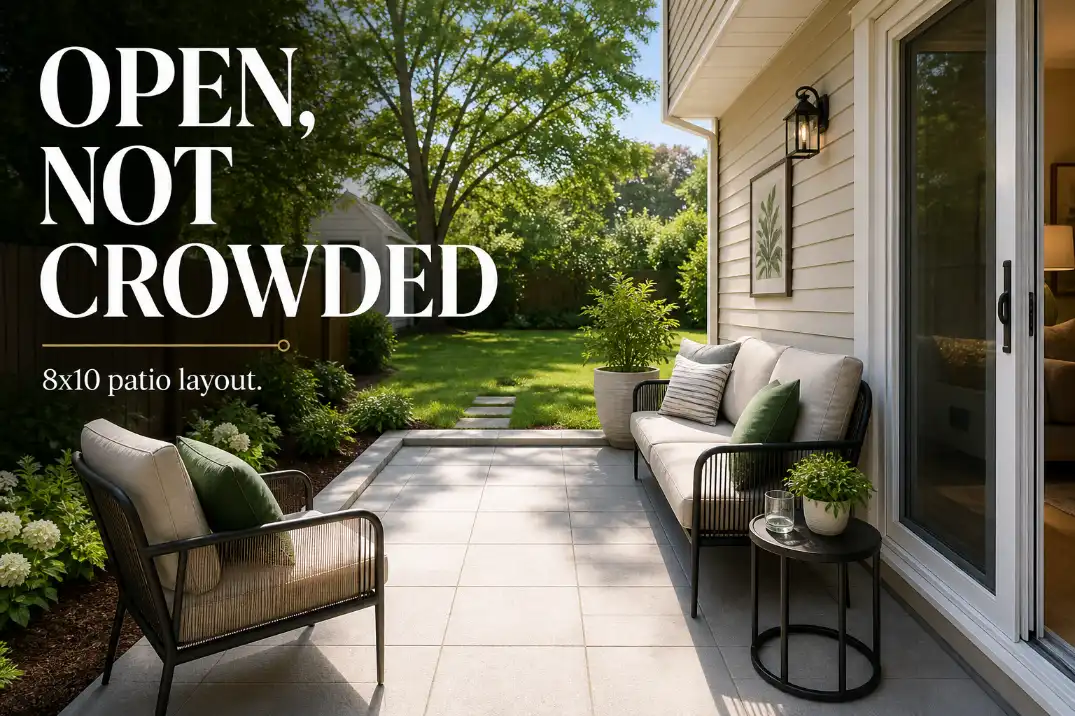
An 8×10 patio feels open when the 10-foot side carries the furniture and the 8-foot width stays usable for movement. The common mistake is treating 80 square feet like a small outdoor living room instead of a tight rectangle where every chair, table, planter, and door path competes for the same floor space.
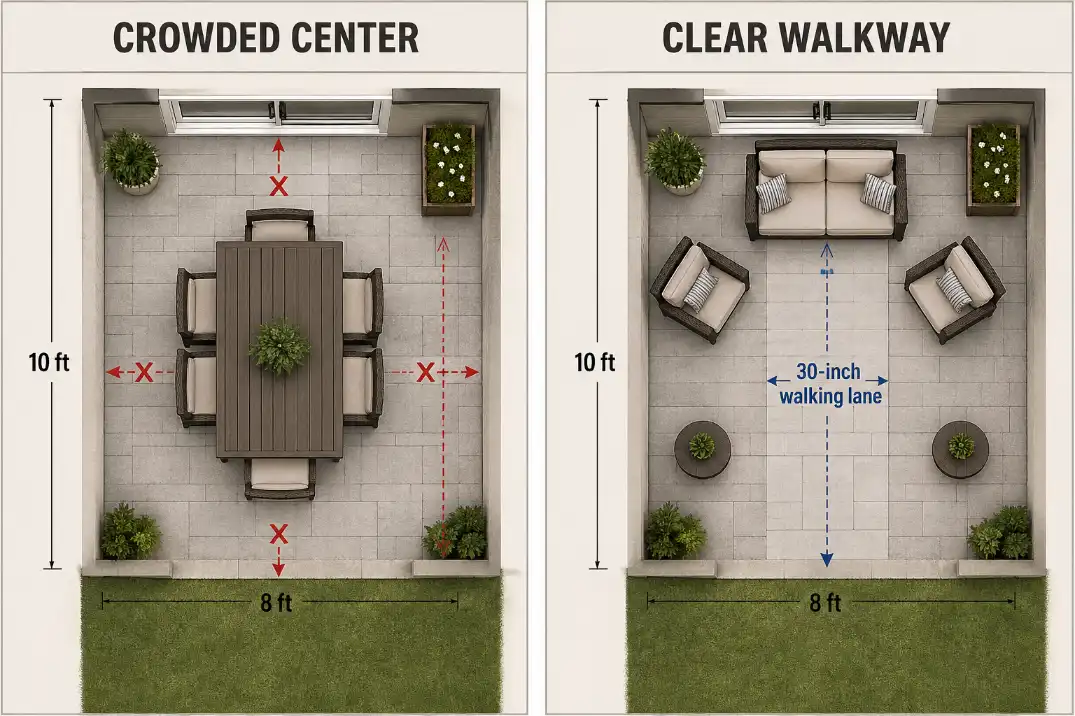
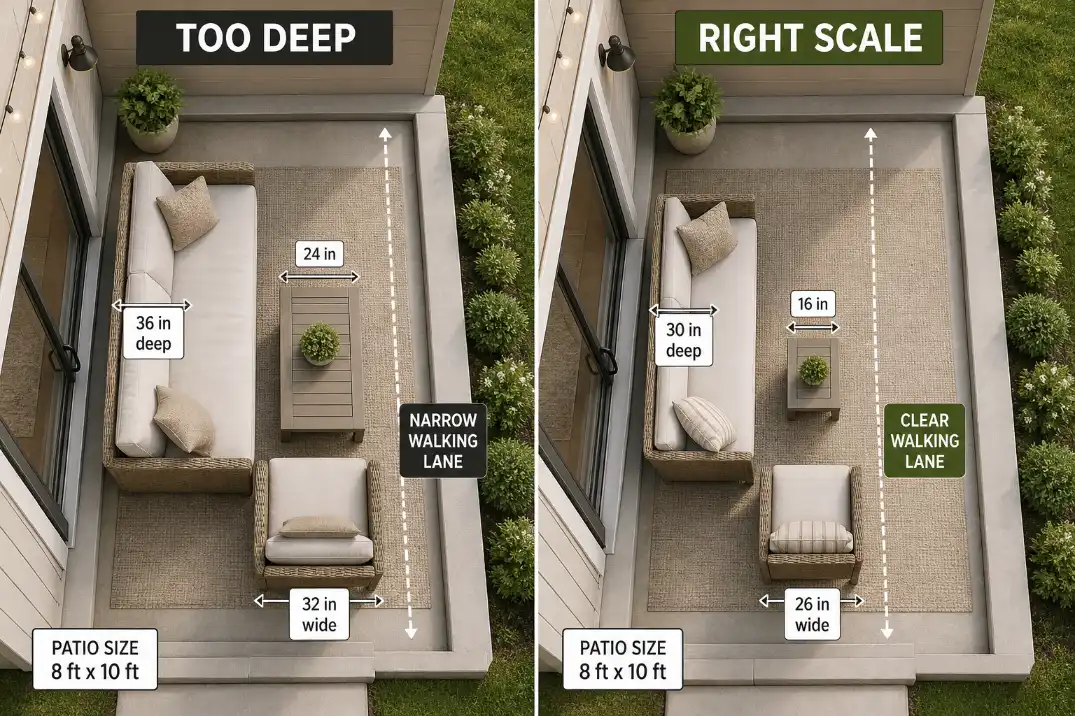
Start with three checks: keep at least 30 inches of clear walking space, avoid deep seating over about 32 inches unless it sits tightly against an edge, and protect the open side that connects to the yard, view, or steps. A 36-inch walkway feels noticeably easier than a 24-inch squeeze path.
The difference between a patio that “fits furniture” and one that feels open is usually not style; it is whether people can move, sit, and turn without stepping around the layout.
The 8×10 Rule: Use the Long Side, Protect the Short Width
The most important thing about an 8×10 patio is its shape. Ten feet gives you enough length for a loveseat, bench, or narrow dining setup. Eight feet disappears quickly once seating depth, chair pull-back, and a table are added.
Keep the center useful, not decorated
A center coffee table looks natural in a showroom layout, but it often makes an 8×10 patio feel smaller. If people need to cross the patio from the door to the yard, grill, or steps, the center should stay mostly open.
That does not mean the space should look bare. It means the visual weight belongs near the edges. A small side table, slim planter, or narrow bench usually does more for the patio than one more centered object.
If the patio already feels tight, the best first move is not always buying a smaller set; sometimes it is identifying which piece is quietly making the whole space feel cramped.
Start with the door and the open edge
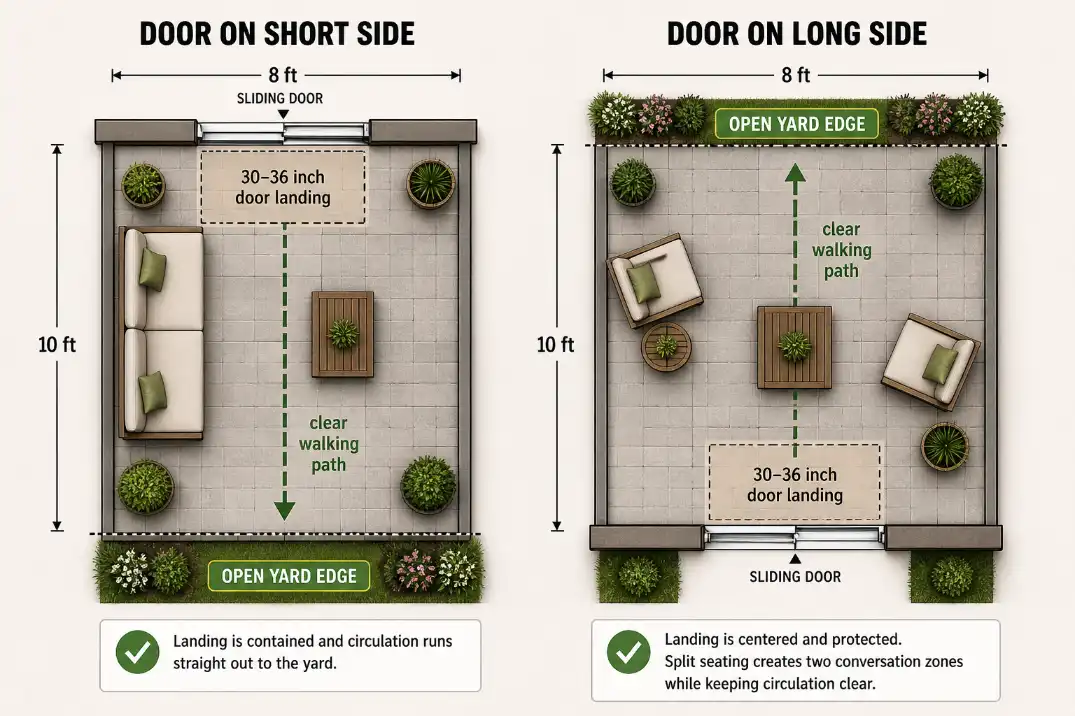
Before choosing a layout, find the two areas that should not be blocked: the door landing and the open edge.
If a sliding door opens onto the short 8-foot side, keep the first 30–36 inches outside the door clear and push the main seating onto a long side. If the door is on the 10-foot side, split the furniture so the door does not open directly into a loveseat or chair back.
If one side of the patio opens to the yard, keep that side lighter. A patio feels more open when the eye can move beyond the slab. Placing a bulky sofa, storage box, or row of wide planters along that open edge can make the whole area feel boxed in.
6 Layout Ideas That Work Best on an 8×10 Patio
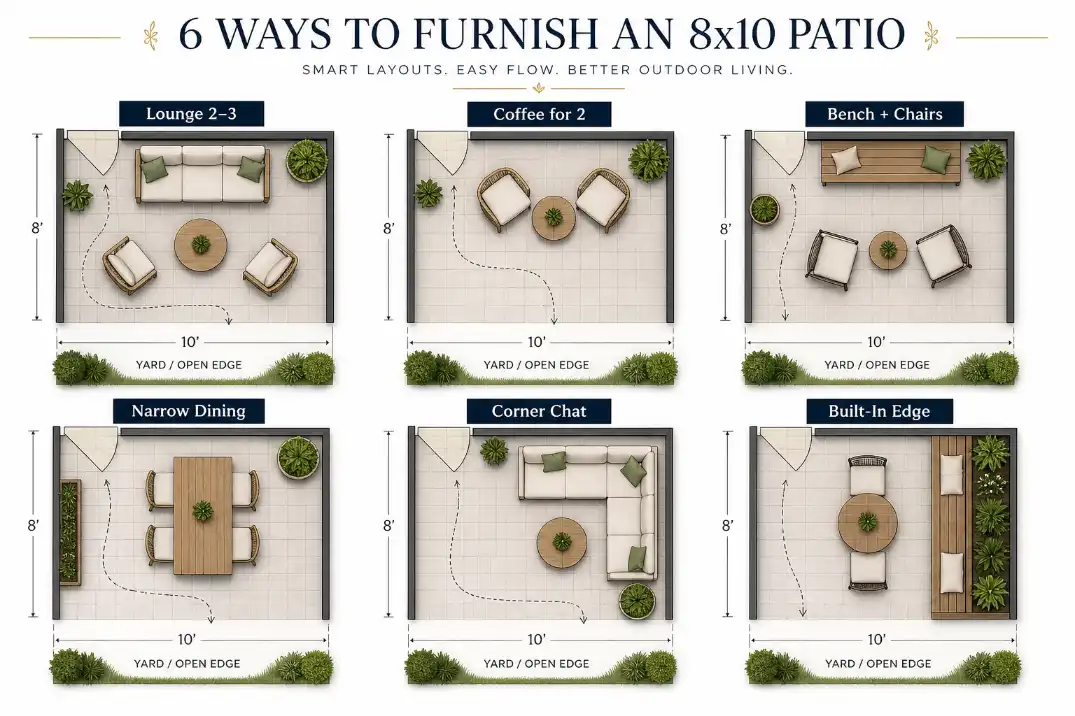
These layouts are not equal in every yard. The best one depends on whether the patio is mainly for coffee, dining, lounging, or occasional guests.
1. Loveseat on the 10-foot side with one chair
Best placement: Put a compact loveseat against the 10-foot edge, angle one chair near the opposite corner, and use a side table instead of a coffee table.
Use when: You want comfortable lounge seating for two or three people without filling the patio.
Avoid when: The long side is interrupted by a door, grill, or main walkway.
This is usually the safest layout for an 8×10 patio because the largest piece sits where the patio has the most length. A loveseat around 52–60 inches wide and 28–32 inches deep works far better than a deep outdoor sofa. Once the seat depth reaches 36 inches, the remaining walking area starts to feel narrow.
The chair should not face the loveseat in a perfectly rigid way if that blocks movement. A slight angle often feels better because it opens one corner and creates a more natural path through the space.
2. Two chairs and one small table
Best placement: Place two slim chairs at a slight angle with a 14–20 inch side table between them.
Use when: The patio is mostly for morning coffee, reading, or one-on-one conversation.
Avoid when: You regularly need seating for four.
This is the most open-feeling layout because it keeps furniture count low. Two chairs also make it easier to adjust the patio for shade, wind, or guests.
The key is chair scale. Two oversized lounge chairs can crowd an 8×10 patio more than a slim loveseat. Look for chairs around 24–28 inches wide when openness matters. Bulky club chairs with thick arms often look comfortable online but dominate small patios in real use.
This is where many homeowners misread the issue: the patio does not need a more complete furniture set, it needs fewer pieces that avoid the small-space mistakes that visually shrink the backyard.
3. Bench against the wall with movable chairs
Best placement: Run a bench along a house wall, fence, raised planter, or railing, then add one or two lightweight chairs.
Use when: You need flexible seating but want the floor to stay clean.
Avoid when: The bench would block the door landing or yard access.
A bench can work beautifully on an 8×10 patio because it does not need the same pull-back space as a loose dining chair. A bench that is 48–60 inches wide and 18–20 inches deep can seat two people while staying visually calmer than multiple chairs.
The mistake is choosing a bench that behaves like a sofa: thick arms, deep cushions, heavy frame, and wide base. For this layout, the bench should be slim and edge-bound. If it projects too far into the patio, it loses the advantage.
4. Narrow dining table along the edge
Best placement: Place a narrow rectangular table parallel to the 10-foot side, with chairs or a bench arranged so the pull-back space does not block the main path.
Use when: Dining is the patio’s main purpose.
Avoid when: You want both dining and lounging every day.
Dining is possible on an 8×10 patio, but it needs discipline. A table may fit while empty and still fail when chairs slide back. Plan for about 30–36 inches from the table edge to the nearest wall, planter, railing, or furniture piece.
A 28–32 inch wide rectangular table usually works better than a large round table. A 36-inch round bistro table can work for two. A 48-inch round table usually starts to overwhelm the patio once chair movement is included.
The fix that often wastes time is swapping a square table for a round one without reducing the real dining footprint. Shape helps, but clearance decides whether the layout works.
If meals are the main use, do not judge the layout by the table alone; the real test is how much room the dining set needs once people actually sit down.
5. Corner conversation layout without a bulky sectional
A corner conversation layout works best when the corner already has a reason to become the focal point, such as a view, garden bed, privacy screen, or small fire feature. Place a loveseat on one edge and a single chair on the adjacent edge to create an L shape without using a full sectional.
This layout becomes weaker when the only usable corner is also the main traffic route from the door to the yard. A “small sectional” is often still too large for this footprint. Many compact outdoor sectionals run 72–84 inches on one side and 28–36 inches deep. On an 8×10 patio, that can leave the rest of the space feeling like an aisle.
A better approach is modular: one slim loveseat, one chair, and one small side table. You get the social shape of a sectional without locking the patio into a heavy block.
6. Built-in edge seating for the cleanest floor
Built-in seating is strongest when it can follow a permanent edge such as a wall, fence, step, or raised planter. It works because it removes loose legs, chair shifting, and visual clutter from the floor, so the patio can feel calmer even if the seating capacity stays the same.
This option is less flexible than movable furniture, so it makes the most sense when every loose furniture arrangement blocks the same path. A built-in bench can solve a layout problem that another compact chair set only rearranges.
This is the point where buying another furniture set stops making sense. If the patio’s door, open edge, and walking route are fixed, it may be time to consider whether built-in seating would solve the floor-space problem more cleanly.
Furniture Sizes That Keep an 8×10 Patio Open
The right layout can still fail if the furniture is too deep, too wide, or too visually heavy. On a small patio, the difference between a good piece and a risky one may be only 4–6 inches.
| Furniture piece | Better size for 8×10 | Risky size | Why it matters |
|---|---|---|---|
| Loveseat depth | 28–32 in | 36+ in | Deep seating eats the walking lane |
| Lounge chair width | 24–28 in | 32+ in | Wide arms crowd corners fast |
| Side table | 14–20 in | 24+ in | Larger tables interrupt movement |
| Dining table | 28–32 in wide | 40+ in wide | Chair pull-back becomes difficult |
| Round bistro table | 30–36 in | 42+ in | Works for two, not a full group |
| Outdoor rug | 5×7 ft | 8×10 ft | Large rugs can visually trap the slab |
A rug is worth special attention. An 8×10 rug sounds logical because it matches the patio size, but it can make the whole slab feel covered edge to edge. A 5×7 rug under the seating zone often leaves a cleaner border and keeps the patio from looking stuffed.
The same applies to planters. Tall, narrow planters usually work better than low, wide ones. A planter that is 12–16 inches wide can define a corner. A row of 24-inch-wide planters along the open edge can make the patio feel fenced in.
What Usually Makes an 8×10 Patio Feel Crowded
A crowded patio is not always overfurnished by count. Sometimes one wrong object blocks the layout’s best path.
Center coffee tables
A coffee table is the most common “looks right, feels wrong” piece on an 8×10 patio. It completes the seating group visually but often sits exactly where feet and traffic need to go.
Use a side table first. If you still want a center table, keep it small, lightweight, and easy to move. A table that has to stay permanently in the middle should earn that space.
Full-size dining sets
A four-person dining set can technically fit, but technical fit is a low standard. Once chairs pull out 18–24 inches and people sit down, the patio may lose its open feel.
If dining matters more than lounging, commit to a dining-first plan. If lounging matters more, do not force a full dining set into the remaining space.
Fire pits in the middle
Fire pits are easy to overestimate on small patios because photos make them look cozy. On an 8×10 patio, a central fire pit with four chairs usually fights the open-feel goal. It takes the exact area that should stay flexible.
A small tabletop fire bowl or narrow fire table near an edge may work better, but only if the manufacturer’s clearance requirements are respected. Wood-burning fire pits are rarely the simplest choice for a tight patio near siding, railings, cushions, or overhangs.
Storage boxes and wide planters near the door
Storage is useful, but a storage box near the door can turn the patio into a squeeze point. If storage is necessary, place it along a non-traffic edge or choose a bench that doubles as storage without projecting into the main path.
How to Choose the Best Layout for Your Patio
The right layout depends less on trends and more on what the patio needs to do most often.
If you use it daily for two people
Choose two chairs with a side table or a loveseat with one chair. This gives comfort without pretending the patio needs to host a crowd every day.
If you eat outside often
Use a narrow dining table along the long side. Skip the lounge chair unless the patio has an unusually clear open edge. Dining and lounging can both fit only when the furniture is very compact.
If the patio connects to a grill
Keep the route between the door, grill, and dining area clear. A grill needs working space, heat clearance, and a landing spot for food. If a chair has to be moved every time someone cooks, the layout is not working.
If the patio is closer to square than narrow
A true 8×10 patio behaves differently from a 10×10 patio. Those extra 20 square feet can make centered furniture more forgiving, but an 8×10 layout has to protect the short width more carefully. If your slab is closer to square than rectangular, the furniture logic changes because a 10×10 patio gives centered layouts more breathing room than an 8×10 space.
Questions People Usually Ask
Can an 8×10 patio fit both dining and lounge seating?
Usually not comfortably. It can fit a narrow dining setup with a bench or two chairs, or it can fit a compact lounge setup. Trying to include both often leaves no easy walking path.
What size rug works best on an 8×10 patio?
A 5×7 outdoor rug is usually safer than an 8×10 rug. It defines the seating area while leaving visible patio edges, which helps the space feel less boxed in.
Should patio furniture face the house or the yard?
Face the best view or the most comfortable direction, but do not block the open edge. On small patios, keeping the yard-facing side visually open often matters more than creating a perfect indoor-style conversation circle.
The Bottom Line on an Open 8×10 Patio Layout
The best 8×10 patio furniture layout is not the one that fits the most pieces. It is the one that protects the short 8-foot width, puts the heaviest piece on the 10-foot side, and keeps the center useful enough for real movement.
For most patios this size, that points to a slim loveseat with one chair, two compact chairs with a side table, a wall bench with movable chairs, or a narrow dining setup along the long edge.
If the patio still feels crowded after that, the problem is probably scale, not arrangement. One lighter chair, one smaller table, or one clear walking lane can change the space more than another piece that promises to “finish” it.
For a broader planning lens before you commit to furniture, layout, or hardscape changes, see the University of Georgia Extension.