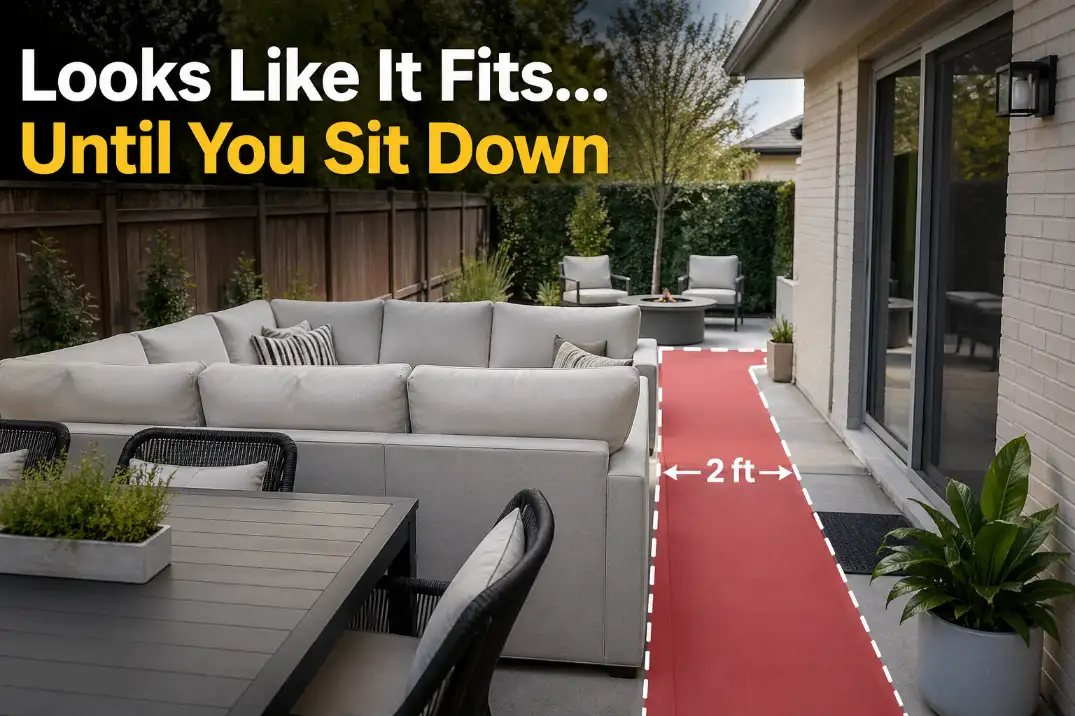
A 10×10 patio gives you 100 square feet, but it does not function like an empty 100-square-foot room. Once you subtract chair pull-back space, a door path, grill clearance, steps, posts, or the route to the yard, the usable furniture zone is often closer to 55–70 square feet.
That is why many “small patio sets” still feel too large after they arrive.
The safest answer is not to buy the smallest set possible. It is to choose one main use first. A 10×10 patio can usually handle compact dining, a small lounge setup, or a grill-plus-two-seat layout.
It rarely handles dining, lounging, storage, and cooking at the same time. The practical threshold is simple: if you cannot keep at least one 30–36 inch walking lane open, the furniture does not really fit.
What Actually Fits on a 10×10 Patio?
| Furniture setup | Fit rating | Best size range | When it fails |
|---|---|---|---|
| Bistro set for 2 | Best fit | 24–30 inch table | Chairs are bulky or deep |
| Dining for 4 | Tight but workable | 36–42 inch round table | Table reaches 48 inches or more |
| Loveseat lounge | Good fit | 48–58 inch loveseat | Coffee table is too large |
| Compact sectional | Risky fit | Short modular pieces under about 70–76 inches | Deep cushions, chaise return, thick arms |
| Full sectional | Usually no | Rarely practical | 80–90 inch L-shape dominates the patio |
| Grill plus 2 seats | Good if simplified | Grill, slim cart, two chairs | Full dining set is added too |
| Dining + lounge + grill | Usually no | Only in very minimal versions | Every zone competes for the same walkway |
The mistake people make is reading “seats four” as “fits a small patio.” Seat count is not the useful number. Footprint, chair movement, and walking space matter more.
The Three Layouts That Work Best
Layout 1: Dining-first patio
For a dining-first 10×10 patio, start with a 36-inch round table and two chairs. Four chairs can work, but they need to be slim and easy to move. A 42-inch round table is usually the upper practical limit unless the patio has no grill, no storage, and no awkward door path.
A 48-inch table may technically sit inside the patio, but it often fails in use. Chairs need about 24 inches behind them for tight pull-back and closer to 36 inches for comfortable movement. On a 10-foot patio, those inches disappear quickly.
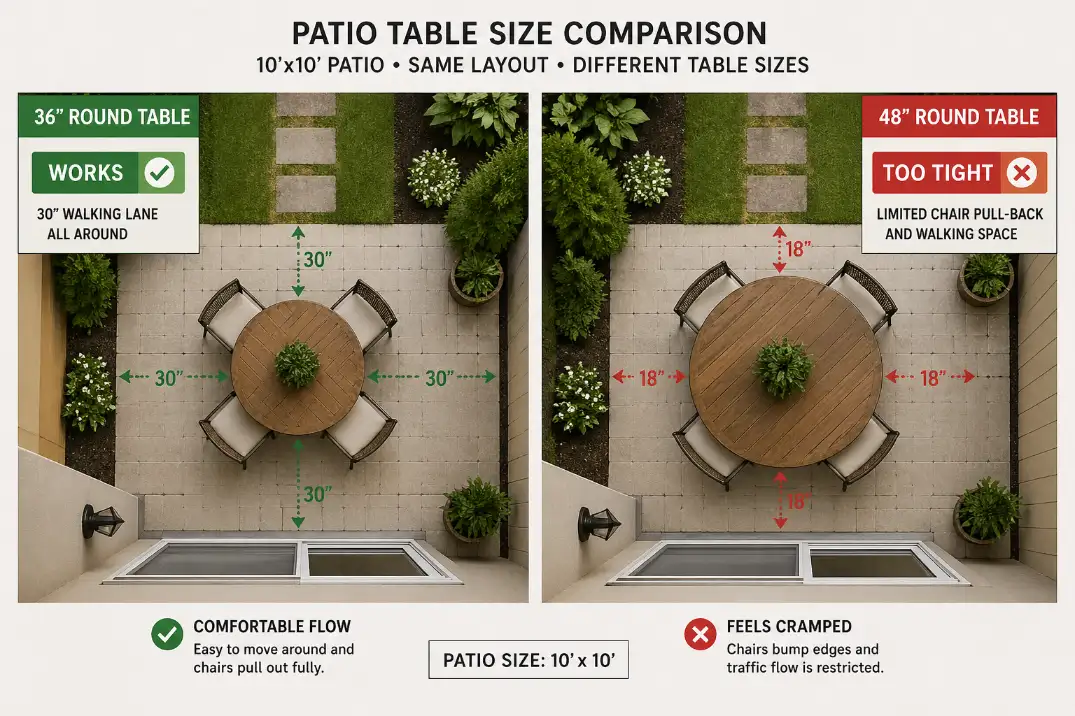
If outdoor meals are the main use, this is usually a better direction than trying to squeeze in both a dining table and a sofa. For patios where cooking is also competing for space, the decision framework in Small Patio Dining or Grill Zone helps clarify which use should win.
Layout 2: Lounge-first patio
A lounge-first layout works best with a compact loveseat, one or two slim chairs, and a small table. Look for a loveseat around 48–58 inches wide, chairs under 30 inches wide, and a coffee table around 18–22 inches deep.
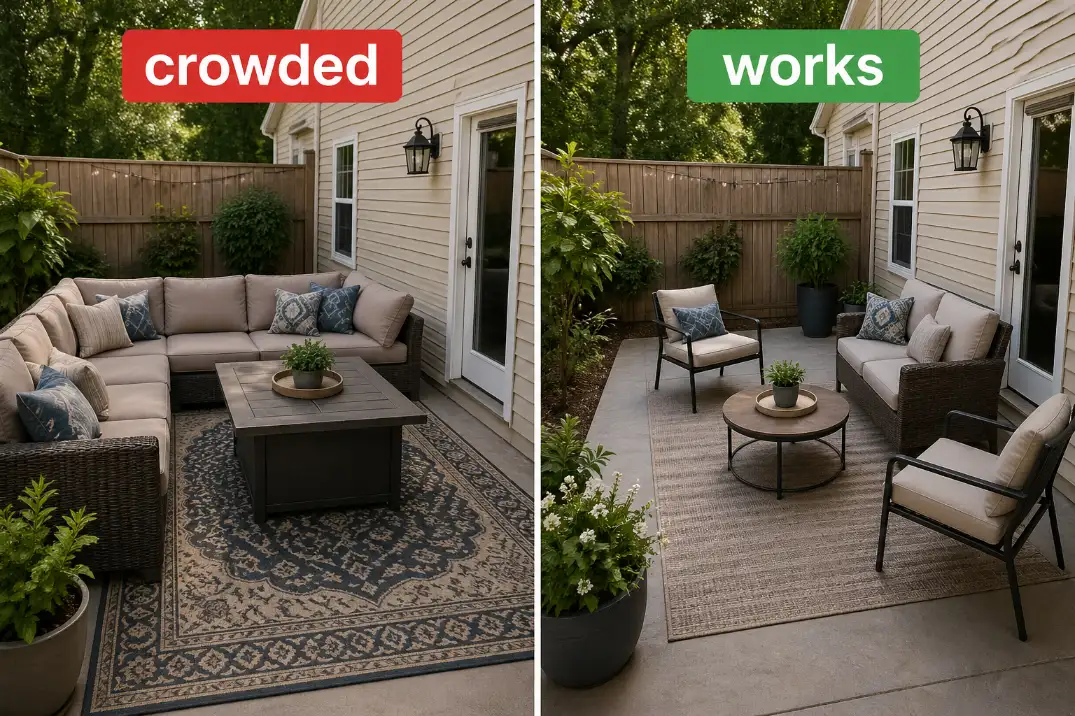
This is where a loveseat usually beats a sectional. A sectional can look efficient because it uses a corner, but deep cushions and a chaise return often consume the most useful part of the patio. A compact modular sectional may work if it stays under about 70–76 inches and has a short return. A full 80–90 inch L-shaped sectional is usually too much.
For more general layout adjustments, Patio Furniture Layout Fixes That Make a Big Difference is useful because many cramped patios need better traffic flow more than more furniture.
Layout 3: Grill-plus-seating patio
If the patio also needs a grill, simplify the furniture. A grill, a compact prep cart, and two chairs can work. A grill, four-person dining table, lounge chair, storage box, and planter cluster usually cannot.
The grill zone needs room for heat, lid swing, tools, and safe movement. Even a compact grill can disrupt the layout if it forces people to walk behind seated guests or reach over chairs to use prep space. In this setup, a folding side table or slim cart often beats a permanent dining table. For this exact decision, Compact Prep Table or Grill Cart for Small Patio is the more useful next read.
The Clearance Rules That Matter Most
Keep one real walking lane
A 30-inch path is tight but workable. A 36-inch path feels noticeably better, especially if people carry plates, pass through with pets, or move between the house and yard. Anything under about 24 inches starts to feel like a squeeze rather than a patio.
Protect the door zone
The first 3 feet outside the patio door should stay mostly open. If a chair back, grill cart, or table corner blocks that area, the patio feels crowded before anyone even sits down.
Chair pull-back space is not optional
Dining chairs need space behind them. Plan for about 24 inches for minimal pull-back and 30–36 inches for easier movement. This is the hidden measurement that makes many online furniture sets disappointing in real patios.
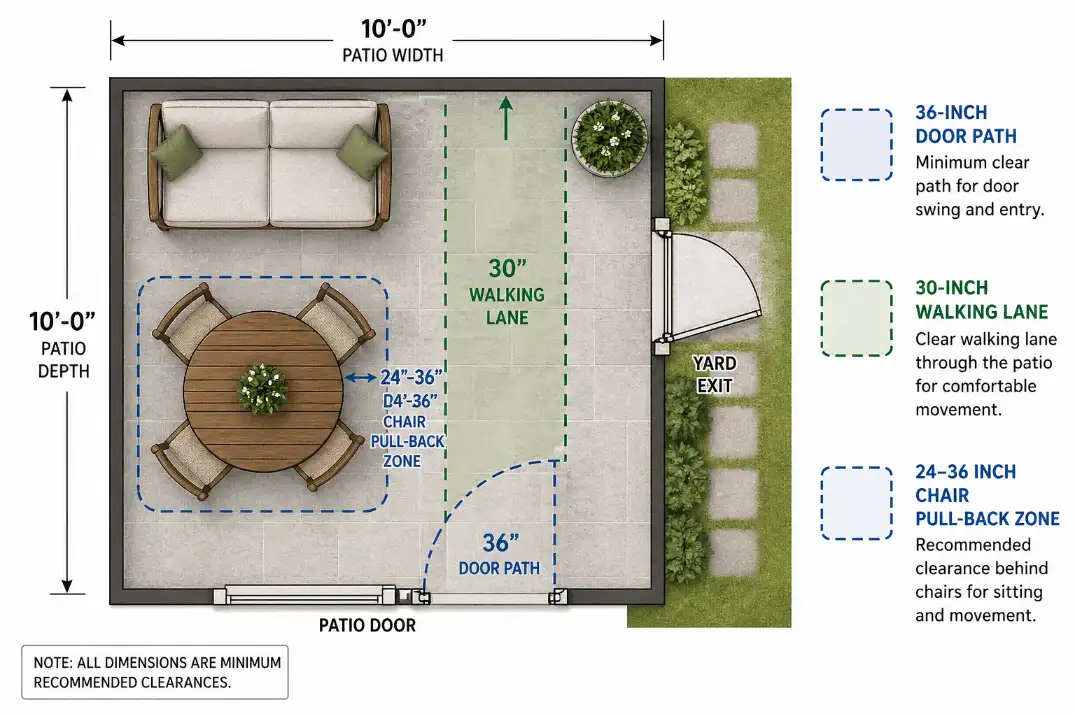
Pro Tip: Leave one corner open. It may look unfinished in a product-photo mindset, but it gives the patio space to turn, set down a cooler, move a chair, or add a planter later.
What Usually Does Not Fit Well
Six-person dining sets
A six-person dining set is the classic “fits on paper” mistake. The table may fit inside 10×10 feet, but the chairs make it fail. A 60-inch rectangular table with chairs can require nearly 8–9 feet in one direction once people are seated.
Oversized egg chairs and chaises
Egg chairs, recliners, and chaise lounges often fail because of depth. A chaise can run 65–80 inches long. On a 10-foot patio, that leaves too little room for walking, side tables, or door access.
Storage benches that become furniture clutter
Storage sounds practical, but a 48-inch storage bench can become another bulky furniture piece. If it does not double as real seating or fit against a dead edge, it often makes the patio less usable.
Too many “small” pieces
Several small pieces can crowd a patio faster than one well-chosen main piece. Two chairs, two side tables, a plant stand, an ottoman, a cart, and a storage box may each seem reasonable alone. Together, they create the same problem as one oversized set. This is the same failure pattern behind many small patio design mistakes that waste space.
Test the Layout Before You Buy
Before ordering furniture, mark the footprint on the patio with painter’s tape, cardboard, or string. This takes 15–20 minutes and can prevent the most expensive mistake.
Mark the table, chairs, grill, loveseat, or sectional at their actual dimensions. Then mark the extra zones: 24–36 inches behind dining chairs, 30–36 inches for the walking lane, and about 3 feet near the door. Leave the markings in place for a day if possible. Walk through the patio the way you normally use it.
If you keep stepping over tape lines or cutting through the future seating area, the layout is already too tight. A smaller side table will not fix that. The main furniture footprint has to shrink.
Better Furniture Choices for a 10×10 Patio
Choose round over rectangular for dining
Round tables are more forgiving because they remove sharp corners from the traffic path. They also make two-chair and four-chair setups feel more natural in a square patio.
Choose slim frames over thick arms
Thick arms can steal 6–10 inches per seat without improving comfort much. On a 10×10 patio, that can be the difference between a working lounge and a blocked path.
Choose movable pieces over permanent bulk
Folding chairs, stackable chairs, nesting tables, and lightweight side tables give the patio flexibility. This matters more in small spaces than matching every piece perfectly.
Use carts only when cooking is the main use
A prep cart can be useful, but it should not become a permanent obstacle. If the cart blocks the path from the grill to the table, the patio will feel awkward during the exact moments it is supposed to function best.
When grill placement is part of the layout, Best Patio Layout for Grill, Prep Space, and Dining gives a stronger full-zone plan.
Quick Buying Checklist
- Keep at least one 30–36 inch walking lane open.
- Choose one main use: dining, lounging, or cooking.
- Keep dining tables around 36–42 inches for four people.
- Avoid 80–90 inch sectionals unless the patio has almost no other furniture.
- Check chair depth, not just chair width.
- Leave the first 3 feet outside the door mostly clear.
- Tape the layout before ordering.
- Do not rely on tiny accessories to fix oversized main furniture.
Final Takeaway
The best furniture for a 10×10 patio is not the set with the highest seat count. It is the setup that leaves the patio easy to enter, sit in, move through, and reset.
For most homes, that means a bistro set, a compact four-person round table, a loveseat-based lounge layout, or a grill-plus-two-seat arrangement. Once you try to combine all of those at once, the patio stops feeling like an outdoor room and starts feeling like storage.
For broader outdoor room planning guidance, see Oklahoma State University Extension.