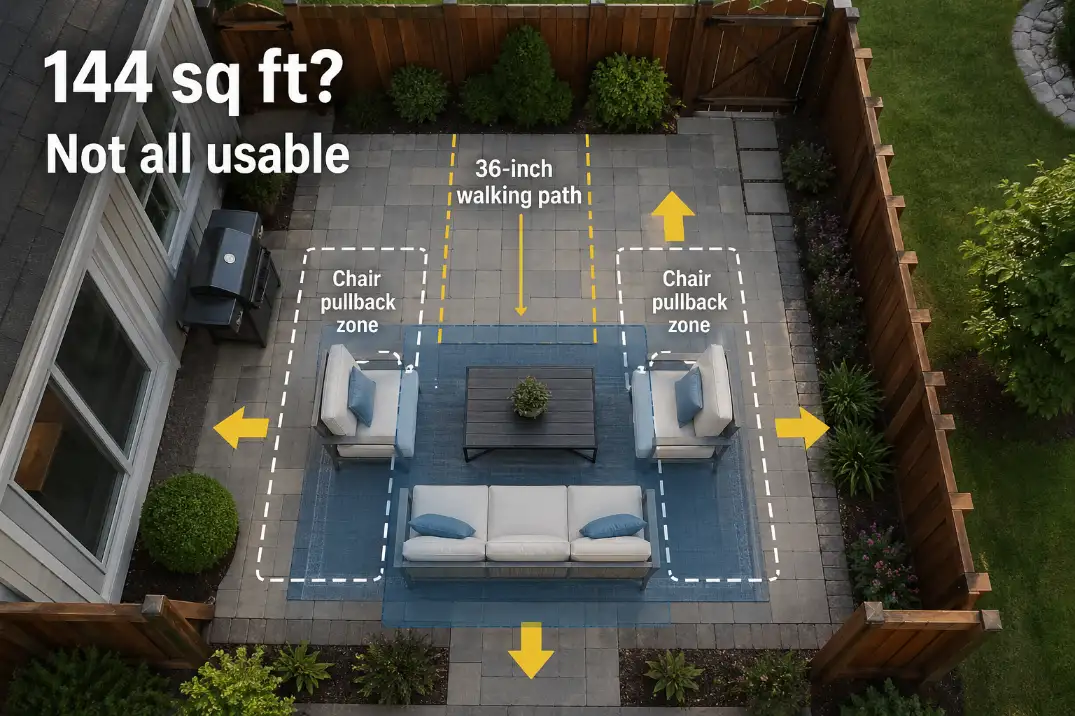
A 12×12 patio gives you 144 square feet, but not 144 square feet of furniture space. Once you account for chair pullback, walking paths, door swing, grill clearance, and the awkward dead space around bulky pieces, many 12×12 patios behave more like 80–110 square feet of usable layout area.
That is why the right question is not “Can this set fit?” It is “Can people still move after the chairs are pulled out?” A four-person dining set usually works. A six-person dining set can work, but only with slim chairs and limited competing furniture. A compact lounge setup often works better than a deep sectional. A grill plus seating is possible, but only when the cooking zone stays controlled.
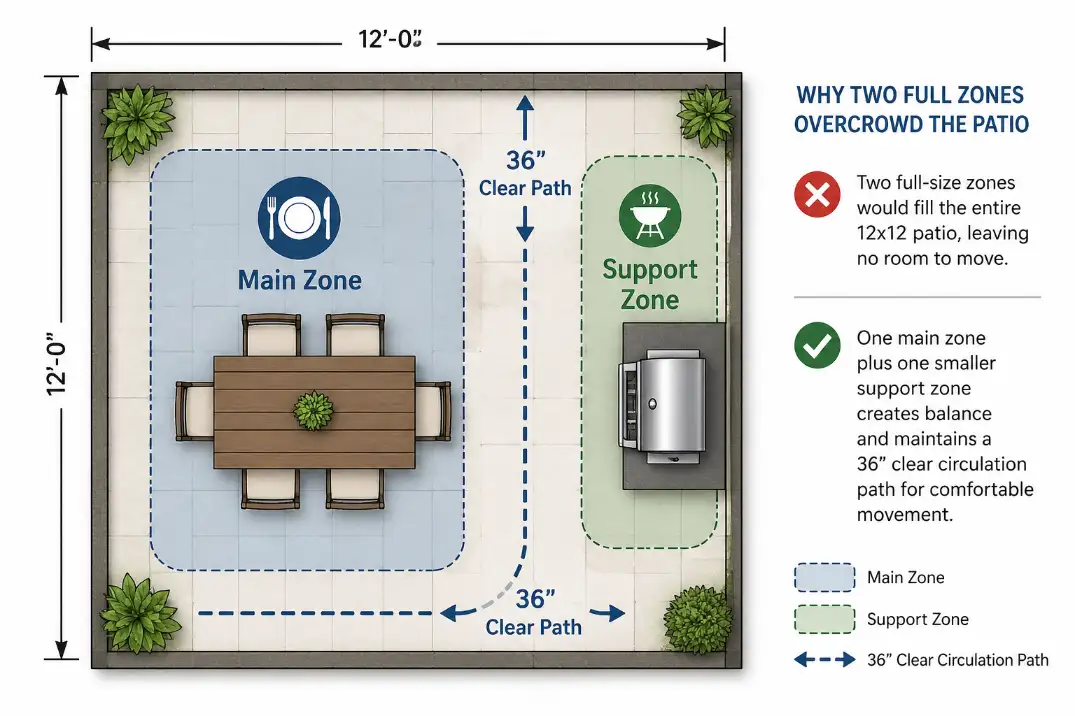
The best rule: a 12×12 patio usually supports one main outdoor function plus one smaller support function, not three full zones.
The 12×12 Patio Fit Rule
A 12×12 patio is generous compared with a tiny slab, but it is still a single-primary-use space. The strongest layouts begin with one main purpose: dining, lounging, or cooking. Everything else should support that purpose rather than compete with it.
One main zone, one support zone
Good combinations include a four-person dining set with a narrow serving cart, a loveseat setup with side tables, a grill with a compact dining table, or lounge chairs with a small fire table.
Weak combinations usually try to stack too much: full dining set plus full lounge set, large sectional plus fire table plus grill, or six-person dining table plus grill island.
Compared with what fits on a 10×10 patio, the extra 44 square feet in a 12×12 layout usually buys comfort and movement, not a second complete outdoor room.
What Actually Fits Comfortably
The safest furniture choices are normal-sized but disciplined. You do not need miniature furniture. You need pieces that still leave room once people sit down.
| Furniture Setup | Does It Fit? | Best Version | Main Risk |
|---|---|---|---|
| 4-person dining set | Yes | 42–48 inch round table | bulky chairs |
| 6-person dining set | Tight / conditional | slim 60–72 inch table | chair pullback blocks paths |
| Loveseat + 2 chairs | Yes | 52–60 inch loveseat | oversized club chairs |
| Small sectional | Conditional | shallow L-shape | dominates one corner |
| Grill + 4-person dining | Yes, if separated | grill on edge + compact table | heat and traffic conflict |
| Full lounge + full dining | Usually no | choose one as primary | no circulation |
Four-person dining is the cleanest fit
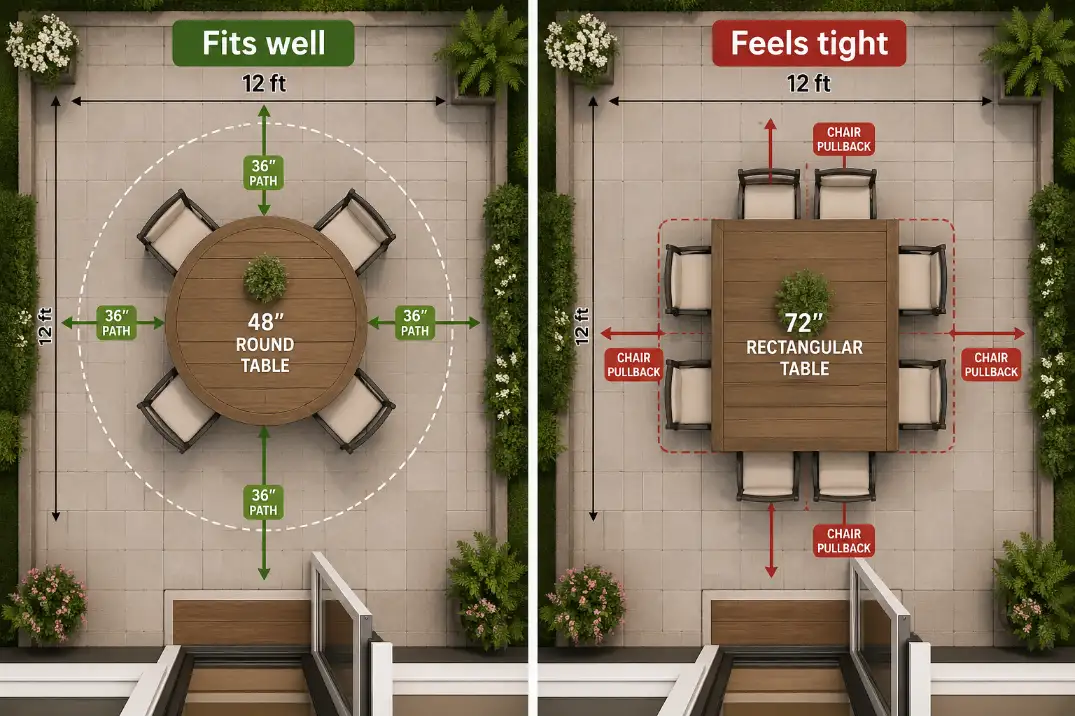
A 42–48 inch round or square table with four chairs is usually the most reliable dining setup for a 12×12 patio. With chairs pulled out, plan for roughly 8×8 to 10×10 feet of working space depending on chair size.
A six-person table is possible, but it becomes conditional. A 72-inch rectangular table may need close to 9×10 feet once chairs are active. If the patio also has steps, a sliding door, a grill, or a storage box, that setup can crowd the space quickly.
Compact lounge seating beats a large sectional
For lounging, a 52–60 inch loveseat, two 28–32 inch chairs, and small side tables usually work better than a bulky set. The layout feels best when the largest piece sits against the least-used edge and the center stays open.
A 90×90 inch sectional is the common trap. It may technically fit in one corner, but it often leaves only a narrow squeeze path. If the sectional leaves less than 30 inches along the main route, it is too large for everyday use.
Grill plus seating works with restraint
A grill can fit on a 12×12 patio, but it should not sit where guests need to pass behind the cook or where dining chairs back into the heat zone. The grill belongs on an edge, with seating turned away from the cooking path.
The problem is rarely the grill alone. It is the collision between heat, prep space, chair movement, and traffic. If cooking is part of the layout, the issues in outdoor cooking layout mistakes become directly relevant.
The Layouts That Work Best
Dining-first layout
Place the table slightly off-center instead of perfectly centered. A centered table often creates four weak margins. An off-center table can create one useful 30–36 inch walking path from the door to the yard.
Best fit: 48-inch round table, four slim chairs, one narrow side cart.
Avoid: six bulky armchairs, oversized umbrella base, large storage box near the door.
Lounge-first layout
Use a loveseat as the anchor, not a full sofa. Add two chairs only if they do not block the main route. Side tables are often better than one large coffee table because they preserve legroom and movement.
Best fit: loveseat, two chairs, two small side tables.
Avoid: deep sectional, large square coffee table, multiple ottomans.
Grill-and-eat layout
Keep the grill zone simple. A grill, a compact prep cart, and a four-person table can work if the cook has a clear edge and guests are not seated directly in the traffic path.
A compact cart is often more useful than a permanent station because it adds landing space without locking the patio into one arrangement. For smaller cooking setups, a compact prep table or grill cart can solve more than a larger built-in surface.
What People Usually Misread
The biggest mistake is measuring furniture while everything is tucked in. Product photos show the cleanest version of a patio, not the version people actually use.
Chair pullback is the hidden space cost
A dining chair needs about 24 inches just to pull out and closer to 30 inches to feel comfortable. If someone needs to walk behind that chair, 36 inches is a better target.
That turns a compact-looking table into a much larger working footprint during dinner.
Depth matters more than width
People often compare furniture by width first. On a 12×12 patio, depth is often the bigger problem. Outdoor club chairs can be 34–38 inches deep. Add legroom and a coffee table, and one seating group can consume half the patio.
Matching sets can reduce flexibility
A full matching set may look finished, but it can trap the layout. Mixed pieces often work better: a loveseat instead of a sofa, armless dining chairs instead of bulky swivel chairs, side tables instead of a large central table.
Pro Tip: Tape the furniture footprint on the patio and leave it for 24 hours. Walk through it from the door with chairs “pulled out” before buying anything large.
When a 12×12 Patio Feels Bigger or Smaller
Two patios can measure 12×12 and behave completely differently.
Open edges help
A patio that opens to lawn on two sides feels more forgiving than one boxed in by railings, walls, shrubs, or privacy screens. Open edges do not create more square footage, but they make movement feel less trapped.
Door placement matters
A centered sliding door can split the patio into two shallow zones. A side door often works better because it lets one larger furniture zone form naturally. Steps and landings also reduce usable space. A 3-foot landing along one side can make the patio function more like a 12×9 area.
Covered patios need more caution
A covered 12×12 patio may feel cozy, but it can also make furniture, smoke, heat, and airflow feel tighter. If a grill is involved, do not treat the covered space like an open slab. Smoke movement, ceiling clearance, and furniture placement matter more than the tape-measure footprint.
If you are deciding whether cooking or dining deserves priority, the tradeoff is similar to the one explained in small patio dining or grill zone decisions.
What Not to Buy First
Do not start with the biggest piece you like. Start with the patio’s main job.
A large sectional is the most common trap because it looks efficient. It uses a corner, seats several people, and photographs well. But if it forces every other piece into the leftover space, it is not efficient. It is controlling the patio.
A six-person dining set can create the same problem. If two to four people use the patio most nights, a four-person table plus folding guest chairs may work better than a permanent six-chair layout.
The point where small fixes stop helping is easy to spot: if you have to angle the main furniture piece just to make it fit, it is probably too large. Smaller accessories will not rescue an oversized anchor piece.
Quick 12×12 Patio Fit Checklist
Use this before ordering furniture online.
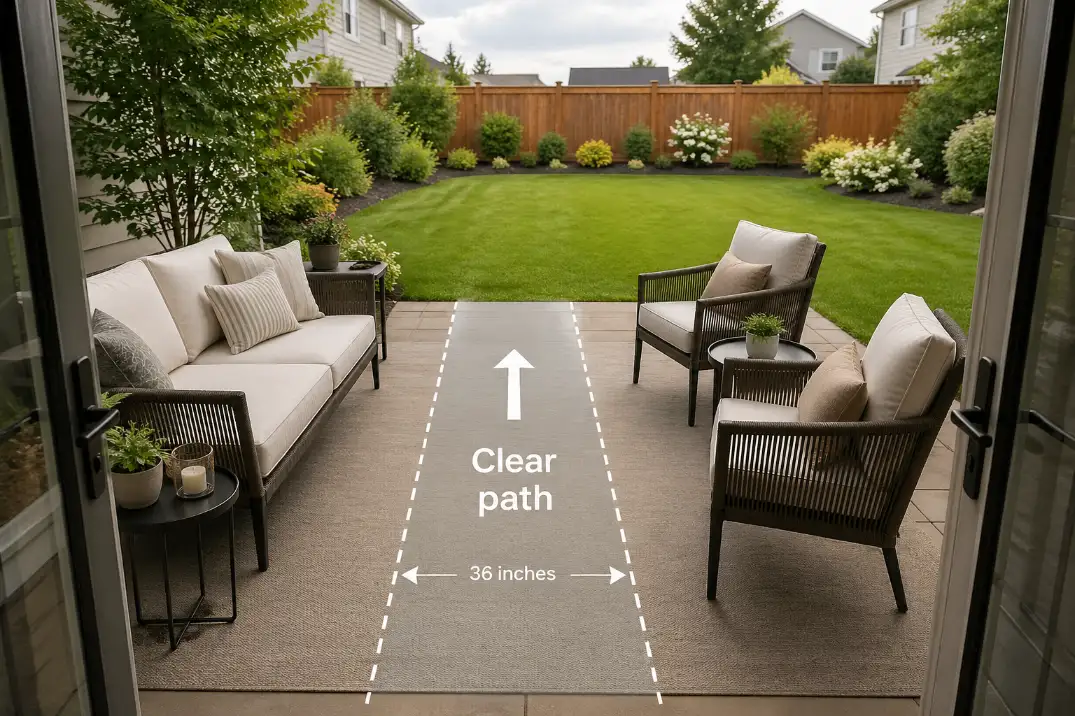
- Keep one 30–36 inch route clear from the door to the yard or main exit.
- Measure chairs pulled out, not tucked in.
- Treat seating deeper than 36 inches as a major space commitment.
- Choose one main use before adding support pieces.
- Avoid combining full dining, full lounge, and grill zones.
- Use compact side tables before adding a large coffee table.
- Recheck the layout during the time of day you actually use the patio.
That last point matters. A layout that feels fine at noon can feel crowded at 7 p.m. when food, shade, pets, guests, and chair movement all enter the same space.
Questions People Usually Ask
Can a 12×12 patio fit a table for six?
Yes, but it is conditional. A slim rectangular table or compact round table can work, but bulky chairs and nearby grill equipment can make the layout feel tight. Six seats are possible; six comfortable seats plus another full zone is the trap.
Can a 12×12 patio fit a sectional?
A small shallow sectional can fit. A deep L-shaped sectional often dominates the space. If it leaves less than 30 inches of clear movement on the main route, a loveseat and two chairs will usually function better.
Is 12×12 big enough for a grill and dining table?
Usually, yes, if both are compact and separated. A grill plus a four-person dining set is realistic. A grill island plus six-person table is usually too much.
What is the best all-around setup?
For most homes, the best all-around setup is either a four-person dining set with a small serving cart or a compact conversation set with one clear 36-inch path. Both give the patio a purpose without making every movement feel negotiated.
The Bottom Line
A 12×12 patio can hold real outdoor furniture, but it rewards restraint. The best layouts do not ask how many pieces can fit inside 144 square feet. They ask what still works after chairs move, people walk through, and the patio is used for more than a photo.
Choose one main function. Protect the walking path. Keep the anchor piece scaled to the patio. That is what makes a 12×12 space feel finished instead of crowded.
For practical guidance on functional outdoor spaces and landscape planning, see the University of Minnesota Extension landscape design guide.