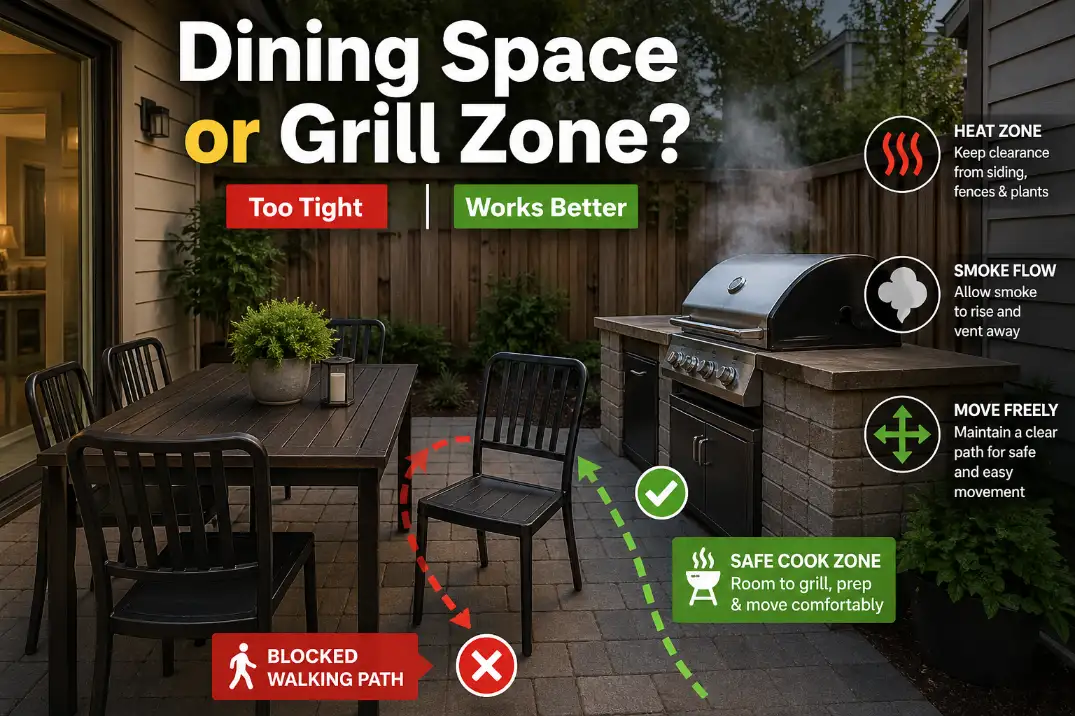
A small patio should usually prioritize a better grill zone first, then make the dining area smaller and smarter. The reason is practical: a dining area gets uncomfortable when it is tight, but a grill zone can become smoky, awkward, hot, and unsafe.
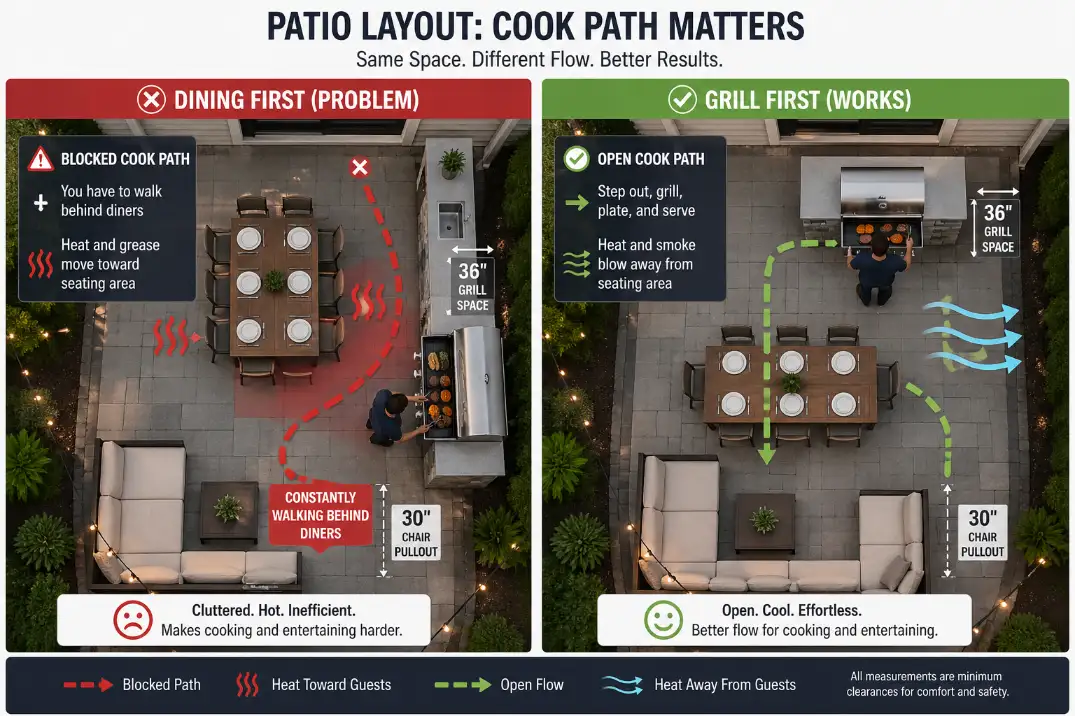
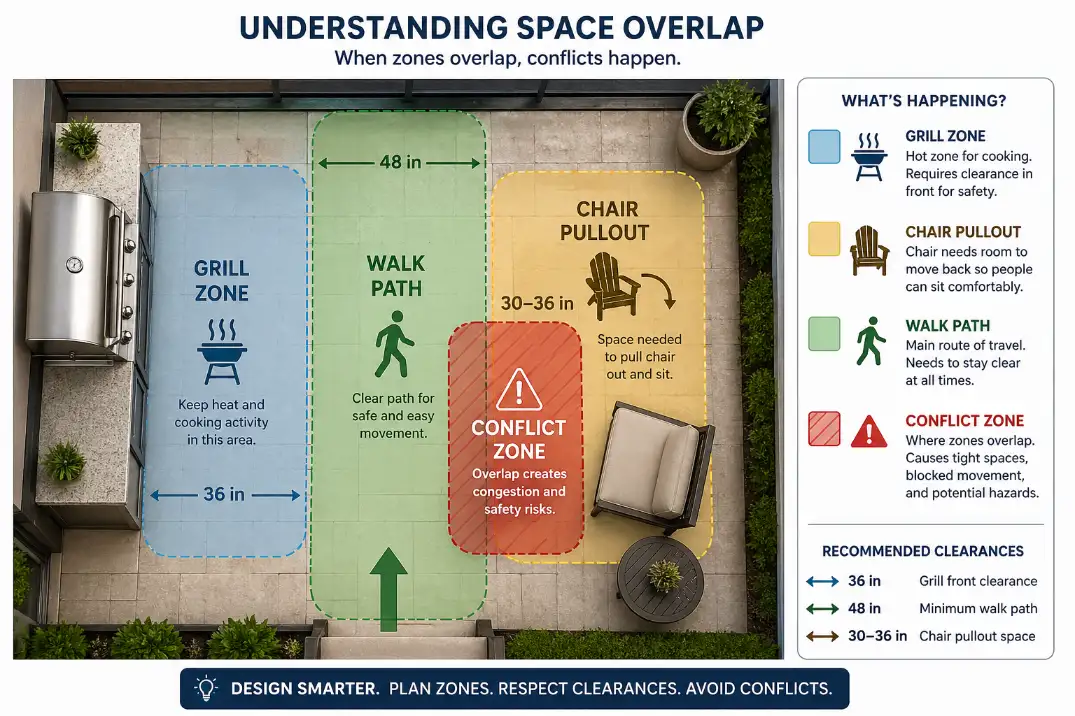
Start with three checks before buying anything: the cook needs at least 36 inches in front of the grill, chairs need 30–36 inches to pull out, and the main path should stay about 36 inches wide.
If those zones overlap, the patio will not feel “cozy.” It will feel like every meal requires moving furniture. This is different from a simple small-space problem. The real issue is usually zone conflict: the grill, table, chair pullout, and walking path are all trying to use the same strip of patio.
The Simple Priority Rule
Protect the least flexible zone first
The grill is less flexible than the table. It needs a stable surface, lid clearance, heat clearance, smoke escape, grease access, and room for the cook to step back. A table can shrink, fold, slide against a wall, or lose two chairs. A hot grill cannot safely borrow space from a crowded seating area.
For patios under about 120 square feet, this matters a lot. A full grill zone plus a full dining set usually leaves no real circulation. The patio may look finished, but it will fail once people sit down and someone starts cooking.
If you are still deciding where the grill belongs, the spacing logic in How Much Space a Grill Area Really Needs to Work Well is a better first step than choosing the table size first.
Do not let the table win by default
Dining furniture often wins because it is visually dominant. A table sits in the center, chairs frame the space, and the patio looks “complete.” But that does not mean the layout works.
A 48-inch round table can overwhelm a small patio once chairs pull out. A 30–36 inch bistro table, a narrow wall-side table, or a bench on one side usually preserves more usable space. The goal is not to remove dining. It is to stop the dining set from controlling the grill path.
Use the 10-Minute Dinner Test
Test the patio as people actually use it
Do not judge the patio while chairs are pushed in. Pull the chairs out. Open the grill lid. Stand where the cook would stand. Have someone walk from the patio door to the yard while the cook is “working” for 10 minutes.
If a chair has to move so the grill can open, the dining set is too large or in the wrong place. If the cook has to back into a chair, planter, railing, or door swing, the grill zone is too weak. If guests must pass behind the hot grill to reach the table, the traffic path is wrong.
Repeated moving is the failure sign
A small patio does not need generous space everywhere. It needs a layout that does not require constant adjustment. If every cookout starts with sliding the table, folding a chair, or moving a plant, the setup is not flexible. It is overloaded.
Pro Tip: If the grill rolls into position, mark its correct cooking spot with a grill mat, paver edge, or furniture alignment so the safe position is repeatable.
The Clearances That Decide the Layout
| Patio element | Bare minimum | Better target | Failure sign |
|---|---|---|---|
| Grill work space in front | 36 inches | 48 inches | Cook backs into chairs |
| Chair pullout space | 30 inches | 36 inches | Chairs block the walkway |
| Main walking path | 36 inches | 42–48 inches | Guests pass behind the grill |
| Grill-to-seating comfort gap | 4–6 feet | 6–8 feet | Heat or smoke reaches diners |
| Four-person dining footprint | About 10×10 ft | More if chairs are bulky | Table controls the patio |
These are not luxury dimensions. They are sorting tools. If the patio cannot satisfy all of them, protect the grill work space and walking path first. Then scale the table down.
What People Usually Get Wrong
A smaller grill does not always fix it
This is the most common weak fix. A compact grill helps only if the grill is in the right place. If it still sits in the doorway path, under low cover, beside the best chair, or in the wind line that pushes smoke into diners, the patio will still feel wrong.
A smaller grill solves width. It does not automatically solve heat, smoke, lid swing, grease access, or traffic flow. If wind is part of the problem, When Wind Ruins Backyard Cooking explains why placement often matters more than another accessory.
A bigger table is often wasted space
A six-person table sounds useful, but on a small patio it may only earn its footprint a few times a year. The rest of the season, it steals space from the grill path and makes the patio feel narrower than it is.
For everyday use, a compact two-person setup with flexible extra seating often works better than a permanent oversized dining set.
The real problem is overlap
“Crowded” is just the visible symptom. The real issue is overlap between grill space, chair pullout space, and walking path. Once those collide, no amount of styling fixes the layout.
The Best Setup for Most Small Patios
Put the grill on an edge, not in the social center
Most small patios work better when the grill sits along an outer edge, close enough to the kitchen path but outside the main seating pocket. That position keeps the cook out of the center and reduces smoke exposure for guests.
Avoid placing the grill beside the best chair, under the main umbrella, or in the only route from the door.
If the surface under the grill is part of the issue, Best Surfaces Around a Backyard Grill Area explains which materials handle heat and grease best.
Make dining flexible instead of full-size
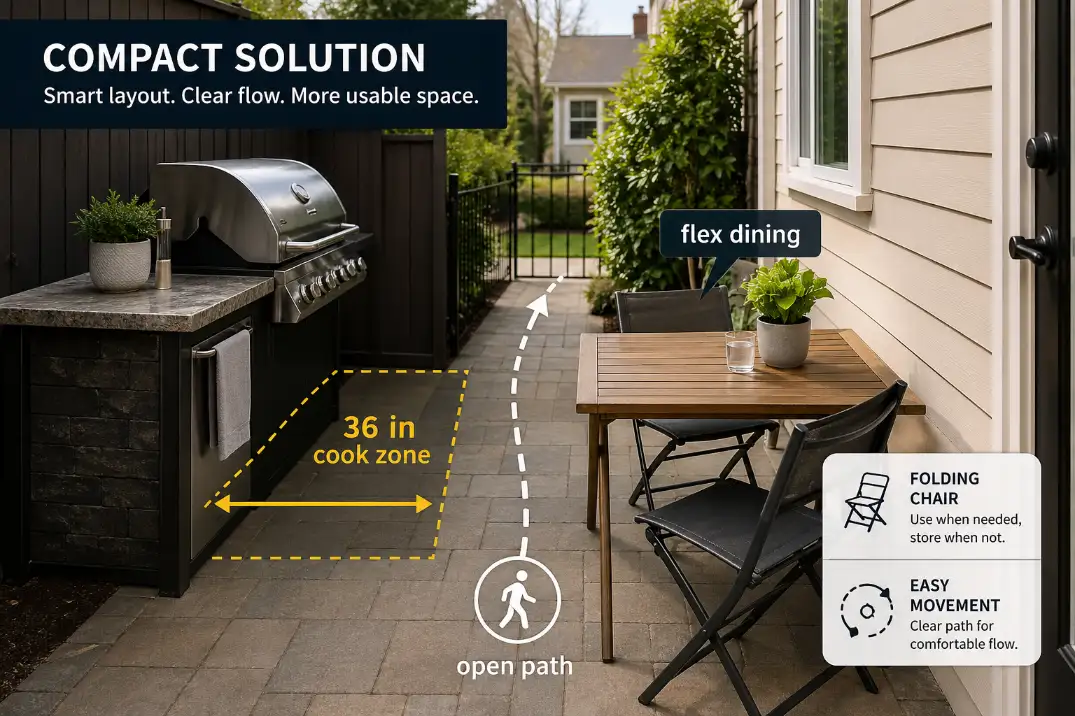
Choose dining furniture after the grill path is protected. Compact tables, benches, and folding chairs are usually better than bulky full sets.
A bench can save 12–18 inches of space. Stackable or armless chairs reduce the pullout footprint. A wall-side table keeps the center open.
When Dining Should Take Priority
The grill is occasional or portable
If the grill is rarely used, dining can lead. But the grill still needs a safe temporary position. A movable grill only works if its cooking spot is clear and repeatable.
The patio is too narrow for a full grill station
If the grill leaves less than 36 inches of passage, the station is too large. At that point, shrinking dining further will not fix the layout. The grill setup needs to be reduced.
If the grill itself is oversized, When a Grill Station Is Too Big for the Patio gives a clearer fix path.
The Final Decision
For most small patios, prioritize the grill zone first, but keep it efficient. Protect the cook space, walking path, and safety clearances before expanding the dining area.
Then build dining around what remains using smaller, flexible furniture.
The rule that holds everything together is simple: dining can shrink and still work; a grill zone cannot shrink past safety.
For broader official grilling safety guidance, see the National Fire Protection Association.