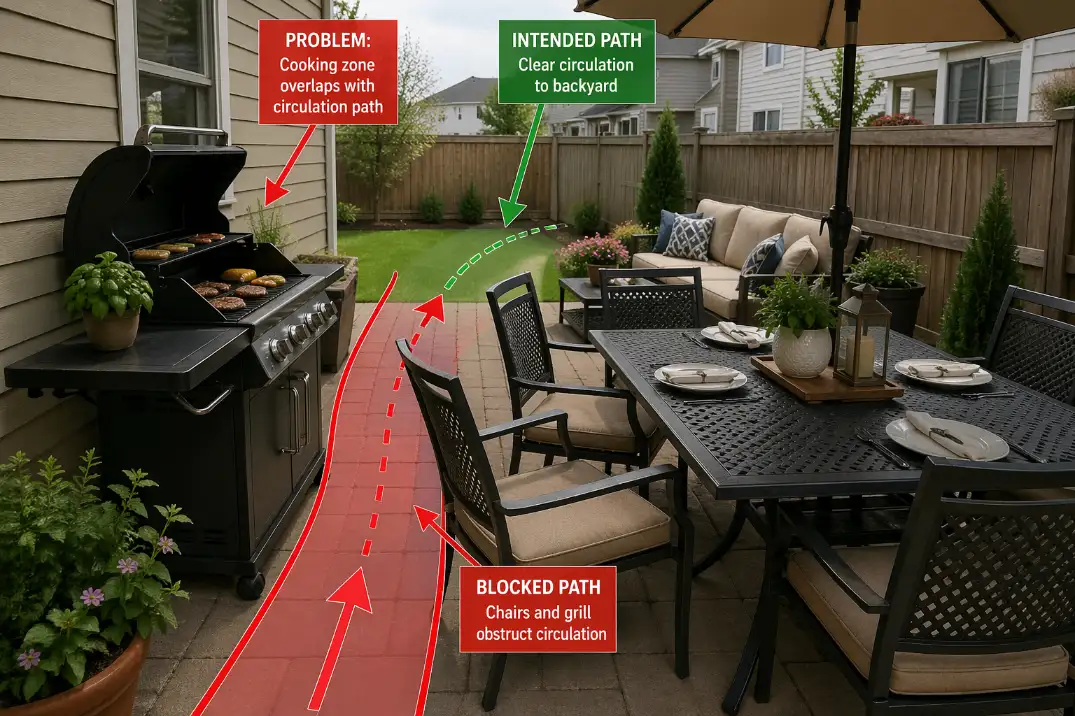
If your patio feels fine until someone starts grilling, the patio is not just small. The layout is failing. In most cases, the grill zone, dining zone, and walking path are all borrowing the same space.
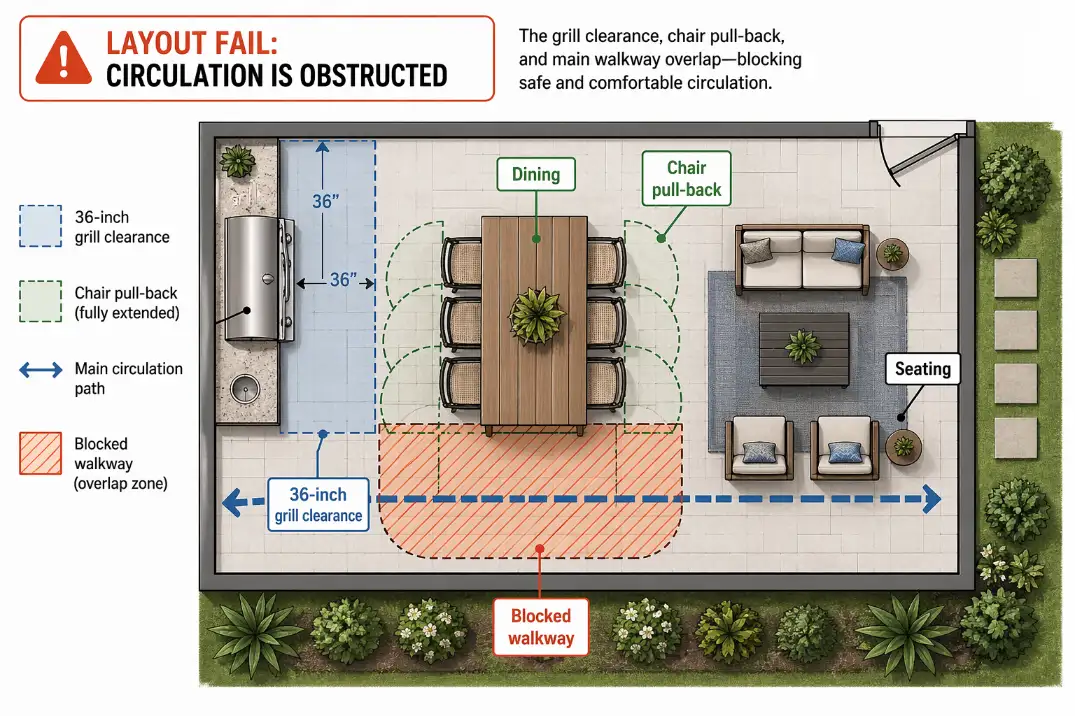
Start with three checks: can someone work at the grill with about 36 inches behind them, can chairs pull back without killing the route through the patio, and does one path stay open at roughly 30 to 36 inches during actual use?
If not, this is not a styling issue. It is a capacity issue.
That matters because people usually misdiagnose the problem. They blame the table, buy smaller chairs, or keep trying to tidy the patio.
But crowding is the symptom. The real issue is overlap. On a patio under about 120 square feet, a full grill, full dining setup, and separate lounge zone usually do not coexist well unless one zone gets sharply reduced.
Quick diagnostic checklist
- The grill works only when nobody passes behind it
- Two pulled-out chairs erase the main walkway
- The route from the back door to the yard cuts through the cooking zone
- The patio handles 2 people reasonably well but breaks down at 4 or more
- The space looks balanced when empty and awkward when used
- One removed chair or planter immediately makes the layout feel easier
The real issue is overlap, not just too much furniture
Most patios with this problem are not overloaded by accident. They are arranged in a way that guarantees conflict. The grill sits near the house because it is convenient.
The table lands in the center because that feels visually correct. Extra seating fills the edges because it seems efficient. The result looks organized but works badly.
That is why many small patios fail in a predictable way. The same 3 to 4 feet of space is expected to handle cooking clearance, chair pull-back, serving movement, and everyday circulation.
No furniture swap can fully solve that if the path logic stays wrong.
This is the same kind of usability failure behind patio layout problems that make spaces hard to use: the patio looks complete, but the movement pattern is broken.
The only measurements that really decide this
Grill operating space
A practical minimum is about 36 inches behind the cook. If this area is also a pass-through route, 42 inches works much better. Below 30 inches, the grill starts forcing everyone else to stop, squeeze, or reroute.
Dining chair clearance
An occupied chair usually needs around 24 inches of depth, but if someone must pass behind it, that number climbs closer to 30 to 36 inches. If pulled-out chairs wipe out the route, the table is not merely large. It is badly placed.
One permanent path
Every usable patio needs one protected route from the house to the yard, gate, or stairs. If that path disappears during meals or while grilling, the layout is not functioning.
What actually fits, and what usually does not
Many SERP articles stay vague here. That is a mistake. Readers need a harder answer.
Around 10×10 feet
A 10×10 patio can handle a compact dining setup or a grill with light seating. It usually cannot handle a full grill, a real dining table, and a separate lounge grouping without turning into a daily traffic problem.
Around 12×12 feet
A 12×12 patio can often support a grill and a 4-seat table if the table is not oversized and the path is protected. This size can work well, but only if the layout stops prioritizing symmetry over circulation.
Around 14×16 feet and up
Once the patio moves beyond roughly 200 square feet, grill plus dining becomes more forgiving. A modest lounge element may fit too. But even here, a centered table and pass-through grill zone can still waste the footprint.
The important distinction is not small patio versus large patio. It is whether the patio is trying to do two jobs well or three jobs badly.
What people usually blame first, and why that is often wrong
The table gets blamed first because it looks dominant. But the grill is usually the less flexible object. A table can shift 12 to 18 inches and still work. A grill cannot lose operating room that easily.
People also overrate corner placement. Pushing the grill into a corner sounds efficient, but corners often trap the cook, compress turning space, and create dead areas that still interrupt movement. The grill looks tucked away while continuing to cause the problem.
What most people underestimate is active chair movement. Static furniture footprints are misleading. The patio may appear acceptable when chairs are tucked in, but the real test happens when 2 or 3 chairs are occupied, the grill lid is open, and someone is carrying food.
That is when the hidden failure becomes obvious. It is also why patio furniture layout fixes that make a big difference often help more than simply downsizing furniture.
The fix that wastes time most often
Buying smaller furniture before fixing the zone logic is usually a weak move.
A slightly narrower table or slimmer chair profile might recover a few inches, but if the walkway still cuts between the grill and the table, the patio remains tense and annoying. You have not solved the real issue. You have only made it look slightly less crowded.
The stronger order of decisions is much clearer:
Cut low-value pieces first
Accent chairs, side tables, decorative stools, and oversized planters often steal 6 to 18 inches each from the exact edges the patio needs most.
Shrink the lounge zone before the dining zone
On most patios where meals actually matter, lounge seating is the lower-value use. Deep lounge chairs are frequent space thieves.
Change the dining format before replacing the grill
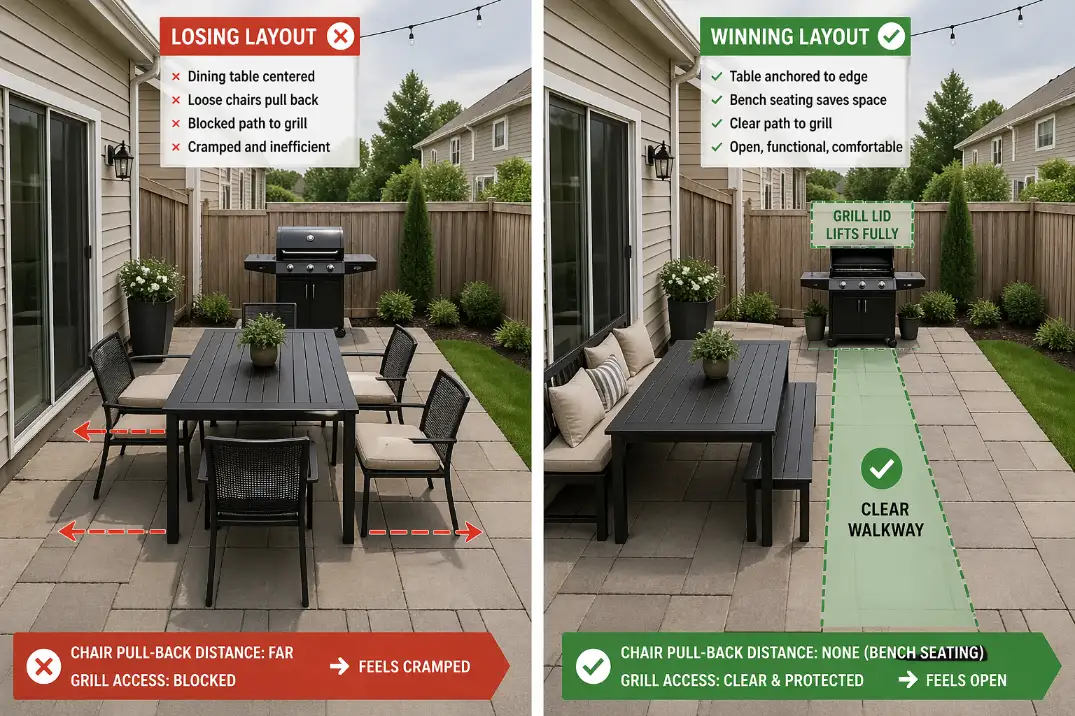
A 36- to 42-inch round table, a bench on one side, or a wall-side dining setup usually saves more usable room than switching grills.
Replace the grill last
If the layout is rational and the patio still cannot handle the program, then the footprint is the issue. But that is not where the decision should start.
That same logic shows up in backyard zoning mistakes that hurt outdoor flow. People often shrink the most obvious piece instead of the least efficient one.
A better decision table
| If this is your goal | Keep | Reduce or remove first | Usually the smarter move |
|---|---|---|---|
| Outdoor dining matters most | Grill + dining table | Separate lounge grouping | Use a bench or lighter side seating |
| Casual gathering matters most | Grill + flexible seating | Full dining set | Switch to compact dining or perch seating |
| Narrow patio with strong through-traffic | Main path + grill clearance | Centered table layout | Anchor furniture to one edge |
| Patio feels full but not usable | Essential zones only | Small extras and filler pieces | Simplify before buying new furniture |
| Plants and decor are squeezing the edge | Hardscape function | Decorative perimeter clutter | Give back 12 to 24 inches of edge clearance |
Visual crowding matters, but less than people think
Some patios technically have enough clearance and still feel cramped. That is usually visual crowding rather than true circulation failure. Too many small planters, bulky furniture arms, broken surface lines, or planting beds pushing inward by 12 to 24 inches can make the patio feel tighter than it is.
But this is where people often get the priority wrong. Visual crowding is real, but it is still secondary. A visually busy patio can function. A patio with a broken path cannot. If softscape is also compressing the edge, the problem may overlap with what happens when backyard plants crowd paths and seating. In those cases, recovering even 1 foot of edge width often changes the patio more than a furniture replacement does.
Pro Tip: Tape out the grill footprint, lid swing, chair pull-back, and a 36-inch path before buying anything. It is one of the fastest ways to separate a real size limit from a bad layout.
When you should stop trying to force all three zones
This is the decision point many articles soften too much: if your patio is under about 10 by 12 feet and you want a full grill, full table, and separate seating zone, one of those three usually needs to shrink or leave. That is not pessimism. It is the honest boundary.
A small patio usually does two jobs well. It rarely does three equal jobs well.
Best choice when dining is the priority
Keep the grill and table. Drop the separate lounge zone or replace it with a bench.
Best choice when social seating matters more
Keep the grill and flexible seating. Reduce dining to a smaller table or compact side setup.
Best choice when the patio edge is already compromised
If beds, paving issues, or awkward access are already stealing usable width, move one function off the main pad instead of compressing all three more tightly. Sometimes what looks like a furniture issue is partly a footprint issue, especially where the usable surface is already being undermined by problems similar to cheap backyard pavers that shift and stain.
The shortest path to a patio that works
Protect one path first
Choose the one route that matters most and keep it open at 30 to 36 inches during real use.
Give the grill its own zone
Do not let the grill depend on borrowed circulation space.
Pull the table off the center
Centered layouts waste critical working room on small patios.
Remove pieces before replacing pieces
Live with a simplified setup for 7 to 14 days. That usually reveals the correct long-term decision faster than shopping does.
The best small patio layouts are not the ones that squeeze in everything. They are the ones that choose what matters and protect space for it.
For broader official guidance on grill placement and safe outdoor cooking clearances, see the National Fire Protection Association.