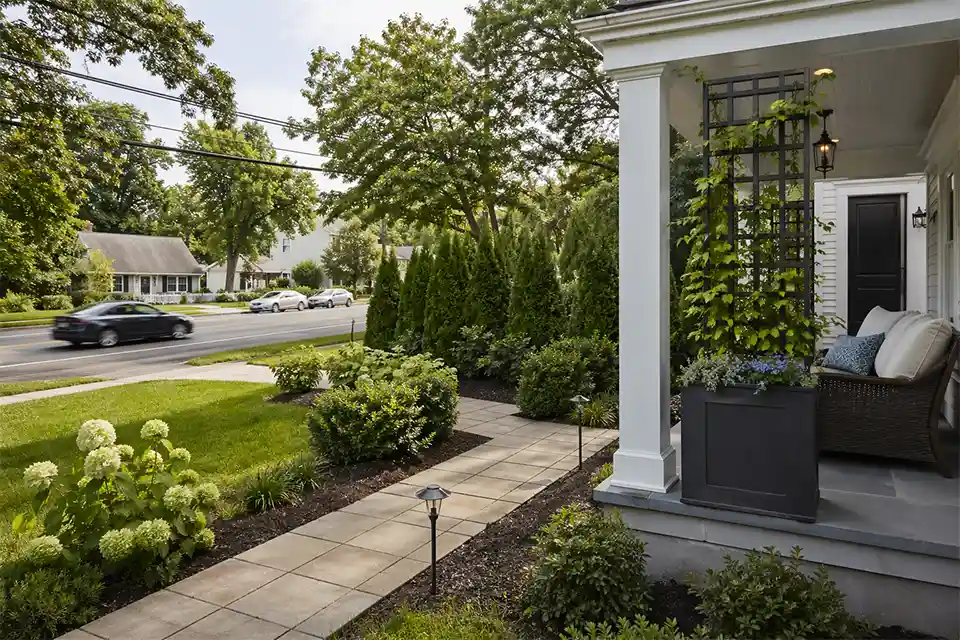
A fence is not the only way to block a busy road view, and in many front yards it is not even the smartest first move. The real challenge is finding a screen that reduces visual exposure without making the house feel shut off, creating a driveway visibility problem, or forcing a hard barrier that looks wrong from the street.
For most homes, the best long-term answer is still a layered planting plan. But not every front yard has the depth, layout, or patience for that. In tighter front yards, the better first move is often a targeted screen rather than a full front-edge privacy build.
For a broader look at this design direction, see these front-yard landscaping ideas for privacy without fences.
Quick Answer: Where to Start First
If your front yard has real planting depth, start with a mixed evergreen shrub screen.
If your yard is shallow, driveway-heavy, or exposed in just one key spot, start with a planter with trellis.
If the road view mainly bothers you at the porch, front window, or entry path, you usually do not need to screen the whole frontage. You need targeted screening.
If your driveway exit, corner lot, or front walk already feels visually tight, do not start with the tallest or densest screen at the street edge.
If your front yard is shallow, the exposure is concentrated near one main use area, and you want a no-fence solution that feels more intentional than makeshift, a planter-with-trellis setup is usually the cleanest category to browse first. It solves a focused sightline problem without forcing you into an oversized full-yard privacy project.
| BEST CATEGORY FOR TIGHT SETUPS |
|---|
| Outdoor planter with trellis |
| Best for shallow front yards, porch zones, and exposed sightlines where full-yard planting is not realistic. |
| This category works best when you need targeted screening near the entry, porch, or one main window instead of screening the whole frontage. |
| Look for stable outdoor planters with real soil volume, weather-resistant materials, and a trellis structure sturdy enough to support a true visual screen. |
| 🔴 SHOP planter with trellis |
What Actually Works in a No-Fence Front Yard
Blocking a busy road view without a fence is usually a constraint problem, not a simple shopping problem.
You are working around four realities at once:
- the front yard still has to look welcoming from the street
- the driveway and walkway still need visibility
- the screening has to survive sun, wind, splash, and upkeep
- most front yards do not have enough depth for a thick full-height privacy wall
That is why the best solutions are rarely the tallest categories alone. The winners are the ones that create visual interruption without making the frontage feel defensive.
If privacy matters but you still want the house to feel open and residential, it helps to look at front-yard privacy fixes that still look welcoming before you build the screen too aggressively.
The 5 No-Fence Ways to Block a Road View
| Category | Best use case | What it does well | Where it falls short |
|---|---|---|---|
| Mixed evergreen shrub screen | Average front yards with bed depth | Natural long-term screening with year-round structure | Too slow if you want instant coverage |
| Planter with trellis | Tight front yards, porch zones, exposed entry views | Fast, targeted screening in one specific problem area | Not ideal for screening an entire frontage |
| Selective decorative screen panel | One awkward sightline near a porch, window, or seating zone | Creates visual interruption with less planting commitment | Can look forced if overused across the whole yard |
| Low wall with planting behind it | Homes that need definition more than total concealment | Softens road exposure while keeping curb appeal strong | Less effective if you want direct eye-level blocking right away |
| Small trees plus underplanting | Wider front yards where upper openness is the problem | Breaks taller sightlines without boxing the yard in | Usually too open at eye level on its own |
A Fast Scenario Guide
| Yard condition | Start with | Avoid first | Why |
|---|---|---|---|
| Shallow front yard | Planter with trellis | Full hedge wall | You need targeted screening, not depth-heavy planting |
| Driveway-heavy frontage | Selective screen or planter near the porch or entry | Dense shrubs at the street edge | Visibility and access matter more here |
| Front porch exposed to traffic | Planter with trellis | Whole-yard screening project | One dominant sightline is the real issue |
| Street-facing front window | Layered shrubs or a selective screen band | Tall open-trunk trees alone | Eye-level density matters most |
| Corner lot or near an intersection | Low wall with planting or carefully placed shrubs | Anything tall in a visibility zone | Safety and sight lines come first |
| Wider front yard with open upper views | Small trees plus shrubs below | One flat hedge row | You need layered interruption, not one blunt line |
| Sloped yard toward the street | Layered planting matched to grade | Straight uniform screening line | Slope changes how the view lands and how screening reads |
If your front yard drops toward traffic, the screening strategy changes quite a bit, which is why this guide on adding privacy in a front yard that slopes toward a high-traffic street is worth checking before you commit to a layout.
Best for Most Homes: Mixed Evergreen Shrub Screens
This is still the strongest long-term solution for many front yards.
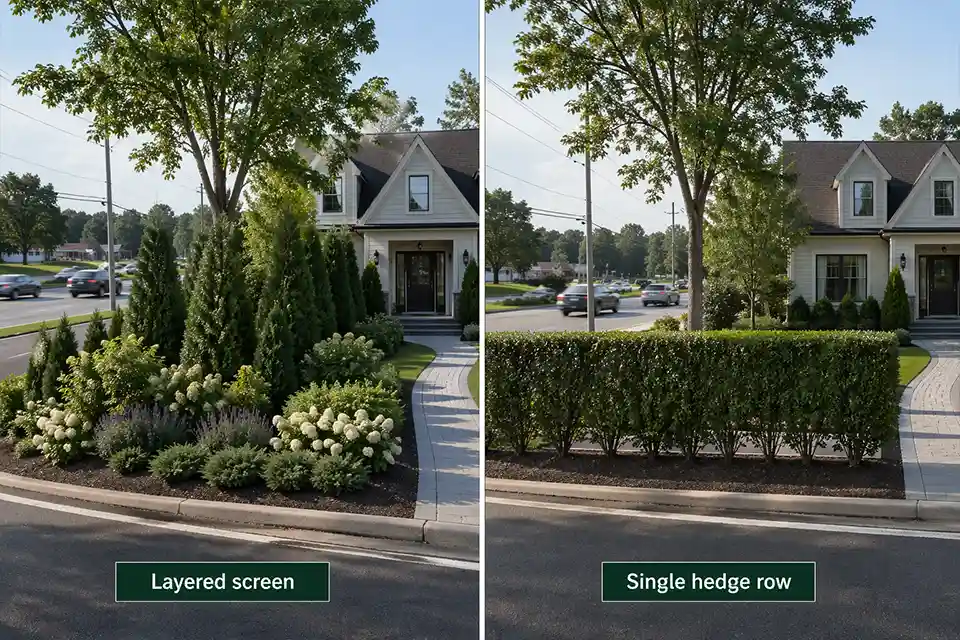
A mixed shrub screen works because it does not try to imitate a fence. It interrupts the road view in layers, so the eye stops reading the street as one open strip. That usually looks better, ages better, and feels more appropriate in a front yard than a single rigid wall of planting.
What to look for in this category:
- mature height in roughly the 5- to 8-foot range for the back layer in a typical front yard
- dense lower branching, not bare stems with foliage only at the top
- evergreen or mostly evergreen structure if year-round screening matters
- a growth habit that can screen without swallowing the walkway, windows, or front elevation
Best for:
- front yards with moderate planting depth
- steady traffic exposure where the goal is softer screening, not total isolation
- homeowners who care most about long-term curb appeal
Skip if:
- you need a fast privacy result
- your front yard is mostly driveway or hardscape
- the screen would sit too close to a driveway exit or front corner where visibility matters
Choose evergreen, columnar, or layered?
This is where many shrub plans go wrong.
Choose evergreen screening shrubs when year-round coverage matters and the road exposure feels constant.
Choose columnar forms when the yard is tight and width matters more than mass. They can help frame a view and reduce exposure without eating the whole bed, but they usually work better as accents or vertical anchors than as the full screen.
Choose a layered mix when you want the most natural result. That usually means taller evergreen structure in back, medium shrubs in front, and a softer lower edge that keeps the screen from looking blunt.
In most front yards, layered beats flat. One straight hedge line often looks sparse at first, then oversized later.
A planted evergreen screen is still the strongest landscape answer for many front yards, but it usually makes more sense to choose the planting plan first and shop locally for the right shrub size and variety. If you are leaning that way, this guide on how to choose front-yard plants for busy street exposure will help you avoid plants that struggle near traffic, reflected heat, and roadside stress.
When a Selective Screen Panel Works Better Than a Planter
This is the category many articles either overuse or ignore.
A selective decorative screen panel works best when the yard already has enough planting, but one angle still feels too exposed. Maybe the front seating area feels visible from passing cars. Maybe one front window lines up directly with the street. Maybe the entry path feels too open even though the beds are fine.
In that situation, a freestanding screen or narrow panel can solve the exact view problem without introducing more planting maintenance or bulky containers.
Best for:
- one stubborn sightline
- front porches with side exposure
- transitional spaces where you want privacy without full enclosure
Skip if:
- you need the screen to carry the whole privacy load
- the front yard already feels busy or overdesigned
- the panel would look like a random object rather than part of the composition
This is usually a secondary solution, not the first one to browse. But it deserves a place here because it often beats a planter when the planting already exists and the problem is just one leftover angle.
When a Low Wall With Planting Behind It Makes More Sense
A low wall is not a privacy wall. That is exactly why it works in some front yards.
This approach is strongest when the goal is to create separation and buffering, not to fully hide the street. A low wall gives the yard a defined edge. Planting behind it adds softness and some visual interruption. Together, they can make the road feel farther away without making the house look closed off.
Best for:
- homes where curb appeal matters as much as privacy
- front yards that already feel too open but not fully exposed
- lots where a full screen would be too heavy visually
Skip if:
- you need immediate eye-level coverage
- the road sits unusually high relative to the yard
- the wall would create a harsh front-edge look without enough planting support
This is not the best affiliate path here, but it is an important ranking and decision-support category because many front yards need buffering, not concealment.
Why Small Trees Help, But Rarely Solve It Alone
Small multi-stem trees are useful when the front yard feels exposed from above eye level, especially when headlights, larger vehicles, or upper sightlines make the yard feel too open.
But they are usually a supporting layer, not the complete answer.
A small tree with open trunks does not block the lower eye-level view where most front-yard privacy problems actually happen. That is why the better strategy is often:
- small trees for upper interruption
- evergreen shrubs for body
- lower plantings for softness at the edge
- a planter or selective screen where one angle needs immediate control
Use trees when you want the yard to stay airy. Do not rely on them alone if the real issue is direct ground-level exposure from passing traffic.
What This Article Solves — And What It Doesn’t
This article is mainly about blocking the view, not blocking the noise.
Shrubs, screens, planters, and low walls can make a front yard feel calmer because they reduce direct visual exposure. They can soften the psychological effect of traffic. But if your main complaint is sound, these categories are not true acoustic barriers.
That distinction matters because many homeowners think “busy road” means they need one solution for everything. Usually they do not. They need a design move that handles the visual pressure first. Noise control is a different problem.
Check Before You Build Anything Tall or Dense
Before you commit to any front-yard screening move, check three things:
- whether the screen affects driveway sight lines
- whether your neighborhood or HOA treats front-yard structures differently from backyard ones
- whether the placement could make the front walk, corner, or street edge feel tighter than it already is
This does not have to become a code research project. It just means you should not buy or plant first and think about visibility later.
The Common Mistakes That Lead to Bad Results
Choosing height before density
A tall but leggy plant often screens worse than a slightly shorter, fuller one.
Treating the whole yard as one problem
Many front yards do not need broad screening. They need one porch view, one window angle, or one entry line softened.
Using one straight hedge as a fence substitute
This often looks blunt, gaps out early, and becomes harder to manage over time.
Buying decorative planters that are too small
Pretty containers are not the same as privacy infrastructure. If they cannot stay stable and support healthy planting, they are not doing the real job.
Trying to solve traffic noise with visual screening alone
View management and noise control are not the same thing.
If your house deals with steady street exposure and you are trying not to overcorrect, this piece on front-yard privacy problems on busy streets is a useful next read.
When Not to Buy Yet
Do not rush into a product category if one of these is still unclear:
- you have not identified the exact angle that bothers you most
- your driveway or corner visibility is already tight
- the front yard has almost no usable placement space
- the problem is more about headlights and glare than constant direct views
- you are still deciding whether the yard needs broad planting or one targeted screen
In those cases, sketch the sightlines first.
Stand at the porch, the front window, and the driveway exit. Mark the exact line you want to interrupt. That usually reveals whether you need a layered planting plan, a targeted privacy object, or a buffering edge treatment.
A Simple Front-Yard Decision Guide
Choose a mixed evergreen shrub screen if:
- you have real planting depth
- year-round softness matters
- you want the best long-term curb-appeal result
Choose a planter with trellis if:
- the yard is tight
- the exposure is concentrated in one zone
- you want a faster and more targeted solution
- you need a product category that matches the no-fence constraint cleanly
Choose a selective screen panel if:
- most of the yard already works
- one awkward sightline is the real issue
- you want the least invasive structural fix
Choose a low wall with planting behind it if:
- you want buffering more than concealment
- the yard feels too open but not fully exposed
- you want privacy that still reads as curb appeal
FAQ
What blocks a busy road view fastest without a fence?
A planter with trellis or a selective screen panel usually creates the fastest visible improvement, but only in a targeted zone. For a broader, more natural result, layered planting is usually better.
Is a hedge always the best answer?
No. A hedge works when the front yard has enough depth and the layout supports it. Many shallow front yards do better with partial screening and one focused visual barrier near the porch or front window.
Do small trees provide enough privacy on their own?
Usually not. They help soften the upper view, but most front-yard privacy discomfort happens at eye level, which is why lower planting mass or targeted screening matters more.
Are planters a real privacy solution or just a decorative trick?
They are a real solution when used in the right place and in the right size. The mistake is buying decorative containers that are too small, too light, or too weak to function as a true visual barrier.
Is a low wall enough to block a road view?
Not by itself in most cases. It works better as a buffering tool paired with planting behind it.
Final Verdict
For most front yards, the best design answer is still a layered evergreen planting plan. That is usually the strongest long-term way to soften a busy road view without making the house feel shut off from the street.
But the right no-fence solution depends on what kind of exposure you actually have.
- choose layered evergreen screening if you have room and want the best long-term landscape result
- choose planter-with-trellis screening if the yard is tight and one exposed zone is the real problem
- choose a selective screen panel if most of the yard already works and one angle still feels too open
- choose a low wall with planting behind it if the goal is buffering and edge definition, not total concealment
That is the real dividing line here: not fence versus no fence, but broad natural screening, targeted screening, or visual buffering.
If you want a more planting-focused reference before choosing your screen layout, the University of Maryland Extension guide to mixed privacy screens is a useful place to start.