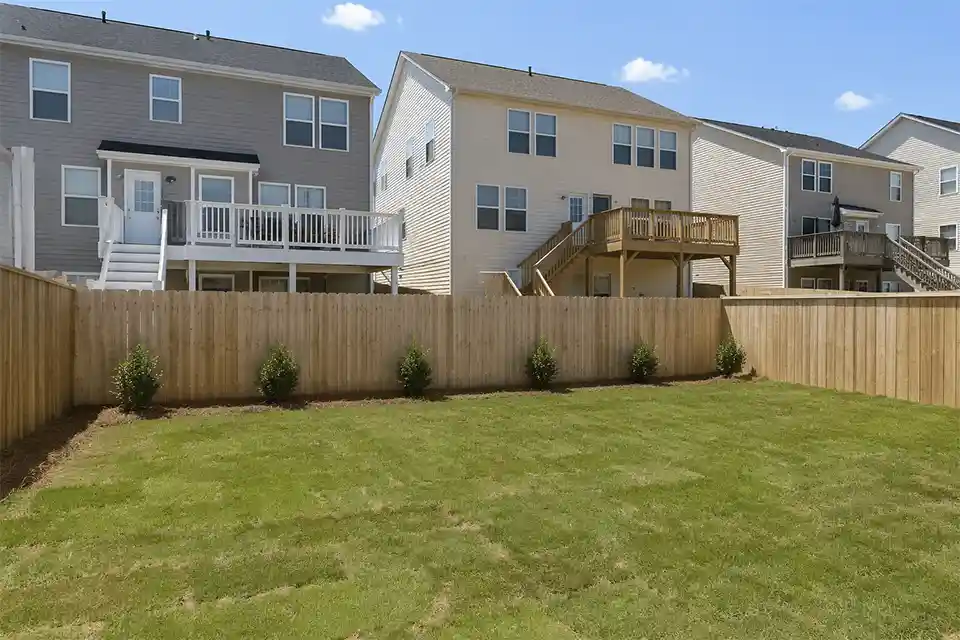
In most new construction backyards, the privacy problem is not that nothing was installed. It is that the only thing installed is the boundary.
A 6-foot fence may block direct views at ground level, but it does very little once neighboring windows look down from 10 to 18 feet above grade, a rear patio sits 18 to 30 inches higher than yours, or the builder planted small shrubs that will need 2 to 4 growing seasons before they do real screening work.
That is the first distinction that matters in a builder-grade yard.
The next checks are practical. Stand in the part of the yard you actually use and look outward. Can you see second-story windows? Is a neighboring deck or patio slightly elevated? Is there an open rear corner where the fence line visually leaks?
Then check the planting depth along the fence. If the bed is narrower than about 30 to 36 inches, many hedge-first plans already start with a physical limitation.
This is not the same as an older yard that lost privacy after trees came down. Here, the more common problem is that the privacy layer has not formed yet.
Why new construction privacy feels worse than it looks
The fence arrives before the privacy system exists
In new construction lots, builders often finish the yard in the order that makes the lot saleable, not private. The fence goes in, the patio goes in, the sod goes in, and the planting package makes the perimeter look landscaped. But “finished” is not the same as functional. The fence marks the edge. The actual privacy system usually depends on plant height, plant density, and vertical interruption that are still years away.
That is why a newly finished backyard can feel exposed even when nothing looks obviously missing. The visible parts are there. The screening function is not.
Builder landscaping often looks complete long before it works
A row of 1-gallon or 3-gallon shrubs may visually soften the fence line on day one, but it does almost nothing if the real sightline starts above 6 feet or cuts diagonally across the yard. People often interpret young plants as an incomplete version of future privacy. Sometimes that is true. Sometimes it is not. If the spacing is too wide, the mature width is too narrow, or the bed depth is too shallow, the privacy gap is built into the plan from the start.
A useful threshold is this: if clear openings wider than roughly 18 to 24 inches remain at eye level after the second growing season, patience alone is probably not the solution.
Tight lot spacing makes immaturity more obvious
New developments often compress the distance between houses to 15 to 35 feet from outdoor zone to outdoor zone. That makes immature screening feel harsher than it would on an older, deeper lot.
A fence that feels acceptable on paper can still leave a patio exposed once everyone is using elevated decks, upstairs bedrooms, and rear-facing living spaces.
That is why Second-Story Windows Ruining Backyard Privacy? What Helps Most is often more relevant than a generic fence article in this kind of yard.
Find the real exposure before you add anything
Upper-story windows usually matter more than people think
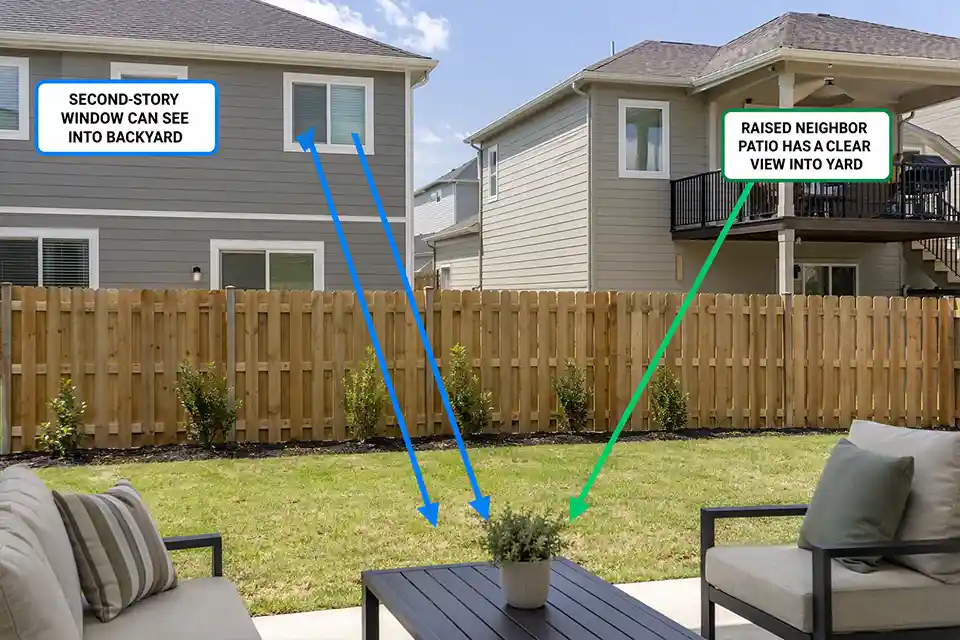
In builder-grade backyards, upper windows are often the first thing to check because the planting is too young to interrupt a downward angle. If you can see a neighbor’s upper windows from your patio, assume they can see most of the seating area unless something interrupts that line. This is where many privacy attempts go wrong. Homeowners add low shrubs, grasses, or decorative fence-line planting because the perimeter feels bare. The yard becomes softer, but not more private.
What matters here is vertical interception. If the view begins 8 to 12 feet above grade, a 2-foot to 4-foot planting layer is not solving the actual problem.
Raised patios and decks create the harshest short-range problem
A nearby deck or patio that sits only 18 to 30 inches above your yard can create a more uncomfortable privacy issue than a more distant second-story window.
The reason is simple: it is closer, more direct, and often aligned with the exact part of the yard you use for sitting, dining, or grilling. If the overlook source is only 12 to 20 feet away, perimeter planting can be too slow and too far back to matter soon enough.
In those cases, Neighbor’s Deck Overlooks Your Backyard? Privacy Fixes That Actually Work is the closer match. The question is not how to screen the whole lot first. It is how to stop the most intrusive sightline from landing directly in the use zone.
One open corner can cancel out a lot of planting
An exposed rear corner is easy to underestimate because it does not look dramatic when you stand in the middle of the yard. But diagonal sightlines are often what make a new-construction backyard feel watched. Homeowners keep adding material along the longest fence run while the real leak enters from the corner.
Quick diagnostic checklist:
- You can see second-story windows from the main patio
- A neighboring patio or deck sits noticeably above your grade
- A rear or side corner stays visually open
- Fence-bed depth is under about 30 to 36 inches
- The exposed seating area sits within roughly 15 to 20 feet of the overlook source
What people usually misread in new-build privacy yards
Small plants are not the same as a young privacy plan
This is the mistake that burns the most time. People see small plants and assume the yard is simply “early.” But early only helps if the layout is capable of becoming effective. A shrub that matures to 3 feet wide cannot close a 5-foot spacing gap convincingly. A narrow bed cannot support a dense, layered hedge without future crowding or weak fill.
A young privacy plan should already show logic: enough density, enough vertical intent, and enough space for roots and canopy to become functional.
Softening the edge is not the same as screening the view
A lot of new-build yards get a quick decorative upgrade that makes the fence line prettier without making it more private. Ornamental grasses, loose flowering shrubs, and scattered accent planting can reduce starkness, but they often do very little to stop the view path. People overestimate how much visual softness changes actual privacy. They underestimate how literal sightlines are.
That is one reason Backyard Privacy Problems: Fixes That Usually Fail connects so well to this topic. A fix can look sensible and still miss the mechanism.
Taller-looking boundaries are often overrated
Many readers assume the next move is simply more height. Sometimes it is. But often the better question is where that height belongs. Chasing the whole perimeter upward can waste time, money, and planting room if the main problem is one patio view, one upper-window angle, or one diagonal leak.
What helps now versus what helps later
What can improve privacy this season
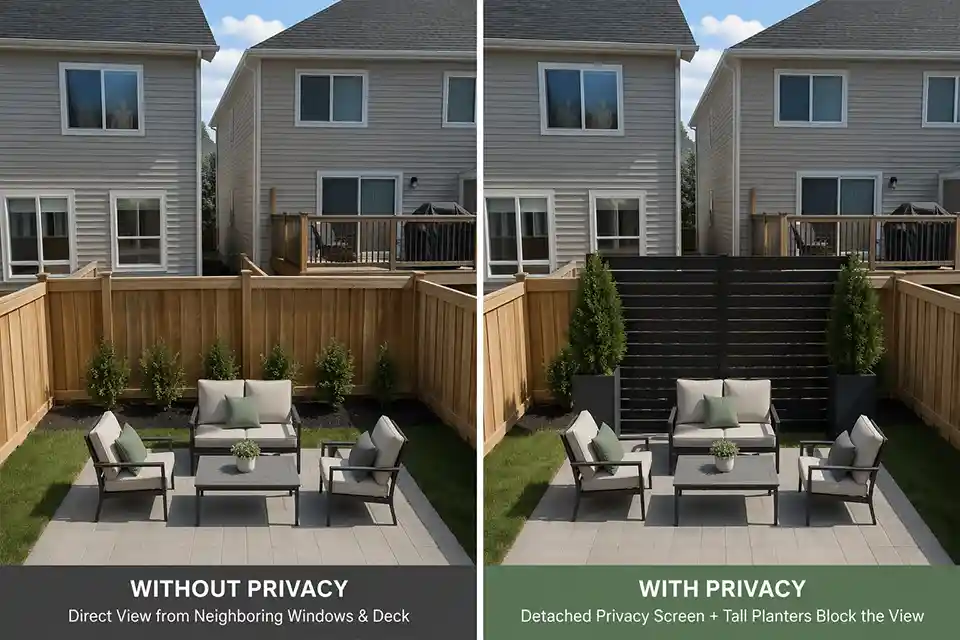
In a bare new-construction yard, the fastest gains usually come from targeted screening around the use zone. Freestanding panels, pergola-side coverage, tall planters, and detached screens can interrupt a direct line of sight immediately.
They are especially useful when the patio is the uncomfortable part and the rest of the yard matters less.
The key distinction is what each fast fix actually does. Detached panels and pergola-side screening are usually strongest for blocking a direct patio-to-patio or patio-to-deck view.
Tall planters can soften and partially interrupt lower sightlines quickly, but they usually do less against upper-story exposure unless they support real vertical mass.
That is why the best short-term fix is not the one that looks most finished. It is the one that blocks the most annoying view this season.
This is the step many new-construction owners skip because it feels temporary. But temporary is not the same as pointless. In a yard that needs 2 to 4 years for planting to mature, an immediate bridge solution can make the space usable right away.
What usually starts helping in 1 to 2 growing seasons
Medium-height screening shrubs, grouped evergreen structure, and layered planting beds begin to matter once they have had at least one full growing cycle.
This is where density matters more than plant count. One thin row often stays thin longer than expected. Two coordinated layers usually outperform a single decorative strip.
A practical comparison helps here:
| Exposure source | What people try first | Why it underperforms | What works better |
|---|---|---|---|
| Second-story windows | Low shrubs along fence | Too low for the view angle | Taller vertical interruption |
| Raised patio or deck | Full fence-line hedge | Too slow and too far back | Patio-zone screening first |
| Open rear corner | More plants on the longest fence | Misses the diagonal leak | Close the corner first |
| Tiny builder shrubs | Wait and hope | Layout may never fill properly | Rework spacing and layering |
| Narrow fence bed | Hedge-first plan | Limited root room and width | Pull the screen inward |
What changes upper-story privacy long term
Long-term privacy usually comes from elements that work above fence height: taller evergreen mass, structured tree canopy, columnar forms placed in the correct line, or layered screens that reach the 8- to 12-foot zone and eventually beyond.
This is where many builder-installed yards need to stop thinking like border beds and start thinking like vertical sightline control.
Pro Tip: If the bed along the fence is too shallow, moving part of the privacy layer 4 to 6 feet inward can perform better than forcing every plant into the perimeter.
The best order of operations in a bare new-construction yard
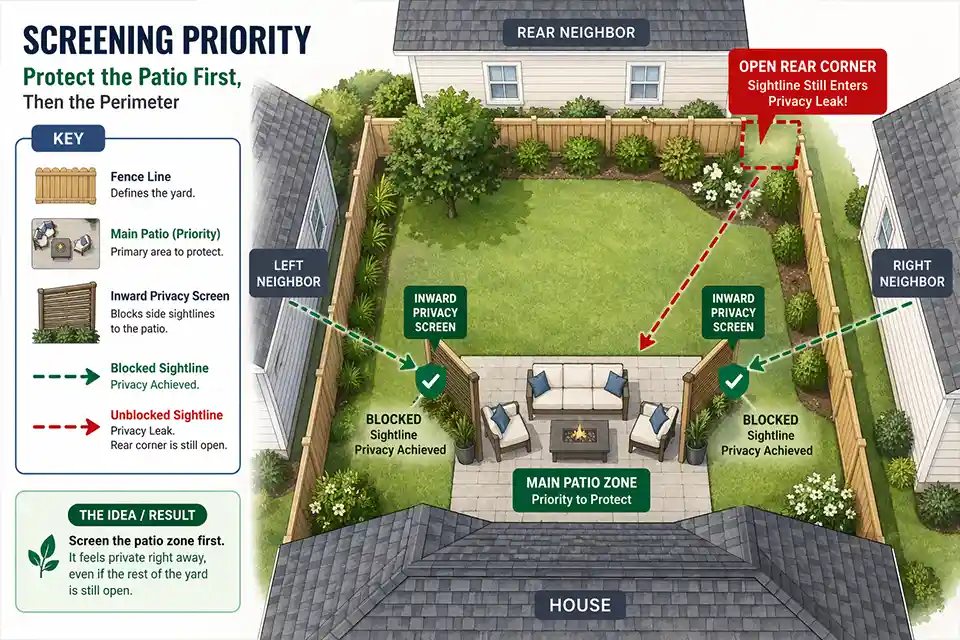
First, protect the part of the yard you actually use
The smartest privacy plan usually starts with the patio, dining area, or lounge zone rather than the entire property line. If the core use zone is roughly 12 by 16 feet or 14 by 18 feet, solve that space first. The whole backyard does not need to become private at once for the yard to start feeling better.
Second, close the worst leak rather than treating the whole perimeter equally
One open rear corner or one direct overlook from a neighboring deck can matter more than 40 linear feet of fence. This is where selectivity matters. Treating the entire boundary as if all sides are equally exposed leads to slow, diluted fixes.
That is also why Small Backyard Privacy Fences Fall Short fits this discussion. In tighter lots, smart placement often beats broader perimeter effort.
Third, build the long-term screen layer
Once the worst exposure is controlled, then the permanent planting plan makes more sense. This is where layered structure, mature width, growth rate, and maintenance logic should decide the design. The point is not to install more plants. It is to install the right screening system in the right order.
When the standard hedge fix stops making sense
A fence-line hedge is not always the right first answer
If the bed depth is under 30 inches, the problem comes from above 8 feet, or the uncomfortable exposure is concentrated around one sitting area, a hedge-only perimeter strategy often wastes the first few years. The plants may survive. The yard may even look greener. But the actual privacy result can stay disappointing.
Placement matters more than coverage in many small builder yards
This is where routine advice starts to fail. In a compact new-construction lot, a detached screen, inward planting line, or focused patio shield can outperform a more traditional edge-only solution. That feels less intuitive at first, but it is often the point where the outcome changes.
The clearest decision rule is this: if the privacy problem starts mainly at ground level and runs sideways, perimeter planting still makes sense. If it starts from above, from a raised structure, or through one diagonal corner, it is no longer mainly a fence problem. It is a sightline problem, and the layout has to answer that.
In a new-construction backyard, the goal is usually not to make the entire perimeter disappear at once. It is to break the most intrusive sightline first, make the main use zone feel protected sooner, and then let the long-term screening system catch up.
For broader landscape screening guidance, see the University of Maryland Extension guide to plants for mixed privacy screens.