Last updated: July 7, 2026
Cold climates do not simply pause a small garden for winter. They reveal how little margin the design really has.
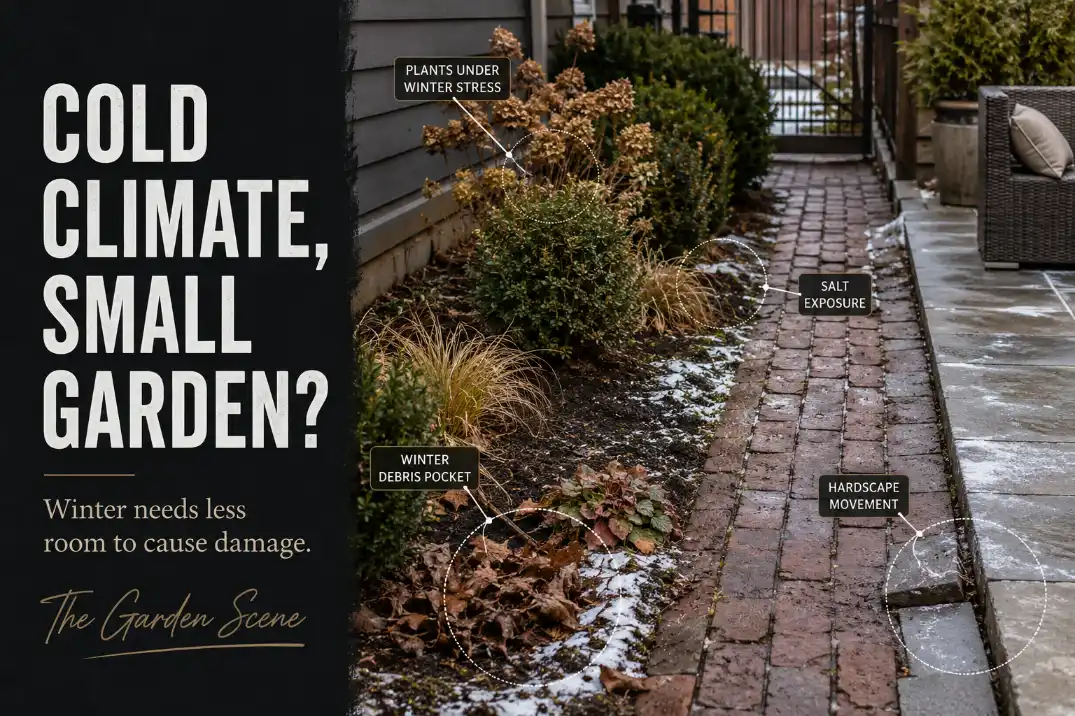
That is the part homeowners often underestimate. A compact garden can look finished in summer because every inch is planted, edged, paved, or styled. In winter, that same tightness gives freeze-thaw movement, salt splash, snow piles, wet debris, and plant loss fewer places to go.
The result is not always dramatic damage. More often, it is one lifted paver, one browned evergreen, one soggy corner, or one exposed soil patch that makes the whole space feel worn out by spring.
This is not the same problem as choosing plants for a late spring frost. Late spring frost is a short timing issue around tender new growth. Cold-climate small garden design is a full winter pressure problem: frozen ground, thaw water, deicing salt, snow storage, debris weight, plant gaps, and hardscape movement all working inside a tight space.
The goal is not to make a garden immune to winter. The goal is to keep winter pressure from landing on the most fragile, most visible, or hardest-to-repair parts of the design.
Why Cold Weather Hits Small Gardens Harder
The useful test for a small garden in a cold climate is simple: where does winter pressure go when there is no spare room?
A narrow bed beside a walkway may need to absorb snow storage, salt splash, runoff, foot traffic, frozen soil, and spring cleanup in the same few feet. A small patio edge may need to handle furniture legs, meltwater, leaf buildup, paver movement, and a planting border without much tolerance between them.
That compression is the real issue. In warm months, tight planting can feel lush and efficient. In winter, the same tightness can trap wet leaves, hold snow against stems, push meltwater toward hardscape seams, and expose every missing plant.
Cold-climate pressure usually shows up in five places first:
| Winter pressure | Early sign in a small garden | Prevention move |
|---|---|---|
| Freeze-thaw movement | Lifted edge, recurring puddle, widened seam | Keep thaw water moving away from tight joints and low spots |
| Salt exposure | Browned foliage, thin turf edge, crusty soil line | Keep sensitive planting away from splash and snow-storage zones |
| Winter debris | Wet leaves packed in corners or against crowns | Leave cleanout access where wind, snow, and water drop debris |
| Plant loss | One dead shrub creates a large visual hole | Avoid relying on one plant for the whole screen or edge |
| Hardscape movement | Rocking paver, tilted step, awkward transition | Treat small shifts early before they reduce usable route width |
A cold-climate small garden works better when it is designed as a pressure system. Ask where water will freeze, where salt will land, where snow will sit, where debris will collect, and what the garden will look like if one plant fails.
Freeze-Thaw Turns Tight Edges Into Failure Points
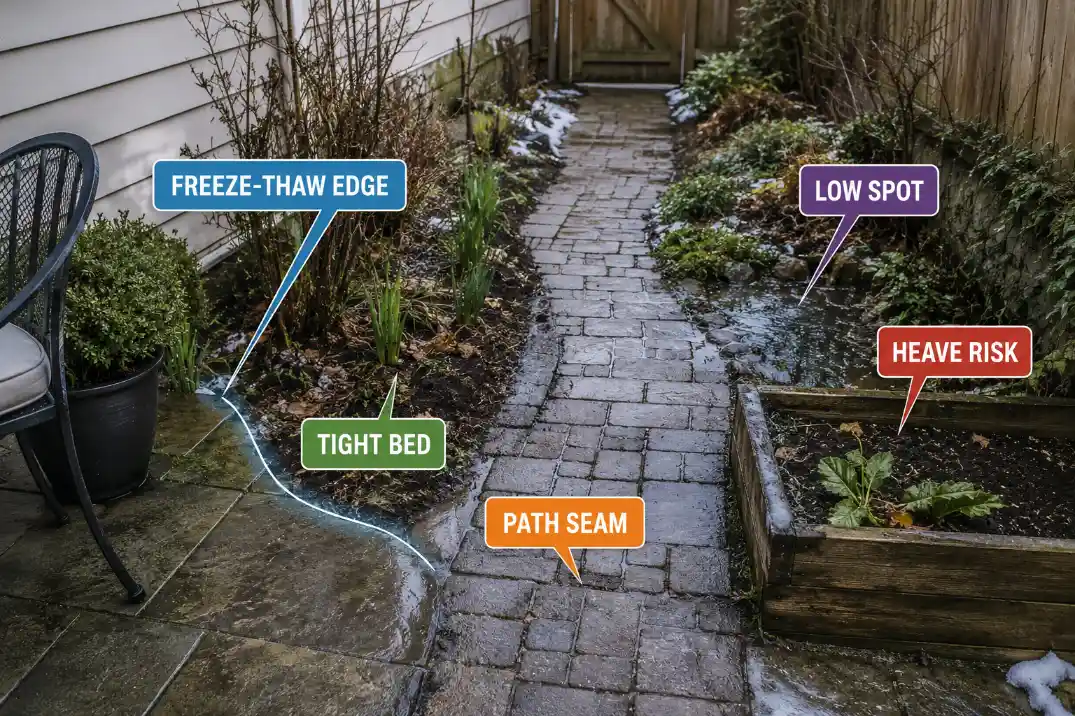
Freeze-thaw damage starts where water is allowed to pause. In a small garden, that pause often happens at a patio seam, path edge, raised-bed corner, compacted soil pocket, low step, or narrow planting strip.
When that water freezes, thaws, and freezes again, it can push mulch aside, lift edging, widen cracks, loosen pavers, or create a dip that holds even more water next time. The failure is cumulative. One small low spot becomes the place winter keeps working on.
The early signs are usually modest: mulch that keeps migrating from the same edge, a paver that rocks after thaw, a seam that stays wet longer than the rest of the surface, or a bed edge that looks slightly pushed out in spring. In a large yard, those might be background flaws. In a small garden, they interrupt the only path, the only seating edge, or the main view from the house.
The prevention move is not to overbuild every edge. It is to stop water from being trapped in the tightest places. Before regular freezing begins, clear the drainage path at patio seams, step edges, downspout outlets, and low corners. In early spring, after the main thaw, check whether water repeatedly sits in the same pocket.
If the garden already has a thaw-water pattern, handle that before adding decorative edging or new plants. A narrow garden with recurring water movement may need deeper drainage attention, especially where runoff keeps cutting through the same bed. For related water-path problems, see small garden drainage problems.
Small-space caution: do not seal, pack, or decorate every transition until it looks “finished.” Cold-climate edges need some serviceability. A simple edge that lets water escape is usually stronger than a tight decorative edge that traps ice and fails every spring.
Salt Damage Starts Where Winter Access Meets Planting
Salt damage is usually blamed on the plant, but in a small garden the better question is where salty slush is being forced to land.
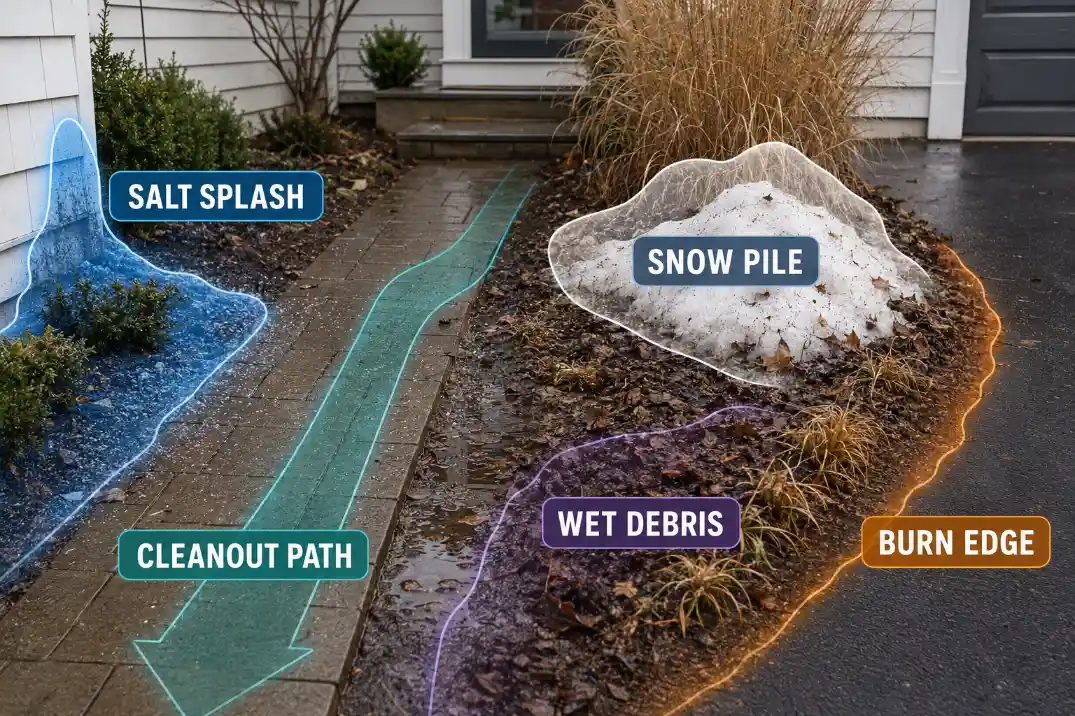
Deicing salt and salty runoff collect where winter access meets planting: front walks, driveway corners, sidewalk strips, street-facing beds, steps, and the edges where shoveled snow gets stacked.
The University of Minnesota Extension notes that deicing salts can damage plants through root uptake and salt spray, with symptoms such as brown leaves or needles, foliage loss, and branch injury. See their guide to deicing salt effects on landscapes for the plant-stress mechanism.
In a compact garden, the salt zone may be narrow, but that strip may also be the main border. When an evergreen edge browns, a turf strip thins out, or the same bed declines every spring, the issue may not be that the planting is weak. It may be sitting directly in the splash path.
The early signs are patterned. One side of a shrub browns more than the rest. The soil edge looks crusty. The plants closest to the walkway struggle while the same species farther back look fine. A narrow lawn strip beside a salted path thins out every year.
The prevention move is placement before replacement. Keep sensitive plants out of the direct splash zone where possible. Even 12 to 18 inches of buffer can matter in a small bed if it moves the most vulnerable foliage away from salty slush. Where space is too tight, use a tougher edge condition: a washable hard edge, a gravel or mulch strip that can be refreshed, or a planting layer that is not carrying the entire design.
Also watch snow-storage habits. If shoveled snow always lands on the same planting edge, that pile may carry salt, grit, debris, and extra weight into the bed. In front-yard or sidewalk-facing gardens, the salt pattern may be similar to the problems covered in road salt curb splash on sidewalk strips.
Do not solve salt exposure by simply choosing “hardy” plants. A plant can handle winter temperature and still struggle in salty soil, wet freeze-thaw pockets, or repeated salt spray.
Winter Debris Makes Small Gardens Look Neglected Faster
Winter debris becomes a design problem when the garden has no easy place to shed it.
Leaves, broken twigs, grit, plow residue, wet mulch, and windblown trash collect where movement slows down. Fence corners, raised beds, steps, storage edges, containers, and tight patio borders are common collection points. Snow can press that debris into planting crowns or hold it against edging for weeks.
In a larger landscape, that pocket may be hidden. In a small garden, it may be the first thing visible from the kitchen window, front door, or patio seat.
The early sign is a corner that always looks dirty after snowmelt. Another sign is a plant crown that stays buried under wet leaves, or mulch that forms a soggy ridge against a path. If debris keeps returning to the same spot, the design has created a collection pocket.
The prevention move is cleanout access. Before leaves start dropping or before regular winter weather sets in, look at the tightest corners and ask whether you can actually reach them with a rake, broom, gloved hand, or blower. If a planter, bench, decorative object, or storage bin blocks the only access, debris will stay there longer and hold moisture where you do not want it.
A simple small garden often ages better than an over-detailed one in cold climates. Fewer blocked corners, fewer tiny unreachable pockets, and clearer service edges reduce the spring reset. For a deeper seasonal cleanup angle, fall backyard cleanup problems covers how small outdoor spaces become harder to reset when debris has nowhere to go.
Plant Loss Changes the Whole Small-Garden Structure
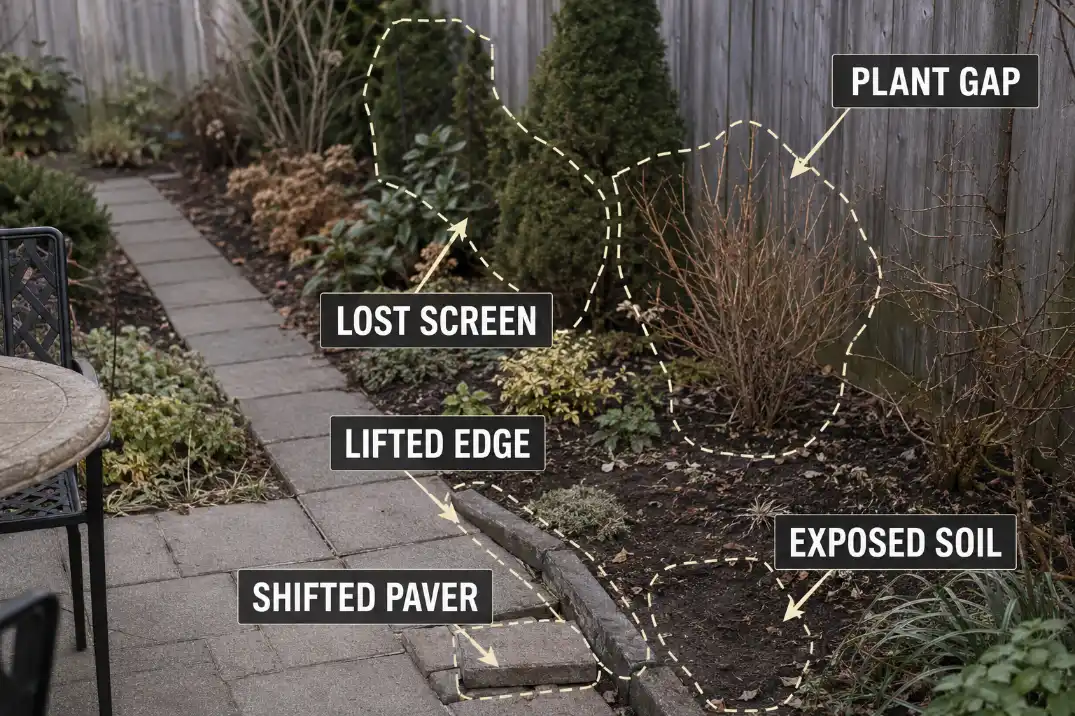
In a small garden, one lost plant can remove more than foliage. It can remove the screen, the edge, the winter mass, the soil cover, and the visual stop that made the design feel complete.
That is why plant loss in cold climates should be judged by role, not just replacement size. One evergreen may provide winter structure, privacy, background color, and a stopping point at the end of a path. One shrub may soften a fence corner, cover exposed soil, and balance a seating area. One groundcover strip may keep a narrow bed from looking bare.
Winter plant loss can come from several causes: salt exposure, frozen soil, poor drainage, wind burn, snow load, root-zone stress, animal browsing, or repeated freeze-thaw movement around crowns. The University of Minnesota Extension’s guide to protecting trees and shrubs in winter notes that winter sun, wind, cold temperatures, snow, ice, salt, and animal feeding can all injure woody plants.
The early sign is not always a dead plant. It may be one browned side, a split branch after snow load, a shrub that leafs out weakly, exposed soil around the crown, or a plant that keeps declining in the same exposed position.
The prevention move is layered structure. Do not let one plant carry the entire winter view. Use a mix of height, texture, and seasonal structure so the garden still has shape if one plant thins out. In a very small garden, that may mean one sturdy background shrub, a lower edge layer, and enough open space around both for snow and cleanup.
What most homeowners miss: replacing the dead plant is not the first decision. The first decision is whether the spot killed the plant. If the same location gets salt, snow load, wind, or thaw water every year, the next plant may fail for the same reason.
Hardscape Movement Shrinks Usable Space Before It Looks Broken
Hardscape does not have to collapse to become a problem in a small garden. It only has to move enough to steal usable space.
Freeze-thaw cycles can lift pavers, widen joints, loosen edging, tilt stepping stones, shift gravel, or create a small trip edge. In a compact garden, that shift may affect the only walking route, the only chair pullback area, or the transition between patio and planting bed.
The early signs are practical: a paver rocks underfoot, a joint keeps opening, gravel migrates into a bed, water collects along one seam, or a step feels slightly uneven. A 1- to 2-inch shift is not just cosmetic when the path is already tight. It can change how safely people move through the garden, especially near steps, gates, and entries.
The prevention move is to watch drainage and edges before adding surface decoration. If water keeps sitting along a seam, do not hide it with a planter. If a paver rocks after thaw, do not ignore it until the whole route feels unstable. If edging keeps tilting, check whether soil, ice, roots, or water pressure is pushing it from behind.
For paver-specific movement, joint problems, and repair logic, shifting patio paver repair is a better next step than trying to solve full hardscape repair here.
Do not overdo hardscape fixes by making every edge rigid and decorative. Cold-climate small gardens need stable surfaces, but they also need water escape, serviceable joints, and simple transitions that can be corrected before a small shift becomes a repeated spring project.
This Is Not the Same Problem as Late Spring Frost
Late spring frost is a timing problem. It affects tender new growth, early planting decisions, and short-term protection when warm weather arrives too early.
Cold-climate small garden design is different. It is about what happens over the whole winter system: frozen ground, thaw cycles, snow storage, salt splash, wet debris, root stress, wind exposure, and hardscape movement.
Plant choice still matters, but it is not the whole answer. A plant can match your hardiness zone and still struggle if it sits beside a salted walk, under a heavy snow pile, in a wet freeze-thaw pocket, or in a narrow bed with no cleanup access.
If your main concern is spring timing and tender plants, use a page focused on late spring frost timing and plant protection. For this page, the better question is: what winter pressure is the small garden being forced to absorb every year?
Design note: cold-climate resilience is not about making the garden look untouched after winter. It is about avoiding fragile edges, single-point plant failures, trapped water, and damage patterns that repeat in the same place every spring.
How to Make a Small Garden More Winter-Resilient
A winter-resilient small garden is not the one with the most cold-tolerant plants. It is the one that gives freeze, salt, snow, debris, water, and movement enough margin that one weak point does not pull the whole design apart.
Before regular freezing begins, walk the garden as if winter is already using it. Where will water sit? Where will snow be shoveled? Which planting edge will receive salt spray? Which corner will collect leaves? Which hardscape seam already looks low? Which plant would leave the biggest hole if it failed?
Then repeat the walk after the main spring thaw. The pattern after winter is often more useful than the plan on paper.
Use this compact check before redesigning, repairing, or replanting:
- Check any low spot that stays wet after thaw; treat it as a freeze-thaw pressure point, not just a puddle.
- Look for repeated salt-burn lines along walks, driveways, street edges, and snow piles.
- Identify corners where wet debris collects and make sure you can actually reach them for cleanup.
- Notice whether one shrub, evergreen, or groundcover strip is carrying too much of the garden’s winter structure.
- Test narrow paths for rocking pavers, lifted edges, widened joints, or awkward transitions after winter.
- Keep sensitive planting out of the most exposed salt and snow-storage zones where space allows.
- Avoid adding decorative objects that block drainage, cleanup access, or already-tight walking routes.
The strongest cold-climate small gardens are not designed only for peak bloom. They are designed for what remains after snow, salt, ice, debris, and thaw water have moved through the space.
That is the real winter test: whether the garden still has structure, usable paths, cleanable edges, and enough tolerance that one damaged spot does not make the whole space feel broken.