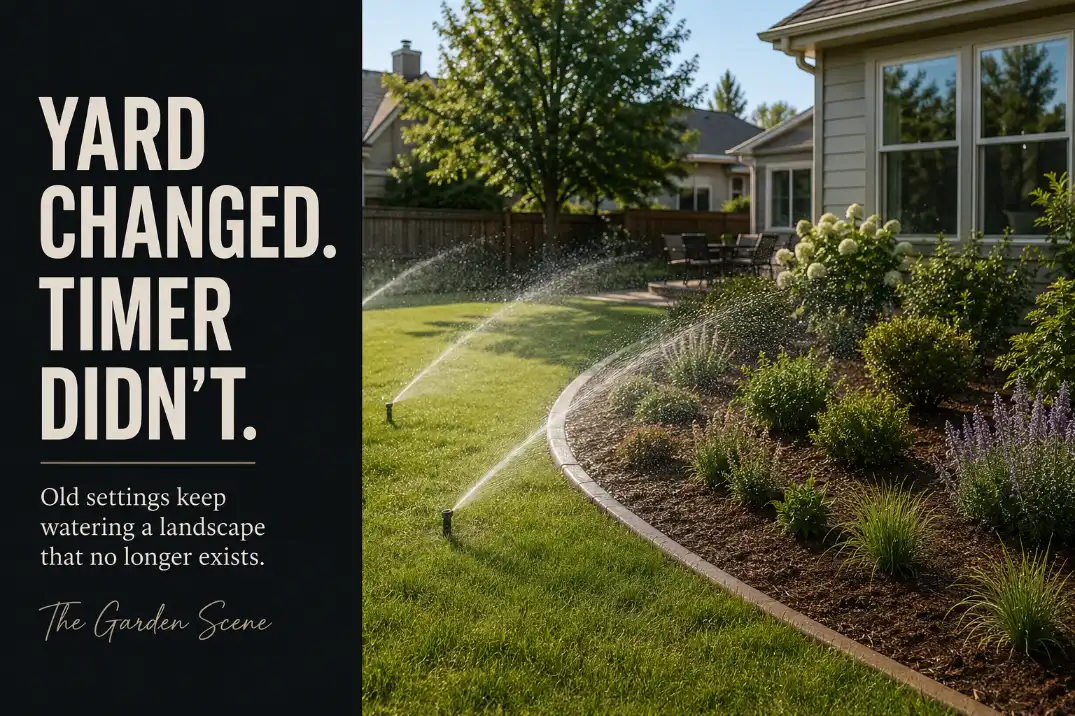
A watering timer can run perfectly and still make the wrong decision for the yard.
The real failure is not mechanical. It happens when a schedule created for new sod, recently planted shrubs, summer heat, or a larger lawn remains active after those conditions disappear. The controller continues doing exactly what it was told to do; the yard simply no longer matches the instructions.
That is timer inertia. Because the valves open, the sprinklers rise, and the cycle ends normally, there is no obvious breakdown forcing the homeowner to review the settings. Gradual changes in planting, shade, rainfall, and lawn area can therefore accumulate around an untouched schedule.
The useful test is not, “Did the system run?” It is, “Does each active setting still serve something that needs this water now?”
The U.S. Environmental Protection Agency advises adjusting irrigation schedules as seasons and landscape water needs change. That is the right way to view a timer: as a stored record of earlier conditions, not proof that the current schedule is still appropriate. EPA WaterSense irrigation guidance reinforces the need to match irrigation to changing site conditions.
Why Old Timer Settings Stop Matching the Yard
The first check is not whether the timer works. It is whether every zone still has the target, exposure, and planting demand it had when the schedule was created.
The timer repeats decisions; it does not reassess them
A conventional timer remembers watering days, start times, and zone durations. It does not notice that a shrub has established, a tree now casts afternoon shade, or a section of lawn has been replaced.
The original settings may have made sense when:
- New sod needed establishment watering.
- Recently installed plants had limited root systems.
- Hot, dry weather increased soil moisture loss.
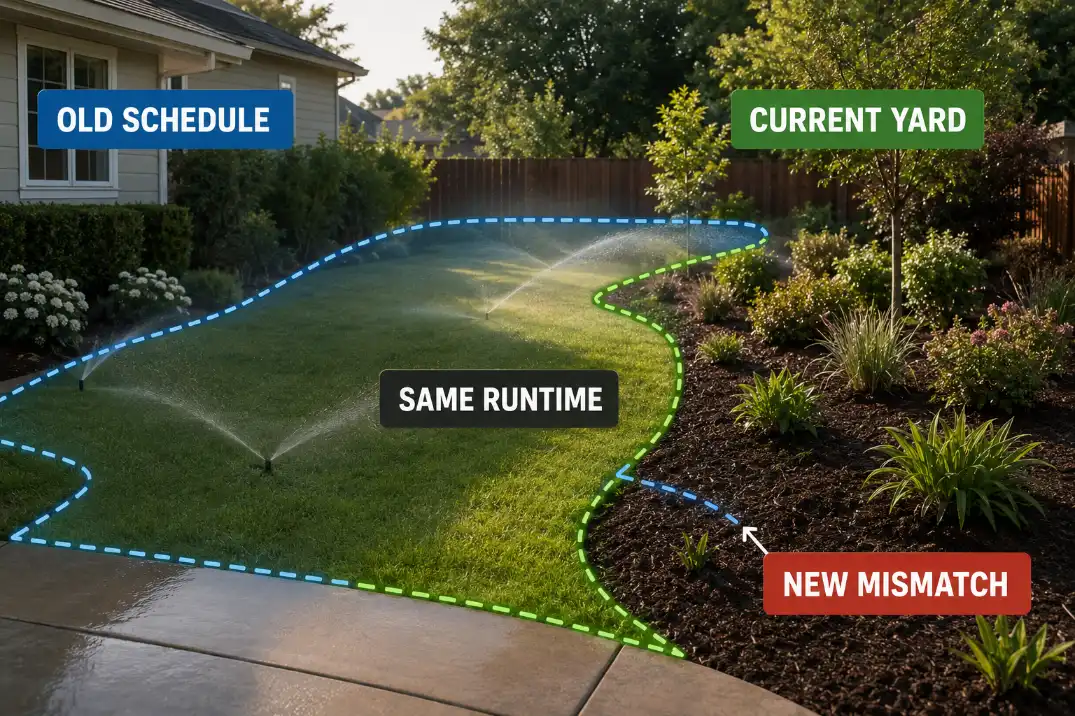
- Lawn extended into an area that is now mulch or planting.
- A temporary landscape project required extra attention.
The mismatch begins when those conditions end but their settings remain.
Early signs are often subtle. A sprinkler may still sweep across a former lawn edge. Established planting may receive the same cycle created at installation. A zone may now cover turf, mature shrubs, mulch, and hardscape even though those areas no longer share one useful watering pattern.
This is particularly common in sprinkler zones serving mixed backyard areas. The old runtime keeps operating, but the zone no longer represents one coherent water need.
Small changes accumulate before the mismatch becomes obvious
Yards rarely change in one dramatic project. A bed widens one year. A shrub canopy fills in the next. A tree creates more shade. A difficult strip of lawn is gradually replaced with gravel or mulch.
Each change can feel too small to justify reopening the timer. Together, they can leave the system watering a yard that no longer exists.
Surface wetness may hide the problem. Wet leaves, dark mulch, and damp pavement confirm where water landed, but they do not show whether the intended root zone needed that cycle or received water evenly.
Common Mistake: Do not preserve a schedule simply because the plants still look acceptable. Cool weather or periodic rain can temporarily hide excessive irrigation. A lack of immediate plant damage does not confirm that the settings still match the yard.
Seasonal Changes That Make the Schedule Wrong
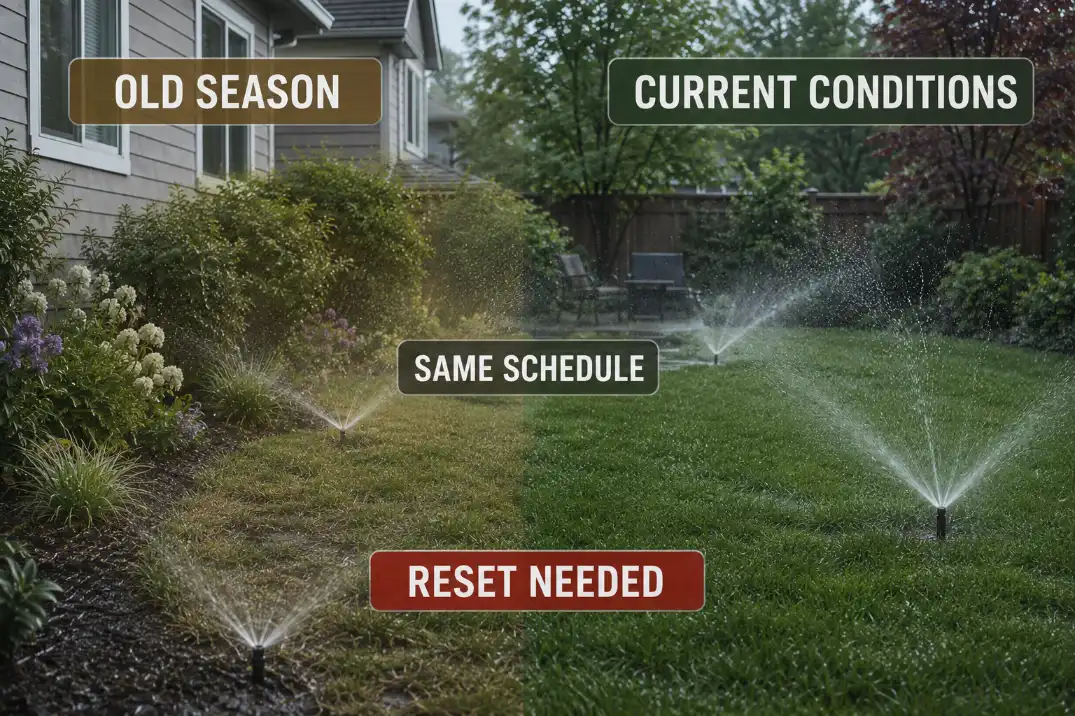
Treat a meaningful season change as a schedule-review trigger—not as something to address only after runoff, soggy soil, or stressed plants appear.
Weather changes faster than watering habits
A schedule that matched hot, dry conditions can become excessive when nights cool, days shorten, rainfall increases, or shaded soil takes longer to dry.
The reverse is also possible. A mild spring schedule may become inadequate during sustained heat. The prevention rule is not to assume one setting is permanently too high or too low. It is to stop temporary seasonal adjustments from becoming the unexamined default.
Warning signs include:
- Summer frequency continuing into cooler fall weather.
- A dry-season program remaining active through a wetter spring.
- Soil still feeling moist when the next cycle begins.
- A short-term heat adjustment remaining after temperatures moderate.
- Irrigation continuing unchanged through a sustained shift in rainfall.
EPA WaterSense recommends adjusting irrigation to seasonal conditions and checking whether water is reaching the intended landscape. The practical point is adaptation, not a fixed percentage reduction. WaterSense irrigation practices support reviewing schedules as weather and plant demand change.
Rainfall also needs interpretation. A quick storm, several light showers, and a longer wet period do not affect every soil or bed equally. The calendar may mark a new season, but soil drying and plant response show whether the schedule still fits.
Do not solve seasonal change by reducing every zone equally. A sunny lawn, a shaded shrub bed, and a recently planted area may respond differently to the same weather.
What Happens After Plants Mature or Lawn Shrinks
Permanent landscape changes deserve permanent schedule decisions. A smaller lawn, established planting, or a converted bed should not remain tied to settings created for the earlier layout.
Establishment watering should not become permanent
New plants often need closer moisture attention while their roots begin expanding into the surrounding soil. That temporary need should be reviewed as the planting establishes.
This does not mean every mature plant automatically needs less water. Species, exposure, soil, root space, weather, and plant health still control demand. The practical question is narrower: is an establishment setting still serving an establishment need?
A common failure occurs when several new shrubs are added and the entire zone—or the whole yard schedule—is increased to support them. Established lawn and older planting then receive extra irrigation because of a need confined to a few small root zones.
The stronger move is to separate temporary new-plant care from the long-term schedule. Watering new plants without soaking the entire yard may mean using targeted hand watering while established areas remain on settings tied to their current demand.
A smaller lawn can leave old coverage watering the wrong area
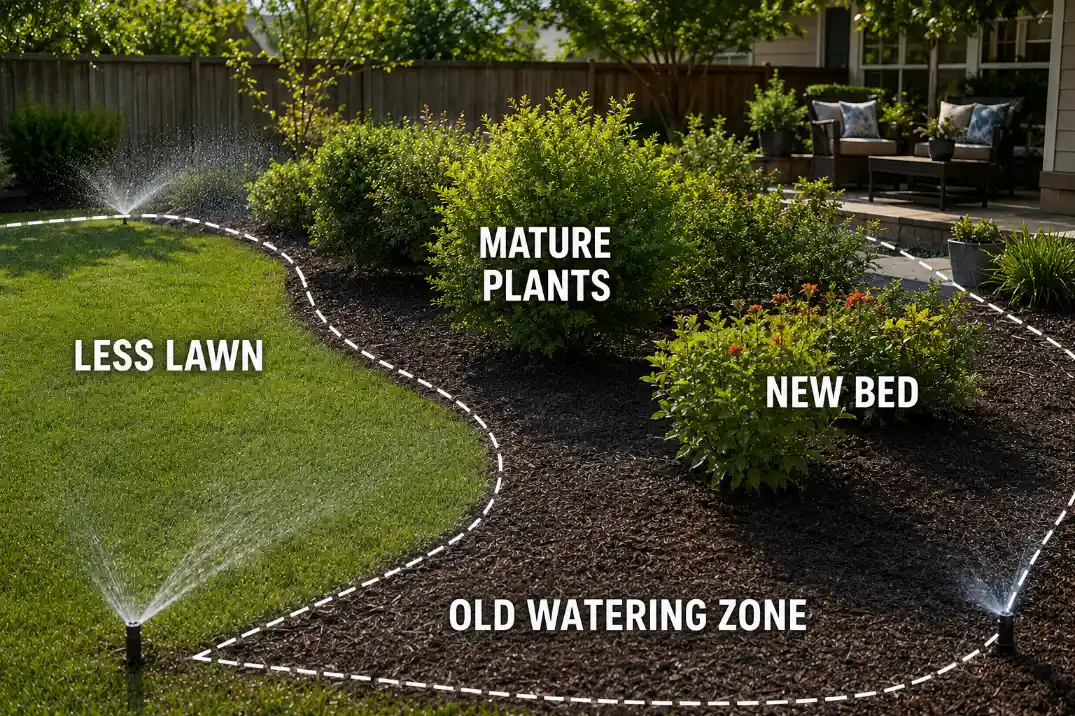
Lawn reduction creates one of the clearest timer mismatches. The turf disappears, but the zone continues watering its former footprint.
That space may now contain mulch, gravel, a path, drought-tolerant planting, or an expanded patio. Even a new bed occupying the former lawn area may not need water delivered at the same frequency or in the same pattern as turf.
Watch a normal cycle and trace where the spray now lands. Look for water reaching:
- The former lawn boundary.
- New mulch or gravel.
- Walkways and patio surfaces.
- Established beds with different moisture needs.
- Open spaces between widely spaced plants.
Changing the schedule may reduce unnecessary watering, but runtime cannot correct every physical mismatch. If the spray still targets the wrong footprint, the problem may involve coverage or zone layout rather than time alone.
New beds create different needs, not one whole-yard need
A new bed can contain several watering conditions. Fresh plants may need temporary attention, while nearby mature shrubs do not. A mulched interior may retain moisture longer than an exposed edge.
Containers complicate the comparison because their limited soil volume and exposed sides can make them dry faster than nearby ground beds. One dry container should not become evidence that the entire lawn or landscape needs a longer cycle. The difference is explained further in why container plants dry faster than ground beds.
The correct response may differ by area: reduce an outdated setting, provide temporary targeted watering, or correct a distribution problem the timer cannot solve.
Why Rain Sensors Do Not Fix Every Watering Habit
A rain sensor can cancel a cycle. It cannot correct the outdated baseline the timer returns to afterward.
Rain shutoff devices interrupt or delay scheduled irrigation after sufficient rainfall. Colorado State University Extension describes them as devices that prevent the controller from following its normal program under wet conditions. They pause the stored schedule rather than rewriting it. Colorado State University Extension irrigation guidance explains that distinction.
Once the sensor dries and releases the system, the timer can resume the same settings it used before the rain. It does not necessarily know that:
- Lawn has been removed.
- Plants are now established.
- A new bed occupies part of a former zone.
- Seasonal demand has declined.
- Water is landing outside the intended root area.
Sensor dry-out and soil dry-out can also differ. UF/IFAS Extension notes that a rain sensor may allow irrigation again before the landscape soil actually requires more water. UF/IFAS rain-sensor guidance supports checking the landscape rather than treating sensor release as proof of need.
Rain Habit Check: A skipped cycle confirms that the sensor responded to rain. It does not confirm that the underlying frequency, runtime, or irrigated footprint is still appropriate.
Periodic rain can hide an excessive base schedule because the sensor blocks some cycles. The mismatch becomes visible again when drier weather returns and the old program resumes.
How to Reset the Schedule Without Guessing
Resetting should begin in the yard, not at the controller. First identify which assumptions are outdated; then change only the settings connected to those changes.
Review the yard before changing the timer
Use a short field check:
- What lawn, bed, or planting areas have changed?
- Which plants were new when the schedule was created?
- Which areas now stay moist longer or dry faster?
- Where does each active zone currently place water?
- Which settings were intended to be temporary?
This separates obvious schedule mismatches from problems that need a different correction.
For example, a consistently wet walkway may indicate that the spray pattern no longer matches the landscape. Reviewing sprinkler overspray onto patios, walkways, and siding can help distinguish excessive runtime from misplaced coverage.
Use a five-step observation-led reset
- Identify what physically changed.
Compare the current yard with the conditions that existed when the schedule was created. Note lawn reduction, new beds, established planting, added shade, exposure changes, and seasonal shifts. - Observe one normal watering cycle.
Watch the system when operating it is safe and appropriate. Confirm which zones run and whether they serve plants, open ground, or hardscape. - Compare each zone with its current target.
Check the intended soil or root-zone response instead of relying on wet leaves or pavement. Decide whether the target still needs that frequency and whether water reaches it effectively. - Change the outdated assumption—not every setting at once.
Separate temporary new-plant needs from established-area schedules. Adjust the zones whose demand or footprint changed rather than applying one reduction across the yard. - Recheck after several cycles and the next meaningful weather shift.
Look for soil staying wet too long, genuine plant stress, runoff, missed areas, or water reaching spaces that no longer need irrigation.
Field Judgment: The correct reset is not automatically “water less everywhere.” One area may need a lower frequency, another may need temporary targeted watering, and another may have a coverage problem that additional runtime will only make worse.
Review the schedule again after a major seasonal shift, lawn reduction, bed conversion, planting project, establishment period, or sustained change in rainfall. Those events alter the conditions the timer is supposed to represent.
When more runtime still fails to wet the intended root area—or water repeatedly reaches the wrong surface—the problem has crossed the boundary from scheduling into coverage, layout, or repair.
A timer should describe the yard that exists now. Once the landscape changes, the old schedule is no longer a setting to preserve; it is an assumption to test.