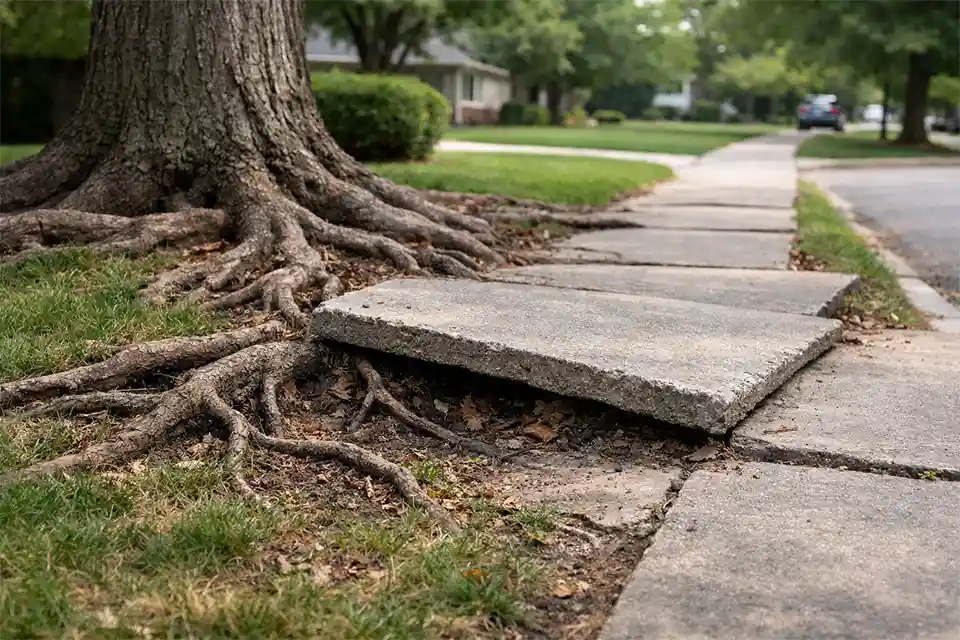
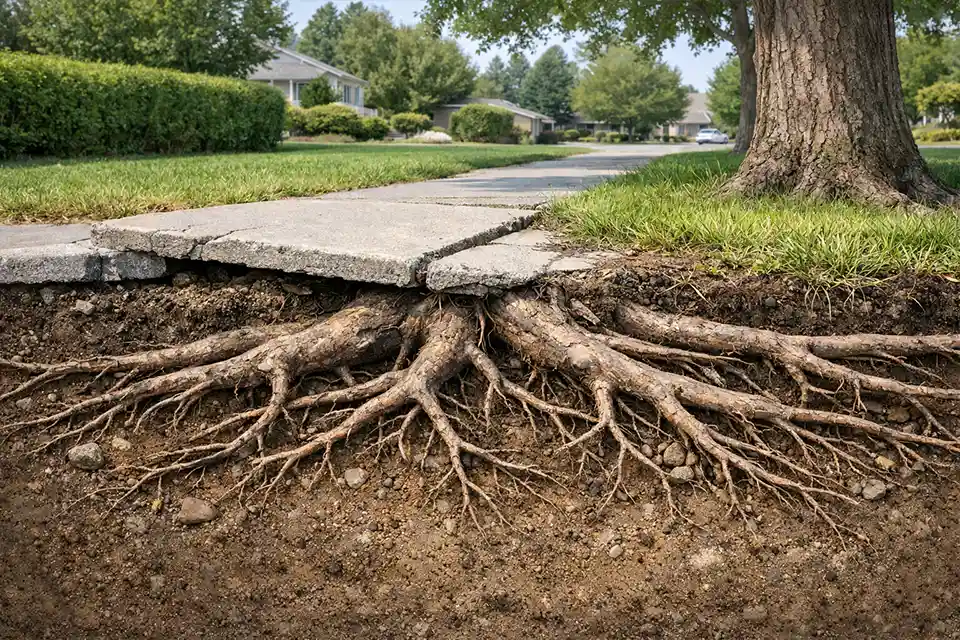
When tree roots push up sidewalks and damage nearby lawns, the underlying issue usually comes from large structural roots expanding within the top 6–12 inches of soil. This shallow growth pattern allows roots to spread wide beneath pavement, gradually lifting sidewalk slabs and disrupting turf roots nearby.
The most reliable fix typically involves combining pavement repair with root management, rather than treating the sidewalk damage alone. Homeowners often address the problem through root barriers, controlled root pruning, and sidewalk repairs such as grinding or slab replacement. In many cases, adjusting irrigation depth and soil conditions also helps reduce future root pressure.
Lawns around exposed roots often struggle because soil depth becomes extremely shallow—sometimes only 1–2 inches above the root surface. Restoring turf usually requires soil leveling, reseeding with shade-tolerant grass varieties, and improving drainage or watering patterns.
Tree species, soil structure, and sidewalk construction methods all influence how quickly this issue develops. In areas with compacted soils or narrow planting strips—conditions common in many suburban neighborhoods—roots frequently grow horizontally instead of downward, increasing the likelihood of sidewalk lifting over time.
Why Tree Roots Grow Close to the Surface
Most urban trees develop root systems that are far wider than their canopy. While some roots extend deeper, the majority remain in the upper soil layers where oxygen and moisture fluctuate.
Several environmental conditions make shallow root growth much more likely.
Soil Compaction Near Hard Surfaces
Sidewalks, driveways, and streets compress the soil during construction. When soil density rises above roughly 1.6 g/cm³, oxygen movement through the soil becomes limited.
Roots naturally seek areas with better oxygen availability, which often means growing just beneath the surface. Over time, as those roots increase in diameter, they begin pushing against concrete slabs.
Limited Rooting Space
Many street trees grow in narrow planting strips between sidewalks and roads. These spaces may provide only 3–6 feet of usable soil width, forcing roots to spread sideways rather than downward.
In these situations, roots frequently travel directly beneath sidewalks where moisture collects and soil temperatures remain relatively stable.
Grass growing above these roots often declines as competition for moisture and nutrients increases. This interaction between shade, root competition, and turf health appears frequently in front yards with mature trees, as explained in Front Yard Shade Trees Where Grass Is Not Growing.
Irrigation Patterns That Encourage Surface Roots
Frequent shallow watering encourages roots to remain near the soil surface. If irrigation only penetrates 4–6 inches deep, roots have little reason to grow downward.
Deep watering that penetrates 10–12 inches into the soil every 7–10 days generally encourages deeper root development, which may reduce pressure on pavement surfaces.
Early Warning Signs Before Sidewalk Damage Becomes Severe
Sidewalk lifting usually develops gradually over many years. Most yards show visible warning signs long before slabs become dangerously uneven.
Quick Diagnostic Checklist
• Hairline cracks appearing between sidewalk sections
• Raised soil ridges running parallel to the pavement
• Exposed tree roots emerging through the lawn
• Grass thinning around the base of mature trees
• Sidewalk slabs lifting more than ½ inch above adjacent panels
• Lawn mowers hitting surface roots during cutting
Once sidewalk height differences reach 1½–2 inches, the pavement often becomes a trip hazard and typically requires repair.
How Tree Roots Damage Front Yard Lawns
Although lifted sidewalks are the most visible problem, root systems also affect turf health in several ways.
Soil Displacement
As structural roots expand, they push surrounding soil upward. This soil movement disrupts turf roots and creates uneven lawn surfaces that are difficult to mow.
Even roots only 1 inch thick can gradually raise the soil enough to expose turf crowns and reduce grass stability.
Competition for Water and Nutrients
Large trees can absorb 40–100 gallons of water per day during hot summer weather. In dry climates such as Arizona or inland California valleys, this water demand often leaves nearby grass dehydrated.
Grass growing within the root zone must compete for both water and nitrogen, which often leads to patchy or thinning turf.
Reduced Soil Depth
In some yards, surface roots limit soil depth above them to just 1–2 inches, making it difficult for most turf species to establish healthy root systems.
This condition often explains why grass repeatedly dies back around mature trees even with regular watering.
Tree Species Most Likely to Damage Sidewalks
Certain tree species are more prone to causing sidewalk damage because they develop aggressive surface root systems. These trees often grow quickly and produce large structural roots close to the soil surface.
| Tree Type | Root Behavior | Sidewalk Damage Risk | Typical Growth Rate |
|---|---|---|---|
| Silver maple | Wide shallow roots | Very high | Fast |
| Willow | Extensive moisture-seeking roots | Very high | Fast |
| Poplar | Aggressive horizontal roots | High | Fast |
| American sycamore | Large surface structural roots | Moderate–high | Fast |
| Red oak | Deeper root tendency | Moderate | Medium |
| Dogwood | Compact root system | Low | Slow |
Fast-growing trees frequently produce large root systems within 10–20 years, which increases the chance of sidewalk lifting as the tree matures.
Conditions That Increase Sidewalk Damage
Several environmental factors strongly influence how likely roots are to lift pavement.
| Factor | Effect on Roots | Likelihood | Preventive Strategy |
|---|---|---|---|
| Clay soil | Roots remain near surface | High in Midwest | Soil aeration |
| Narrow planting strips | Roots forced under pavement | Very common | Install root barriers |
| Frequent shallow irrigation | Surface root growth | Moderate | Deep watering cycles |
| Thin concrete slabs | Pavement lifts easily | Common in older suburbs | Reinforced replacement |
| Mature tree age | Root diameter increases | High after 15–20 years | Structural root management |
Many neighborhoods built before the 1990s installed sidewalks only 3–4 inches thick, making them particularly vulnerable to root pressure.
In yards where drainage issues also affect soil stability, root displacement can worsen ground movement over time. Water flowing from nearby pavement can accelerate erosion around tree roots, similar to the conditions described in Front Yard Drainage Problems When a Driveway Channels Rainwater Toward the Lawn.
Sidewalk Repair Options When Roots Lift Concrete
Once sidewalk panels begin lifting, repairs usually focus on restoring a safe walking surface while preserving the tree if possible.
Concrete Grinding
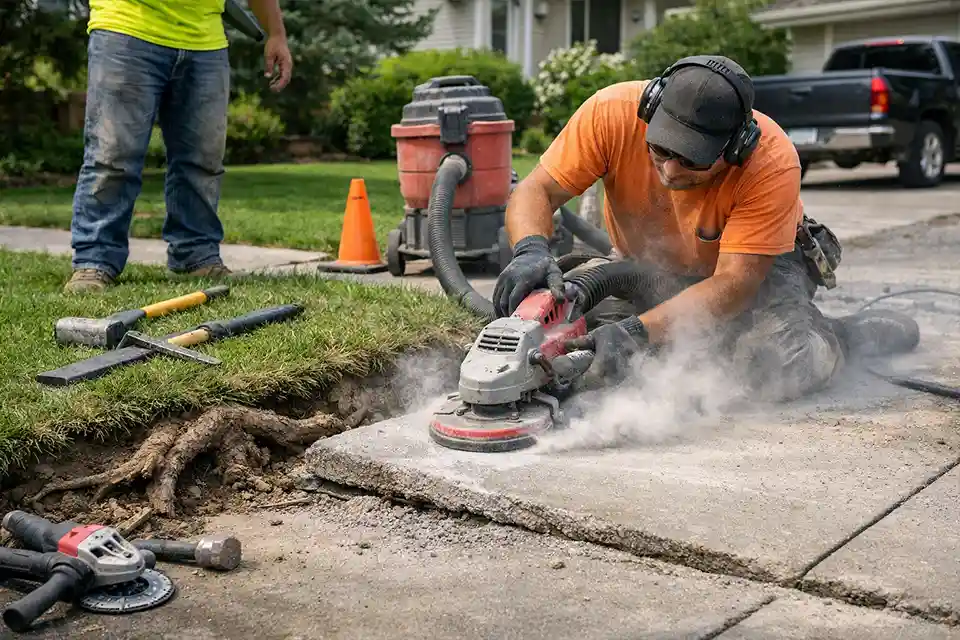
If height differences remain relatively small—typically ½–1½ inches—contractors can grind down the raised edge of the concrete.
This approach is often the least expensive repair option and can extend sidewalk usability for several years.
Slab Jacking or Leveling
Another method involves injecting grout or polyurethane beneath the concrete slab to raise or stabilize sunken sections.
This technique works best when soil erosion rather than root expansion caused the uneven surface.
Full Sidewalk Replacement
When slabs lift more than 2–3 inches, replacing the affected section often becomes the safest option.
Modern sidewalk construction may include reinforced concrete, thicker slabs (4–6 inches), and expansion joints that allow limited movement without cracking.
Root Barriers: One of the Most Effective Preventive Solutions
Root barriers redirect tree roots downward before they reach pavement surfaces. These barriers are typically installed as vertical panels placed in the soil between the tree and the sidewalk.
Most professional installations place barriers 24–36 inches deep, which is sufficient to intercept most structural roots.
High-density polyethylene (HDPE) and polypropylene barriers are common materials because they resist soil pressure and can last 20–40 years underground.
When installed correctly, root barriers often reduce future sidewalk damage by 70–90 percent, especially in areas where planting strips are narrow.
Properties with complex landscape conditions—such as sloped yards or erosion-prone soil—may experience additional ground movement when roots interact with drainage patterns. These combined issues often appear in uneven landscapes similar to those discussed in Sloped Backyard Problems Including Drainage, Erosion, and Safety.
Managing Roots Without Damaging the Tree
While cutting roots may seem like a quick fix, excessive root removal can destabilize mature trees.
Arborists typically follow several guidelines:
• avoid cutting roots larger than 2–3 inches in diameter
• limit pruning to less than 20 percent of the root system
• prune roots only on one side of the tree when possible
• maintain a minimum distance of 3–5 times the trunk diameter
These precautions help preserve tree stability during storms or high winds.
In some neighborhoods where mature landscaping already increases maintenance demands, surface root problems often appear alongside other long-term design issues. Many homeowners encounter similar challenges after initial landscaping plans overlook long-term growth patterns, a topic explored in Low Maintenance Garden Design Mistakes Homeowners Regret.
Repairing the Lawn After Tree Root Damage
Once sidewalk repairs or root management are complete, the surrounding lawn often needs restoration. Turf struggles around mature trees primarily because soil depth becomes shallow and root competition intensifies.
Repairing the lawn usually requires rebuilding the soil environment so grass can re-establish a stable root system.
Regrading Soil Around Exposed Roots
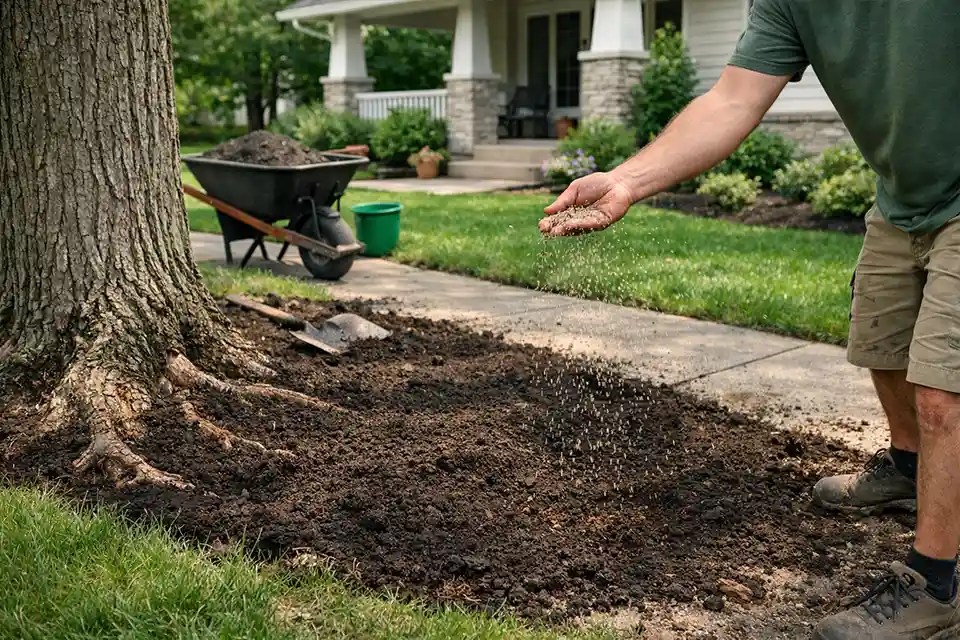
When roots push upward, the lawn surface becomes uneven and thin. Adding soil carefully can restore a smoother grade without harming the tree.
Most turf restoration projects add about 2–3 inches of quality topsoil over shallow root areas. The soil should be gently feathered outward so that water drains naturally away from the trunk.
It is important not to bury the tree trunk itself. Covering the root flare with more than 1 inch of soil can reduce oxygen availability and weaken the tree over time.
Choosing Grass That Tolerates Tree Roots
Grass growing near trees must tolerate both shade and root competition. Some turf varieties adapt better to these conditions than others.
| Grass Type | Shade Tolerance | Root Competition Resistance | Best Regions |
|---|---|---|---|
| Tall fescue | High | Moderate | Midwest, Northeast |
| Fine fescue | Very high | Moderate | Northern states |
| St. Augustine | Moderate | Moderate | Florida, Gulf Coast |
| Kentucky bluegrass | Low–moderate | Low | Cooler climates |
| Bermuda grass | Low | Moderate | Southern states |
Fine fescues often perform well beneath mature trees because they tolerate lower light levels and can survive in thinner soil layers.
Adjusting Irrigation and Fertilization
Lawns growing around tree roots often require slightly different care than open turf areas.
Helpful adjustments may include:
• watering deeply so moisture penetrates 8–12 inches into the soil
• applying slow-release fertilizer at about 0.5–1 pound of nitrogen per 1,000 sq ft
• mowing slightly higher, usually 3–4 inches, to reduce heat stress
These changes encourage grass to develop stronger roots that can compete more effectively with nearby trees.
Preventing Future Sidewalk and Lawn Damage
While repairs solve the immediate problem, preventing future root conflicts is just as important.
Several landscape planning strategies significantly reduce the chance of recurring sidewalk damage.
Planting Trees Farther From Hard Surfaces
One of the simplest prevention strategies is increasing the planting distance between trees and sidewalks.
Urban forestry guidelines often recommend planting medium to large trees at least 6–10 feet from sidewalks when space allows. Larger species may require 10–20 feet of clearance to accommodate their mature root systems.
Expanding Tree Root Zones
Small planting strips frequently cause root conflicts. Increasing soil space around trees can dramatically improve root behavior.
Methods include:
• widening planting beds along sidewalks
• removing compacted soil and adding organic matter
• installing permeable pavers instead of solid pavement
These changes allow roots to spread naturally without pushing upward against rigid surfaces.
Installing Root Barriers During Landscape Projects
Root barriers work best when installed early in a tree’s life, before structural roots expand outward.
Barriers placed 24–36 inches deep between sidewalks and young trees redirect root growth downward. Many commercial barriers last 30 years or longer, making them a long-term preventive solution.
In areas where sidewalk proximity also affects privacy or yard usability, landscaping adjustments sometimes solve multiple issues at once. For example, thoughtful plant placement and spacing can improve both root management and visual screening, similar to strategies described in Front Yard Privacy Problems When the Sidewalk Runs Only a Few Feet From Your Windows.
When Sidewalk Damage Becomes a Safety Concern
As sidewalk lifting progresses, uneven pavement can create serious trip hazards for pedestrians.
Many municipalities consider sidewalk height differences above 1½–2 inches to be hazardous. In these situations, property owners may receive repair notices requiring corrective work.
Signs that sidewalk damage may require immediate attention include:
• cracks widening between concrete slabs
• slabs tilting sharply toward the lawn
• exposed roots pushing through soil near pavement edges
• repeated lifting even after previous repairs
If these conditions appear, professional evaluation from a certified arborist or landscape contractor is usually recommended.
Long-Term Landscape Planning Around Mature Trees
Tree roots are not always the primary cause of front yard maintenance problems. In many cases, the issue develops because landscape design did not anticipate how the tree would grow over decades.
Large shade trees can eventually produce root systems that extend 2–3 times the width of their canopy. When sidewalks, driveways, or irrigation systems sit directly within that root zone, conflicts become likely.
Good landscape planning considers how trees interact with other yard features, including:
• sidewalks and walkways
• lawn irrigation systems
• drainage patterns
• outdoor seating areas
• planting beds
When homeowners design front yards with these long-term relationships in mind, they often avoid repeated maintenance issues.
Landscape planning mistakes frequently appear when initial designs prioritize quick curb appeal rather than long-term maintenance. Several of these common issues are explained in Front Yard Landscaping Mistakes That Lower Home Value.
Frequently Asked Questions
Can tree roots break concrete sidewalks?
Yes. As roots grow in diameter, they exert upward pressure against pavement. Over time, even moderate root growth can lift 4-inch concrete slabs, especially when roots develop directly beneath the sidewalk.
Is it safe to cut roots that are lifting a sidewalk?
Small roots may sometimes be pruned safely, but cutting large structural roots can weaken the tree. Arborists usually avoid removing roots larger than 2–3 inches in diameter unless the tree’s stability can be maintained.
How long does it take for tree roots to lift sidewalks?
Sidewalk lifting often develops slowly over 10–25 years, depending on tree species, soil conditions, irrigation patterns, and pavement thickness.
Are certain trees less likely to cause root damage?
Yes. Smaller ornamental trees with compact root systems—such as dogwood, redbud, or Japanese maple—typically create fewer conflicts with sidewalks than fast-growing shade trees.
Do root barriers stop roots completely?
Root barriers do not stop roots entirely. Instead, they redirect roots downward and away from pavement surfaces, which significantly reduces the likelihood of sidewalk lifting.
Authoritative Reference
Research on urban tree root behavior and pavement interactions is widely documented by university forestry programs. The USDA Forest Service Urban Forestry Program provides extensive resources on managing trees in developed environments.