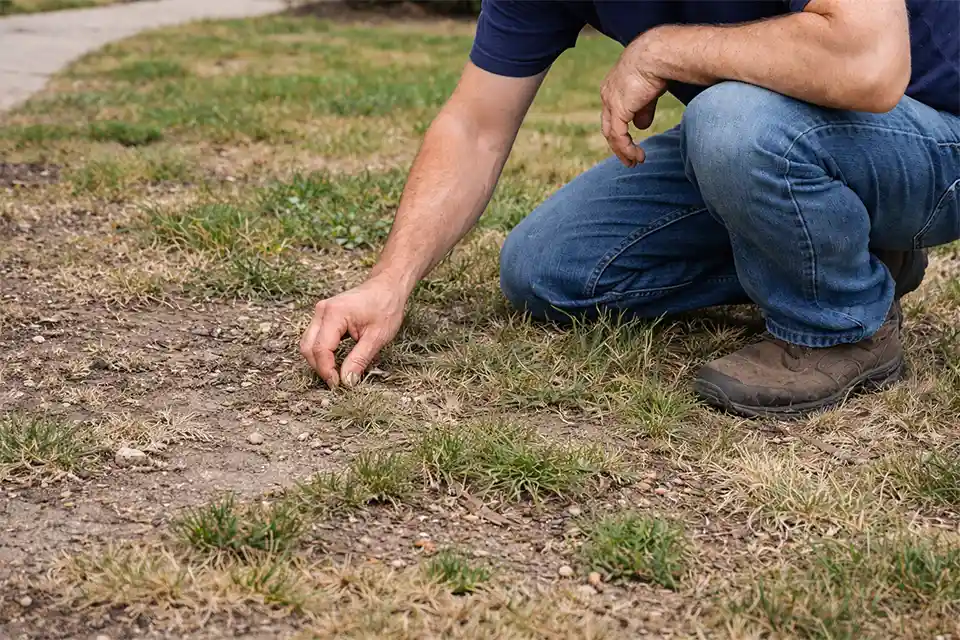
Patchy grass in a front yard rarely starts as a surface problem. It usually begins below the lawn, where the soil stops supporting steady root growth. Grass thins out in one area, stays weak in another, and then weeds begin filling the open spaces. What looks like a mowing issue, a watering mistake, or bad seed is often a root-zone problem that has been developing for months.
That is why poor soil creates such frustrating front yard maintenance problems. Grass depends on a narrow balance of moisture, air, nutrient availability, and rooting depth. When that balance breaks down, turf no longer grows evenly. In humid Florida conditions, weak soil often turns patchy during long stretches of heat and rainfall because the lawn stays stressed and weeds keep germinating. In Arizona, poor soil may show up first as thin, droughty turf that burns out fast. In northern states with freezing winters, compacted soil often delays spring recovery, and weeds take advantage of that lag before the lawn thickens again.
The hard part is that poor soil does not always fail in one obvious way. A front yard can be compacted near the sidewalk, low in organic matter across the middle, and slightly waterlogged in a shallow depression near the street. From a distance, all of it looks like “bad grass.” Underneath, the causes are different.
How Poor Soil Turns a Thin Lawn Into a Weed Problem
Weeds do not usually invade healthy, dense turf at random. They take advantage of the weak zones first. Once grass loses density, more sunlight reaches the soil surface, temperature swings become sharper, and weed seeds have more room to germinate. The lawn no longer acts like a closed canopy.
This is why homeowners often feel like weeds appeared overnight. In reality, the grass usually weakened first. The weeds are just making the failure more visible.
In many front yards, runoff also makes the problem worse. Water may wash off the driveway, move along the front walk, or collect near the curb after storms. That uneven moisture pattern can turn already-poor soil into a repeating cycle of bare spots and weed pressure. Some of those site-level drainage patterns overlap with Driveway Runoff and Front Yard Drainage Problems.
Quick Diagnostic Checklist
-
Grass stays thin even during active growing season
-
Bare patches keep returning in the same spots
-
Water pools for hours or runs off too quickly
-
The soil feels hard a few inches below the surface
-
Turf color changes sharply across short distances
-
Weeds are heavier in open, sunlit patches
-
Reseeding improves the lawn briefly, then fades
The Main Soil Conditions That Cause Patchy Grass
Compacted Soil
Compaction is one of the biggest reasons front yard grass becomes uneven. Soil particles are pressed so tightly together that roots cannot move easily, oxygen exchange drops, and water either sits on the surface or escapes as runoff. The lawn may still look decent for a while, which is why compaction gets missed so often. By the time bare patches appear, root depth is usually already shallow.
This is especially common in front yards built on disturbed construction soil, lawns near curbside parking, and strips that get repeated foot traffic from mailboxes or entry paths.
Low Organic Matter
Soil with low organic matter has poor buffering ability. It dries out quickly, holds nutrients less evenly, and makes turf more vulnerable to heat stress. In the Midwest, where spring rainfall can be followed by hot summer weeks, this often creates a lawn that greens up early and then thins out fast once temperatures climb above about 85°F to 90°F.
Low-organic soil also makes recovery slower after mowing, traffic, or dry periods. Grass never really gets ahead. It just survives until the next stress event opens another patch.
Poor Drainage
Poor drainage does not always mean the whole lawn is muddy. Sometimes only one section stays wetter than the rest because of grade, fill soil, or a dense layer a few inches below the surface. That area may look thin, yellowish, or invaded by moisture-tolerant weeds while the rest of the yard seems merely weak.
Clay-heavy soils often make this worse because water infiltration slows down and air movement through the root zone drops. If that pattern sounds familiar, it often overlaps with the issues discussed in How to Fix Clay Soil Drainage Problems in Front Yards.
pH Imbalance and Nutrient Lockout
A lawn can be fertilized regularly and still perform poorly if the soil pH is off. Nutrients may be present, but the grass cannot use them efficiently. That creates a front yard that looks underfed even when it is technically being maintained.
This is one reason repeated fertilizer applications often disappoint. The visible problem appears to be weak growth. The actual problem may be reduced nutrient availability, poor root function, or both.
Shallow or Layered Soil
Some front yards have a thin decent-looking surface layer sitting over dense fill or compacted subsoil. The top inch may seem workable, but roots hit resistance quickly. That creates a lawn that looks fine after light rain and then falls apart in heat, traffic, or prolonged wet periods.
PRO TIP: If the same front yard spots fail every season, stop treating them as isolated lawn patches. Repeating patterns usually mean the soil profile below them is limiting recovery.
What Different Weed Patterns Usually Mean
Weed pressure is not just random clutter. It often reveals what the soil is doing wrong.
Crabgrass and other annual grassy weeds usually spread where turf has opened and sunlight is hitting bare soil. Clover often shows up where lawn density is weak and nitrogen availability is limited. Sedges are more common where moisture lingers longer than homeowners realize. Broadleaf weeds often expand where the lawn is already stressed and no longer thick enough to compete.
This matters because weed control alone rarely fixes the yard. Killing visible weeds may improve the look of the lawn for a few weeks, but the same areas often reopen because the grass never regained the ability to close the gaps.
What people often miss is that wet-soil weeds and dry-soil weeds can both appear in the same front yard. One side may be compacted and slow-draining, while another side dries out too fast because the soil is thin or depleted. The lawn looks uniformly messy, but the failure pattern is mixed.
Why Reseeding Often Fails in Poor Soil
Many front yard repairs fail because homeowners start at the top of the problem instead of the bottom. They add seed, starter fertilizer, and extra water. The lawn greens up briefly, then fades again. That short burst makes the repair look successful, but it only improved surface appearance, not the root environment.
Seed needs more than soil contact. It needs a root zone that can hold moisture without staying saturated, exchange air, and allow roots to move downward. In compacted or poorly structured soil, seedlings may germinate but stall quickly. In low-organic soil, they may emerge and then dry out during heat. In patchy front yards with partial shade, weak soil can combine with reduced light and make the repair fail even faster. Where shade is part of the pattern, compare those symptoms with Front Yard Shade From Trees and Grass Not Growing.
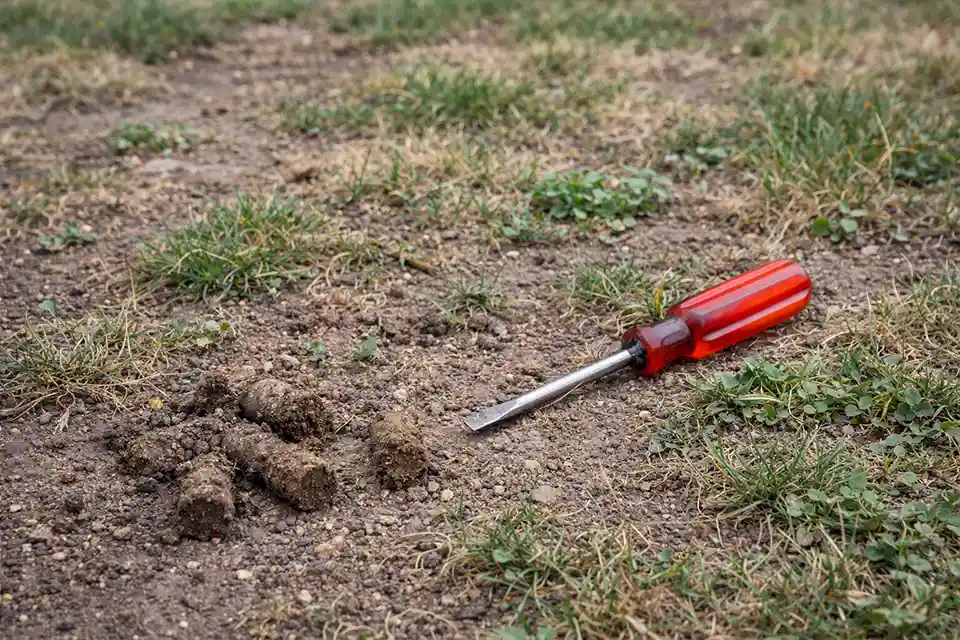
Table: Soil Condition, Signal, and Best First Action
| Condition | Common Signal | What It Usually Leads To | Best First Action |
|---|---|---|---|
| Compacted soil | Hard ground, runoff, shallow rooting | Thin grass and recurring bare spots | Core aerate and reduce repeated traffic |
| Low organic matter | Fast drying, weak color, poor recovery | Heat stress and patchy density | Add light compost topdressing |
| Poor drainage | Standing water or soggy recurring zones | Root stress and moisture-loving weeds | Correct drainage before reseeding |
| pH imbalance | Pale or weak turf despite feeding | Nutrient lockout and uneven growth | Run a soil test |
| Shallow topsoil | Quick decline near pavement or curb | Weak establishment and drought stress | Improve root zone depth gradually |
How to Diagnose the Root-Zone Problem Correctly
A patchy lawn caused by poor soil is easy to misread because the symptoms overlap. Yellowing can come from wet roots, dry roots, low nitrogen, or shallow soil. Bare spots can result from compaction, runoff, heat reflection, or weak seed establishment. That is why diagnosis has to be more physical, not just visual.
Start by checking how easily a screwdriver or soil probe enters the ground after normal moisture conditions. If it becomes difficult within a few inches, compaction is likely part of the problem. Then look at how water behaves. Does it soak in gradually, run sideways, or pond in one zone for several hours? That tells you whether structure and drainage are involved.
It also helps to compare the same area in different weather. A patch that fails first during heat may be dealing with shallow or low-organic soil. A patch that stays weak after rain may be oxygen-starved. A zone that struggles both wet and dry often has dense layered soil underneath.
A soil test is one of the few steps that prevents guesswork. It helps separate nutrient issues from structural ones. Homeowners often spend an entire season treating the lawn as a fertilizer problem when the bigger issue is that roots cannot function well enough to use what is being applied.
A Better Repair Order for Front Yards With Poor Soil
The sequence matters. Grass repair works better when the soil limitation is addressed first.
1. Test the Soil
Check pH and nutrient levels before adding random amendments. This prevents overcorrecting and gives a clearer starting point.
2. Relieve Compaction
Core aeration is usually more useful than surface scratching when the lawn is hard below the top layer. It opens the soil, improves oxygen flow, and gives water a better path into the root zone.
3. Improve Organic Content
A light topdressing of compost, usually around 1/4 inch to 1/2 inch, helps moderate moisture and improve surface structure. Thick layers are a mistake because they can bury existing turf and create uneven grade.
4. Correct Drainage Problems
If part of the yard stays wet, address the drainage pattern before reseeding. Otherwise the same section is likely to fail again. Front yards at the base of a slope often show this kind of repeated decline, especially after storms, which is similar to the broader pattern in Homes at the Bottom of a Hill With Front Yard Drainage Problems.
5. Reseed or Renovate After Soil Correction
Once the root zone is improved, seed or sod has a better chance of lasting. Repairing first and diagnosing later usually wastes both time and material.
PRO TIP: Do not judge lawn repair after two weeks of green-up. Poor-soil front yards often look improved before roots are actually established deeply enough to hold through heat or heavy rain.
Table: Common Lawn Repair Mistakes in Poor Soil
| What Homeowners Try | Why It Seems Reasonable | Why It Often Fails | Better Move |
|---|---|---|---|
| Adding more seed | Bare spots look like missing grass | Seedlings fail in the same weak soil | Fix compaction or drainage first |
| Watering lightly every day | Keeps the surface damp | Encourages shallow rooting | Water deeply and appropriately |
| Applying more fertilizer | Lawn looks pale and weak | Does not fix structure or pH problems | Test soil before feeding |
| Spraying weeds only | Improves appearance quickly | Grass still cannot compete afterward | Restore turf density through soil repair |
| Adding thick topsoil | Covers the damage fast | Can create layering and grade issues | Use modest topdressing and renovation |
When the Better Fix Is Not More Lawn
Some front yards are too difficult to keep uniformly dense because the site itself keeps stressing the soil. Pavement reflection, thin roadside soil, repeated runoff, and chronic dryness can make turf a poor long-term choice in the weakest sections.
That does not mean the yard is hopeless. It may mean the lawn area should shrink in the most failure-prone zones. In dry western climates or sunny curbside strips, converting part of the space to lower-water planting may perform better than repeatedly trying to force grass into hostile soil. That kind of transition often aligns with broader ideas in Low-Water Front Yard Landscaping: Practical Solutions That Last.
This is where many front yard projects go wrong. People assume every visible patch must be repaired back into lawn. Sometimes the smarter move is to decide which areas can realistically support turf and which ones should become a different part of the landscape.
One Authoritative Reference That Supports This Approach
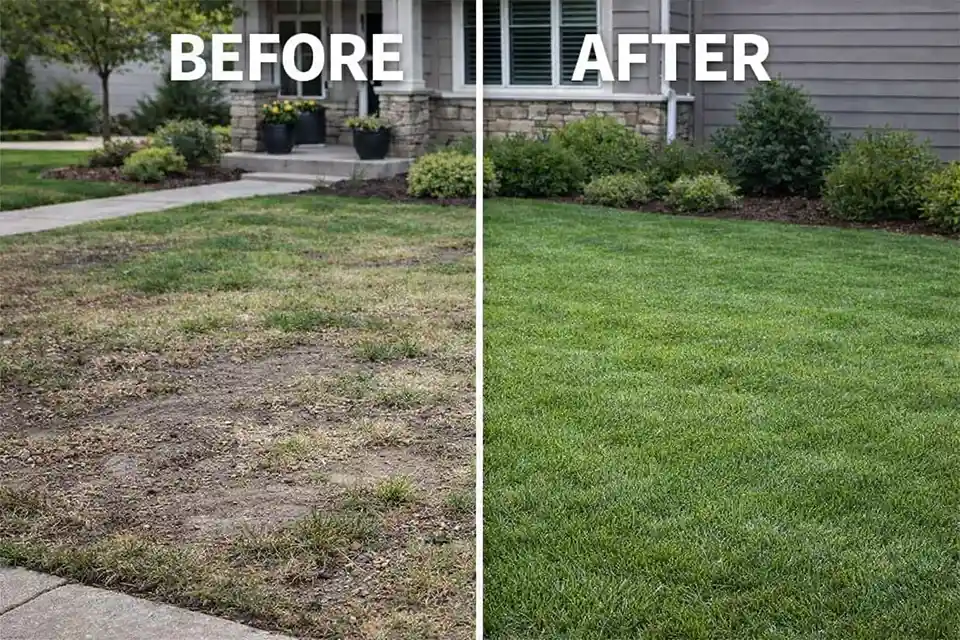
A practical reference for this kind of lawn diagnosis is the University of New Hampshire Extension lawn repair guide, which emphasizes identifying the limiting condition before trying to restore turf. That principle matters in front yards with poor soil because surface fixes tend to fail when the underlying root zone is still compacted, imbalanced, or draining badly.
Questions Homeowners Commonly Ask
Can poor soil really cause both patchy grass and weeds at the same time?
Yes. Weak soil reduces turf density first. Once the canopy opens, weeds gain access to light, space, and exposed soil.
How long does it take to improve a front yard with poor soil?
Visible change can begin within weeks, but meaningful improvement often takes one full growing season. Heavier clay or badly compacted soil may take longer.
Is fertilizer enough to fix patchy grass?
Not usually. Fertilizer may help color temporarily, but it does not solve compaction, drainage issues, shallow topsoil, or pH imbalance.
Should I add new topsoil over the bad areas?
Only carefully. Dumping thick new soil over weak lawn areas can create layering problems and uneven grade. Light topdressing is usually safer.
Final Takeaway
Poor soil causes patchy grass and weeds in front yards because it weakens turf from below before the damage becomes obvious above ground. Compaction limits roots, low organic matter makes moisture swings harsher, poor drainage reduces oxygen, and pH imbalance can keep grass from using nutrients effectively. Once turf density drops, weeds move into the open spaces and make the yard look even worse.
That is why the lasting solution is not just more seed, more fertilizer, or more weed control. The real fix is improving the root zone so the lawn can compete again. Until the soil can support dense, stable turf, the same weak areas will keep reopening.