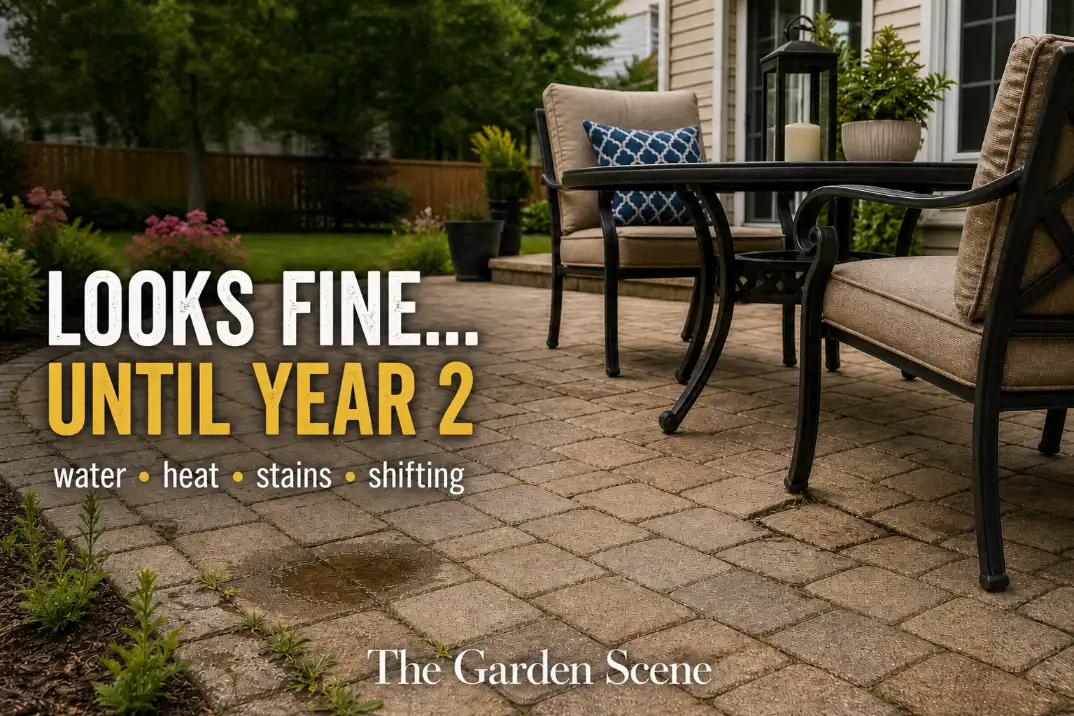
The patio surface mistakes that age badly usually start below the finish, not on top of it. Water that stays longer than 24 to 48 hours, pavers that settle more than about 1/2 inch, joints that widen after one season, or slick film that returns every few weeks are not just cosmetic problems.
They usually point to weak base prep, poor drainage, the wrong finish for the climate, or a surface that cannot handle the way the patio is actually used.
This is different from a patio that simply looks dated. A dated patio may need restyling. A badly aging patio keeps producing the same physical failure: damp patches, stains, movement, heat discomfort, or maintenance that never seems to hold.
Quick Diagnostic Checklist
Use these checks before blaming the patio material itself:
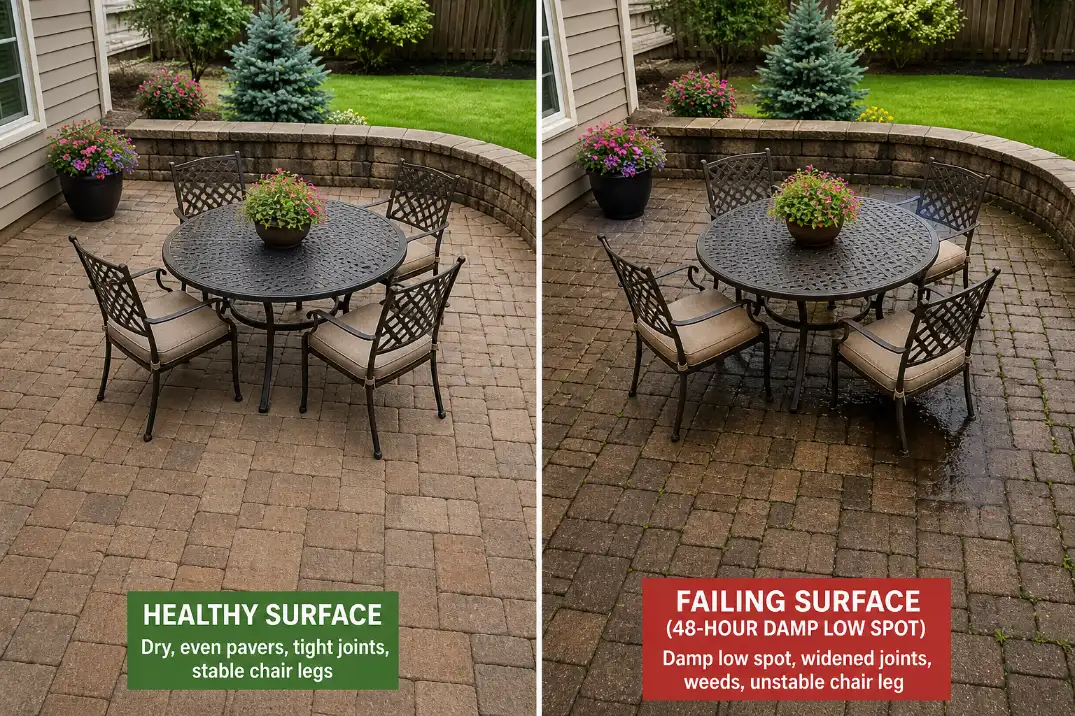
- Water sits in the same spot more than 24 to 48 hours after normal rain.
- Chairs rock because pavers, stone, or concrete sections have settled.
- Joints collect weeds, loose grit, or washed-in soil within one growing season.
- The surface becomes too hot to cross barefoot during summer afternoons.
- Damp shaded areas feel slick even after cleaning.
- Grill grease, planter rings, or leaf stains soak in instead of fading.
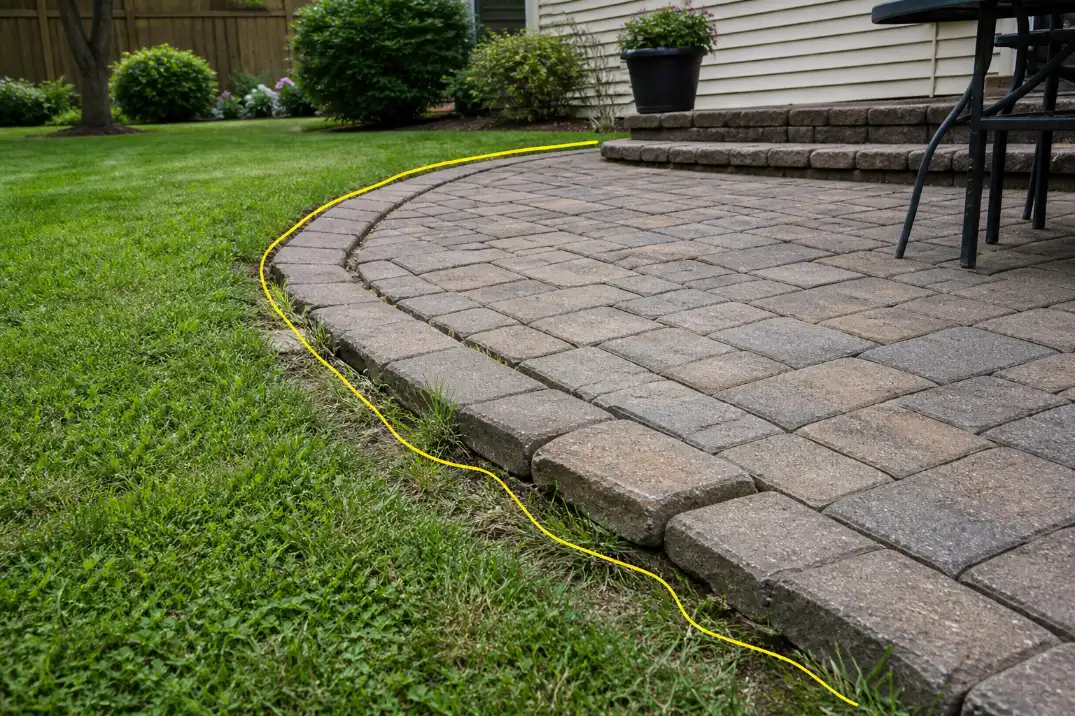
- Edges spread outward after storms, mowing, or repeated foot traffic.
Mistake 1: Judging the Surface Without Asking What Is Under It
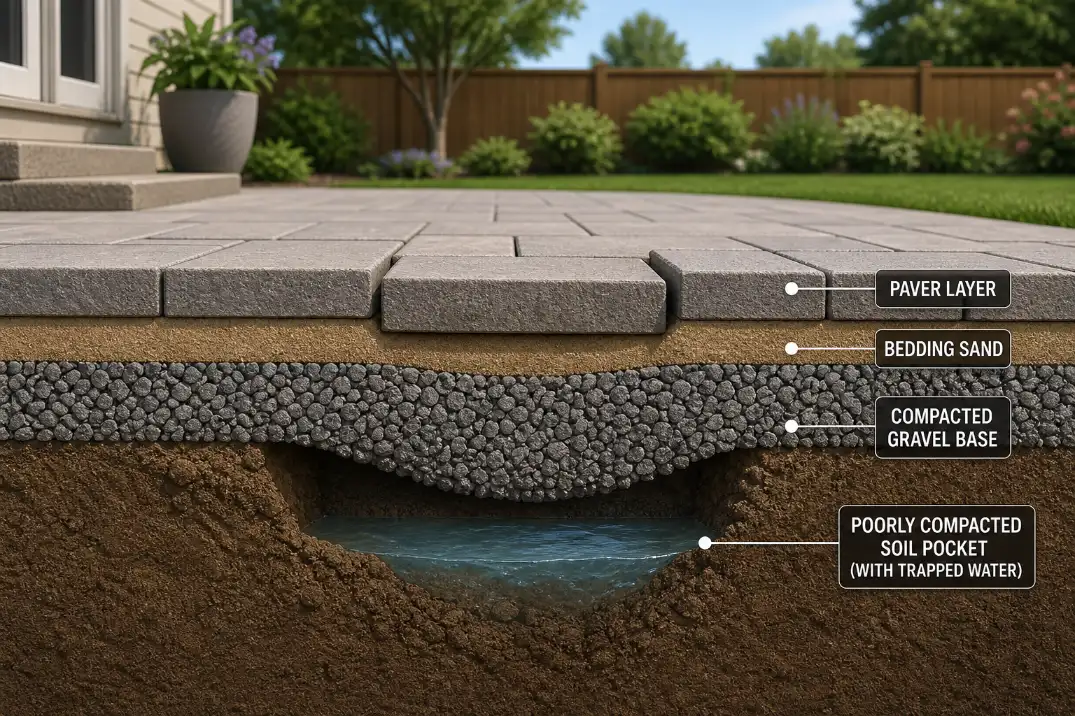
A patio can fail even when the surface material is good. This is the mistake homeowners often miss because the visible finish gets all the attention: pavers, stone, concrete, brick, porcelain, gravel, or decomposed granite. But most long-term aging problems are decided by excavation depth, compacted base, drainage path, bedding layer, and edge restraint.
Surface Movement Is Usually a Base Symptom
When pavers rock, flagstone shifts, or low spots appear, the surface is usually showing a problem that started underneath. A weak base holds moisture, compresses unevenly, or moves under repeated load. The visible symptom is an uneven patio. The mechanism is poor support below the surface.
A patio that supports dining chairs, lounge furniture, a grill, and foot traffic needs more than a pretty top layer. If the ground below was not compacted well, or if the base was too shallow for the soil and climate, the surface may start showing dips within 12 to 24 months.
In freeze-thaw regions, this matters even more. Water trapped below the surface can expand during freezing weather and lift or shift sections. In warmer states, the same mistake may show up more quietly as settling, puddling, and widening joints.
If a patio already feels unstable, the issue may be closer to the ground preparation than the finish. That is why the warning signs in Uneven or Sloped Ground? Here’s Why Your Patio Feels Unstable are useful before assuming a new surface material will solve the problem.
The Bad Fix: Resetting the Top Without Correcting the Base
Lifting and resetting a few loose pavers can make the patio look better for a while. It does not solve the cause if the base below is still soft, wet, shallow, or poorly compacted.
That is the point where a routine repair becomes wasted effort. If the same section sinks again after a season, the problem is not the paver. It is the support system underneath it.
Mistake 2: Choosing a Surface That Cannot Dry Properly
A patio does not need to be visibly flooded to age badly. Slow drying is enough. When water lingers in low spots, joints, shaded edges, or under planters, it feeds stains, algae, loose joint material, and slippery film.
Flat Is Not the Same as Functional
Outdoor surfaces should not be perfectly flat. They need enough pitch to move water away from the house and away from sitting areas. A common practical range is about 1/8 inch to 1/4 inch per foot, depending on the site and surface.
Too little slope creates the same damp areas after every storm. Too much slope creates a different problem: chairs feel unstable, tables sit awkwardly, and rolling grills or carts become harder to use. The best patio surface feels level enough for furniture but still drains deliberately.
If water is already collecting near the house, surface choice alone is not the first decision. The drainage path has to be understood first, especially in cases like Patio Water Pooling Against the House, where the patio surface may be part of a larger runoff pattern.
Permeable Surfaces Are Not Magic
Gravel, permeable pavers, open-joint stone, and decomposed granite can help water move down instead of across the surface. But they only work if the layers below can accept and move that water.
On compacted clay soil, a permeable surface over a poorly draining subgrade can still stay wet. In heavy Midwest storms or parts of the Southeast with frequent rainfall, water may enter the patio faster than the base can disperse it. That can create the same aging pattern: damp joints, soil migration, weeds, and uneven settlement.
A non-permeable surface needs reliable surface drainage. A permeable surface needs reliable subsurface drainage. Confusing those two ideas is one of the easiest ways to choose a patio that looks smart but ages badly.
For yards where drainage is already a known issue, the comparison in Pavers vs Gravel for Backyards With Drainage Problems is more useful than choosing by appearance alone.
Mistake 3: Picking Porous Materials for Messy Zones
Porous patio surfaces can age beautifully in the right place. They can also absorb every mistake made around them. Natural stone, brick, concrete pavers, unsealed concrete, and some textured finishes may hold leaf tannins, rust marks, grill grease, planter runoff, and muddy paw prints.
The mistake is not choosing a porous material. The mistake is putting it where the patio will be messy every week.
Grill Areas Are Surface Stress Tests
A grill zone is harder on a patio surface than a seating zone. It adds heat, grease, ash, dropped food, sauces, and sometimes rolling equipment. If the surface absorbs grease, the stain may move below the depth that ordinary cleaning can reach.
This is where people often waste time. They keep scrubbing the same darkened area every few weeks, but the use pattern has not changed. If the surface is absorbing the mess, cleaning is only chasing the symptom.
A grill area may need a denser surface, a protective mat, a better landing zone, or a layout that keeps cooking mess away from the most visible part of the patio. The surface logic overlaps directly with Best Surfaces Around a Backyard Grill, where cleanup, heat, and stain resistance matter more than decorative texture.
Planters Age Surfaces Quietly
Large planters are another underestimated source of patio aging. They trap moisture underneath, block sunlight, leave fertilizer salts, and sometimes create rust marks from metal stands. Because heavy planters may sit in one spot for 6 to 12 months, the stain is often discovered late.
Pro Tip: Use planter feet or risers under large containers so air can move beneath them and water does not sit directly against the patio surface.
Mistake 4: Forgetting That Heat Is a Surface Failure
A patio surface can look clean and still fail in daily use. Heat is one of the clearest examples. Dark concrete, dark porcelain, dense stone, and some composite or coated surfaces can become uncomfortable in full afternoon sun.
The problem is not only bare feet. Heat changes how the patio gets used. Families avoid it during the exact hours when outdoor space should feel useful.
Some aging patio problems are easier to control when you know whether the surface needs cleaning, degreasing, or a more targeted non-slip patio treatment.
Comfort Counts as Performance
In hot summer regions, especially in parts of Arizona, Texas, Nevada, and inland California, surface temperature can climb far above air temperature. A dark patio in full sun may be technically durable and still unpleasant from midafternoon into early evening.
People often underestimate this because they choose materials in spring, fall, or under showroom lighting. The surface looks refined when selected, then becomes the reason the patio sits empty from 2 p.m. to 6 p.m. in July.
For family yards, pet areas, pool-adjacent patios, and barefoot routes, heat should be treated as a real surface requirement. A lighter color, more shade, better airflow, or a different material may matter more than a premium-looking dark finish. The comfort tradeoffs are explained more closely in Why Some Patio Surfaces Get Too Hot in Summer.
Mistake 5: Choosing Smooth Finishes Where Dampness Is Normal
Smooth patio finishes can look modern, but they are unforgiving in wet or shaded places. Around pools, under trees, beside irrigation overspray, near covered patios, or in humid climates, dampness is not an occasional event. It is part of the normal condition.
Slickness Is a Pattern, Not Just a Cleaning Problem
A patio that feels slick once after a storm may just need cleaning. A patio that develops the same slick film every wet season has a surface-condition mismatch.
This is where people overestimate sealers. A sealer may reduce staining or water absorption, but it does not automatically make a too-smooth surface safe when damp. Some sealers can even change the surface feel depending on product type, thickness, and application.
The better question is not “Can this be washed?” It is “Will this still feel secure when wet?” In family backyards, that decision connects directly to Best Low-Slip Patio Surfaces for Family Backyards, especially where children, pets, pool splash, or shaded walkways are involved.
Mistake 6: Cleaning Harder Instead of Fixing the Cause
Cleaning is necessary. Over-cleaning is often a sign that the patio has a design or surface problem.
If the same stain, slick patch, weed-filled joint, or damp corner returns every few weeks, stronger cleaning is not the real fix. The patio is telling you the condition is being recreated.
Pressure Washing Can Make Some Problems Worse
Aggressive pressure washing can remove joint sand, roughen some surfaces, push water into weak areas, or leave visible wand marks on softer materials. It may make the patio look better for a weekend while weakening the parts that hold it together.
Harsh cleaners can also create problems on certain stone, concrete finishes, or sealed surfaces. The wrong cleaner may discolor the surface, strip protection unevenly, or leave residues that attract dirt.
Pro Tip: If a patio needs more than one or two serious cleanings per year to look acceptable, look for the repeated cause before increasing the cleaning intensity.
Re-Sealing Is Not a Repair
Sealing over a dirty, damp, slick, or unstable surface rarely solves the underlying problem. It may trap discoloration, create uneven sheen, or make a smooth surface feel slicker.
Sealing can be useful when the patio is stable, clean, dry, and compatible with the product. It is not a substitute for drainage, texture, base repair, or joint stability.
Clean, Repair, or Replace?
The most useful question is not always “What surface is best?” Sometimes it is “Is this patio aging normally, or has it crossed into repair territory?”
| What you see | Likely meaning | Best next move |
|---|---|---|
| Light dirt, mild fading, even patina | Normal outdoor exposure | Clean and monitor |
| Same damp patch after 48 hours | Low spot or drainage problem | Regrade, reset, or redirect water |
| Pavers or stone settling 1/2 inch or more | Base movement | Lift the area and rebuild the base |
| Slick film returns every wet season | Texture and moisture mismatch | Improve drying or reconsider finish |
| Grease stains keep darkening near grill | Porous surface in high-mess zone | Protect, reseal properly, or change the grill pad area |
| Edge spreads again after repair | Weak edge restraint or base | Rebuild the edge, not just the joint |
| Wide joints refill with weeds each season | Soil/debris collection and moisture | Reset joint material and fix water flow |
This table is where routine maintenance stops being the answer. Dirt can be cleaned. Repeated movement, recurring dampness, and spreading edges need diagnosis.
How Patio Surface Mistakes Change by Climate
The same surface mistake does not age the same way everywhere. Climate changes the failure pattern.
Humid Southeast
In humid areas such as Florida and much of the Southeast, slow drying is often the bigger issue than dramatic cracking. Shaded patios may develop algae, dark joints, and slick film quickly. A smooth or porous surface in shade can feel older after two wet seasons even if it has not physically shifted.
Hot Southwest
In desert and hot-summer regions, heat and glare become bigger surface problems. Dark finishes, dense materials, and unshaded patios can look sharp but perform poorly. The surface may not be “damaged,” but it can still fail the comfort test.
Freeze-Thaw Northern States
In northern climates, trapped water is more likely to become movement. Poor base prep, weak joints, and low spots can turn into heaving, cracking, spalling, or uneven pavers after repeated freeze-thaw cycles. Here, drainage and base depth matter more than almost any decorative finish choice.
Coastal Areas
Coastal moisture can accelerate staining, rust marks, salt residue, and surface film. Metal furniture feet, planters, and fasteners can leave marks faster than expected. A patio in a coastal California or Atlantic setting may need more attention to material compatibility and airflow than a similar inland patio.
Choosing a Patio Surface That Ages Better
The best patio surface is not the hardest, darkest, smoothest, or most expensive one. It is the one whose weakness is least likely to be triggered by your actual site.
Choose by Failure Mode, Not Material Name
A patio surface only ages well when its weak points match low-risk conditions. Concrete, pavers, stone, gravel, and porcelain can all work. They can also all fail when used in the wrong place.
| Patio surface | Ages badly when | Better fit |
|---|---|---|
| Concrete | Flat, slick, poorly jointed, or exposed to repeated staining | Simple patios with good slope and planned control joints |
| Pavers | Base is weak, edges spread, or joints wash out | Repairable patios with compacted base and firm edge restraint |
| Natural stone | Porous stone sits under trees, planters, or grill mess | Premium patios with drainage, airflow, and a sealing plan |
| Gravel or decomposed granite | Chairs, runoff, pets, or foot traffic keep moving the material | Informal seating edges, paths, or low-furniture zones |
| Porcelain | Finish is too smooth, glare is high, or installation is weak | Modern patios with textured outdoor-rated tiles and proper drainage |
This is why material rankings can be misleading. The surface that ages best is not the one with the fewest weaknesses. It is the one whose weakness is least likely to be triggered by your patio’s water, sun, traffic, furniture, and maintenance routine.
Match the Surface to the Patio’s Hardest Job
A dining patio needs stable chair movement. A lounge patio can tolerate more texture. A grill area needs stain resistance and cleanup. A pool-adjacent patio needs wet grip. A shaded patio needs drying and traction. A freeze-thaw patio needs base strength and water control.
The mistake is choosing one material trait and pretending it solves every condition. A patio surface ages better when the material, base, slope, joints, edges, and maintenance level all match the same real use pattern.
Questions People Usually Ask
Can an old patio surface be saved without replacing it?
Sometimes. If the problem is surface dirt, light staining, or faded sealer, cleaning and proper maintenance may be enough. If the patio has repeated pooling, settling, loose edges, or slickness that returns every wet season, saving it usually requires repair below or around the surface.
What patio surface ages worst in full sun?
Dark, dense, low-reflective surfaces tend to be the most uncomfortable in full sun. The exact material matters less than color, exposure, airflow, and whether people need to walk barefoot or sit near the surface during peak heat.
Is sealing worth it if the patio already has drainage problems?
Usually not as the first fix. Sealing may reduce staining, but it will not correct low spots, trapped water, base movement, or poor slope. Drainage and stability should come before cosmetic protection.
Are pavers always better because they can be repaired?
No. Repairability is useful only when the base and edges are sound. If pavers keep sinking, spreading, or losing joint material, the patio is not aging well just because individual pieces can be lifted.
The Bottom Line on Patio Surface Mistakes That Age Badly
A patio surface ages badly when it fights the site. Water sits where it should drain, the base moves where it should support, heat builds where people need comfort, stains soak in where cleanup should be easy, and joints or edges become the maintenance problem.
The smartest surface choice is not the one that looks newest for the first month. It is the one that still works after summer heat, spring rain, winter movement, grill spills, planter moisture, furniture scraping, and everyday traffic.
If the patio dries predictably, stays stable, feels safe when damp, and does not need constant correction, it will age better even with a little natural patina.
For broader official guidance on reducing hardscape runoff with permeable pavement, planted drainage areas, and other green infrastructure strategies, see the U.S. Environmental Protection Agency.