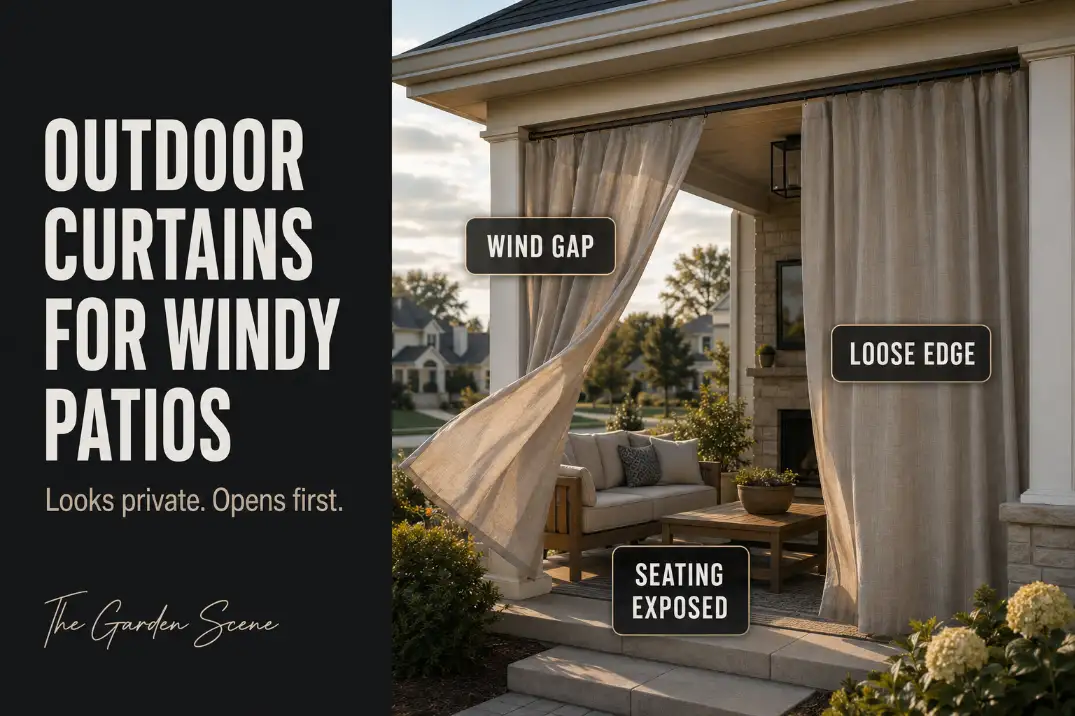
Outdoor curtains fail on windy patios when the curtain moves before it screens. The most common problem is not the fabric pattern, color, or even the word “outdoor” on the label. It is an unsupported edge that lets wind open a privacy gap exactly where the seated sightline needs coverage.
Start by checking whether the side gap opens more than 4 inches, whether the lower edge swings 12–18 inches away from the patio line, and whether the curtain twists around a post during ordinary afternoon gusts.
A curtain that ripples is normal. A curtain that exposes the sofa, dining chair, or neighbor-facing angle has become a sail.
On patios that regularly see 15–25 mph breezes, the order matters: control the edge first, choose fabric weight second, and only then worry about tiebacks, color, and fullness.
Outdoor curtains can work in wind, but only when the patio gives them enough structure to block the view before the fabric starts moving.
Curtains Move Before They Screen
The first failure is usually a side gap
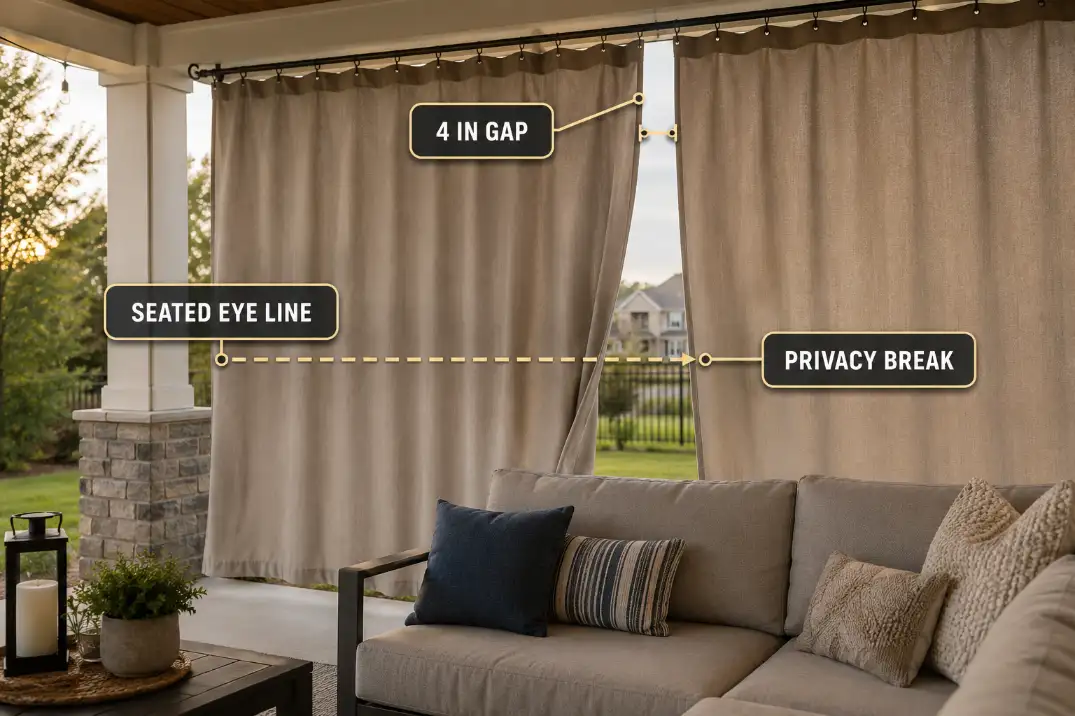
Privacy curtains look convincing when they hang straight. Real patios rarely stay that still. Wind does not need to push the whole curtain open to ruin the effect. It only needs to lift one side edge, bow the lower half, or create a narrow gap from the exact angle where someone can see in.
That is why the first test should be done from the seat, not from the doorway. Sit where the patio is actually used and look toward the exposed view. I
f a 4-inch gap gives a direct line from a neighbor deck, sidewalk, driveway, or upstairs window, the curtain is not having a small cosmetic issue. It is failing at the only job that matters.
Normal movement is not the same as privacy failure
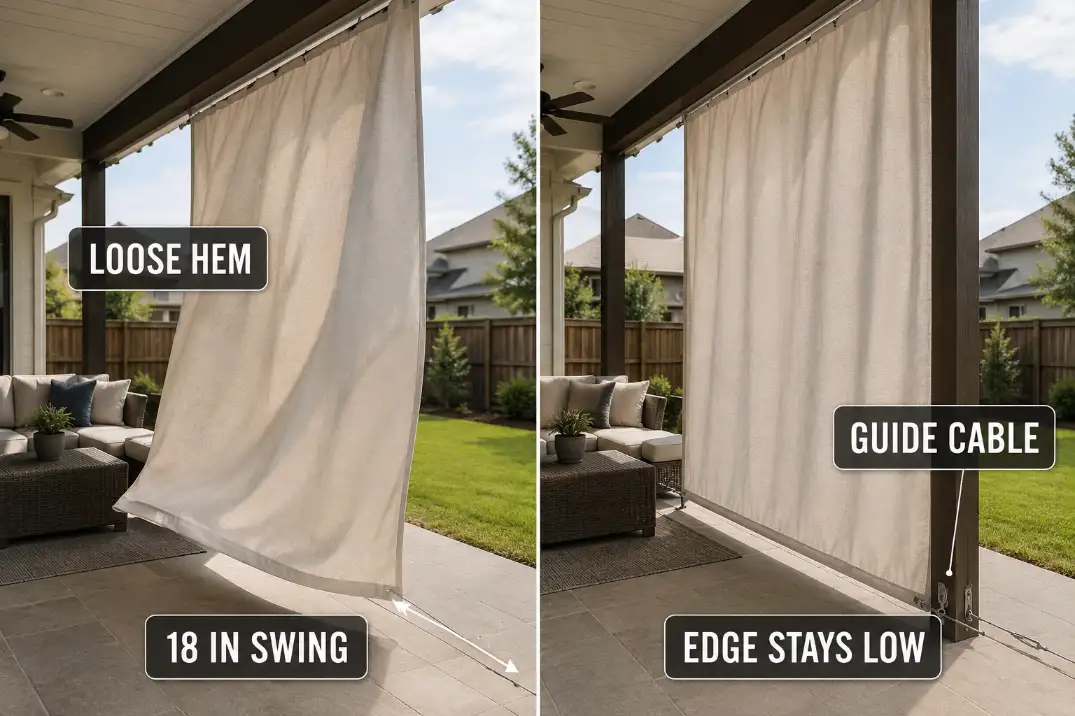
Some motion is healthy. Fabric should breathe, dry, and release pressure. A curtain that softly ripples while the view remains blocked is doing its job. A curtain that swings outward 12–18 inches at the bottom, wraps around a post, or exposes the seated eye line is not.
This is where homeowners often overestimate fabric weight. A heavier curtain on a weak rod can still swing like a door. A moderate-weight curtain on a track, short return, or lower guide can stay calmer because the wind has fewer loose edges to grab.
If the whole patio already acts like a wind corridor, curtains should not be asked to solve the layout alone.
Seating, tables, and exposed openings may need the same wind-path thinking used in a wind-resistant patio furniture layout, where the goal is to reduce wind pressure through the use zone instead of fighting every gust after it arrives.
Wind Gaps and Tiebacks
Tiebacks should control resting position, not hide failure
Tiebacks are often treated as decoration, but on a windy patio they decide where the curtain rests when it is not fully closed.
A tieback placed too high can make the lower half flare outward. A tieback placed too far behind the post can twist the panel and reopen the view line from the side.
A better starting point is the lower-middle third of the panel, often around 36–42 inches above the patio surface. That height usually controls the loose edge without turning the curtain into a tight fabric bundle.
The goal is not to cinch the panel as hard as possible. The goal is to keep the edge from drifting into the walkway or opening the view the curtain was meant to block.
Bottom flare usually matters more than top flutter
The top of the curtain may look secure because it is attached to a rod or track. The bottom edge is where privacy usually breaks first. If the lower half swings more than 12–18 inches during normal breezy periods, it will expose furniture, legs, faces, or dining activity from angled views.
A 1–2 inch bottom clearance is usually practical because it keeps the hem out of puddles, pollen, and grit. A 5–6 inch bottom gap may improve airflow, but it can also let the panel kick outward and reveal too much when wind rises.
When tiebacks stop making sense
Tiebacks stop being the right fix when the curtain has to stay tied shut all day to behave. At that point, the patio does not have soft privacy. It has fabric columns.
That is the moment to consider a lower guide cable, side anchor, partial fixed panel, or true wind screen. If the curtain only works when it is restrained, a dedicated option like patio wind screens may be the more honest fix than buying another set of heavier panels.
Block the View Line, Not the Whole Opening
The target is the exposed angle
A calm curtain setup does not need to seal the patio like an indoor room. It needs to interrupt the specific view that bothers you. That may be a neighbor window, a sidewalk angle, a driveway edge, or the side of a dining zone.
This distinction matters because full-width curtains can create more wind load than the patio can manage.
A narrow panel at the exposed corner can outperform a full curtain wall that catches every gust. If the view problem is only 3 feet wide, a 10-foot curtain run may be creating unnecessary movement.
Overlap works better than tension at sharp angles
Wind gaps become more noticeable when someone views the patio from the side. A curtain that looks closed from straight ahead may still open visually from an angle. Overlap helps because it covers the line of sight even when the fabric shifts slightly.
A 6–10 inch overlap at a corner or between two panels is often enough to hide a minor gap. This is especially useful for renters or HOA-limited patios where drilling side channels into posts may not be allowed.
In those cases, the curtain should work like part of a layered screen, similar to the logic behind temporary patio privacy ideas that solve the view line without making every element permanent.
Fabric Weight Matters
Weight helps only after the edge is controlled
Fabric weight changes how soon a curtain starts to move. Very light outdoor sheers can flutter in 5–10 mph breezes and may feel busy even when the privacy line is mostly intact. Midweight outdoor polyester or acrylic panels usually behave better because they hang with more body. Heavier curtains can help on exposed patios, but only if the hardware can carry the load.
As a rough decision range, thin 120–160 gsm panels are better for shade softness than wind privacy. Panels around 220–300 gsm usually hang calmer, resist minor lifting better, and still slide reasonably well. Much heavier fabric may move less, but it can dry slower, strain brackets, and become harder to manage after rain.
Drying time changes the right fabric choice
In humid places such as Florida or the Gulf Coast, a curtain that stays damp for more than 24 hours after rain becomes a maintenance problem.
In dry Arizona conditions, drying is easier, but UV exposure and dust can age fabric quickly. In northern states, freeze-thaw seasons make dragging hems and wet lower edges more punishing.
That is why “heavier” is not automatically better. A curtain that resists wind but holds moisture too long can create mildew, staining, and stiff folds. Calm fabric still needs enough airflow to dry between weather events.
| Patio condition | Better curtain priority | What to avoid |
|---|---|---|
| Light breeze, protected corner | Midweight fabric and simple tieback | Overbuilding the whole opening |
| Crosswind through open side | Edge control, return, or lower guide | Only buying heavier curtains |
| Humid rainy climate | Fast-drying outdoor fabric | Thick fabric that stays damp 24+ hours |
| Exposed deck or upper patio | Shorter panels or partial screen | Full loose curtain wall |
| Curtain must stay restrained | Bottom guide, anchor, or wind screen | More fabric weight alone |
| HOA or rental limits | Overlap and non-permanent placement | Drilling before checking rules |
Tracks, Rods, and Corners
Hardware is the control system
For windy patios, the rod or track is not just a way to hang fabric. It is the control line. A rod with wide ring spacing lets the panel billow between attachment points. A track keeps the top edge more consistent, especially across a covered patio beam.
Bracket spacing matters. On longer runs, supports every 24–36 inches usually feel more stable than a rod held only at the ends. Long unsupported rods can flex, and once the top line flexes, the curtain below moves more.
Corners need a return, not just a stop
Corners are where outdoor curtains often disappoint. A panel that stops exactly at the corner post may look tidy, but wind can peel it open from the side. A short return around the corner, even 12–18 inches, changes the behavior because the loose edge is no longer sitting directly in the wind path.
On decks and raised patios, this becomes even more important because wind can come under, around, and across the structure.
A partial screen strategy may work better than a full curtain wall, especially when the goal is to block wind on a deck without blocking the view.
Lower control is different from adding weight
A weighted hem slows movement. A lower guide cable or discreet side anchor controls the path of movement. That difference matters on exposed patios.
Weights can help when the curtain only lifts lightly. They are less effective when wind repeatedly pushes the entire bottom edge outward. In that case, the curtain needs a controlled travel line, not just a heavier hem.
A bottom guide cable, side clip, or anchor point can keep the lower edge from swinging into seating while still allowing the curtain to slide or open when needed.
Soft Screening That Stays Calm
Start with the exact view problem
Before buying curtains, mark the exact privacy problem from the seated position. Is the issue one neighbor window, a street-side angle, or a full exposed property line? The narrower the problem, the more selective the fix can be.
For HOA neighborhoods, this step also keeps the project visually quieter. A curtain under a covered patio may feel less permanent than a tall fence or heavy screen, but local rules can still affect what is allowed.
Where restrictions are tight, think in the same layered way used for HOA-friendly patio privacy: solve the view line first, then choose the least heavy-looking element that can actually hold up.
Use this quick windy patio curtain check
- If the curtain opens more than 4 inches at the critical sightline, fix the edge before changing fabric.
- If the bottom swings more than 12–18 inches in normal afternoon wind, add lower control or reduce panel width.
- If the curtain stays damp longer than 24 hours, prioritize faster drying and more airflow.
- If rods flex across spans longer than 6–8 feet, add supports or move to a track.
- If tiebacks must stay closed all day, consider a partial fixed screen instead.
- If the panel blocks a walkway when it moves, shorten the run or shift the screen zone.
- If high-wind weather is forecast, open, secure, or remove panels rather than treating curtains as storm protection.
The calmest solution is usually mixed
The best windy-patio privacy setup is often not curtain-only. It may use one curtain panel at the key sightline, a planter or partial screen near the corner, and a track or lower guide that keeps the fabric from drifting into daily use areas.
This mixed approach feels less dramatic than a full wall of curtains, but it usually performs better. It gives the wind fewer loose surfaces to grab, keeps the patio from feeling closed in, and lets the fabric stay soft instead of forcing it to do structural work.
Outdoor curtains are worth using when they soften a view, add shade, and move only within limits. They are the wrong fix when the patio needs a true wind barrier, a rigid privacy screen, or constant restraint just to stay usable.
The real decision is not whether curtains can work in wind. It is whether the patio gives them enough support to screen before they move.
For broader official high-wind safety guidance, see the National Weather Service wind safety guidance.