Quick Solution Summary
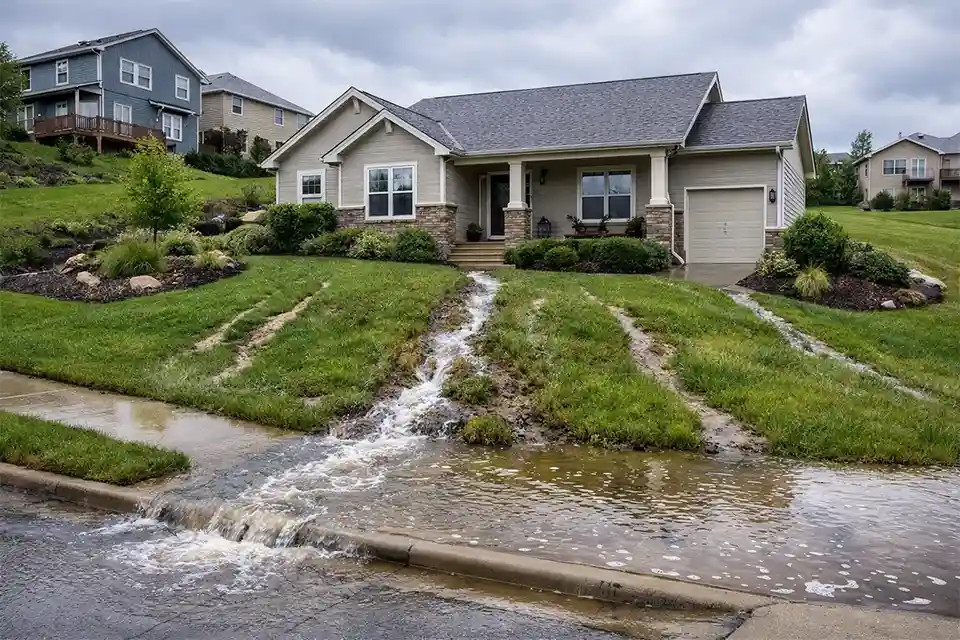
If your home sits at the lowest point on a neighborhood street, your front yard often becomes the place where stormwater naturally collects. During moderate storms—especially when rainfall exceeds 0.75–1.5 inches within a few hours—water flowing downhill from roofs, driveways, sidewalks, and streets can accumulate in the lowest yard along the slope.
This situation is common in suburban neighborhoods where road grading directs runoff toward lower elevation areas before reaching storm drains. The problem becomes worse when compacted soil, clay-heavy ground, or poor yard grading slows water absorption.
The most effective solutions usually involve intercepting runoff before it spreads across the lawn. Landscape swales, French drains, catch basins near the street, or minor regrading can redirect water safely away from the yard. In many cases, combining two drainage strategies reduces standing water by 60–80% during typical storm events.
Understanding how runoff travels through sloped neighborhoods is the key to fixing the problem permanently.
Why Homes at the Bottom of Hills Often Collect Water
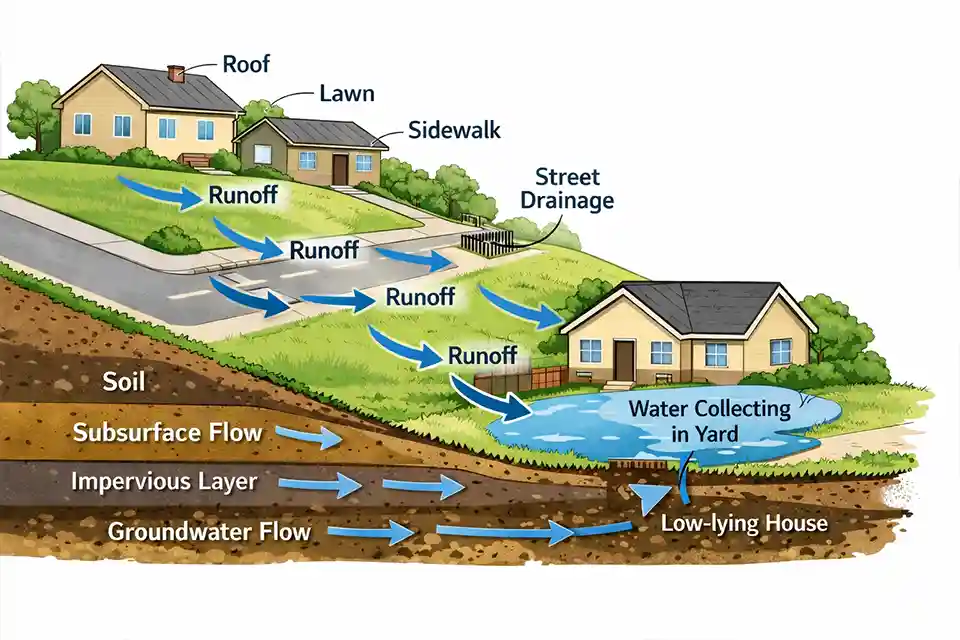
In sloped neighborhoods, water always moves toward the lowest elevation. When several homes sit uphill from yours, rainwater from multiple properties may eventually converge in one place.
During a 1-inch rainstorm, a typical 2,000 sq ft roof can shed more than 1,200 gallons of water. When several houses, driveways, and sidewalks contribute runoff, the combined volume can overwhelm the lowest yard in the block.
Several factors usually combine to create drainage problems.
Runoff from uphill homes
Rainwater leaving roofs and driveways uphill often flows toward the street. If the road slopes toward your property, some of that water may spill into your lawn before reaching a storm drain.
Street runoff movement
Most residential streets are designed with a slight downhill slope of about 1–3% to move water toward drainage inlets. However, water may temporarily spread into adjacent yards along the path.
Compacted soil in front yards
Lawns near sidewalks or driveways often become compacted. Compacted soil absorbs water much more slowly, sometimes allowing puddles to remain for 24–48 hours after rainfall.
If driveway runoff also enters the yard, the issue may resemble the situation described in
Driveway Runoff Causing Front Yard Drainage Problems.
Slightly lower yard elevation
Even a small difference—such as a lawn sitting 2–3 inches lower than the curb—can allow water to spill from pavement into the grass.
How Runoff Typically Travels Through Hillside Neighborhoods
In neighborhoods built on sloped terrain, stormwater usually follows predictable paths.
Rainwater tends to move through three stages:
-
Sheet flow – water spreads thinly across roofs, pavement, and soil surfaces
-
Channel formation – repeated storms create visible flow paths through grass or mulch
-
Collection point – water gathers at the lowest elevation in the landscape
For homes at the bottom of a hill, the front yard often becomes this collection point.
Quick Diagnostic Checklist
You can often confirm downhill runoff problems by observing the yard during or shortly after rainfall.
-
Water flows from the street or neighboring yard into your lawn
-
Standing water remains longer than 12–24 hours
-
Grass appears thin or yellow in low areas
-
Small erosion channels appear in mulch or soil
-
Water pools near sidewalks or driveway edges
If several of these signs occur together, the issue usually involves runoff accumulation rather than simple soil drainage limitations.
Conditions That Make the Problem Worse
| Factor | Impact | Likelihood |
|---|---|---|
| Clay-heavy soil | Water drains slowly and remains trapped | High in Midwest and Texas |
| Steep neighborhood slope | Runoff speeds increase | Moderate to high |
| Large paved surfaces | Increases water volume | Very common |
| Poor yard grading | Water collects near lawn center | Moderate |
| Roof downspouts near slope | Adds additional runoff | Common |
Homes built on clay soils frequently experience similar drainage symptoms explained in
How to Fix Clay Soil Drainage Problems in Front Yards.
Practical Solutions That Redirect Runoff
The most reliable fixes focus on redirecting water before it spreads across the lawn.
Landscape swales
A swale is a shallow landscaped depression that gently guides water away from low areas.
Typical design:
-
depth: 4–8 inches
-
width: 2–4 feet
-
slope: 1–3% grade
Planted swales slow runoff while allowing soil to absorb water gradually.
Slope-related drainage patterns are also discussed in
Sloped Front Yard Landscaping Problems and Drainage Issues.
French drains
French drains move water underground through a gravel trench and perforated pipe.
Typical installation includes:
-
4-inch perforated pipe
-
gravel trench 12–18 inches deep
-
landscape fabric to prevent soil clogging
Depending on slope, a French drain can handle 15–25 gallons per minute.
Catch basins near the curb
Catch basins intercept surface runoff where water enters the yard from the street. The basin collects water and redirects it through underground pipes.
Downspout extensions
Roof drainage should exit at least 6–10 feet away from the foundation and ideally discharge into a drainage path rather than a low lawn area.
Downspout placement problems often contribute to pooling similar to the issue described in
Front Yard Drainage Problems Caused by Downspouts Near Walkways.
When Yard Regrading Becomes Necessary
Sometimes the yard simply sits too low relative to the surrounding street or sidewalk.
In these cases, landscape grading may provide the most permanent fix.
Common adjustments include:
-
raising low lawn areas with 3–6 inches of topsoil
-
shaping a gentle slope away from the house (2% minimum grade)
-
adding shallow drainage channels along property edges
Even minor grading adjustments can change how water flows across the property.
Comparing Common Drainage Solutions
| Solution | Best Use | Difficulty | Effectiveness |
|---|---|---|---|
| Landscape swale | Redirect surface runoff | Low | Moderate |
| French drain | Move underground water | Moderate | High |
| Catch basin | Capture street runoff | Moderate | High |
| Yard regrading | Fix low yard elevation | High | Very high |
| Gravel infiltration trench | Manage small runoff flows | Low | Moderate |
In many yards, combining a swale with a French drain produces the most reliable results.
Environmental Conditions That Influence Drainage
Regional climate patterns also affect how severe the problem becomes.
For example:
-
Florida thunderstorms may drop 2–3 inches of rain in a single afternoon
-
Midwestern clay soils hold water longer after rainfall
-
Pacific Northwest winters produce extended periods of saturated ground
-
Northern states often experience sudden snowmelt runoff in early spring
Rapid snowmelt can release large water volumes within 24–48 hours, especially when temperatures rise above 40°F after freezing conditions.
When Drainage Problems Begin Affecting the Foundation
Persistent runoff that repeatedly flows toward the house may eventually cause structural moisture problems.
Possible warning signs include:
-
damp basement walls
-
water entering crawl spaces
-
mold or mildew odors
-
small cracks in foundation walls
If water consistently moves toward the home, installing perimeter drainage or adjusting grading becomes essential.
Water accumulation around hardscape areas can create similar issues, as explained in
Patio Drainage Problems Most Homeowners Notice Too Late.
Key Insights for Homes at the Bottom of Hills
Front yards located at the lowest point in a neighborhood naturally collect runoff from surrounding slopes. The issue rarely comes from just one source. Instead, several factors often interact:
-
slope-driven runoff from uphill homes
-
street drainage patterns
-
compacted or clay-heavy soil
-
roof drainage from nearby structures
-
insufficient yard grading
Addressing only one factor may reduce standing water but not eliminate the problem. A combination of runoff interception, landscape grading, and improved drainage infrastructure typically produces the most reliable long-term solution.
For detailed residential stormwater management guidance, the University of Minnesota Extension provides research-based recommendations for managing runoff in home landscapes:
https://extension.umn.edu/yard-and-garden-landscape-design/managing-stormwater-home-landscape
Frequently Asked Questions
Is it common for lower homes in a neighborhood to have drainage issues?
Yes. Water naturally flows downhill, so homes located at lower elevations often receive runoff from surrounding properties and streets.
How long should water remain in a yard after rain?
Healthy soil usually drains within 6–12 hours. If water remains for longer than 24 hours, drainage improvements may be needed.
Can plants help improve drainage?
Deep-rooted plants improve soil structure and infiltration capacity, helping water absorb more efficiently.
Do French drains require maintenance?
Most systems require occasional inspection. Clearing debris and ensuring proper outlet flow every 1–2 years keeps them functioning efficiently.