Quick Solution Summary
Large front-facing windows are great for natural light and curb appeal, but when they face directly toward a busy road, they can quickly become a privacy problem. Passing cars create constant sightlines into living rooms, headlights illuminate interiors at night, and drivers sitting higher than street level often look directly into windows.
The most reliable fix is layered front-yard screening. Instead of relying on fences—which many municipalities limit to 3–4 feet in front setbacks—privacy is created through strategic landscaping that interrupts visibility at multiple heights.
A typical privacy layout includes three layers:
-
Low plant layer (2–3 ft) such as ornamental grasses or dense perennials
-
Mid-height shrubs (4–6 ft) placed along the primary sightline from the road
-
Small ornamental trees (12–20 ft mature height) that break long viewing angles
When these layers are spaced across 8–12 feet of planting depth, they can reduce direct visibility into windows by 60–80% while still allowing daylight into the home.
This strategy works especially well in suburban neighborhoods where vehicles travel 25–40 mph, creating brief but frequent sightlines toward homes. Breaking those sightlines is far more effective than trying to block them with a single barrier.
Why Large Front Windows Become a Privacy Issue
Front-facing windows were historically designed to overlook quiet streets or landscaped front yards. In many modern neighborhoods, however, traffic patterns and smaller lot sizes expose those windows directly to passing vehicles.
Several physical factors amplify the problem.
Driver Sightline Geometry
Drivers sit higher than pedestrians, usually 48–60 inches above the road surface. When homes sit close to the street, this elevated viewpoint aligns almost perfectly with living room windows.
Even a modest slope can worsen this angle.
If the front yard slopes downward toward the road by 5–10 degrees, the viewing angle from vehicles increases significantly.
Headlight Glare at Night
Vehicle headlights are typically positioned 24–36 inches above the road surface. At night, beams travel directly through front windows, illuminating the interior and revealing silhouettes.
Homes with large picture windows often experience the strongest glare during evening traffic hours.
Short Front Setbacks
Many suburban developments place homes only 20–35 feet from the street. At that distance, there is little room for landscaping to soften views before sightlines reach the house.
This situation frequently overlaps with the visibility issues discussed in Front Yard Privacy Without Fences in Dense Suburban Neighborhoods.
When homes sit close to the road, privacy solutions must rely on landscape structure rather than physical barriers.
Quick Diagnostic Checklist
Before designing a privacy solution, it helps to confirm whether the window exposure problem is caused primarily by road geometry, traffic patterns, or yard design.
Check the following conditions:
-
Window faces directly toward a street with traffic speeds above 25 mph
-
Distance from window wall to road edge is under 30 feet
-
Window sill height is below 30 inches
-
Front yard slopes downward toward the street
-
Cars frequently stop near the house (intersection, bus stop, crosswalk)
-
Headlights shine directly into the window at night
If three or more of these conditions apply, landscaping privacy buffers will significantly improve comfort inside the home.
How Street Visibility Actually Works
Privacy problems rarely come from a single design flaw. They usually appear when several environmental factors combine.
| Factor | Impact on Privacy | Typical Range | Recommended Fix |
|---|---|---|---|
| Window size | Larger glass areas increase visibility | 5–8 ft wide windows | Layered landscaping |
| Setback distance | Short setbacks reduce visual buffer | 20–30 ft | Create deeper planting beds |
| Traffic speed | Faster vehicles widen viewing angles | 25–40 mph | Mid-height shrubs |
| Yard slope | Downhill yards expose windows | 3–10° slope | Raised planting beds |
| Night lighting | Interior lighting increases visibility | evening hours | Window treatments |
When multiple factors occur together, a home can become visible from dozens of vehicles per minute during peak traffic periods.
Understanding these mechanics helps homeowners design landscaping that blocks views from the correct angles, rather than simply planting random shrubs.
The Layered Privacy Strategy That Works Best
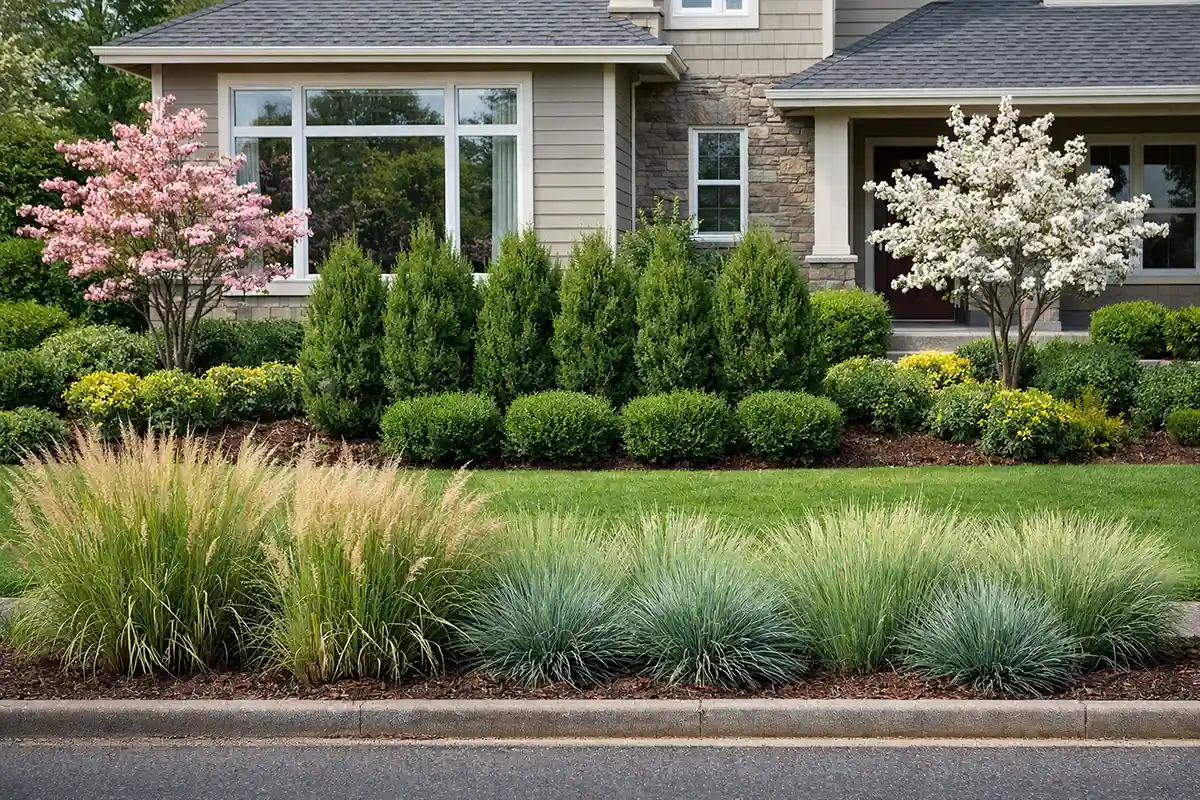
Single hedges or isolated trees rarely solve front-yard privacy problems. Instead, effective designs rely on layered landscaping, which disrupts sightlines from multiple heights.
The key is to place plants at different distances from the street so that views toward the window are repeatedly interrupted.
Layer 1: Ground-Level Screening (2–3 ft)
The lowest layer softens the edge of the yard and blocks the lowest viewing angles from passing vehicles.
Typical plants include:
-
ornamental grasses
-
compact evergreen perennials
-
low hedging shrubs
Spacing typically ranges between 18–30 inches to create continuous visual texture.
Although these plants are not tall enough to block windows, they reduce the visual depth that drivers perceive when looking toward the house.
Layer 2: Mid-Level Shrubs (4–6 ft)
This layer performs most of the privacy work.
Shrubs placed roughly 10–15 feet from the house interrupt the main sightline between the road and the window.
Dense evergreen shrubs are often the most reliable option because they maintain screening during winter months.
These layered planting strategies are commonly used in front yard privacy landscaping approaches such as those described in Front Yard Landscaping for Privacy Without Fences.
When shrubs are spaced correctly, they create filtered views rather than a hard barrier, which helps maintain the open feel of the front yard.
Layer 3: Small Trees (12–20 ft Mature Height)
Trees provide the vertical element that breaks long-distance views.
Rather than forming a wall, small ornamental trees disrupt sightlines from vehicles approaching at different angles.
Popular options include:
-
serviceberry
-
eastern redbud
-
multi-stem dogwood
-
Japanese maple
Trees spaced 12–18 feet apart usually create enough canopy interruption to prevent direct views into windows.
This approach becomes even more effective when combined with broader privacy buffer strategies such as those explained in How to Create a Privacy Buffer in a Suburban Yard Step-by-Step.
Example Layout Plan for Busy-Road Privacy
The most successful front-yard privacy solutions follow a predictable spatial structure.
Below is a simplified layout showing how layered planting interrupts sightlines between the street and a large window.
| Landscape Zone | Typical Height | Distance From Road | Purpose |
|---|---|---|---|
| Ornamental grasses | 2–3 ft | 3–6 ft | soften curb edge |
| Evergreen shrubs | 4–6 ft | 8–12 ft | block direct sightline |
| Small trees | 12–20 ft | 12–20 ft | break long-range visibility |
| House facade | — | 20–35 ft | protected window zone |
By spacing layers gradually between the street and the house, the landscape creates a visual corridor disruption rather than a single blocking element.
Drivers approaching at 30 mph experience shifting sightlines that prevent clear views into the home.
Choosing the Best Plants for Busy-Road Privacy
Plant selection has a major impact on how well a privacy landscape performs. The goal is to combine plants with dense branching, appropriate height, and predictable growth habits.
| Plant Type | Mature Height | Growth Speed | Best Use |
|---|---|---|---|
| Skip laurel | 6–10 ft | moderate | evergreen shrub screen |
| Arborvitae | 10–15 ft | moderate | vertical privacy row |
| Boxwood | 3–5 ft | slow | structured hedge |
| Miscanthus grass | 5–7 ft | fast | seasonal visual barrier |
| Serviceberry tree | 15–20 ft | moderate | layered canopy screening |
Spacing shrubs roughly 3–5 feet apart allows them to form dense screening within 3–5 growing seasons depending on climate.
Plant selection may also vary depending on regional conditions. In humid climates like Florida, evergreen shrubs maintain year-round coverage, while colder northern states often benefit from mixed evergreen and deciduous layers.
Traffic Noise and Dust: The Overlooked Privacy Problem
Homes facing busy roads often experience more than visual exposure.
Traffic also introduces:
-
constant noise
-
airborne dust
-
headlight glare
Dense landscaping buffers can reduce traffic noise by 3–5 decibels, depending on plant density and planting depth.
Shrubs with dense branching—such as laurels or viburnum—help trap dust particles before they reach the home.
Although landscaping cannot eliminate road noise entirely, layered planting significantly improves the microclimate of the front yard and the comfort level inside the house.
These improvements become even more noticeable in neighborhoods where pedestrian traffic increases visibility near the house, similar to the situations described in Front Yard Privacy Problems When the Sidewalk Runs Only a Few Feet from Your Windows.