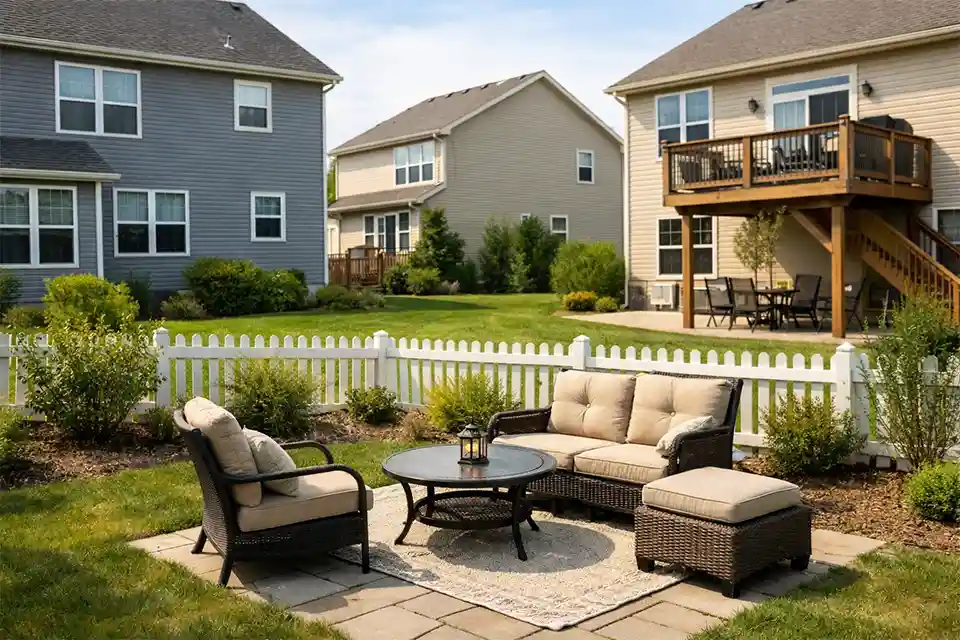
Backyard privacy problems rarely appear the moment a yard is finished. Most homeowners notice them later—often after installing a patio, fire pit, or outdoor dining area. What looked like a comfortable outdoor space on paper suddenly feels exposed once neighbors begin using their decks, balconies, or upstairs windows.
In many suburban developments across the United States, homes sit only 20–40 feet apart. That distance may feel generous indoors, but outdoors it rarely prevents visibility. When neighboring houses have two-story windows roughly 18–22 feet above ground, or elevated decks 8–12 feet high, they can see directly into large portions of a backyard.
The problem becomes worse when common privacy solutions are applied incorrectly. Decorative fences, scattered shrubs, and lightweight screens often address only ground-level views, while elevated viewing angles remain completely open.
Backyard privacy issues are therefore rarely caused by a single missing element. They usually emerge from a combination of yard layout, neighboring elevation, plant spacing, and incomplete screening layers.
Understanding why typical solutions fail is the first step toward designing outdoor spaces that actually feel private.
Quick Diagnostic Checklist
If your backyard never feels fully private, the cause is often structural rather than decorative. Use this checklist to identify common design problems.
• Neighboring homes have second-story windows facing your yard
• A deck or balcony nearby sits 8–15 feet above ground level
• Backyard seating areas sit directly along the property line
• Fences are below 5–6 feet tall
• Privacy plants are spaced more than 4–5 feet apart
• The yard is long and narrow, allowing direct sightlines across the entire space
When two or more of these conditions occur together, simple privacy upgrades rarely work on their own.
Why Backyard Privacy Solutions Often Fail
Many backyard privacy attempts focus on adding decorative elements rather than analyzing how people actually see into the space.
Visibility in residential environments is controlled by three main factors:
• Viewing angle
• Elevation differences
• Screening density
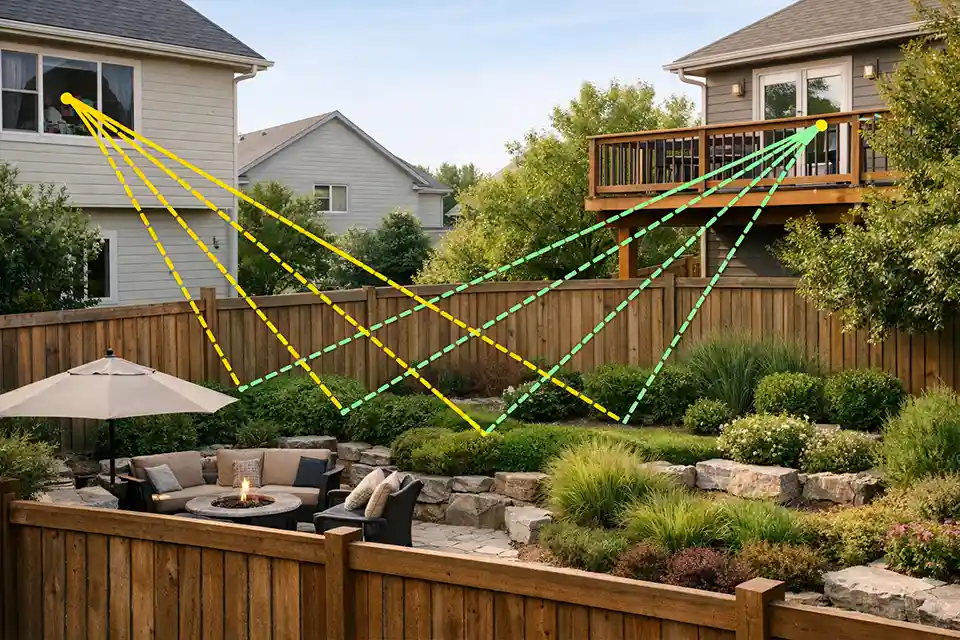
A decorative fence, for example, may block views from someone standing at ground level. But a neighbor looking from a second-floor window can often see over that same fence without obstruction.
Similarly, planting a row of small shrubs may seem like a privacy solution. Yet most shrubs reach only 4–6 feet within the first few years. During that time, the yard remains almost completely visible.
Another overlooked issue is yard geometry. Many suburban properties are designed with rectangular lots between 40 and 60 feet wide. When patios and seating areas are installed near property boundaries, sightlines from neighboring houses often converge directly on those spaces.
These design issues frequently appear in outdoor layouts that look attractive but are difficult to use comfortably. Similar usability problems are discussed in Backyard Layout Problems That Make Outdoor Spaces Hard to Use, where layout geometry often affects both functionality and privacy.
The Most Common Backyard Privacy Fixes That Don’t Work
Homeowners often try several quick solutions before realizing the real problem lies in the layout itself.
| Privacy Attempt | Why It Usually Fails | Typical Result |
|---|---|---|
| Short decorative fencing | Blocks only ground-level sightlines | Second-story views remain open |
| Widely spaced hedges | Gaps remain visible for years | Privacy takes 3–5 years to develop |
| Patio umbrellas | Coverage area too small | Only partial privacy while seated |
| Thin lattice screens | Angled views pass through gaps | Privacy inconsistent |
| Random tree planting | Canopy too high above ground | Lower sightlines stay exposed |
| Single-side screening | Other viewing angles ignored | Backyard still visible from multiple directions |
The key pattern here is that most fixes attempt to block one direction of visibility, while backyard privacy problems typically involve multiple viewing angles at once.
How Neighbor Elevation Creates Privacy Problems
Elevation differences between homes are one of the most overlooked causes of backyard privacy issues.
In many suburban neighborhoods, even small elevation changes—sometimes only 2–4 feet—can dramatically increase visibility between properties. When this difference is combined with second-story windows or raised decks, the viewing angle becomes much wider.
For example:
• A two-story window at 20 feet can easily see over a standard 6-foot fence
• A deck elevated 10 feet above ground provides a direct view across multiple yards
• Slight uphill properties allow neighbors to see over hedges and screens
Because of these factors, privacy barriers must be designed vertically rather than relying on a single horizontal element like a fence.
Long narrow yards are particularly vulnerable to these issues. When a backyard stretches 60–80 feet deep but only 35–45 feet wide, sightlines from neighboring homes can extend across nearly the entire property. These spatial challenges are explored further in Backyard Design Problems in Long Narrow Yards.
Backyard Layout Mistakes That Expose Outdoor Spaces
Backyard privacy problems often originate from the way outdoor spaces are arranged.
A common design pattern places patios or seating areas directly along the back property line. Homeowners do this to preserve lawn space in the center of the yard, but the result often places gathering areas exactly where neighboring sightlines intersect.
Imagine two homes separated by 25–30 feet, both with patios installed along the same property line. Even with fences and landscaping, the seating areas often face each other across a narrow corridor.
This configuration creates constant visual exposure. Over time, homeowners attempt multiple privacy fixes—screens, pergolas, tall plants—but the underlying layout problem remains unchanged.
Similar design oversights appear in many so-called low-maintenance landscapes. Outdoor spaces that look simple and minimal can later develop hidden functional issues, a pattern discussed in Why Low Maintenance Backyards Often Become High Maintenance.
Environmental Conditions That Influence Backyard Privacy
Climate conditions across the United States can strongly influence which privacy strategies work best.
In humid regions like Florida or the Gulf Coast, dense evergreen plants grow quickly thanks to moisture levels that often exceed 70–80% humidity during summer months. Many screening hedges can reach 8–10 feet within two growing seasons.
By contrast, desert regions such as Arizona or Nevada experience extreme heat above 100°F for long periods during summer. Fast-growing privacy plants may struggle without irrigation, and shade structures often become more practical solutions.
Northern climates—including states like Wisconsin or Minnesota—face a different challenge. Many commonly used screening plants are deciduous, meaning they lose their leaves for 4–5 months during winter. Privacy that works perfectly in July may disappear completely by December.
These environmental differences mean backyard privacy design must adapt not only to neighboring structures but also to regional climate patterns and plant growth behavior.
In the second part of this guide, we’ll examine the planting mistakes, fence limitations, and layered privacy strategies that actually work in real backyard environments.
Privacy Planting Mistakes Homeowners Often Make
Many backyard privacy problems continue even after homeowners add plants. The issue usually isn’t the idea of planting—it’s how the plants are selected and spaced.
A common mistake is choosing ornamental shrubs that look attractive but never become dense enough to block visibility. Plants such as small flowering shrubs may reach 4–5 feet tall, yet remain open enough for sightlines to pass directly through them.
Spacing is another frequent problem. Screening hedges placed 5–6 feet apart can leave large visual gaps for several years. Even fast-growing plants often require 3–5 growing seasons before branches fully fill those openings.
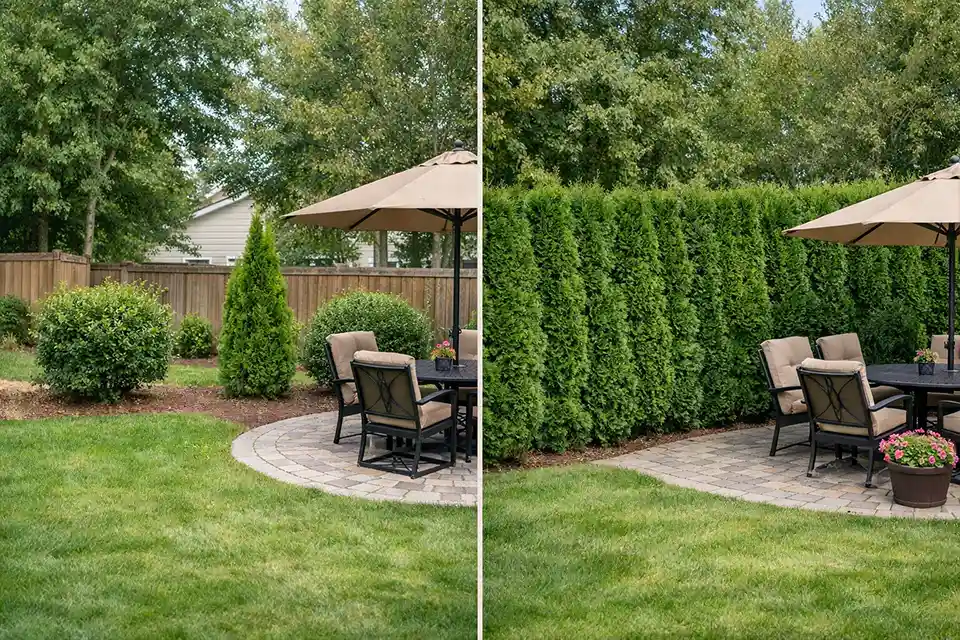
Effective privacy planting typically relies on tighter spacing and dense evergreen foliage. Many landscape designers place screening plants 3–4 feet apart, allowing branches to overlap and create a continuous visual barrier within two to three years.
Climate also plays an important role. In humid regions such as Florida or coastal areas of California, evergreen hedges may grow 12–24 inches per year under good irrigation. In arid climates like Arizona, growth rates may slow to 6–10 inches annually without supplemental watering.
The key principle is simple: privacy depends more on foliage density than plant height.
Fence Limitations Most Homeowners Ignore
Fences are often the first solution homeowners consider when backyard privacy becomes a concern. While fences can improve privacy, they rarely solve the entire problem.
Most residential areas in the United States limit backyard fence height to 6 feet, and occasionally 7 feet depending on local zoning rules. This height works well for blocking views at ground level but offers little protection from elevated sightlines.
For example:
• A neighbor looking from a second-story window about 20 feet high can easily see over a 6-foot fence
• An elevated deck 8–10 feet above ground creates a wide viewing angle across multiple yards
• Slight elevation differences between properties may allow neighbors to see directly over fences
These limitations explain why some backyards still feel exposed even after installing a new fence. Structural barriers must usually be combined with landscaping or vertical screening elements to interrupt higher viewing angles.
| Fence Height | Visibility from Second Floor | Privacy Result |
|---|---|---|
| 4 feet | Fully visible from most angles | Minimal privacy |
| 6 feet | Blocks ground-level views | Limited elevated privacy |
| 7–8 feet | Reduces some elevated sightlines | Moderate privacy |
| Fence + plants | Breaks multiple sightlines | Strong privacy solution |
Because of these limitations, fences work best when they serve as the first layer in a multi-layer privacy design.
The Layered Privacy Method That Actually Works
Landscape designers rarely rely on a single barrier to create privacy. Instead, they combine several elements that block sightlines at different heights.
A reliable backyard privacy strategy typically includes three vertical layers.
Structural Layer
The structural layer forms the base barrier.
Examples include:
• wooden privacy fences
• tall decorative screens
• pergolas with side panels
• masonry or composite walls
These structures usually reach 6–7 feet and block direct horizontal views into the yard.
Dense Vegetation Layer
The second layer fills visual gaps above and around structural elements.
Common screening plants include:
• arborvitae hedges
• clumping bamboo varieties reaching 12–15 feet
• dense evergreen shrubs such as viburnum or podocarpus
When spaced 3–4 feet apart, these plants gradually form a continuous wall of foliage that blocks mid-level sightlines.
Canopy Layer
The final layer addresses elevated viewing angles.
Trees provide vertical coverage that breaks the visibility corridor from second-story windows or raised decks. In warm climates, species such as magnolia or live oak can form dense upper canopies. In colder northern states, columnar spruce varieties often provide reliable year-round screening.
The goal is not to completely enclose the yard but to interrupt clear sightlines from multiple heights.
Homeowners who attempt to rely on a single privacy feature often experience ongoing frustration. A layered approach produces more reliable results in real residential environments.
Privacy Strategies for Different Backyard Layouts
Backyard privacy solutions also depend on yard shape and surrounding structures. Different layouts require slightly different screening strategies.
Long Narrow Backyards
Narrow yards—often 35–45 feet wide but more than 60 feet deep—tend to create direct viewing corridors from neighboring homes. Layered planting along the property line helps break these long sightlines.
This issue frequently appears in suburban developments and is closely related to the design challenges discussed in Backyard Design Problems in Long Narrow Yards.
Elevated Neighboring Homes
When nearby houses sit on higher ground or raised foundations, standard fences rarely provide enough coverage. Taller hedges or tree screens are often required to block elevated viewing angles.
Sloped Backyards
Yards with significant grade changes can unintentionally expose patios or seating areas to neighboring properties. Even a 3–5 foot elevation difference can increase visibility across fences.
These landscape challenges often appear alongside drainage and stability concerns explained in Sloped Backyard Problems: Drainage, Erosion, and Safety.
Patio Placement
Sometimes privacy problems come from where outdoor features are located. When patios sit directly against the property line, they often fall directly within neighboring sightlines.
Design adjustments—such as moving seating areas 10–15 feet inward—can significantly reduce visibility.
Outdoor spaces that prioritize appearance over usability often encounter these issues later. Many similar layout mistakes are discussed in Backyard Layout Problems That Make Outdoor Spaces Hard to Use.
Backyard Privacy Methods Compared
| Privacy Method | Short-Term Effect | Long-Term Effect | Maintenance |
|---|---|---|---|
| Decorative fence | Moderate | Limited | Low |
| Hedge planting | Low initially | High after maturity | Moderate |
| Privacy screens | Moderate | Moderate | Low |
| Trees | Low early growth | High canopy coverage | Low–moderate |
| Layered landscaping | High | Very high | Moderate |
Layered landscaping consistently provides the most reliable long-term privacy because it addresses multiple viewing angles simultaneously.
Questions Homeowners Often Ask
How tall should backyard privacy plants be?
For effective screening, most privacy hedges need to reach 8–12 feet depending on surrounding building height. Short hedges around 4–5 feet rarely block elevated views.
Is a fence enough to create backyard privacy?
A fence alone typically blocks only ground-level views. In neighborhoods with multi-story homes, additional plant layers or vertical screening are usually necessary.
How long does it take for privacy hedges to grow?
Fast-growing species may reach useful screening height in 2–3 years, while slower-growing varieties may take 5–7 years depending on climate, soil conditions, and irrigation.
What blocks second-story views into a backyard?
Tall hedges, dense tree canopies, pergola side panels, and layered landscaping are the most effective ways to interrupt elevated sightlines.
Key Insight
Backyard privacy problems rarely come from a single missing feature. Most exposed outdoor spaces result from layout geometry, elevation differences, and incomplete screening layers.
The most successful backyard designs combine structural elements, dense vegetation, and tree canopy coverage to break visibility from multiple directions. When these layers work together, outdoor living spaces begin to feel comfortable, sheltered, and far more usable.
For additional guidance on plant selection and screening strategies, resources from the University of California Agriculture & Natural Resources extension program provide practical research-based recommendations for residential landscape design.