Last updated: July 7, 2026
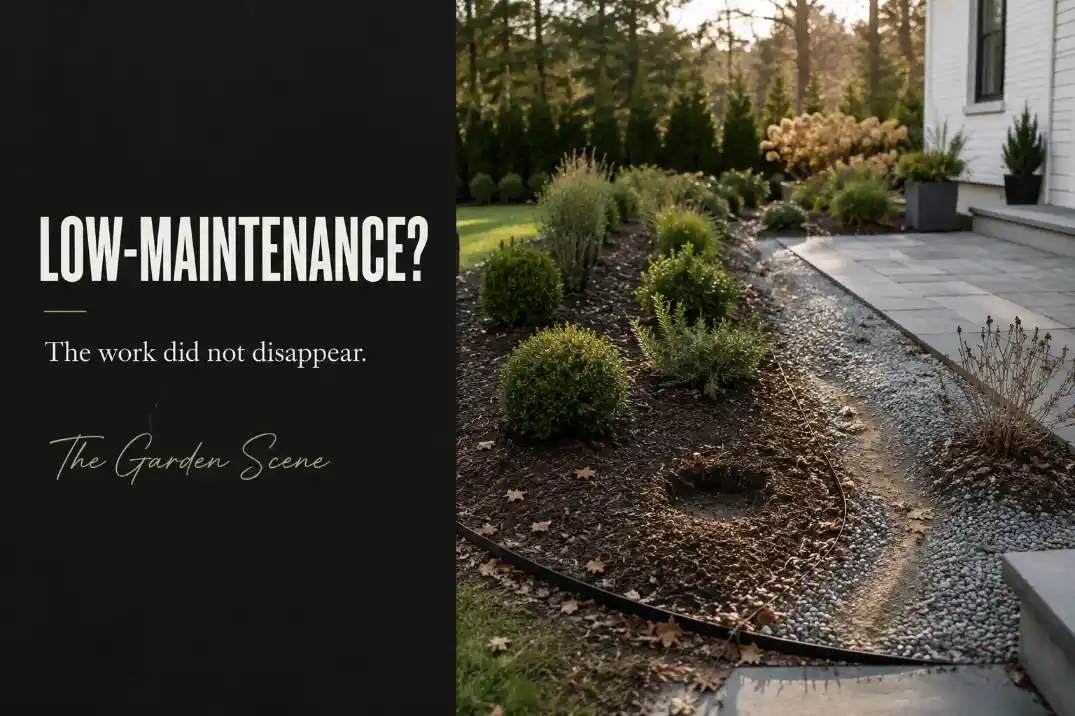
The low-maintenance garden promise sounds like a clean trade: remove the fussy parts, simplify the planting, add mulch or gravel, reduce lawn, use harder surfaces, and the work should drop.
That is the weak version of the promise.
A garden does not become low-maintenance just because it looks simpler on installation day. It still grows, sheds, settles, dries out, collects debris, moves water, exposes soil, and changes with the seasons. The work may stop looking like mowing or deadheading, but it often returns as weeding, edge repair, surface cleaning, runoff control, pruning, plant replacement, or visual gaps that make the whole space feel unfinished.
The better question is not, “How do I make this garden maintenance-free?” The better question is, “Where will the maintenance move, and can the design keep that work small, visible, and easy to reach?”
The Problem Is the Promise, Not the Garden
Low-maintenance design usually begins with a reasonable frustration. Homeowners do not want a yard that needs constant watering, weekly trimming, annual replanting, or weekend-long cleanup sessions. A simpler garden sounds like relief.
The mistake is treating low maintenance as a fixed feature, like a material choice or a style. A garden is not static. Even a very clean layout changes after the first growing season. Shrubs spread beyond their neat outlines. Mulch thins and migrates. Gravel collects leaves and soil. Paver seams catch seeds. Bare soil warms, crusts, or washes. Shade shifts as plants mature. Water finds the lowest path whether the design planned for it or not.
That is why the most polished low-maintenance garden can start to feel needy later. The original design may have reduced one obvious chore while creating several quieter ones.
A no-lawn garden may remove mowing but increase edge control. A gravel bed may look crisp at first but collect organic matter that supports weeds. A simplified shrub border may reduce plant variety but leave bare soil exposed between plants. A larger patio may reduce planting area but add surface stains, debris lines, and runoff marks.
Editorial Note: Low-maintenance is not something a garden “has” on day one. It is a tolerance system for change. If the design cannot absorb growth, debris, water, heat, and seasonal reset, maintenance simply returns in another form.
The strongest low-maintenance gardens are not the emptiest gardens. They are the ones where future work has already been assigned a place.
Maintenance Does Not Disappear. It Moves.
The first test of any low-maintenance choice is not what it removes. It is what it transfers.
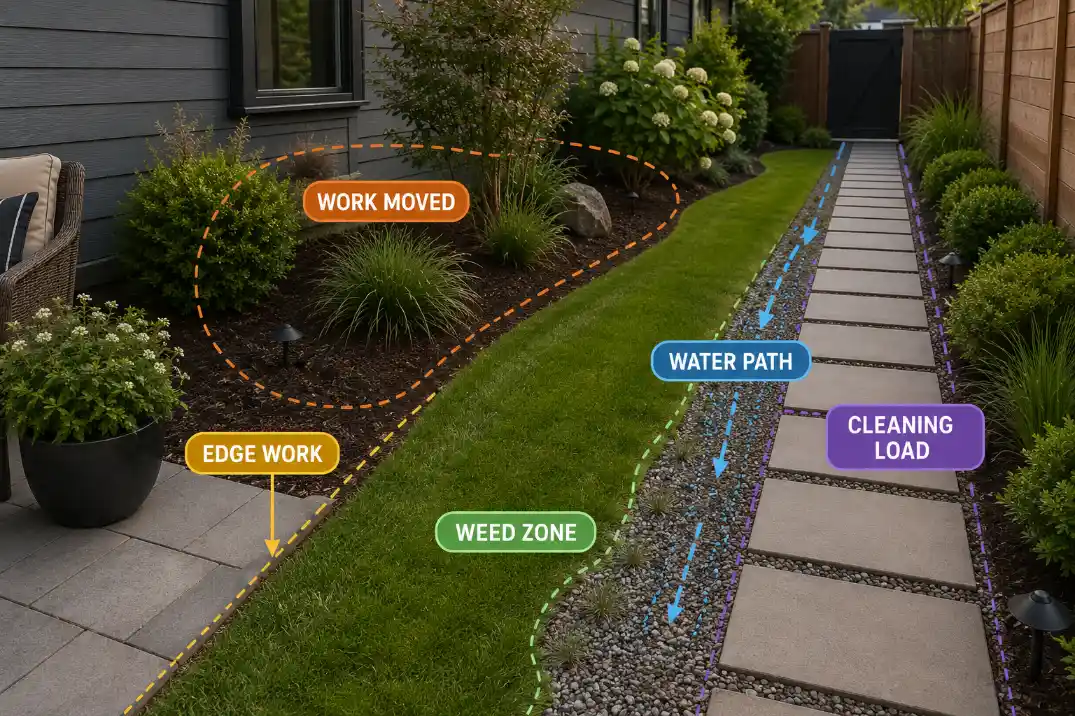
When a design removes one visible task, the pressure often shifts somewhere less obvious. The lawn is gone, but now the edge between gravel and planting bed needs control. The flower border is simplified, but now a few shrubs carry the entire structure. The patio is larger, but water, stains, and leaf debris become more visible.
This is not an argument against low-maintenance choices. It is an argument against trusting them in isolation.
The hidden transfer is usually at the edge
Edges are where many “easy” gardens start to reveal their workload. The line between mulch and lawn, gravel and walkway, planting bed and patio, or shrub mass and open space has to stay readable. When it blurs, the garden can look neglected even if the actual plant count is low.
That is why a low-maintenance redesign often feels good at first and then slowly becomes annoying. The big work was removed, but the small correction points multiplied. If that pattern is showing up in a backyard, the more specific version is covered in why low-maintenance backyards become high-maintenance, where patio edges, storage corners, and daily-use routes make the transfer more obvious.
| Low-maintenance choice | Work it seems to remove | Where the work often moves |
|---|---|---|
| Less lawn | Mowing and edging | Weeds, gravel drift, bed borders, exposed soil |
| More mulch | Watering and bare-ground cleanup | Thin spots, washout, weed pressure, re-edging |
| More gravel or stone | Plant care | Leaf buildup, soil collection, weeds, migration |
| Larger hardscape areas | Planting upkeep | Stains, runoff marks, seams, algae, debris lines |
| Fewer plant varieties | Pruning complexity | Gaps, crowding, heat stress, visual imbalance |
The useful filter is simple: every low-maintenance choice should be judged by both sides of the trade. What chore does it reduce, and what chore does it quietly create?
The Simplest Garden Is Often the Least Forgiving
A simple garden can be beautiful, but simplicity removes hiding places.
When there are fewer layers, every flaw becomes easier to see. A weed in a dense mixed bed may disappear into texture. A weed in a clean gravel field stands out immediately. A thin mulch patch under layered shrubs may be hidden by foliage. A thin mulch patch in a sparse modern bed looks neglected. One missing plant in a full garden may barely register. One missing shrub in a minimal layout can break the whole composition.
This is where low-maintenance advice often confuses simplicity with resilience.
Empty space still needs a job
Open space is not automatically low-maintenance. It has to be stabilized, shaded, drained, walked on, planted, or deliberately surfaced. Otherwise, it becomes a waiting area for weeds, runoff, heat, or debris.
A simplified bed with large open mulch zones may look clean in spring, but by late summer the soil surface is doing more work than the design admits. It has to resist drying, weed germination, erosion, and visual thinness with very little plant cover helping it.
That is why small gardens and compact beds can become especially sensitive. When there is less room for error, every gap matters. Before adding more “simple” fixes, it often helps to step back and decide what truly deserves correction first; that same priority logic shows up in small backyard fix priorities when limited space forces harder choices.
The better version of simplicity is not emptiness. It is fewer elements doing clearer jobs: plants that cover soil, edges that hold their line, surfaces that drain cleanly, and access points that make small corrections easy.
Hardscape Changes the Chore Instead of Ending It
Hardscape reduces plant work only when it is designed as part of the garden system. Treated as an escape from maintenance, it usually creates a different kind of upkeep.
A paved or stone-heavy garden has its own aging pattern. Water leaves marks. Leaves break down in corners. Fine soil settles into joints. Gravel migrates into nearby beds or lawn. Paver seams collect weed seeds. Shaded surfaces can grow slippery film. Edges settle or shift. A clean stone field can slowly become a seedbed if organic debris builds up.
The new maintenance line is usually where hard meets soft
The most important part of hardscape maintenance is rarely the center of the patio or path. It is the meeting point: gravel against lawn, pavers against mulch, walkway against planting, patio against slope, edging against soil.
That boundary gets stepped on, washed across, swept into, or invaded by roots and weeds. If the design treats the hardscape as a finished object instead of part of a changing garden, that edge becomes the new chore.
This is why hardscape-heavy designs need drainage logic and cleaning access, not just a cleaner-looking plan. The same principle applies when a patio surface looks easy on paper but becomes difficult in real use; surface choice, water movement, and debris behavior can all decide whether a patio surface becomes hard to clean and maintain after the first seasons of use.
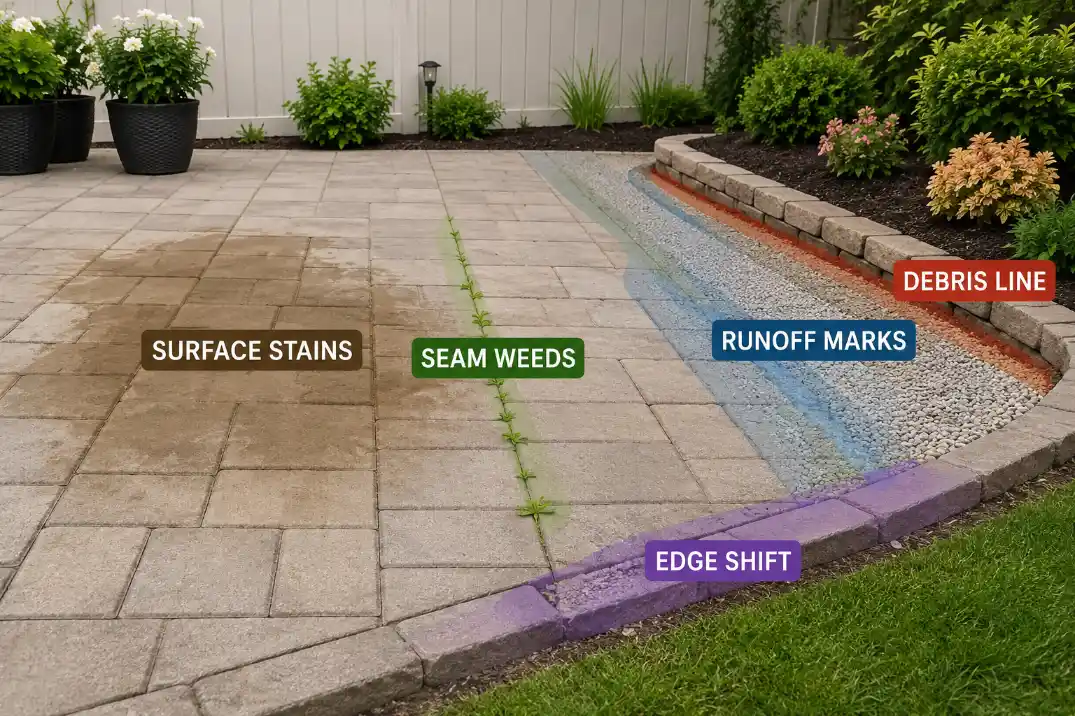
Hardscape is useful when it is chosen honestly. It is not “no maintenance.” It is lower plant maintenance in exchange for surface, seam, drainage, and edge maintenance.
Plants Are Not the Maintenance Problem. Unplanned Growth Is.
Fewer plants do not automatically mean less maintenance. Plants become maintenance problems when their future size, shape, exposure, and role were never planned.
A shrub that was never given room becomes a pruning chore. A groundcover placed where it can escape becomes an edge chore. A tree planted without future shade in mind becomes a lawn or planting-bed problem. A row of small shrubs spaced for installation-day fullness can become a crowded wall three years later.
The opposite mistake is just as common. Removing too many plants can leave soil exposed, which creates weed pressure, heat stress, splash, erosion, and visual emptiness. A garden with too few plants may need more correction because nothing is buffering the site.
Low-maintenance plants still have adult size
The phrase “low-maintenance plant” can be misleading when it is separated from placement. A plant may be easy in the right exposure, soil, moisture pattern, and amount of space. The same plant can be annoying if it is forced into a narrow bed, planted too close to a path, placed against a wall that reflects heat, or expected to stay smaller than its natural form.
This is where many simplified gardens fail quietly. The plant list may be reasonable, but the future size was not allowed for. The garden looks controlled when everything is young. Later, the same design becomes a cycle of clipping, thinning, replacing, and opening space again.
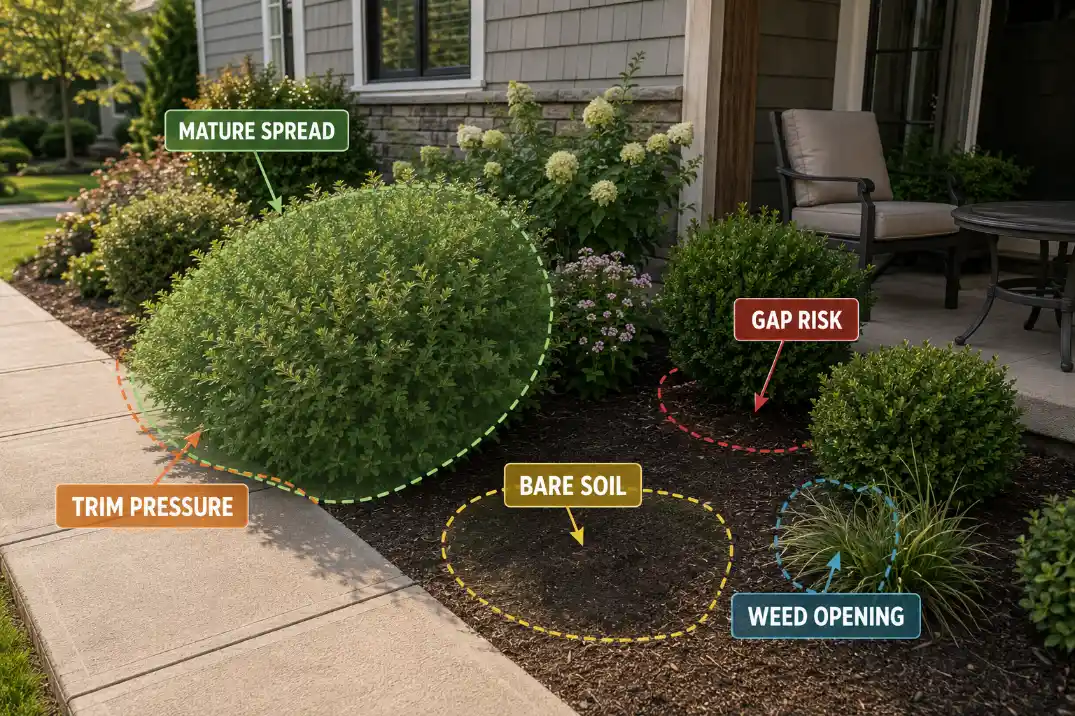
The better question is not, “Which plants need the least care?” It is, “Will these plants still fit the role and space when they reach mature size?”
That one question prevents many low-maintenance designs from turning into pruning projects.
Seasons Keep Rewriting the Design
A garden can feel low-maintenance in one season and demanding in another because every season exposes a different weakness.
Spring brings weed germination, fast growth, mulch movement, and the first signs of crowding. Summer exposes heat reflection, dry soil, water stress, and plants that were placed in the wrong exposure. Fall shows whether the garden can handle leaves, seedheads, debris, and cleanup access. Winter strips away softness and reveals bare structure, shifted edges, exposed soil, drainage patterns, and plants that no longer carry their role.
That seasonal rotation matters because many low-maintenance designs are judged too early. They are judged when the mulch is fresh, plants are small, surfaces are clean, and edges are newly cut. The real test comes after rain, heat, leaf drop, and winter exposure.
Water is especially revealing. A garden may look simple, but if runoff cuts across the same bed, collects at the same edge, or forces extra watering during peak summer heat, the design has not reduced maintenance.
It has created a recurring correction point. That is why water behavior can turn a supposedly easy yard into a repeated cost and care problem, especially where summer watering demand keeps rising around poor layout decisions; the pattern is clearer in summer water use problems in backyard design.
A low-maintenance garden does not need to look perfect in every season. It does need a plan for what each season will reveal.
What True Low-Maintenance Actually Means
True low-maintenance does not mean no work. It means fewer recurring surprises.
A realistic low-maintenance garden makes the future work visible, reachable, and predictable. It does not hide every task behind a clean installation photo. It gives plants room to mature. It keeps soil covered. It controls water before it creates repeat damage. It makes edges stable enough to hold their shape. It allows access for small corrections before they become large repairs.
The best low-maintenance gardens are often not the most stripped-down gardens. They are the most legible gardens. You can see where water goes. You can reach the plants that need occasional pruning. You can clean the surface without fighting trapped corners. You can refresh mulch without rebuilding the bed line. You can tell which plants are supposed to fill space and which edges are supposed to stay open.
The better test is future behavior
Before trusting any low-maintenance idea, test it against future behavior, not installation-day appearance.
| Question to ask | Why it matters |
|---|---|
| What happens after the first growing season? | Young plants, fresh mulch, and clean edges hide future pressure. |
| Where will water go after heavy rain? | Runoff creates repeat work when it crosses beds, seams, or low edges. |
| Can the mature plants fit without constant trimming? | Adult size matters more than nursery size. |
| What surface or edge will collect debris? | Cleaning load often replaces plant care. |
| Can small corrections be reached easily? | Hidden maintenance becomes expensive or neglected maintenance. |
A garden that passes those questions may still need care. But the care is more likely to be short, clear, and occasional instead of repetitive and confusing.
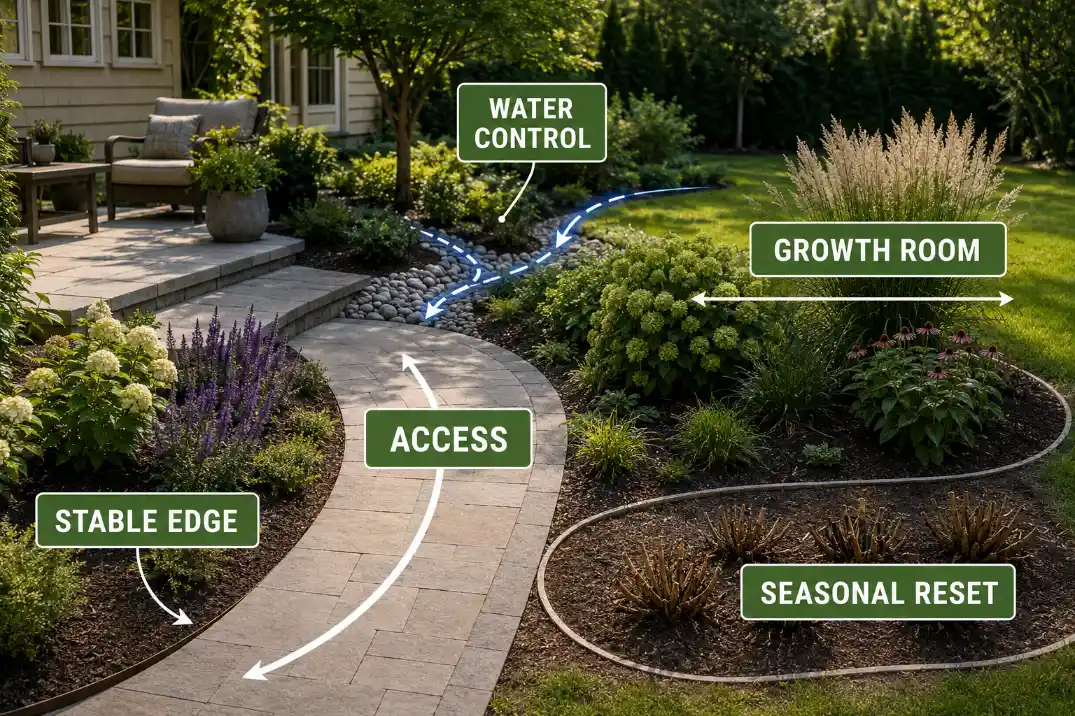
Use this compact check before calling a garden low-maintenance:
- The design shows where water goes instead of hoping it disappears.
- Plants have room to reach mature size without blocking paths or crowding edges.
- Soil is covered by plants, mulch, or stable surface rather than left exposed.
- Hardscape edges can be cleaned, swept, and reset without dismantling the layout.
- Seasonal debris has somewhere predictable to collect and be removed.
- The garden can lose one plant or shift slightly without the whole design looking broken.
- The work is easy to see before it becomes expensive to fix.
That is the real standard. Not no work. Better-contained work.
When This Becomes a Backyard or Front Yard Problem
This page owns the main idea: low-maintenance gardens fail when the design ignores change. But the way that failure appears depends on where the garden sits.
In a backyard, the issue often becomes practical use. Patio edges collect debris. Seating zones block access. Storage corners trap clutter. Water runs across areas people use every day. A backyard version should go deeper into movement, surfaces, outdoor routines, and private-use friction.
In a front yard, the pressure is different. The garden has to stay readable from the street, guide visitors to the entry, handle public-facing beds, deal with foundation planting, and maintain curb appeal even when one plant fails or one edge blurs. For that angle, the stronger next step is the front-yard-specific version on why low-maintenance front yards often become high-maintenance.
The main correction stays the same in both places. Low-maintenance is not the absence of garden work. It is the design’s ability to absorb growth, water, debris, surface wear, and seasonal change without turning every small shift into a new project.
Before simplifying a garden, ask where the work will move. If the answer is clear, reachable, and manageable, the design has a chance to stay low-maintenance. If the answer is hidden behind fresh mulch, new gravel, young plants, or a clean patio photo, the garden is probably borrowing time from the next season.
For a neutral horticultural reference on matching plant choices to site conditions, see the University of Minnesota Extension guide to landscape design and plant selection.