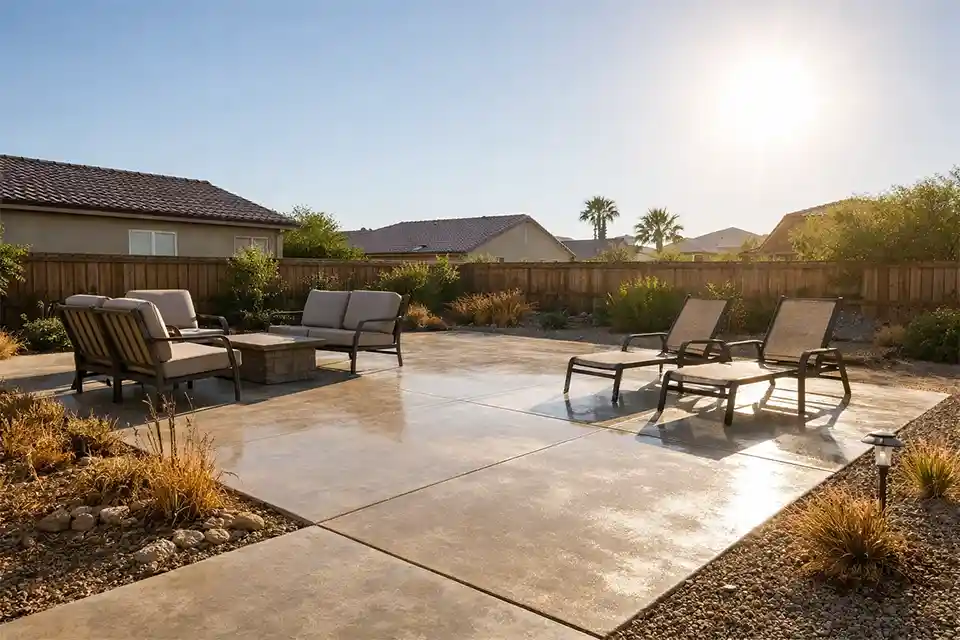
A backyard that fails in hot summer climates usually has a layout problem before it has a plant problem. The fastest way to confirm that is not to inspect it in the morning. Check it during the hardest part of the day. I
f the main seating area still gets direct sun after 2 p.m., if paving and nearby walls are still radiating heat 60 to 90 minutes after the sun shifts, and if the same west- or southwest-facing edges scorch every summer, the yard is not merely stressed. It is misdesigned for the climate.
The core issue is usually not lack of water. It is cumulative heat load. Direct sun, heat-storing surfaces, hot boundary walls, and fast-drying root zones all stack pressure into the same use zone.
That is why some backyards look finished, expensive, and low-maintenance in spring, then become hard to sit in by July. In a real hot-climate design failure, the patio stays uncomfortable until 8 p.m., containers need daily watering and sometimes twice-daily watering above 100°F, and the yard remains technically alive while becoming practically useless.
The real problem is not heat alone. It is where the yard stores it.
Most readers do not need a long list of possibilities here. They need the right ranking.
The most common problem is too much exposed hardscape in the part of the yard people actually use. The second is shade that exists but misses the seating zone. The third is a layout built for appearance rather than late-day comfort.
That order matters. Plant choice is usually fourth or fifth, not first.
1. Too much exposed hardscape in the comfort zone
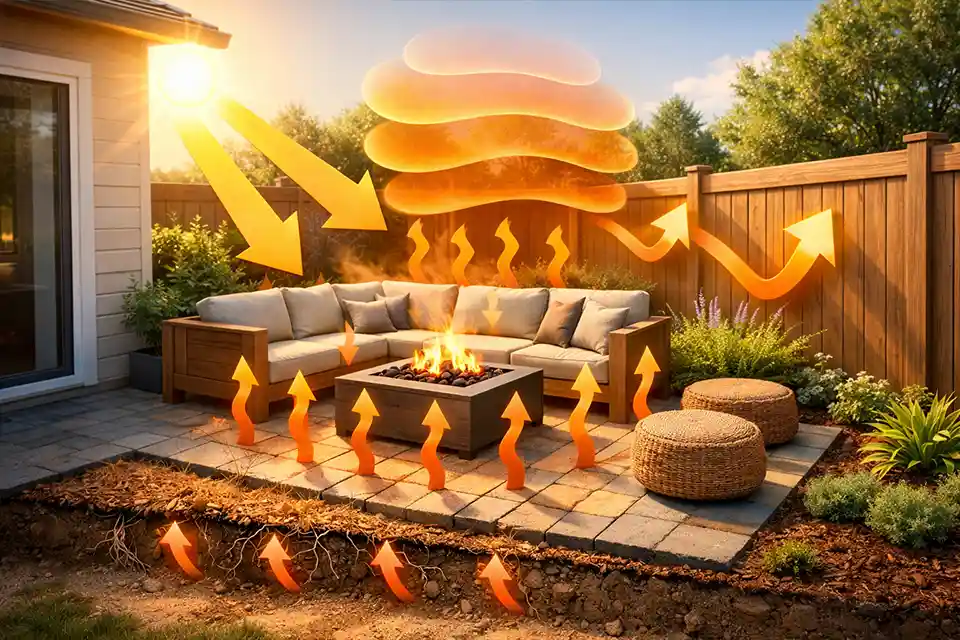
This is the biggest failure pattern in hot-summer backyards. Large patios, dark pavers, long masonry edges, and gravel-heavy borders around seating do not just absorb heat. They keep releasing it after the sun has moved. Many homeowners ask how much sun the yard gets. The better question is what keeps throwing that sun back at you at 5 or 6 p.m.
Once roughly 50% or more of the active use zone is exposed hard surface with weak overhead protection, the backyard usually starts losing comfort faster than expected. That does not mean hardscape is wrong. It means a hardscape-heavy layout in the hottest zone is usually the wrong first move.
That same “looks easy, performs badly” pattern overlaps with why low-maintenance backyards become high-maintenance. In hot climates, low-water style choices often become heat-management problems in disguise.
2. Shade exists, but misses the area that matters
This is the mistake people underestimate most. The backyard may technically have shade and still fail where it counts. Shade on a fence line does not fix a dining table that bakes from 3 p.m. onward. Shade in the back corner does not fix the path just outside the house if that is where people pause, sit, or gather.
Thin shade gets overcredited too. A lightly slatted pergola may improve appearance without meaningfully reducing late-day summer load. In dry climates, that often means the seating area still feels harsh. In humid climates, it can feel worse because the yard recovers more slowly after sunset.
If the main use zone still takes direct sun after 2 or 3 p.m., shade is not solved. It is misapplied.
3. The yard is zoned for looks, not use
This is where good-looking backyards quietly fail. Decorative beds, clean lines, and perimeter styling get the planning attention. The comfort zone gets whatever space is left over. The result is predictable: the yard photographs well, but people avoid it in midsummer.
That is the same broader design mistake behind backyard layout problems that make spaces hard to use. Heat does not create bad zoning. It simply exposes it faster and more brutally.
What people misdiagnose first
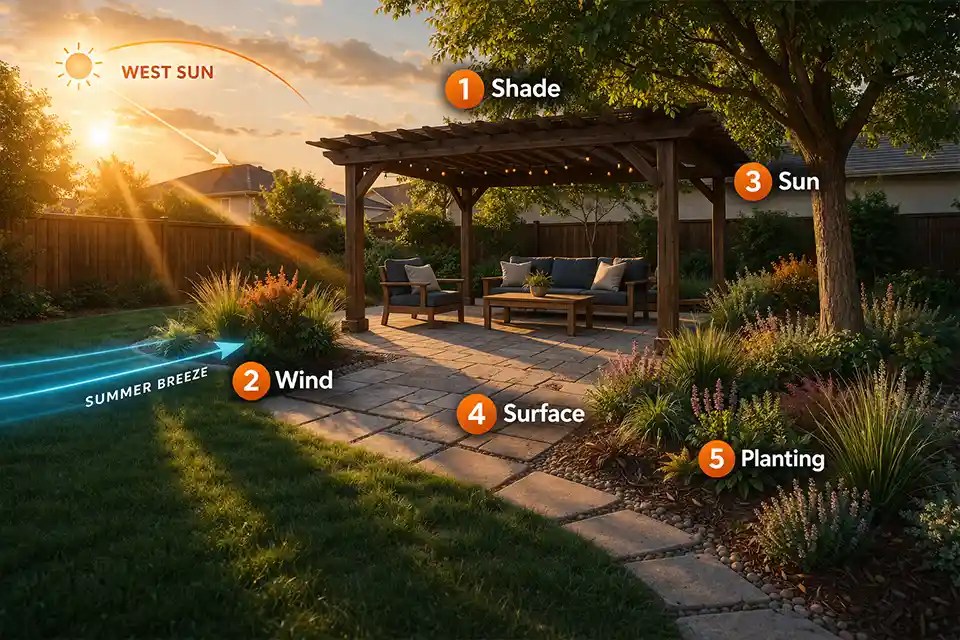
Most homeowners overestimate plant choice and underestimate layout. A heat-tolerant plant does not fix a heat-trap patio. A full-sun label does not mean a plant wants reflected afternoon heat beside masonry, paving, and thin mulch. It usually means the plant can handle strong sun in a workable site. Many backyards in hot climates are not workable sites. They are stacked thermal sites.
Gravel is misread in the same way. Used narrowly, it can make sense. Used broadly around seating and stressed beds, it often works less like a water-wise finish and more like a heat amplifier. That is why backyard landscaping without grass problems often arrive after the yard already looks complete. Low-water and low-heat are not the same thing.
Wilt is another common misread. Minor afternoon droop that fully recovers by morning is not the same as repeated wilt that lingers into the next day with dry soil 2 to 3 inches down. The first is manageable stress. The second usually means the yard is asking roots and leaves to compensate for a bad exposure pattern.
Quick diagnostic checklist
If four or more are true, stop treating this as a plant problem first:
- The main seating area gets more than 3 hours of direct sun after 2 p.m.
- Patio, gravel, or nearby walls still radiate heat near sunset
- The same west-facing plants scorch every summer
- Soil is dry 2 to 3 inches down by the next afternoon after a deep soak
- Containers need daily watering below 95°F
- The coolest shaded area is not where people actually sit
- More irrigation improved survival but not comfort
That last line is the decision point. Survival is not success. Usability is.
Stop doing the wrong fix first
The two most common time-wasting fixes are more water and more plant replacement.
More water helps only after the real heat load has been reduced. On its own, it is usually a support strategy, not a repair. It may delay wilt. It will not stop hardscape glare, cut fence rebound, or make an uncovered patio pleasant at 6 p.m. Frequent shallow watering can even worsen the pattern by keeping roots closer to the hottest upper soil layer.
The second waste is another round of plant swapping. If the same bed has failed for two summers, assume the layout is guilty before the planting palette is. Homeowners often spend too long optimizing the victim instead of fixing the cause. That is one version of the same logic behind costly backyard landscaping mistakes: the symptom gets replaced while the mechanism stays untouched.
Pro Tip: Do not buy replacement plants until you can answer one question at 4 p.m.: where is the heat still being held? That answer is usually more valuable than another nursery run.
The mechanism that actually breaks the yard
The yard fails when several moderate-looking problems overlap in one place.
| Design condition | What it seems like | What it actually becomes in peak summer |
|---|---|---|
| Large open patio | Clean outdoor room | Late-day heat sink |
| Decorative gravel near use zones | Water-wise finish | Reflected heat at foot and root level |
| Light slatted pergola | Shade feature | Partial cover that misses peak stress hours |
| West-facing bed near wall or fence | Sunny planting strip | Repeat scorch zone |
| Container-heavy cooling approach | Flexible greenery | Daily water burden with weak cooling value |
That table is the real decision filter. If the yard is failing because several of those are stacked together, plant-level fixes are not the first move anymore.
Boundary surfaces matter here more than people think. Fences and masonry can help privacy, but when they absorb western sun and throw it back into the seating area, they become part of the heat problem. That is why some backyard privacy problems and fixes that fail improve screening while quietly making summer comfort worse.
In dry desert climates, reflected heat from paving and walls usually dominates first. In humid climates, slower evening cooldown makes weak shade even less forgiving. Different climates change the feel, but not the priority: first reduce stored heat where people sit.
Here is the right order to fix it
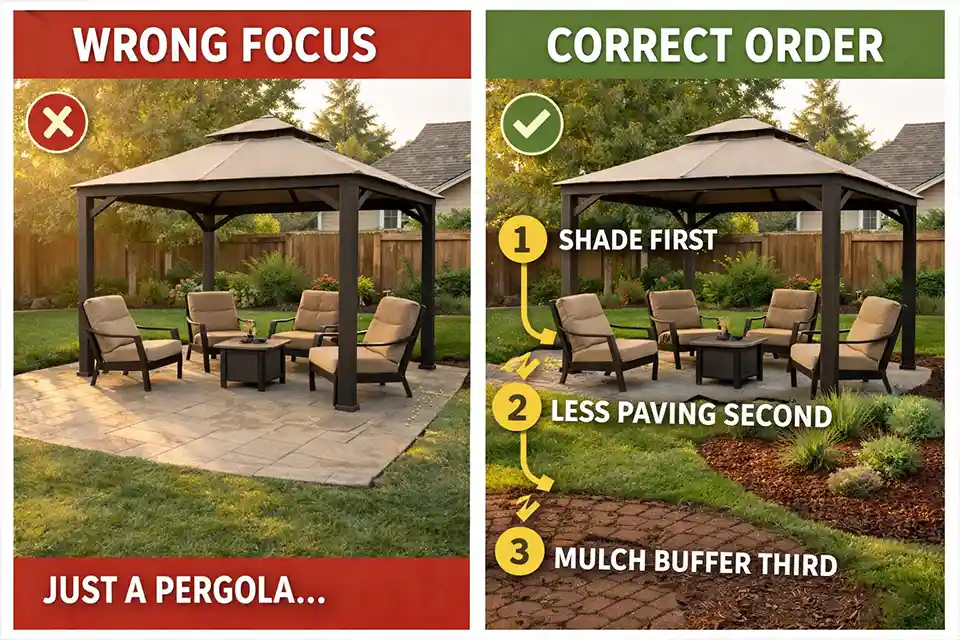
If the yard is uncomfortable in late afternoon, follow this order and do not reverse it.
First: shade the comfort zone
Not the perimeter. Not the decorative bed. Not the corner that happens to be empty. Shade the exact place people use. If the seating area is still exposed after 2 or 3 p.m., this is the first correction. In most hot-climate yards, this change does more than any plant swap.
Second: reduce the hottest hardscape near that zone
Do not start by rebuilding the whole yard. Start where heat is bouncing toward chairs, tables, and adjacent beds. Replacing even 15% to 25% of the most overexposed hardscape-heavy area can materially improve comfort when that reduction happens in the right strip. Dark surfaces deserve attention first because they are usually less forgiving in full western exposure.
Third: improve root-zone buffering
Once shade and surface load are being corrected, then improve the planting beds that still carry stress. In most cases, 2 to 3 inches of mulch works better than a thin cosmetic layer. If the soil underneath is compacted or exhausted, watering more often is usually a weak substitute for fixing the bed.
Fourth: replace plants last
This is the step people rush into first, and that is usually backwards. Replace plants only after the site stops punishing them unnecessarily. Otherwise you are testing plants inside a failed setup and calling the results “plant performance.”
That sequence is the article’s main decision. If the reader follows nothing else, they should follow that.
When tweaking stops making sense
Do not keep tweaking a zone that has already answered the question.
Move to redesign when:
- the same area has failed for two summers
- the best existing shade still misses the main seating zone
- containers are doing too much of the cooling work
- paving, walls, and planting beds are all concentrating heat into one use area
- the backyard is alive, but people still avoid it on ordinary summer evenings
That final point is the cleanest threshold in the whole article. If nobody wants to sit there at a normal summer hour, stop optimizing survival. Redesign for comfort.
Pro Tip: Test the fix before you build it. Put temporary shade fabric or movable umbrellas over the exact use zone during a hot spell. If the yard suddenly becomes usable by 6 or 7 p.m., you already know the first permanent move.
A good hot-climate backyard does not need to look lush or complicated. It needs to stop storing punishment where people are supposed to relax. Until that changes, the yard is not under-watered. It is underdesigned.
For broader official guidance, see the University of California Agriculture and Natural Resources.