
Last updated: July 4, 2026
A corner lot front yard is not harder only because it has more grass. It is harder because the yard has more exposed edges, more awkward strips, more pavement contact, and more places where small messes become public.
A standard front yard usually has one main face: the house, walk, driveway, and street edge in front. A corner lot adds a second street-facing side. That side may not be used like the main entry lawn, but it still has to look maintained because drivers, walkers, delivery routes, and neighbors read it from another angle.
That is the maintenance trap. The corner lot asks you to manage lawn, curb, sidewalk, side lawn, visibility, and debris lines at the same time. The useful fix is not “mow more often.” It is to find which edges and strips keep creating repeat work, then simplify those zones before they absorb every mowing cycle.
Why Corner Lots Create More Front Yard Maintenance
The first diagnosis is exposure. A corner lot behaves like a front yard wrapped around two sides of the property, which changes the workload before any plant or material decision matters.
You are not just maintaining one lawn face. You are maintaining a longer public edge with more transitions. A corner lot often has a front curb, a side curb, a front sidewalk, a side sidewalk, driveway edges, apron corners, and narrow turf strips that sit between hard surfaces. Each line needs a slightly different kind of attention.
A mower may cut the broad lawn, but it does not clean up every sidewalk seam, curb face, utility strip, and corner pocket.
The second issue is visibility. The side yard may not be a private backyard or a quiet service area. On many corner lots, the side lawn is exposed to drivers, pedestrians, school traffic, or neighborhood foot traffic.
A small weed patch along the curb, scattered leaves near the sidewalk, or a ragged mower edge shows faster because the yard is being read from two directions.
The third issue is that the corner has fewer forgiving zones. A deep interior bed can be loose for a few days. A backyard corner can wait. But the outer edge of a corner lot is often the first thing people see. That pressure tempts homeowners to keep everything as lawn or add more decorative planting, even when the real problem is that the area is too narrow, too hot, too exposed, or too broken up to maintain easily.
| Corner lot pressure | Why it creates repeat maintenance |
|---|---|
| Two street frontages | More lawn and edge areas are visible from public view |
| Longer curb line | More trimming, cleanup, and weed pressure along pavement |
| Sidewalk edges | More seams where turf thins, spreads, or looks ragged |
| Narrow curb strips | Small areas become awkward to mow and easier to stress |
| Traffic debris | Wind, grit, leaves, and litter collect along the public edge |
| Open sun and heat | Turf near pavement dries and thins faster |
| Visibility limits | Tall, dense fixes may not be safe near the corner view |
The most useful first check is to walk the lot from the sidewalk, not from the front door. The maintenance pattern usually becomes clearer when you see the yard the way the street sees it.
The Extra Edge Is Where the Work Multiplies
Edge length often controls the workload more than lawn size. A large open rectangle of turf can be straightforward to mow. A smaller area broken into curb strips, sidewalk borders, driveway corners, and bed edges can take more time because every transition needs trimming or cleanup.
The most demanding areas are usually not in the middle of the lawn. They are where grass meets concrete, asphalt, mulch, gravel, or planting beds. A corner lot simply has more of those lines.
A mower can handle the broad passes. The repeated work comes afterward: trimming along the curb, cleaning clippings off the sidewalk, cutting the side strip, touching up the driveway apron, and keeping the corner from looking fuzzy.
When those edges are uneven or loosely contained, the work gets even more repetitive. That is why driveway edge problems in a front yard can feel worse on a corner lot than they do on a simpler front yard.
The Broad Lawn May Not Be the Real Problem
The biggest patch of grass may look like the main workload, but it can be the easiest part if it has clean mower access and few interruptions.
The harder part is the broken perimeter. A thin strip between sidewalk and curb, a curved bed edge near the corner, a small triangle of turf near the intersection, or a narrow side strip beside the driveway can create more handwork than the open lawn. If the edge looks rough again soon after mowing, the problem is not effort. The problem is the shape of the maintenance zone.
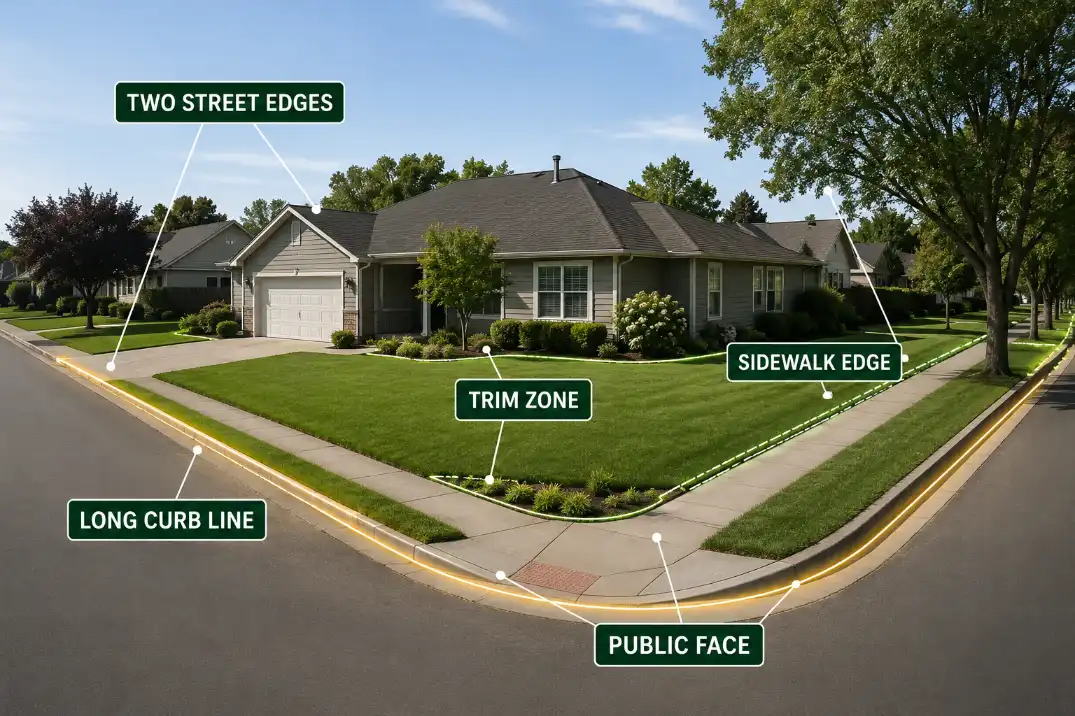
The first maintenance decision is not what to plant. It is which edges deserve to remain lawn. If a strip can be cut cleanly in one pass and still looks neat, it may stay. If it needs trimming, re-edging, weed cleanup, and debris removal every cycle, it is a candidate for simplification.
Narrow Curb Strips Turn Small Areas Into High-Friction Maintenance
A narrow curb strip is a small area with a large maintenance penalty. It sits between hard surfaces, receives heat from pavement, collects debris, and often dries faster than the main lawn. It also makes mowing awkward because the mower may not sit comfortably between curb, sidewalk, mailbox, driveway, and corner curve.
That is why a narrow strip can look worse than the larger lawn even when both are cared for at the same time. The strip is exposed to traffic splash, foot traffic, reflected heat, and edge weeds. The turf has less room to recover, and every imperfection is framed by concrete.
This is where corner lot maintenance becomes frustrating. The homeowner keeps mowing, but the strip still looks thin, weedy, or ragged because it is being asked to perform like normal lawn in a harsher place.
The better diagnosis is whether the strip is worth keeping as turf. Some strips make sense as simple grass if they are wide enough to mow cleanly and stay healthy. Others work better as a controlled low-care edge, especially when they are too narrow to cut easily or too hot to stay full.
For narrow sidewalk zones, the same logic applies to sidewalk strip maintenance in heat and traffic: the strip has to match the conditions, not just the look of the main lawn.

Not every narrow strip needs to disappear. But if a strip needs more trimming than mowing, more repair than use, and more attention than the main lawn, it should not be treated as normal turf.
Traffic Debris Makes the Corner Edge Look Messy Faster
The debris pattern on a corner lot is usually more important than the total amount of debris. Wind moves leaves, seed pods, paper, grit, and small twigs along the curb. Passing cars push dust and street debris toward the edge. Rain can carry loose material into curb pockets, driveway aprons, and sidewalk corners.
The result is a yard that looks messy faster, even if the lawn itself is not neglected. The problem is where the debris lands. On a corner lot, it often lands in the most visible places: curb lines, sidewalk seams, front walk crossings, driveway edges, and the open corner.
This is why a corner lot benefits from clean pickup zones. A simple curb edge, a readable sidewalk line, and fewer fussy planting pockets can make cleanup faster. Dense little beds, loose gravel, sharp inside corners, and complicated borders can trap material and make every windstorm look like a maintenance failure.
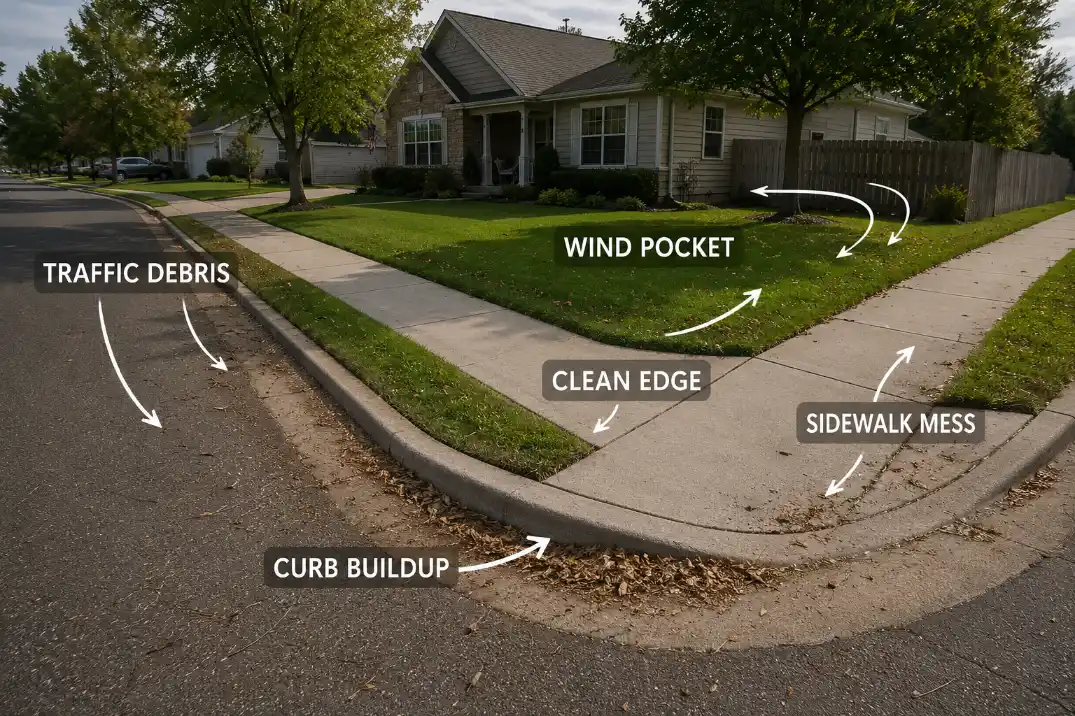
Tree debris can add another layer, especially when branches overhang from a nearby property. But that is a different diagnosis. When the main pattern is leaf drop, shade, twigs, or seed pods from another tree, the issue may be closer to neighbor tree maintenance pressure than a corner-lot edge problem alone.
For the corner lot itself, the useful question is: where does debris repeatedly collect after wind or rain? Those places need simpler edges, not more decorative complexity.
Sun, Heat, and Open Exposure Stress the Lawn Unevenly
Corner exposure often creates uneven turf, not uniform lawn failure. The side lawn may receive sun from a wider angle. The curb strip may sit beside hot pavement. The open corner may catch wind. The lawn near sidewalks and street edges may dry faster than the lawn closer to the house.
That uneven exposure creates patchy maintenance. One area grows fast, another thins out, and another collects weeds where turf is weak. The homeowner ends up treating the whole yard, but the stress is concentrated along the exposed public edge.
The wrong reaction is to push the weakest turf to behave like the protected lawn near the house. More mowing does not fix heat stress. More edging does not fix a strip that is too dry and narrow. More small seasonal planting can create even more upkeep if the area is already exposed, visible, and hard to water evenly.
The better move is to separate useful lawn from pressure lawn. Useful lawn is open enough to mow, healthy enough to recover, and visually worth keeping. Pressure lawn is the turf that exists only because the old layout left a strip there. On many corner lots, that pressure lawn is the part most worth reducing.
The Visibility Zone Limits the Usual Low-Maintenance Fixes
Near the corner, “low maintenance” has to stay compatible with visibility. Tall, dense planting may hide weak turf or reduce mowing, but it can also block the view between drivers, pedestrians, cyclists, and vehicles.
That matters because many low-maintenance fixes people reach for are vertical. A hedge can hide rough turf. Tall grasses can fill an exposed side. A dense shrub mass can reduce lawn. But near a street corner, height is not just a design decision. It can become a sightline problem.
For this article, the visibility zone is not a legal guide. Local rules vary, and a homeowner should check local sightline requirements before adding anything that could block views near the street corner. As a maintenance diagnosis, though, the principle is clear: the corner itself often needs to stay low, open, and easy to read.
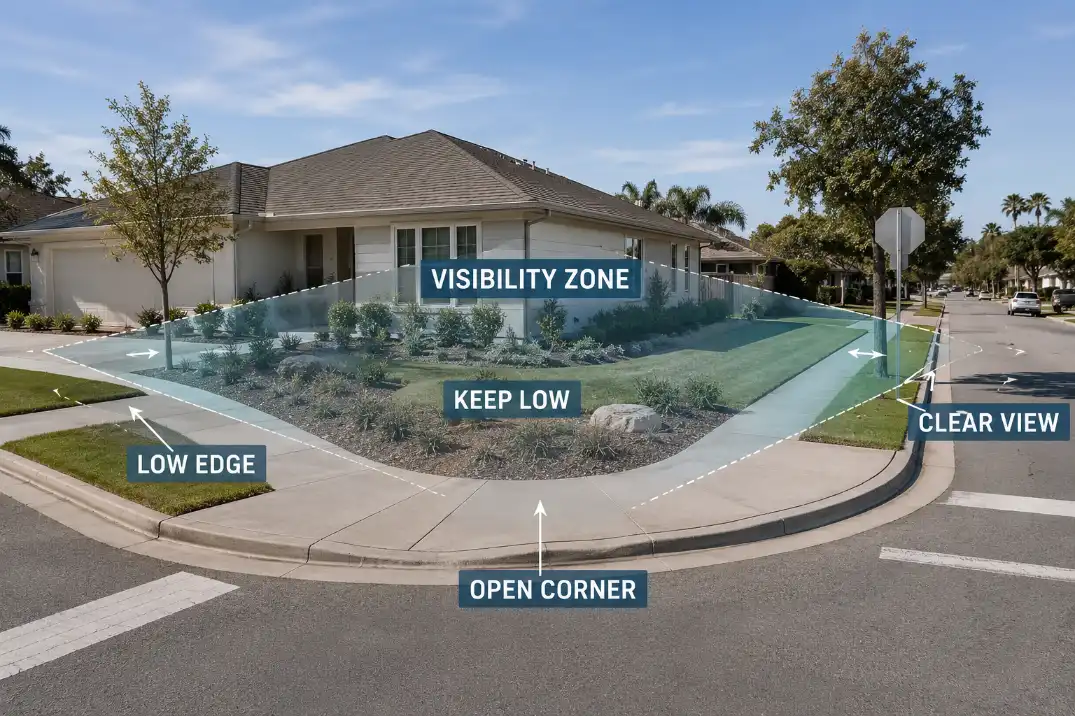
This is where privacy logic and maintenance logic can conflict. A tall screen may reduce the feeling of exposure, but it can be the wrong answer near the corner view. The lower-maintenance answer may be a clean low edge, a simplified ground plane, or a small open turf area that stays readable and safe.
The Side Lawn Should Not Always Be Treated Like a Second Front Yard
The side lawn is often the hidden maintenance sink because it is visible enough to demand care but not useful enough to justify a full front-yard treatment.
If the side lawn is broad, simple, and easy to mow, it may not be the problem. But if it is interrupted by a long curb, narrow sidewalk strip, driveway return, utility features, tree roots, odd slopes, or planting pockets, it can become a chain of small edge problems. It looks like extra lawn, but it behaves like perimeter maintenance.
The goal is not to overdesign the side face. A corner lot can become harder to maintain when every exposed area gets a different treatment: lawn here, small bed there, decorative border along the sidewalk, ornamental clumps near the curb, seasonal flowers near the corner. Each addition may look reasonable on its own. Together, they create more edges and more cleanup points.
The side lawn needs a simpler role. It may stay as clean turf where mowing is easy. It may shift to a low-maintenance edge where turf is narrow or stressed.
It may become a plain bed or low ground plane where repeated trimming no longer makes sense. What it should not become is a second decorative front yard that doubles the upkeep without adding real use.
| Zone on the corner lot | Better maintenance direction |
|---|---|
| Easy open lawn with clean mower access | Keep as simple turf |
| Narrow curb or sidewalk strip | Consider low-care edge, mulch, gravel, or groundcover logic |
| Exposed corner near sightlines | Keep low, open, and visually clear |
| Large unused side lawn with many interruptions | Simplify shape and reduce unnecessary turf edges |
Be careful with replacement planting. Swapping side lawn for high-maintenance plant masses can simply trade mowing for cutting back, dividing, cleanup, or seasonal mess. If the side yard is already exposed and public-facing, ornamental grass maintenance problems can become just as visible as turf problems.
A Better Maintenance Plan Starts by Reducing Repeat Work Zones
A useful corner lot maintenance plan starts by ranking repeat work, not by redesigning the whole yard. The question is: which areas create the same work again and again?
That question prevents every square foot from being treated equally. A corner lot needs priority because not every part of the yard causes the same kind of pressure.
Keep lawn where the mower can move cleanly and the turf stays reasonably healthy. Reduce lawn where the strip is narrow, exposed, weed-prone, or mostly there because nobody has questioned it. Simplify edges where trimming takes longer than mowing. Keep the corner view low and open. Make debris pickup easy along the curb and sidewalk.
This does not require a full redesign. Often, the most effective change is removing small high-friction pieces from the maintenance cycle. A narrow strip becomes a cleaner low edge. A ragged bed border becomes one simpler line. A side lawn loses unnecessary curves. A visible corner stays low instead of becoming a tall planting experiment.
Use this field check before changing the yard:
- Walk both street frontages after mowing and note what still looks unfinished.
- Mark the strips that need trimming every cycle but never look clean for long.
- Watch where debris gathers after wind or rain.
- Separate broad mower-friendly lawn from narrow pressure lawn.
- Keep the intersection corner low and visually open.
- Avoid adding tall planting just to hide a maintenance problem.
- Reduce small fussy edges before reducing the easiest lawn.
- Choose simple public-facing surfaces over decorative pockets that trap debris.
High-turnover display beds can also increase the workload on a corner lot because they sit in the most visible zone.
If the current issue is constant seasonal replacement, the problem may be closer to flower beds that keep needing replanting than basic lawn maintenance.
A lower-maintenance corner lot is not the one with the least landscaping. It is the one where each visible edge has a clear job. The lawn is easy to cut. The curb line is easy to read. The sidewalk strip is not fighting heat and traffic as if it were protected turf. The corner stays open. The side lawn is simplified instead of decorated into more work.
When to Route the Problem Elsewhere
Some visible corner lot problems need a different diagnosis. If the main frustration is an edge that keeps lifting, spreading, or losing its line, the better frame is edging stability.
If the mess comes mostly from overhanging trees, shade bands, seed pods, or branches from another property, diagnose the tree pressure first. If the side lawn has been replaced with plants that now need constant cutting back, the planting choice may be the real issue.
The point is to avoid solving the wrong pressure. A corner lot does create extra maintenance, but the best fix depends on what keeps repeating: edge work, strip stress, debris buildup, visibility limits, or unused side lawn. Once that pressure is named, the yard usually does not need more effort. It needs fewer repeat-work zones.
For intersection planting and visibility context, the Federal Highway Administration notes that sight triangles should remain clear of visual obstructions that limit visibility near intersections: Federal Highway Administration.