
Last updated: June 28, 2026
A front window can feel exposed even when the yard already has shrubs, a low fence, or a planted curb edge. That usually means the privacy problem is not the whole front yard. It is one road-facing view path reaching the inside of the house.
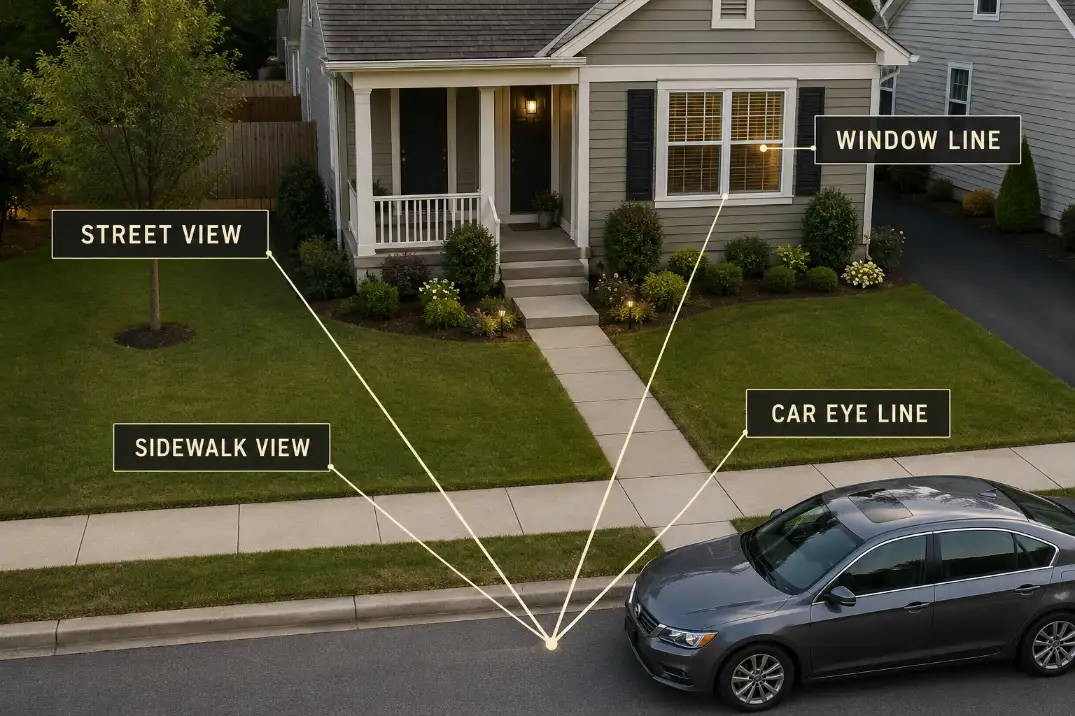
The fix starts by finding that path. A driver sitting in traffic, a person walking on the sidewalk, and headlights coming from an angled road do not see your window from the same height or direction.
If you add more screening at the curb without testing the actual angle, you can spend money, darken the front of the house, and still feel watched from the living room.
The better target is smaller: block the line that reaches the lower or most-used part of the window while keeping the front door, walkway, driveway mouth, and sidewalk clear.
Why Road-Facing Windows Feel Exposed Even After You Add Privacy
A busy-road window privacy problem starts inside the room. The uncomfortable part is not always that people can see the yard. It is that their line of sight reaches the sofa, dining table, hallway, or lit interior behind the glass.
That is why a hedge along the curb can look useful from the street but fail from the room. If the window sits higher than the hedge, or if the view enters diagonally from a sidewalk or stopped vehicle, the hedge may screen the lawn while leaving the glass exposed.
Moving traffic also changes the problem. A pedestrian sees from standing height. A driver sees from a seated position. A pickup or SUV may create a higher eye line than a compact car. A stopped car near a light, school pickup line, neighborhood entrance, or intersection can create a longer, slower look than passing traffic.
This is where the article needs to stay narrower than a general front yard privacy plan for busy streets. If your porch, driveway, entire lawn, and front seating area all feel exposed, you may need a broader plan. But when the main discomfort is what someone can see through the front window, the diagnosis should begin at the glass.
Find the View Line Before Choosing the Fix
Do the first test before buying plants or moving screens. Stand inside the room during the time of day when the window bothers you most. Look out and identify the exact outside position that feels exposed: sidewalk, curb lane, stopped cars, driveway edge, or an angled street approach.
Then test from outside in this order:
- Street test: Stand near the curb or parking lane and check whether the lower half of the window is visible.
- Sidewalk test: Walk past the window at normal sidewalk distance and note whether the view is straight in or diagonal.
- Car-height test: Sit in a parked car or crouch to a seated-driver height and check what part of the window lines up.
- Stopped-vehicle check: Test from the place where cars pause, such as near a stop sign, driveway, traffic light, or neighborhood entrance.
- Porch/window line check: Stand near the front walk and porch edge to see whether a small screen closer to the house would block more than a large hedge near the curb.
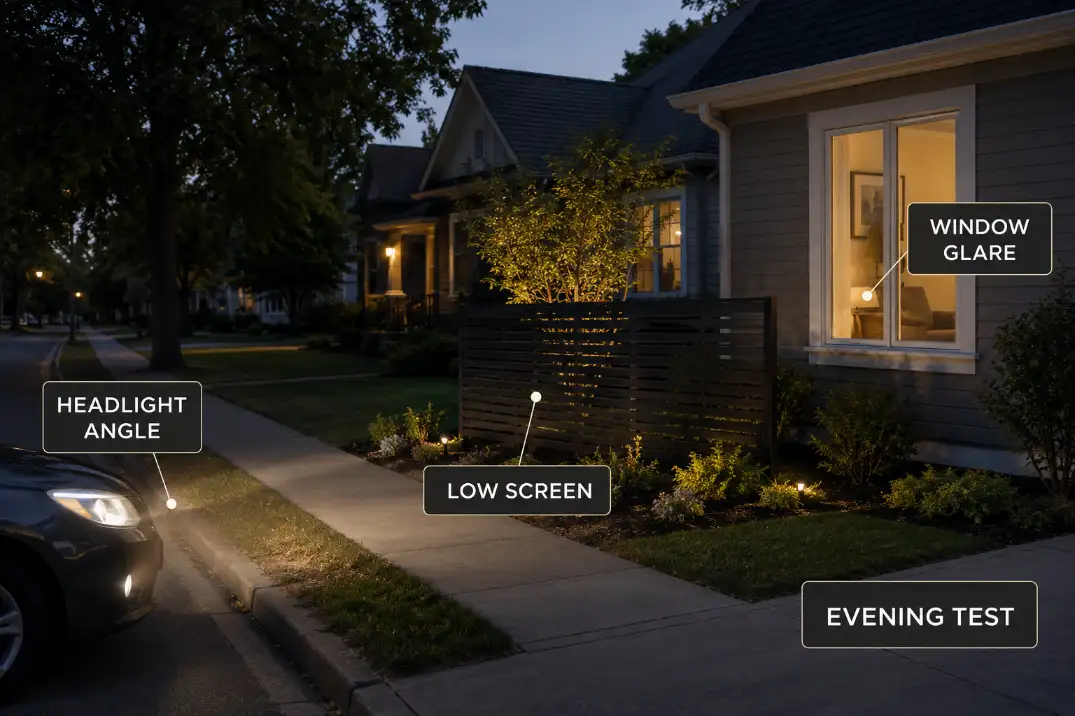
- Evening/headlight check: Repeat after dusk with interior lights on, because glass that feels private during the day can reverse at night.
| Exposure source | Best test position | Likely breakpoint | Fix direction |
|---|---|---|---|
| Passing pedestrians | Walk the sidewalk both directions | Diagonal view across the lower window | Narrow side screen or window-adjacent planting |
| Moving cars | Sit or crouch at car height near the curb | View reaches the lower or middle glass | Mid-height interruption between curb and window |
| Stopped vehicles | Test from stop sign, light, or driveway queue | Long direct view into the room | More solid partial screen near the window line |
| Headlights | Test after dusk with interior lights on | Beam or reflection hits the glass | Low angled screen, planting mass, or interior support |
| Raised trucks/SUVs | Test from a higher seated line | View clears low curb planting | Layered planting or taller narrow screen set back safely |
If one position keeps showing up in the test, that is your real target. If every position exposes the room, the issue is larger than a single window and should route into a broader front-yard privacy plan.
Match the Screen Height to the Window, Not the Property Line
The screen does not need to be tallest at the street. It needs to interrupt the line between the viewer and the part of the window that exposes the room.
A low window with a low sill may need screening closer to the glass because even a seated driver can look into the lower pane. A higher window may only need a mid-height interruption that breaks the eye line without hiding the entire front of the house.
The distance matters too: a screen close to the window can often be shorter than a screen placed far out at the curb because it cuts the view later in the line.
Do not judge height only from the sidewalk. Check the window from seated car height, standing pedestrian height, and the higher line of an SUV or truck. The fix should work from the most uncomfortable position, not from the easiest one.
This is also where plant size can become misleading. A young shrub may look too small in the first season but grow into the right height later. A fast-growing hedge may solve the view but become too bulky for the front walk or driveway edge.
The better decision is not “tall plant or short plant.” It is whether the mature size will block the exposure without swallowing the entry.

For homes with very shallow setbacks, this distinction matters even more. A screen placed at the wrong edge can make a small front yard feel closed while still missing the window angle.
For tighter houses, compare the window line with the kind of placement used in front yard screening layouts close to the street before assuming the curb is the right place to build mass.
Handle Headlights as a Separate Privacy Problem
Headlights are not the same as daytime privacy. A screen that blocks a person’s view may still allow low beams to hit the glass, especially if the road curves toward the house, the driveway points toward the window, or cars stop at an angle.
At night, the window can also reverse. With interior lights on, the room becomes easier to read from outside while the glass reflects more from inside. That is why a front room may feel private during the afternoon but exposed after dinner.
The evening test should answer two separate questions. First, can someone see into the room? Second, does light hit the window directly enough to create glare or a bright flash inside? If both are happening, an outdoor fix may need a lower, denser layer than a daytime screen alone.
Do not solve a headlight problem by building a tall wall across the front yard. A low offset screen, dense planting mass in the beam path, or a narrow solid element near the window line may handle the light without shutting down the entry.
Use Partial Window Screening Before You Build a Full Front Barrier
A full front barrier can work, but it is often too much for a window-specific problem. It can darken the house, hide the front door, crowd the sidewalk edge, and make the entry feel defensive. Partial window screening is more selective. It protects the room where the exposure happens while leaving the rest of the front yard readable.
Comparison Box: Partial Window Screening vs Full Front Barrier
Partial window screening
- Best when one or two windows are the main issue.
- Keeps the front walk and door more open.
- Can preserve daylight better than a full hedge or fence.
- Needs accurate placement because it only works if it hits the tested line.
- Easier to adjust as plants mature or traffic patterns become clearer.
Full front barrier
- Makes more sense when the porch, entry, lawn, and windows all feel exposed.
- Can reduce multiple view paths at once.
- Carries more risk of blocking light, entry visibility, and driveway sightlines.
- Requires stronger attention to local rules and maintenance.
- Can solve the wrong problem if the exposure is only at the window.
The decision is not whether full screening is “better.” It is whether the problem deserves that much structure. If the discomfort happens mainly from inside the room, start with the smaller interruption.
If the whole front of the property is exposed to constant traffic, then a broader street-facing front yard privacy landscaping plan may be the better parent route.
Place the Fix Where It Blocks the Breakpoint Without Closing the Entry
Once the view path is clear, the placement options become easier to judge. The fix should sit where it blocks the breakpoint, not where it looks most decorative on a planting plan.
Window-adjacent planting
This works when the view enters the lower or side portion of the window. A compact planting layer near the window can block the line without requiring a tall curb hedge. The plant should have enough mature spread to interrupt the view, but not so much that it presses against siding, covers the window completely, or creates constant trimming.
Narrow vertical screen
A narrow screen can help when the exposure comes from one diagonal sidewalk or street angle. The screen does not need to cover the whole window. It only needs to catch the path that reaches the room.
This is useful near a porch edge, along the side of a front walk, or inside a planting bed where a hedge would feel too heavy. It should not turn into a freestanding wall in the middle of the yard.
Layered low and mid planting
Layering helps when one height does not solve both pedestrians and vehicles. A low front layer can soften the curb view, while a mid-height layer closer to the house blocks the window line. This keeps the design from looking like one blunt hedge.
The mature size matters more than the first-day look. A layer that seems tidy when planted can become a walkway problem later if it leans into the path or grows wider than the bed can support.
Porch-side interruption
If the view enters from the side of the porch or across the front walk, a small screen near the porch edge may protect the window and still leave the door visible. This is often better than putting mass across the entire front.
The front entry still has to work. A privacy fix that makes visitors wonder where to walk has created a new problem. If the entry starts to feel hidden, use the same open-door logic behind front entry privacy that does not feel closed off and pull the screen away from the main approach.
Driveway and sidewalk edges
Do not place the fix where it blocks the driveway mouth or spills into the sidewalk. The tightest spot is usually where privacy, pedestrian movement, and driver visibility collide.
A screen near the driveway may need to be shorter, set farther back, or broken into layered planting instead of one solid panel. If the front yard already has an awkward driveway edge, use the privacy fix to preserve visibility rather than make the edge feel more blind.
That same boundary issue shows up in driveway edge problems in front yards, where a good-looking border can still create a practical problem.
The Common Mistake Is Fixing the Curb When the View Breaks Near the Window
The most common wrong fix is a good-looking curb hedge that does not line up with the actual exposure. From the sidewalk, it may seem to add privacy. From inside the room, the diagonal view still passes over it or around it.
Common Mistake Box: The Curb Fix That Still Fails
- The hedge screens the lawn but not the lower part of the window.
- The diagonal sidewalk view still reaches the room from one side.
- The hedge grows wide and starts crowding the sidewalk or driveway edge.
- The front yard feels more closed, but the window still feels exposed at night.
- A smaller screen near the window breakpoint would have interrupted the view more accurately.
This is not an argument against curb planting. It is an argument against using it before you know where the view breaks. A curb layer can be part of the solution, especially on a front yard with constant sidewalk traffic, but it should not be the only layer if the window line is higher, closer, or more diagonal than the curb can handle.
When the Yard Fix Needs Help From the Window Itself
Some windows need indoor support because the outside condition is too tight, too bright, or too direct. A very close road, a large picture window, a raised vehicle view, or nighttime interior lighting can overwhelm a subtle outdoor screen.
That does not mean the yard fix failed. It means the window is doing part of the exposure work. In those cases, the outside layer should still block the main view path, while the window treatment handles what remains.
The least intrusive support is usually at the lower portion of the glass. A frosted lower pane, adjustable shade, or interior light control can reduce the view into the room without making the house feel shut all day. The outdoor layer still matters because it changes what people see before their view reaches the glass.
Avoid turning this into a window-film-first solution. If the outside view path remains open, the room may still feel exposed whenever shades are up. The best combination is usually one outside interruption plus one window-level adjustment for nighttime or close-road conditions.
For small front yards where every inch of openness matters, front yard privacy for small yards without a fence can support the same idea: use targeted layers instead of one oversized barrier.
How This Window Fix Connects to Broader Busy-Street Privacy
Use this window-specific approach when the discomfort is mainly inside the front room. The diagnostic question is simple: where does the road view enter the window, and what is the smallest outdoor interruption that stops it?
Move to a broader busy-street privacy plan when the problem includes the porch, front walk, driveway, seating area, noise, dust, or full-yard exposure. At that point, the window is only one part of the front-yard system.
For a window-facing busy road, the cleanest fix is usually not more privacy everywhere. It is a better-placed layer at the breakpoint. Once that spot is clear, the right screen or planting choice becomes smaller, safer, and easier to maintain.
For local visibility and sidewalk rules near driveways or street corners, check your own city code; Phoenix’s street department gives a useful municipal example in its landscaping visibility requirements.