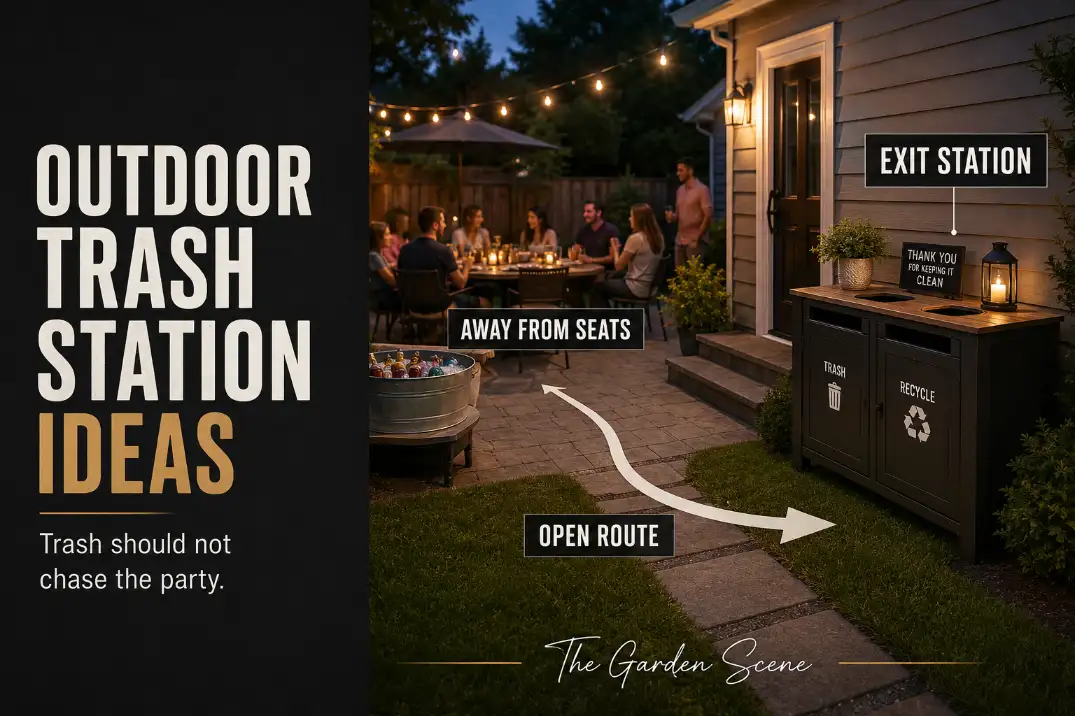
A good outdoor trash setup for parties should be visible, easy to use, and far enough from seating that guests do not feel like they are relaxing beside cleanup. The most common failure is not a lack of trash cans.
It is a drop point that guests cannot read in 1–2 seconds, a bin placed inside the walking route, or an open bag that fills, leaks, or catches wind before the party is halfway over.
For most backyard parties, start with one main waste point beside the exit or food-to-house route. Keep a 30–36 inch walking lane open, place the bin about 3–5 feet off the path, and use a 30–45 gallon lidded container if food is being served. If the bag reaches two-thirds full in the first hour, the setup is undersized or needs an overflow plan.
This is not ordinary backyard storage. For a 2–4 hour gathering, trash placement works more like temporary traffic control: it has to catch plates, cans, napkins, food scraps, and half-finished drinks before they spread across the patio.
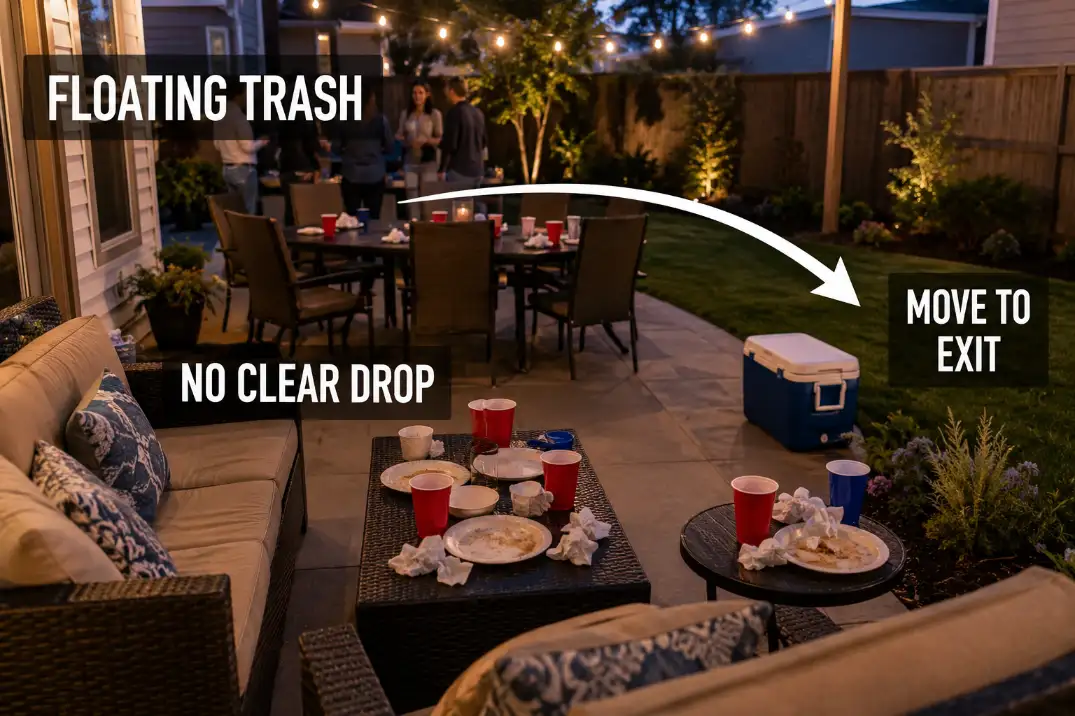
Trash Should Not Float Around
Trash floats around a party when guests do not know where the first easy drop point is. Once one paper plate lands on a side table, other people read that as permission. The mess spreads from there.
Start with one obvious drop point
The first useful idea is simple: create one visible place for waste before adding smaller bins. Guests are usually holding a plate, cup, napkin, or phone while talking. They will not hunt behind a screen, open an unfamiliar cabinet, or lift a heavy lid just to throw away a sticky paper plate.
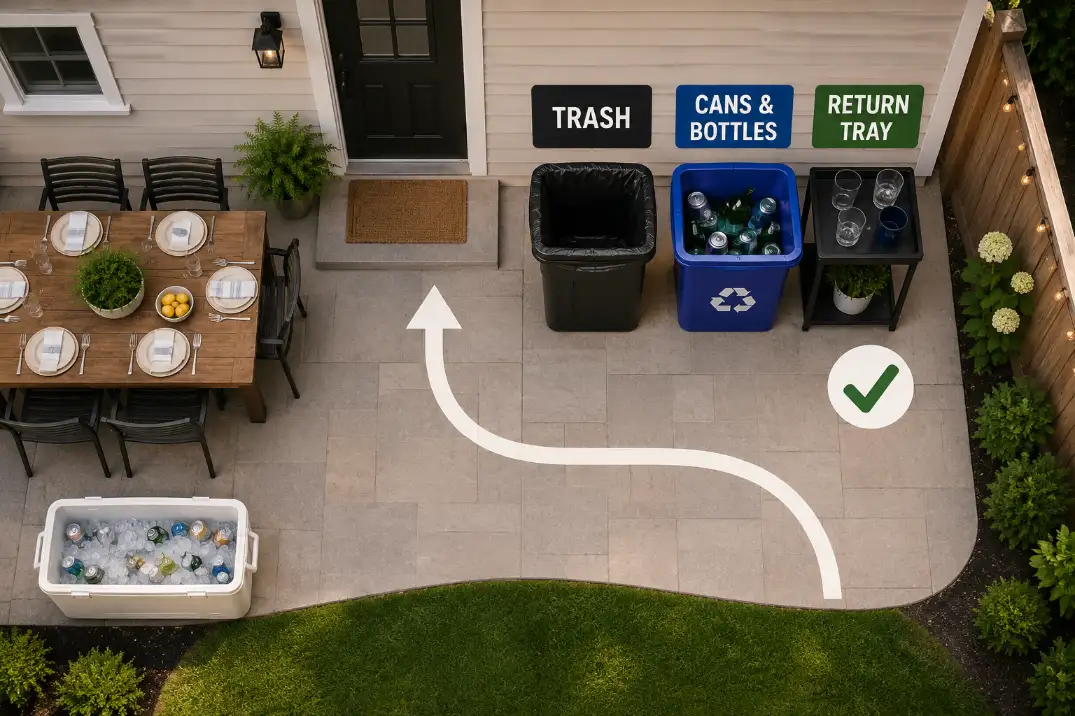
If the trash area is not obvious from about 10–15 feet away, the patio itself becomes the holding zone. A better setup gives one clear answer: trash here, cans and bottles here, reusable items here if needed.
That matters because party movement follows the easiest route, not the homeowner’s original layout plan. The same guest-flow principle shows up in Outdoor Entertaining Flow Ideas, where the issue is not decoration but repeated movement through the yard.
Wind makes a weak setup fail faster
Outdoor trash does not behave like indoor trash. Lightweight plates, napkins, wrappers, and empty cups can move across a patio once the bag is open, the lid is missing, or the bin is too light. Even a mild breeze can turn an open lawn-side bag into a scattered mess.
This is why an open contractor bag tied to a chair often disappoints. It looks easy at the start, but it has no structure, no lid, no clear label, and no clean edge for guests to use.
A lidded bin with a visible label is less casual, but it keeps the party from looking messy after the first 30–45 minutes.
Pro Tip: If guests ask where to throw something away more than once in the first half hour, the drop point is not visible enough.
Place It Near the Exit
The best place for an outdoor party trash station is beside the exit route, not beside the main seating area. Guests naturally carry waste when they leave the patio, walk back toward the house, move from the food zone, or pass through a gate.
Beside the route is not the same as in the route
The bin area should sit close to movement, but not steal movement space. Keep the trash container, recycling bin, and any small return tray outside the 30–36 inch clear walking lane. If the back door opens outward, leave the door swing clear. If steps are involved, do not place the setup where guests have to turn while holding a plate.
A strong working target is 3–5 feet off the main path and 6–10 feet from the back door, patio exit, or gate.
That keeps the drop point easy to notice without making guests step around it. If drinks are also near the same route, separate the drink stop from the waste drop so people are not crowding both at once. The same kind of repeat-stop planning is useful in Backyard Drink Station Ideas.
When the exit spot stops working
The exit spot is wrong if it pinches the only route between the house and the patio. A trash setup that forces guests to squeeze between a chair and a bin will feel like clutter, even if it is technically near the right place.
Test it with a plate and a drink in hand. If you have to turn sideways, step around a lid, or pause while someone else throws something away, shift the bin area to a side edge instead. Convenience should never cost the main walking route.
Hide Without Making It Hard
A party trash area can look clean without disappearing. Full concealment often makes it worse because guests hesitate to open something that looks like storage, furniture, or a closed utility box.
Screen the view, not the purpose
The best compromise is partial screening. A planter, fence return, side wall, or service cart can soften the view from the seating area while leaving the opening, label, or lid easy to see. The setup should be polite visually, but still obvious functionally.
The label should be readable before someone reaches the bin. Large words such as “TRASH,” “CANS & BOTTLES,” or “RETURN TRAY” work better than decorative tags. Small cursive signs may look better in a photo, but guests make this decision quickly and often from several feet away.
Decorative covers are secondary
A good lid and visible opening matter more than a beautiful enclosure. If food scraps, sticky cups, or disposable plates are involved, a lid that closes fully will do more for odor and insects than a stylish open basket hidden behind chairs.
Leave 8–12 inches of working clearance where the lid opens, especially if the bin has a swing lid or hinged top. If guests have to pull the bin forward, move a planter, or lift a heavy cover, the setup is too hard.
This is the same mistake that makes useful patio objects fail in tight layouts; Small Patio Serving Table Placement has a similar route-versus-object problem.
Separate Food and Recycling
Food trash and recycling should be paired, but not blended. The simplest useful layout is usually one lidded trash bin and one clearly labeled recycling container beside it. A third container only earns its place when the party creates a separate stream, such as reusable cups, returnable trays, or locally accepted compost.
Choose the setup that matches the party
For small gatherings, do not overbuild the waste area. A single exit-side lidded bin can be enough for 8–12 guests when most dishes are reusable. For 15–25 guests with canned drinks or disposable plates, use a trash-and-recycling pair. For 25+ guests, or any food-heavy party longer than 3 hours, plan for a bag change or a second ready-to-use bin.
A few simple ideas cover most backyards: an exit-side trash and recycling pair, a side-wall hidden bin area, a drink-zone return tray, or a garage-edge cleanup point with spare liners nearby. The best choice is the one that matches where guests already move.
If the same party also uses a serving cart, keep the cleanup point close enough to support the food route but not so close that guests confuse serving space with waste space.
A cart should help plates, drinks, and refills move cleanly through the party, while the trash-and-recycling pair catches guests after they are finished; Best Outdoor Serving Carts for Patio Parties fits that decision layer better than forcing the trash setup to do every job.
Pair the bins so recycling does not become extra work
If the recycling bin is across the yard, most guests will not use it. If it is beside the trash bin with a large simple label, cans and bottles are much more likely to land in the right place. The waste area should look like one decision point, not two separate errands.
Recycling also gets messy when guests toss half-full cans and bottles into the container. Liquid adds weight, attracts insects, and can leak through the bottom if the container has drainage holes or a loose liner. If canned drinks are the main beverage, place a small “EMPTY FIRST” cue near the recycling side or use a small pour-out bucket only if it can be handled cleanly.
Do not overcomplicate this. For most backyard parties, “TRASH” and “CANS & BOTTLES” are enough. Compost should only be added if your local program accepts the materials you are collecting and the container can be kept closed. A confusing third bin often creates more sorting mistakes than it solves.
| Party Waste Type | Best Container | Best Location | Common Mistake |
|---|---|---|---|
| Paper plates and napkins | 30–45 gallon lidded trash bin | Near exit or food route | Hiding it behind seating |
| Cans and bottles | Open-top or clearly labeled recycling bin | Beside trash | Sending guests to a second location |
| Half-full drinks | Small pour-out point only if managed | Beside recycling, not on seating side | Letting liquid leak into bags |
| Food scraps | Lidded trash bin | Away from seats and buffet edge | Using an open bag |
| Reusable cups or trays | Small return tub | Near drink or serving zone | Mixing reusable items with trash |
| Overflow bags | Spare liner stack or second ready bin | Behind the setup | Waiting until the bag is packed tight |
Keep It Away From Seating
Trash near seating feels convenient, but it usually fails in use. Guests do not want a bin beside their chair, and nobody wants food scraps, sticky cans, or a full bag near the conversation area.
Comfort beats reach
A good rule is to keep the main trash point at least 10–15 feet from the primary seating cluster when the yard allows it. On a larger patio or lawn setup, 15–25 feet can be better as long as the bin remains visible from the main route.
This is where homeowners often overestimate convenience. A container beside the sofa may be easy to reach, but it makes the seating feel less clean. A drop point near the exit requires a few extra steps, but it catches waste when guests are already moving.
Avoid the food-and-seat overlap
The worst spot is often between the buffet and the seating area. That location collects traffic from both directions. Guests stopping to throw away plates interrupt guests walking back with food, and the waste point becomes a standing obstacle.
If the patio already has a tight serving route, fix the food flow before adding another container. Trash should be the final stop in the party path, not a second crowding point beside the table.
For larger gatherings, support items can live behind the guest-facing area: extra liners, paper towels, a small broom, and a cleanup caddy. That back-of-house logic works especially well when the garage or side path already connects to the patio, as in Garage-to-Backyard Utility Zone Ideas.
Clean Enough for Guests
A party trash setup does not need to look expensive. It needs to stay clean when the gathering reaches its busiest point. The real test is not how the bin looks before guests arrive. It is whether the area still feels usable after the first hour.
Use the two-thirds rule
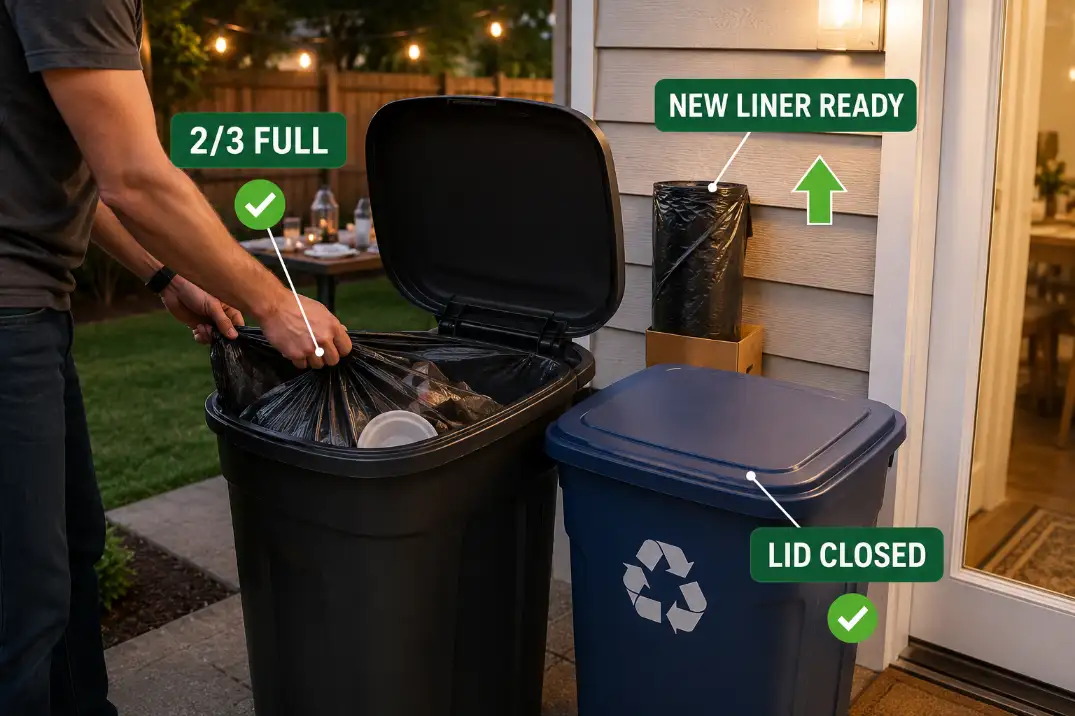
Replace the bag when it reaches about two-thirds full, not when trash is stacked above the rim. A packed bag is harder to lift, more likely to tear, and more likely to make guests balance plates on top instead of opening the lid.
For a food-heavy gathering, check the bin area every 45–60 minutes. For a short 2-hour gathering with 8–12 guests and reusable dishes, one bag may be enough. For a 3–4 hour party with 15–25 guests, disposable plates, and canned drinks, expect at least one bag change and a separate recycling container.
A healthy setup still has room inside the bin, a closed lid, and a clear label. A failing one has waste perched on top, liquid weight in the bag, or guests leaving cups nearby because the opening no longer feels clean.
Keep the backup invisible but close
Extra liners should not be stored where guests have to touch the trash area to find them. Keep them behind the bin, inside a nearby utility cabinet, or in a garage-side caddy. One useful trick is to place one spare liner under the active liner before the party starts. When the first bag comes out, the next bag is already in place.
If your permanent trash bins live in a narrow side yard, do not force guests to use that everyday storage zone during the party. Create a temporary guest-facing drop point and keep the permanent bins out of the main route. For tight side access, Trash Bins in Narrow Side Yard is a better planning reference than dragging the whole party toward the utility area.
Quick Outdoor Trash Station Checklist
- Keep one main trash point visible from the food or exit route.
- Preserve a 30–36 inch open walking path beside the bin area.
- Use a 30–45 gallon lidded bin for food-heavy parties.
- Add recycling when cans or bottles make up more than half the drink waste.
- Keep the main bin at least 10–15 feet from primary seating when possible.
- Check food-heavy setups every 45–60 minutes.
- Replace bags before they pass two-thirds full.
- Use large labels that guests can read in 1–2 seconds.
Questions People Usually Ask
Should outdoor party trash cans be hidden?
They can be partly hidden, but not fully hidden. A planter, side wall, or fence return can soften the view, but guests still need to see the opening and label quickly. If hiding the bin makes people ask where the trash is, the setup has gone too far.
Is one trash can enough for a backyard party?
One trash can can work for a small gathering, especially with reusable dishes. Once the party reaches 15–25 guests, uses disposable plates, or serves canned drinks, a separate recycling container and one planned bag change are usually safer.
Should I use a compost bin for food scraps at a party?
Only use compost if your local program accepts the materials and the container can stay closed. Many party items that look compostable are not accepted everywhere, and an open food-scrap bin near seating can create odor and insect problems.
Where should the trash station go on a small patio?
Place it on a side edge near the exit route, not directly beside dining chairs or in front of the back door. In a small patio, the open walking route matters more than hiding the bin completely.
Final Takeaway
The best outdoor trash station for parties is not the prettiest container. It is the setup guests can read quickly, reach while already moving, and use without interrupting seating, food service, or the back-door route. Start with one visible exit-side drop point, pair recycling only when it solves a real waste stream, and change bags before the area looks full.
For broader waste-reduction guidance beyond the party setup, see the EPA’s recycling guidance.