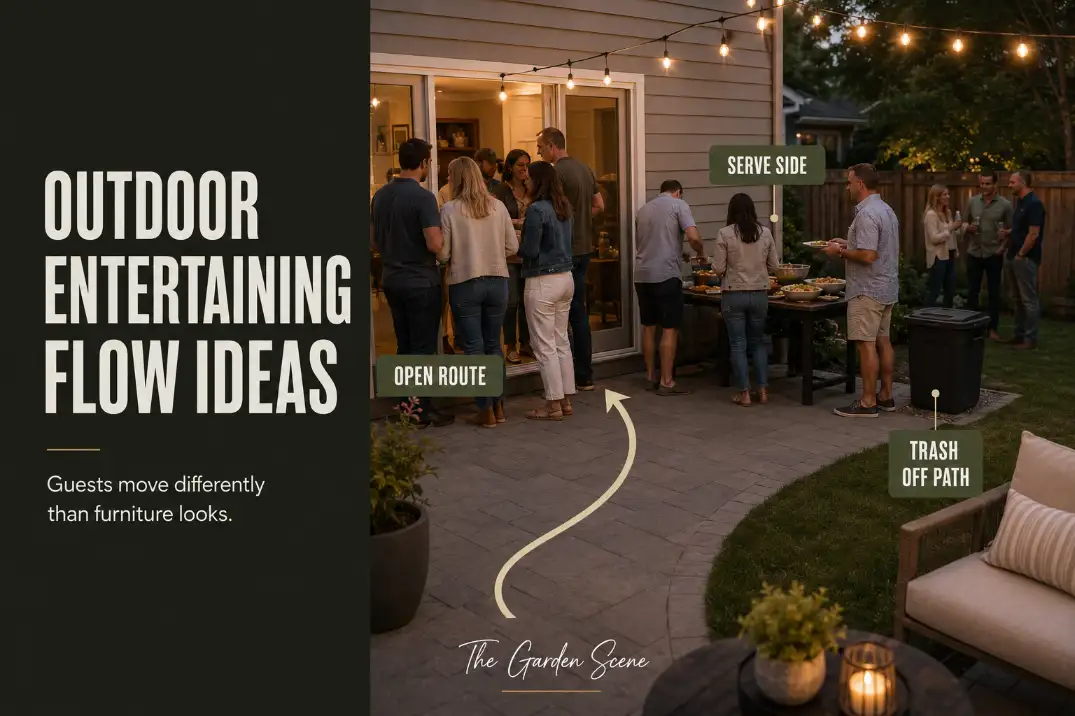
Outdoor entertaining flow ideas work best when they start with guest movement, not furniture placement. A patio that feels comfortable for two people can clog fast when 8–12 guests arrive, especially during the first 10–15 minutes when people step outside, greet each other, set down drinks, and look for food.
The first useful checks are simple: keep a 36-inch minimum walking route, leave 30–36 inches behind dining chairs, and keep serving, coolers, and trash out of the first 5–8 feet outside the back door.
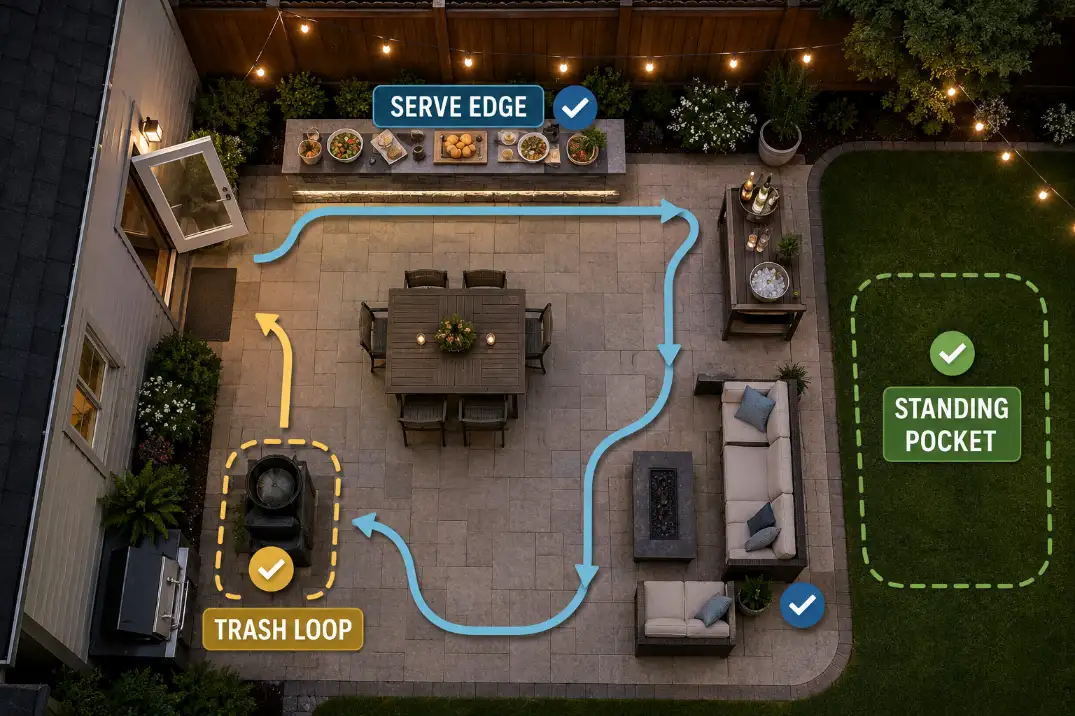
The safest layout usually starts with four decisions: move food to a side edge, keep drinks off the door route, leave one standing pocket open, and place trash after the food stop. A cramped seating area is the symptom. Broken circulation is the mechanism.
Guests Change the Layout
A backyard layout behaves differently when guests arrive because people do not use the space evenly. They collect near doors, pause beside food, hover around drinks, drift toward shade, and gather at the lawn edge while still blocking the patio if no open pocket exists.
Start With the Moving Guest, Not the Empty Chair
The first layout decision should be the guest route. Before deciding where every chair goes, trace four movements: door to drink, drink to food, food to seating, and seating to trash. If two of those routes collide in the same narrow strip, the patio will feel crowded even if the furniture technically fits.
For most patios, 36 inches of open passage is the minimum useful route. When people are carrying plates or drinks, 42–48 inches feels much calmer.
A walkway that narrows to 24 inches behind chairs may still look acceptable in a photo, but it becomes a stop-and-squeeze zone once guests start moving.
The same flow logic that keeps a daily patio usable also matters when planning better flow from the house to the patio, but entertaining exposes weak points faster because several people use the same route at once.
More Seating Is Not Always More Hospitality
Adding chairs until every expected guest has a seat sounds generous. It can also be the reason no one can move comfortably. One badly placed chair can block three people every time someone heads for food, the door, or the trash.
For casual entertaining, cover the core seats first, then protect open movement. Guests often stand for 20–30 minutes before settling, especially at the beginning of a cookout or backyard gathering.
A bench along an edge, two light movable chairs, and one open standing pocket often work better than a full furniture set that freezes the patio.
Pro Tip: Treat the first 6 feet outside the back door as a movement zone before placing any decorative planter, cooler, or spare chair there.
The First Traffic Jam
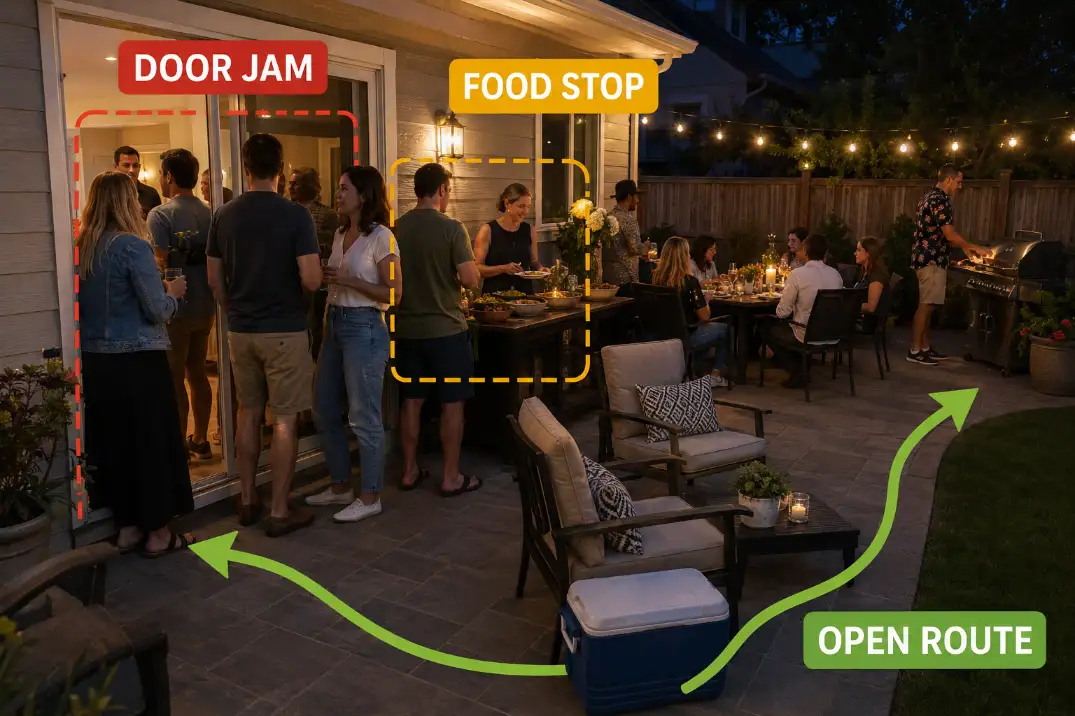
The first traffic jam usually forms before the party feels crowded. It appears at the decision point: guests step outside, close the door, greet someone, find a drink, or turn toward food. If all of that happens in the same few feet, the rest of the patio starts at a disadvantage.
The 30-Second Guest Flow Test
Before guests arrive, walk the party route once while holding a plate and drink. Open the back door, step onto the patio, reach the drink area, move toward food, pass the seating, find the trash, and return to the house.
If you have to twist your body, move a chair, step around a cooler, or pause within the first 5–8 feet, the layout is not ready for entertaining yet. That small test catches more problems than measuring the patio alone.
A clear door zone also helps with everyday use, especially if your patio has the same entry pressure described in keeping a patio entry clear.
The First Stop Belongs Off to One Side
Guests need a natural first stop, but it should not sit directly in the route. A drink tub, narrow console, or appetizer table works better 3–5 feet to the side of the main path than directly across from the door.
That shift creates a simple split. Guests who want food or drinks step aside. Guests heading toward seating or the yard keep moving. The fix is small, but the effect is large because the doorway stops acting like a waiting room.
Serving Without Blocking Doors
Serving is the strongest flow trigger in an outdoor entertaining layout. People do not visit a serving table once. They circle back for drinks, napkins, seconds, dessert, refills, and cleanup. If serving blocks the door or grill path, the patio keeps jamming all night.
Food Goes on the Edge, Not the Crossing
A serving table works best along a side edge, fence line, wall, or patio border where guests can approach, pause, and leave without standing in the main lane. Leave about 48 inches in front of the serving surface when possible. That allows one person to serve while another passes behind.
A central buffet may look balanced, but it usually performs poorly. The patio center should usually stay open for movement, not become the slowest stop in the party.
Drinks Pause Longer Than Food
Food lines tend to move. Drink stations often stall. People stop to choose, open, pour, add ice, talk, or set something down. That makes a cooler or drink table more dangerous to flow than it looks.
The drink station usually belongs near a social edge, not in front of the back door. A good arrangement lets one person linger at the cooler while another walks past with a plate. Food can sit closer to the serving route; drinks need a little more breathing room.
Keep Grill Work Out of Guest Traffic
The grill should not be treated like another casual station unless the cook is meant to be part of the guest route. Hot tools, open lids, smoke, and repeated trips from grill to prep area need their own working pocket.
A grill-prep-dining sequence should feel like a side workflow, not a barrier across the patio. If the grill keeps pulling guests into the cook’s path, the stronger fix is usually relocating the prep or serving surface, not asking guests to “use the other side.”
This becomes especially important when grill, prep, and dining layout already competes for the same few feet.
| Flow Area | Healthier Layout | Failing Layout | Practical Threshold |
|---|---|---|---|
| Back door | Opens into a clear landing | Opens into chairs, cooler, or buffet | Keep first 5–8 feet usable |
| Main route | Guests pass with plates | People turn sideways or stop | 36 inches minimum, 42–48 better |
| Dining chairs | Pull out without trapping the route | Seated guests block movement | 30–36 inches behind chairs |
| Serving table | Sits on a side edge | Sits across the crossing line | About 48 inches in front |
| Trash zone | Visible after food pickup | Hidden or placed at the entrance | Within 6–10 feet of food |
Seating That Still Moves
Seating should support the party, not freeze it. The most comfortable entertaining layouts often have fewer fixed seats than expected because they leave room for motion.
Remove the Chair That Blocks Three People
A spare chair is useful only if it does not steal the route. If one extra chair blocks the path from the door to the food, it helps one person while slowing everyone else.
For 4–6 guests, comfort seating can lead the layout. For 8–12 guests, circulation should lead. Once the group gets close to 15 people, many patios need overflow space at the lawn edge, side yard, or driveway-side path instead of more furniture packed onto the same slab.
This is where compact choices matter. The spacing logic behind patio dining set space becomes more important during entertaining because people are not just sitting once. They are pulling chairs, standing, turning, serving, and walking through with plates.
Leave One Standing Pocket Open
A party layout needs at least one open standing pocket. That pocket can sit near the lawn edge, beside the dining table, or between the lounge and serving area. It should be large enough for 3–4 people to stand without blocking the main route.
This is easy to underestimate because an empty pocket can look like unused space before guests arrive. Once the party starts, that same space becomes the place where people talk, wait, turn, and move without clogging the door.
Trash Has to Belong
Trash placement is not glamorous, but it changes how the party feels. When the trash bin is hidden too well, guests leave plates, bottles, and napkins on tables. When it is too visible or too central, the entertaining area starts to feel like a cleanup zone.
Trash Works Best After the Food Stop
Trash usually works best after the food stop, not before it. Guests should be able to pick up food, eat, move toward the side, and toss plates without walking back through the serving line.
Keep the trash within about 6–10 feet of the food area, slightly to the side, and easy to spot from the dining zone. If people have to ask where the trash is, it is too hidden. If people have to step around it to enter the patio, it is too dominant.
This is one of those practical details that decides whether the patio still looks usable 90 minutes into the gathering. A small waste station can be part of the layout without becoming clutter, especially if the rest of the patio follows the same logic used to reduce patio clutter without losing function.
Do Not Pair Trash and Drinks in One Pinch Point
Trash and drinks should not share the same tight corner. Guests revisit coolers often, and they pause longer than expected while choosing a drink. If the trash bin sits beside the cooler, two separate behaviors stack into one crowded stop.
A better setup is a drink station near the social edge and trash near the food exit path. That creates a small loop instead of forcing guests to back into each other.
A Party Layout That Breathes
A good entertaining layout does not need to look empty. It needs obvious places to move, pause, eat, clean up, and return. The strongest version is usually a loop, not a collection of zones.
Four Flow Ideas That Usually Work
The best idea depends on patio size, but these four patterns solve most party movement problems:
- Put food on a side edge instead of the patio center.
- Move drinks away from the back door so guests can pause without blocking arrivals.
- Keep one standing pocket open near the lawn edge or patio border.
- Place trash after the food route so cleanup does not cross the serving line.
These are small layout decisions, but they change how the patio behaves. A 10×12 patio with a clean side-serving route can feel easier than a larger patio where the buffet, chairs, cooler, and trash all fight for the same crossing lane.
When Weather Changes the Flow
Shade, heat, and evening light can quietly rewrite the party route. On hot afternoons, guests drift toward drinks and shade, so those zones need more clearance than they would on a mild evening. If the cooler sits in the only shaded passage, the whole party will collect there.
At night, people move toward light. If the brightest area is the doorway or food table, guests gather there even when seating exists elsewhere. Soft lighting near the standing pocket helps pull conversation away from the entrance and makes the open route easier to read.
When the Standard Fix Stops Working
Rearranging furniture stops making sense when the patio has no clear route after the essentials are placed. If the door, table, grill, and seating all require the same 3-foot strip, the real fix may be moving one function off the patio.
That could mean placing the drink station on a side wall, moving trash to a nearby utility edge, using the lawn edge for overflow seating, or serving from a narrow console instead of a full table. In some backyards, the best entertaining flow comes from letting the patio do less. A patio does not have to hold every function to host well.
Questions People Usually Ask
How much space should guests have to walk around outdoor furniture?
Use 36 inches as the minimum practical walking route. For party flow, 42–48 inches is better near serving tables, dining chairs, coolers, and the back door because people are often carrying plates, drinks, or bags.
Should the serving table go near the house or farther into the patio?
Near the house is convenient, but not if it blocks the door. The best spot is usually near the house but shifted to one side, so guests can get food without stopping the entry route.
Is it better to have more chairs or more open space?
For casual entertaining, more open space usually wins after the core seats are covered. Guests stand, move, and cluster more than homeowners expect, especially during the first 20–30 minutes.
Where should trash go during an outdoor party?
Place trash close enough that guests see it, usually within 6–10 feet of the food area, but keep it off the main route. It should feel like part of the cleanup loop, not part of the entrance.
For broader guidance on clear route planning, see the U.S. Access Board.