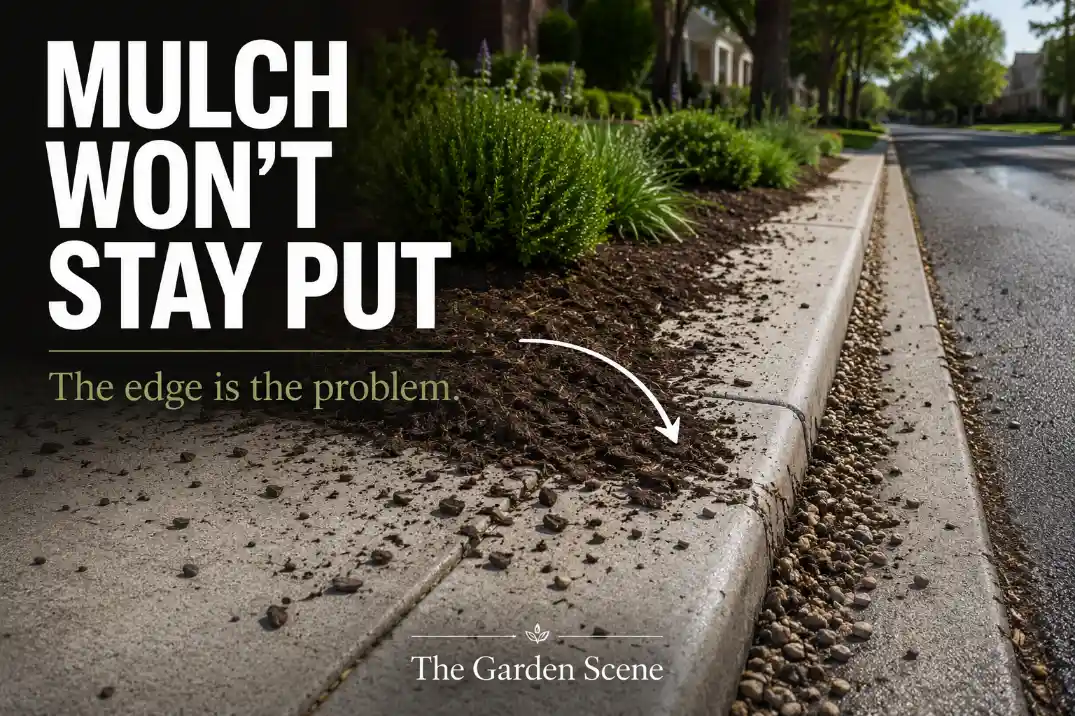
Sidewalk strip mulch and gravel control usually fails because loose material is being used in a place that behaves like a traffic and drainage corridor.
The same issue shows up in curb strips, parking strips, parkways, tree lawns, and “hellstrip” planting areas where soil sits between concrete, street runoff, and foot pressure.
Start with three checks: whether the mulch or gravel sits level with the sidewalk, whether people or dogs cut across the strip, and whether rain carries material toward the curb.
If material moves more than 6–12 inches after one heavy rain or one week of normal foot traffic, the issue is not just untidy landscaping. It is a containment problem.
The cleanest first move is to lower the loose surface below the concrete, then fix the crossing point or runoff path before buying more mulch, gravel, or edging.
Why Material Spills Out
The strip is usually too high
The most common cause is not the mulch brand, the gravel color, or even the edging style. It is grade. If the finished surface sits even with the sidewalk or curb, loose material has no real pocket to settle into. Shoes, paws, stroller wheels, trash bins, runoff, and leaf blowers all push it outward.
A normal planting bed can often carry a 2–3 inch mulch layer without much trouble. A narrow sidewalk strip is less forgiving. In many strips, a 1–2 inch settled layer is easier to control, especially near the sidewalk edge. Once mulch builds above the concrete, adding more only makes the failure more visible.
The target is simple: after watering and settling, the top of the mulch or gravel should sit about 1 inch below the sidewalk and curb edge. That small drop does more than a decorative border because it changes the way material moves.
More mulch is often the wrong repair
The most common wasted fix is topping up the strip every time it looks thin. That hides bare soil for a few days, then restarts the same spill pattern. If the bed is already too high, new mulch simply becomes the next layer that gets kicked, floated, or blown out.
If you need a blower every 2–3 days just to push mulch or gravel back into place, the blower is not maintaining the strip. It is confirming that the surface is too loose, too high, or too exposed.
For strips where water is part of the problem, watering technique matters too. Irrigation that hits the sidewalk first, runs across the bed, or beads on compacted soil can move mulch before a storm ever arrives.
For that specific failure pattern, Water Sidewalk Strip Without Runoff is the closer fix.
Foot Traffic Moves Everything
Shortcut traffic beats neat edging
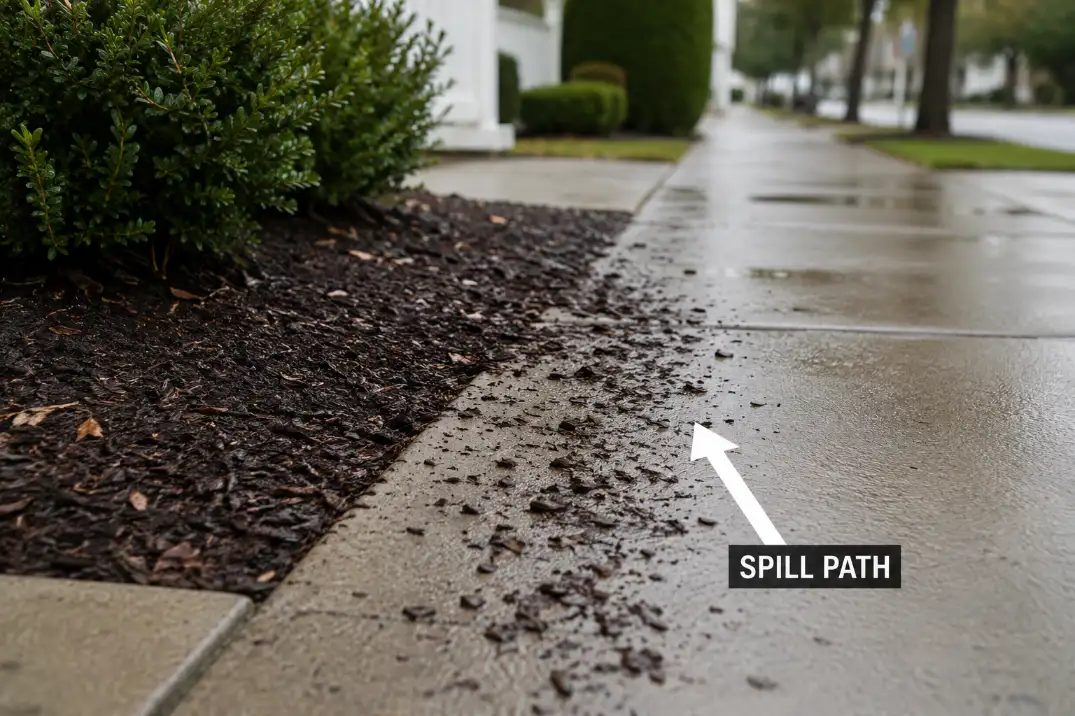
Foot traffic is usually underestimated. A strip may survive rain but fail near a mailbox, driveway apron, school walking route, bus stop, or corner lot where people naturally step through it. If the same 18–30 inch section keeps thinning while nearby areas stay intact, traffic is the main cause.
In real sidewalk strips, the worst spill point is often not the whole bed. It is one curb corner, mailbox shortcut, or trash-bin route that keeps resetting the surface.
Low decorative edging helps only when people are not crossing it. A 2 inch metal or plastic edge can hold mulch against casual movement, but repeated shortcut pressure will still drag material over the line.
Dogs, delivery drivers, kids, trash bins, and stroller wheels do not use the landscape the way the plan intended.
Give traffic one controlled place to land
If the shortcut is obvious, make it intentional. Flat stepping stones set flush with the surface and spaced about 24–30 inches center to center can stop random scuffing.
The goal is not to decorate the strip. It is to concentrate wear where it can do the least damage.
Where traffic is frequent, mulch should not be the only surface. Use tougher shredded bark in planted zones, pavers where feet land, and dense planting where you want to discourage crossing.
If bare soil reappears in the same line within 7–14 days, the route has already shown you where the repair belongs.
This is also why plant choice matters. A strip with constant shortcut pressure needs plants chosen for heat, edge stress, and recovery, not just curb appeal.
Front Yard Plants for Sidewalk Shortcut Traffic covers that plant-side decision more directly.
The Curb Edge Problem
The curb side gets hit twice
The curb edge is harder to control than the sidewalk edge because it gets pressure from both directions. Water runs along it. Car doors swing over it. Tires sometimes clip it. Street sweeping, leaf cleanup, and winter plow piles can all disturb it.
If gravel collects in the gutter after normal rain, the curb edge is not tall enough, the gravel is too small, or the strip is graded toward the street. Pea gravel is especially likely to wander because rounded pieces roll.
Angular crushed stone in the 3/8–1/2 inch range locks together better, but even angular stone needs containment on a strip that slopes toward the curb.
A useful grade check: if the strip drops more than about 1 inch across a 3-foot width toward the curb or sidewalk, loose material will keep moving unless you interrupt that movement with edging, planting, a hard crossing, or a different surface.
A visual border is not always a working edge
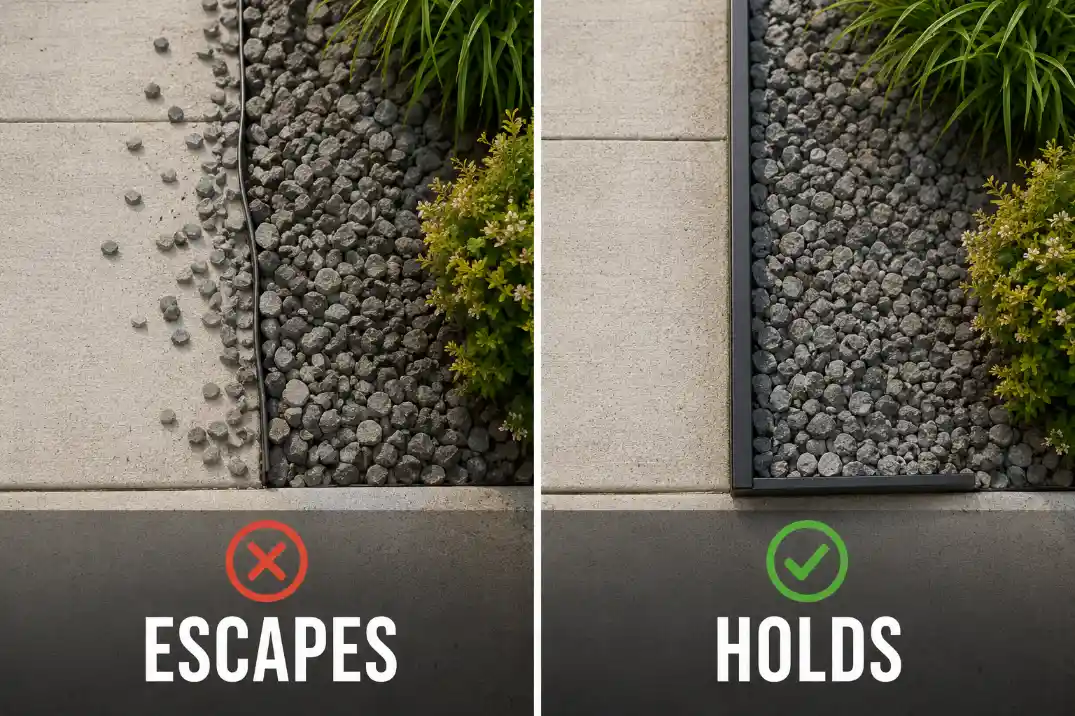
A curb-side border needs enough height and stiffness to resist movement. Thin edging that barely shows above grade may look finished, but it does not hold much.
A more useful edge has about 2–3 inches of exposed height, is anchored firmly, and sits tight enough that gravel cannot work underneath it.
Flexible edging can work in sheltered planting beds. Near a curb, it often lifts, twists, or separates. Once an edge shifts by even 1/2 inch, gravel starts finding the gap. After that, sweeping is not the repair.
Pro Tip: Before installing new edging, remove loose material from the edge line and compact the soil lightly. Edging set into fluffy soil usually shifts before the mulch or gravel does.
The Sidewalk Edge Problem
The walking surface raises the standard
The sidewalk edge is less forgiving than the curb edge because spilled material affects people using the walk. Mulch is messy, but gravel is more serious. Small stones on concrete can roll under shoes, scooters, strollers, and bike tires.
If gravel reaches the sidewalk more than once a week in normal weather, the strip has a control problem. Occasional cleanup after a major storm is normal. Repeated sweeping after ordinary use is not.
The first repair is still grade. Lower the finished material so it sits about 1 inch below the sidewalk edge. Then decide whether the strip needs a harder edge, a crossing point, heavier planting, or a different material.
This is where edging failure becomes obvious. The product may still be visible, but if it leans, lifts, or lets material pass underneath, it is no longer functioning.
If that is the pattern, Front Yard Edging Keeps Shifting is the more relevant repair problem than mulch choice.
Narrow strips need less loose surface
In strips under about 24 inches wide, loose material has very little margin for error. Every footstep, paw, rake pass, mower wheel, or bin wheel is close to an edge.
A narrow strip can still use mulch if it is planted densely, but a narrow strip of loose gravel often becomes a cleanup strip unless it has firm edging on both sides.
That is where the standard mulch refresh stops making sense. If the space is narrow, exposed, and crossed often, the better fix is usually less loose surface, not better loose material.
When Gravel Works Better
Gravel works better than mulch when the strip is hot, dry, exposed, and not heavily crossed. In dry western yards or Arizona-style heat, organic mulch can fade, blow, or break down quickly. Gravel can hold a cleaner appearance longer and does not need seasonal topping in the same way.
But gravel should be treated like a built surface, not sprinkled over soil. The better version has a compacted base, angular stone, and a contained edge. The failing version is thin pea gravel over uneven soil, especially beside a sidewalk.
When edging is not enough
If gravel shifts underfoot, edging alone may not solve it. That usually means the surface is too loose, too rounded, too shallow, or sitting over an unstable base. Angular gravel helps because the pieces lock together better than rounded pea gravel.
For a strip that must stay walkable or handle repeated crossing, a gravel stabilizer grid can make sense. It is most useful when the base is already corrected and the issue is lateral stone movement.
It is not a magic fix for runoff, high grade, or a strip that drains straight into the gutter.
| Condition | Mulch usually works better | Gravel usually works better | Watch point |
|---|---|---|---|
| Frequent foot traffic | Only with stepping stones | Only with firm containment | Loose gravel on sidewalk |
| Hot dry exposure | Can fade and thin fast | Holds appearance longer | Heat near plant roots |
| Heavy rain or runoff | Floats or washes if shallow | Moves if small and rounded | Edge height matters |
| Narrow strip under 24 inches | Better with dense planting | Risky without hard edging | Cleanup frequency |
| Repeated bin or stroller crossing | Needs a hard landing zone | May need stabilizer grid | Surface shifting under wheels |
Gravel is often overestimated as maintenance-free. It reduces replacement, but it raises the standard for containment. Once gravel spreads into lawn, sidewalk cracks, or curb gutters, it is harder to clean than mulch. In front yards where rock keeps migrating outward, Front Yard Gravel Rock Spreading Into Lawn is the same failure pattern in a wider setting.
When Groundcovers Are Cleaner
Plants reduce exposed loose material
Groundcovers are often cleaner than mulch or gravel when the strip has enough soil, enough water, and enough time to fill in. A planted strip does not eliminate maintenance, but it changes the job. Instead of sweeping loose material, you trim edges and manage growth.
Coverage is the key threshold. A groundcover that leaves 50% bare soil after the first season still needs mulch between plants, and that mulch can still move.
Once coverage reaches about 80–90%, there is much less loose material exposed to traffic and runoff.
In warm, irrigated regions, some groundcovers can reduce exposed mulch within one growing season. In dry western climates or colder northern zones, expect two growing seasons before coverage is reliable.
During that establishment window, the strip still needs temporary mulch control.
Choose groundcovers for edges, not just looks
The best sidewalk strip groundcovers stay low, tolerate reflected heat, and recover from light edge pressure. Plants that flop, seed aggressively, or creep across concrete create a different maintenance problem. Cleaner does not mean uncontrolled.
In humid climates, groundcovers may fill quickly but need more edging attention. In northern states, curbside salt and freeze-thaw cycles can thin plants near the street edge. In coastal California, mild winters help establishment, but compacted strip soil can still slow coverage.
Good strip planting also reduces how much mulch is needed. Instead of maintaining a full open mulch layer forever, you can use mulch temporarily while plants establish, then let foliage do the holding work.
For plant selection in this exact hardscape setting, Best Plants for Sidewalk Street Strip is the better guide than choosing general front-yard plants.
Quick Diagnostic Checklist
Use this before buying more material:
- Material moves 6–12 inches after one storm: fix grade, edge, or runoff first.
- Same bare line appears within 7–14 days: foot traffic is the main driver.
- Mulch or gravel reaches the gutter after normal rain: treat it as a drainage-path problem.
- Leaf blower cleanup is needed every 2–3 days: the surface is too loose or too high.
- Gravel reaches the sidewalk weekly: switch material, improve containment, or add a hard crossing.
- Strip drops more than 1 inch across 3 feet: loose material will keep migrating.
- Groundcover remains below 50% coverage after one season: expect mulch movement until plants fill in.
The Cleanest Fix Order
Lower the surface first
Do not start with new edging if the strip is overfilled. Remove loose material until the finished surface sits below the sidewalk and curb. This often changes the maintenance pattern before you buy anything.
Control the crossing point
If people, dogs, bins, or strollers cross the strip, add a controlled landing point. Trying to protect a shortcut with decorative mulch is usually a losing fight.
Strengthen only the edges that fail
Use stronger edging where material actually escapes: curb lines, sidewalk edges, driveway corners, and repeated crossing zones. A full border may look neat, but the repair value is highest at the spill points.
Change the surface when cleanup becomes routine
If sweeping is required every few days in normal weather, the surface choice is wrong for the strip. Mulch may need a lower finished grade, heavier shredded texture, or dense planting.
Gravel may need angular stone, a compacted base, better edging, or a stabilizer grid.
The strip is fixed when the route, grade, and edge are fixed first. Mulch, gravel, or groundcover only works after that.
For broader official mulch depth guidance, see the University of Minnesota Extension.