The best shade solution for a small backyard is not always the largest umbrella. It is the option that shades the seat, table, or lounge zone without stealing the walking path, crowding the furniture, or missing the sun angle that actually causes discomfort.
For most small dining patios, start with a 9-foot tilting market umbrella. For west-facing patios, look at side shade before buying a larger canopy. For lounge seating, consider a cantilever only if the base can sit outside the traffic path.
The buying mistake is simple: people shop by canopy size before checking where the pole, base, mount, or anchor will go.
In a small backyard, the real decision is not “How much shade can I buy?” It is “Where can shade live without making the patio harder to use?”
Quick Shade Match for Small Backyard Setups
| Backyard situation | Start with this category | Why it fits | Skip it if |
|---|---|---|---|
| Small 4-person dining table | 9-foot tilting market umbrella | Best balance of coverage, price, and footprint | The table has no center hole and no room for a base |
| 2-person bistro corner | 6.5–7.5-foot market or rectangular umbrella | Covers the table without overpowering the patio | The sun hits from the side after 3 p.m. |
| Lounge chairs or compact sectional | Cantilever umbrella | Keeps the pole out of the seating zone | The base would block the walkway |
| Narrow patio against a wall | Half umbrella or wall-mounted umbrella | Uses edge space instead of floor space | You need shade that moves around the yard |
| West-facing patio | Outdoor roller shade or side screen | Blocks low afternoon sun better than overhead shade | There is no structure to mount it to |
| Door-adjacent patio | Retractable awning | Preserves floor space near the house | You only need occasional movable shade |
This is a category-selection guide, not a brand roundup. The goal is to help you choose the product type that fits the patio before you waste money on the wrong version of a good-looking shade idea.
Start With the Patio Problem, Not the Product
Small backyards usually have one of three shade problems: overhead heat, low-angle sun, or layout conflict. Each points to a different buying decision.
If the table is hot at midday, an umbrella can work
When the sun is mostly overhead from late morning through early afternoon, a market umbrella is usually the most efficient first purchase. The pole can sit through the table, the base can stay tucked below, and the canopy shades the use zone without turning the patio into a permanent covered structure.
Look for a canopy that extends roughly 2 feet beyond the edge of the table on the sides where people sit. For many 4-person tables, that means a 9-foot umbrella. For a small bistro table, 6.5 to 7.5 feet is usually enough.
If your table is the main hot spot and the pole can sit through the center, this is the category to shop first. Prioritize tilt and base compatibility before paying for a larger canopy.
BEST FIRST BUY FOR DINING PATIOS
Tilting Market Umbrella
Best for small backyard dining tables where the pole can sit through the table. It gives useful overhead shade without needing the large offset base of a cantilever umbrella. Look for a 7.5–9 ft canopy, vented top, sturdy crank, reliable tilt, and a properly weighted base.
🔴 SHOP tilting market umbrellas
If the sun hits from the side, size will not solve it
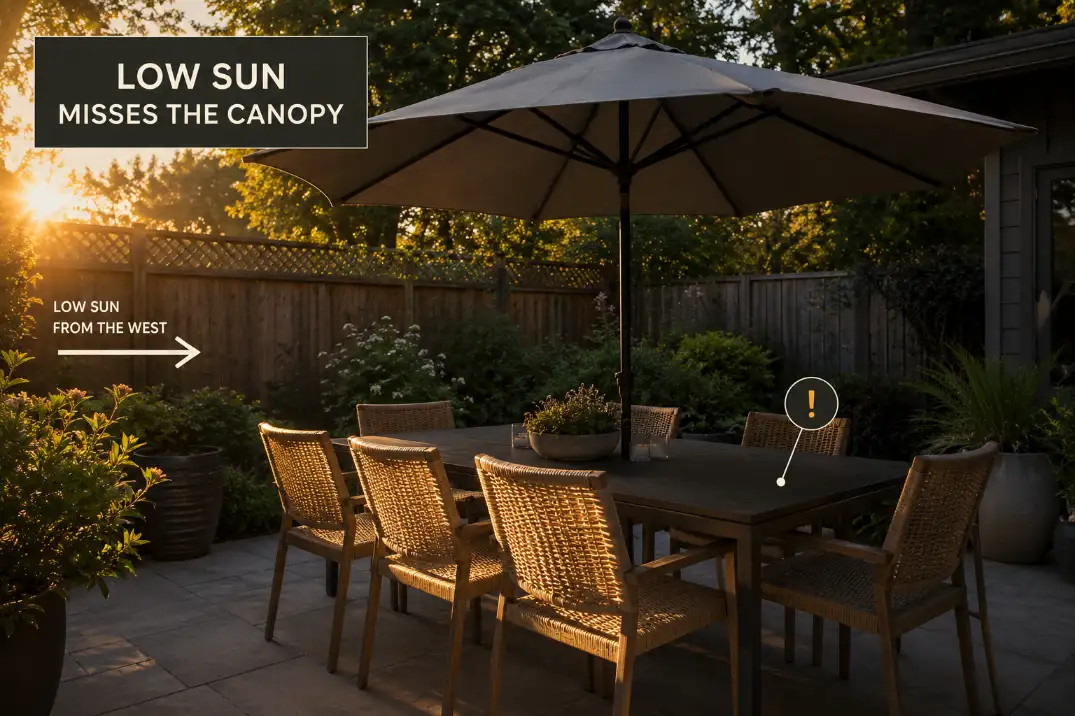
A larger umbrella does not fix low western sun if the rays come under the canopy. That is why west-facing patios often disappoint buyers. The umbrella may be well made, but the category is wrong for the problem.
If the worst glare arrives after 3 p.m., look first at side shade: outdoor roller shades, privacy screens, angled shade sails, or a wall-mounted shade. The visible symptom is a hot chair. The real buying need is directional sun control.
If the seat is still hot after 3 p.m., do not upgrade to a bigger umbrella first. Shop side shade first, because the product needs to block the sun’s direction, not just cover more air above the table.
BEST FIX FOR LOW AFTERNOON SUN
Outdoor Roller Shade
Best for covered patios, pergolas, and west-facing seating areas with strong side glare. It blocks the sun at the angle where umbrellas usually fail. Look for outdoor-rated fabric, secure mounting hardware, UV-blocking material, and smooth roll-up control.
🔴 SHOP outdoor roller shades
For patios where the main problem is late-day exposure rather than overhead heat, the buying logic is similar to the decision process in best patio shade solutions for afternoon sun: the shade has to meet the sun where it actually enters the space.
If the base blocks the path, the umbrella is already too big
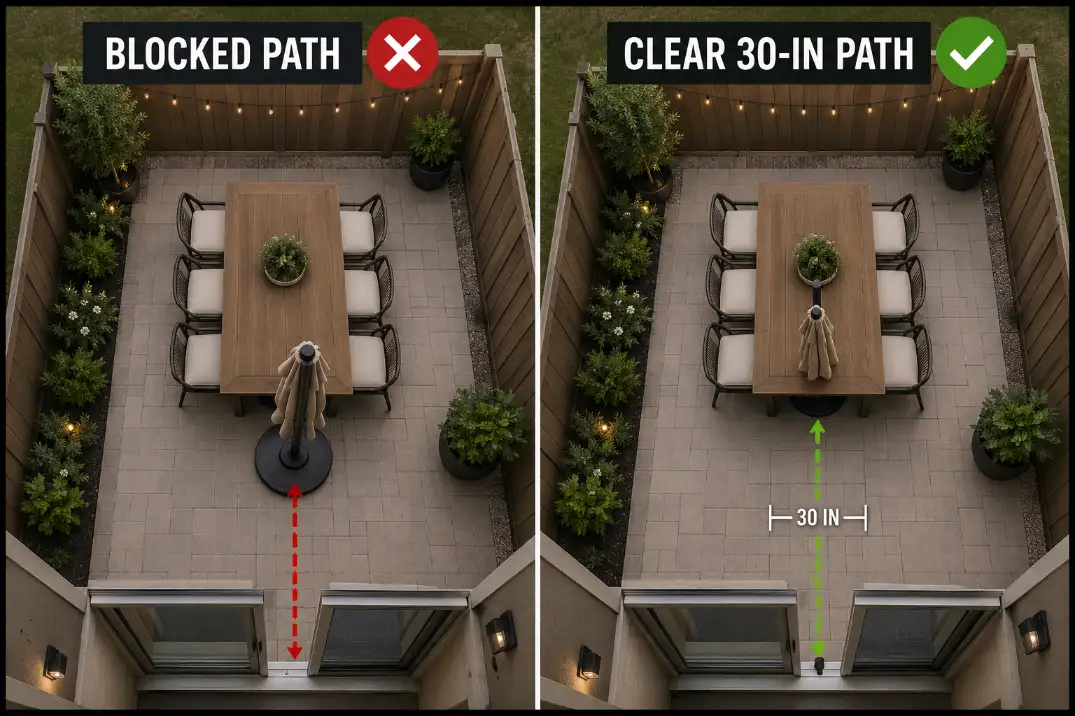
A small backyard can fail even when the shade coverage looks good. If the base sits where people walk, pull out chairs, carry food, or move between the door and grill, the shade solution is fighting the layout.
Keep at least 30 inches of clear walking path where people move often. If the only possible umbrella base location breaks that rule, stop shopping for freestanding umbrellas and consider mounted shade instead.
That is the same practical threshold behind adding patio shade without blocking walkways: the best shade is not helpful if it turns the patio into an obstacle course.
Best Patio Umbrella Categories for Small Backyards
Market umbrellas: best first choice for small dining patios
A market umbrella is the standard center-pole patio umbrella. It is the safest first category for small dining patios because it uses the table as part of the layout. The pole lands where the furniture already has a center point, and the base can often stay mostly out of the walking route.
Best for: small dining tables, bistro sets, patios where the shade target is centered.
Skip if: the table has no umbrella hole, the sun comes from the side, or the base would sit in the walkway.
Look for: a 6.5–7.5-foot canopy for bistro tables, a 9-foot canopy for many 4-person tables, tilt control, a vented canopy, and a base that matches the umbrella size.
The main reason this category wins is efficiency. It gives shade without asking the patio to absorb a separate offset frame or bulky side base.
Cantilever umbrellas: useful for lounge zones, but not the default small-patio buy
A cantilever umbrella places the pole and support arm off to the side. That makes it useful over lounge chairs, outdoor sofas, and sectionals where a center pole would interrupt the seating area.
The catch is the base. A cantilever umbrella often needs a large weighted base, sometimes with multiple plates. In a small backyard, that base must have a dead-space location: behind the seating, beside a wall, near a fence, or outside the main walking path.
Best for: compact lounge areas, outdoor sofas, seating without a center table.
Skip if: the base would land between the door and furniture, or if the patio gets frequent gusty wind.
Look for: a stable base system, 360-degree rotation if the shade needs to move, a vented canopy, easy close controls, and a frame that does not flex loosely when adjusted.
Cantilever umbrellas can be excellent when the base has a true home. But they are too conditional to be the first category for most small patios, especially when dining, doorway access, or narrow walking paths are the main constraints.
A cantilever umbrella can also make a patio feel visually heavier if the frame crosses the main view or the canopy hangs low over the seating area.
If the patio already feels tight, the shade choices in patio shade setups that make a patio feel smaller can help you decide whether the problem is shade coverage or visual crowding.
Half umbrellas and wall-mounted umbrellas: best when floor space is scarce
Half umbrellas and wall-mounted umbrellas are easy to overlook because they seem less flexible than freestanding options. In small backyards, that limitation can be an advantage.
A half umbrella works well against a wall, railing, or fence where a full round canopy would waste half its coverage. A wall-mounted umbrella removes the floor base entirely, which can be a major win near sliding doors, narrow patios, and small bistro corners.
Best for: narrow patios, side-yard seating, wall-adjacent bistro tables.
Skip if: you need shade that can move around the yard, or if the wall cannot support mounted hardware.
Look for: a compact projection, weather-resistant frame, secure mounting method, smooth fold-away action, and enough canopy depth to cover the actual chair position.
If the patio is too tight for any safe base location, do not keep shopping for heavier freestanding umbrellas. A wall-mounted patio umbrella is the cleaner category to browse because it moves the shade source to the edge of the space.
BEST SHADE WHEN FLOOR SPACE IS GONE
Wall-Mounted Patio Umbrella
Best for narrow patios, bistro corners, and door-adjacent seating where a freestanding base would block movement. It creates useful shade from the wall or fence side instead of taking up the walking surface. Look for strong mounting hardware, adjustable arm reach, weather-resistant materials, and fold-away storage.
🔴 SHOP wall-mounted patio umbrellas
Rectangular umbrellas: best for long tables and narrow patios
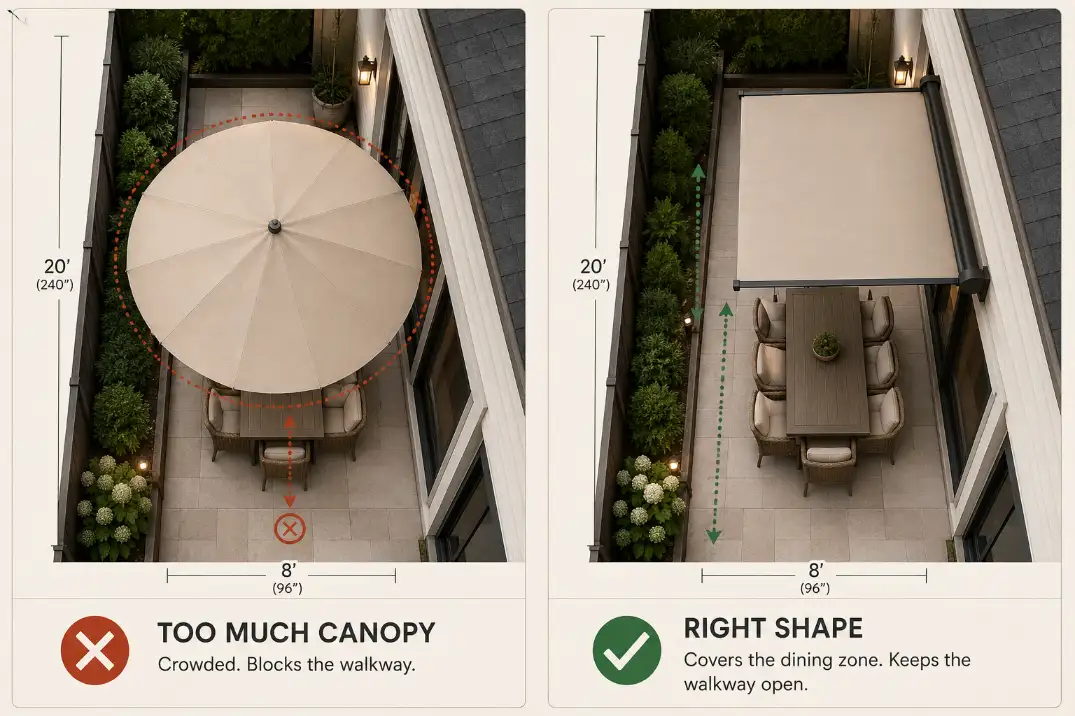
Round umbrellas are common, but they do not always match small backyard geometry. A rectangular umbrella can shade a long table or narrow patio more efficiently because its shape follows the furniture.
Best for: rectangular dining tables, slim concrete patios, long narrow outdoor rooms.
Skip if: the seating area is round or square, or if the umbrella would need to rotate often.
Look for: a canopy shape that matches the table, stable ribs along the long span, tilt if available, and enough clearance so the long edge does not hit walls, fences, or shrubs.
Rectangular umbrellas are not always the default choice, but they are often the smarter one when a round canopy would cover the fence, planting bed, and walkway before it covers both ends of the table.
Size and Base Guidance Before You Buy
A patio umbrella should be sized for the table and the usable patio space, not just the number of chairs.
| Table or seating setup | Practical umbrella size | Base target | Buying note |
|---|---|---|---|
| 2-person bistro table | 6.5–7.5 ft | 50 lb+ | Keep the footprint light and compact |
| 30–38 in. table | 7.5–9 ft | 50–75 lb+ | Good for 2–4 seats |
| 40–50 in. table | 9–11 ft | 75–100 lb+ | Check chair pullback carefully |
| Compact lounge zone | 9–10 ft cantilever | Often 150 lb+ system | Base location matters more than canopy size |
| Narrow patio | Rectangular, half, or mounted shade | Varies by system | Match the patio shape first |
A table hole does not replace a weighted base. It only helps stabilize the pole. If the product listing does not clearly state the base weight or base compatibility, treat that as a warning sign.
For small backyards, a slightly smaller umbrella with the correct base is usually better than a larger canopy with a marginal base. The first feels controlled. The second feels like a problem waiting for wind.
What to Look for in Fabric, Frame, and Controls
Fabric: buy for exposure, not just color
Polyester can be fine for occasional use or budget setups. It is common, affordable, and available in many colors. The tradeoff is that it may fade faster under repeated direct sun.
Olefin is a stronger midrange fabric class for homeowners who use the patio often but do not want premium pricing.
Acrylic performance fabric is usually the better long-term category for high-sun exposure, especially in hot, bright regions such as Arizona, Nevada, Texas, and inland California.
In humid areas like Florida, the Gulf Coast, and parts of the Southeast, drying behavior matters. Fabric that stays damp, traps debris, or is stored wet can become a mildew problem even if it looked good when new.
Frame: aluminum is the practical default
Aluminum is the easiest frame category to recommend for most small backyards. It resists rust better than exposed steel, weighs less, and suits everyday residential use.
Powder-coated steel can be strong, but scratches matter because corrosion can start where the finish fails. Wood looks warmer but usually asks for more care.
Fiberglass ribs are worth considering where ordinary wind movement is common because they flex better than rigid metal ribs.
Controls: tilt and closure matter more than extras
Built-in lights, fringe, and decorative details are less important than the controls you will touch every week. A crank should open smoothly. The tilt should lock firmly. A cantilever arm should rotate without wobbling or feeling loose.
If one person cannot close the umbrella quickly, it is less practical for real weather. In summer storm regions and windy neighborhoods, quick closure is not a minor feature.
When a Patio Umbrella Is the Wrong Purchase
The patio needs side shade, not more canopy
If the harshest sun hits after 3 p.m., a larger overhead umbrella is usually the wrong upgrade. Low-angle sun can slide under the canopy and hit the chairs directly.
This is where buyers often overcorrect. They move from a 9-foot umbrella to an 11-foot umbrella when the better fix is a vertical or angled shade source. More fabric overhead does not change the direction of the sun.
The patio needs rain cover, not just shade
Most patio umbrellas are shade tools first. They may shed light rain briefly, but they are not a dependable rain-cover solution for regular outdoor dining.
If the goal is to keep the patio usable during summer rain, leaf drop, or frequent drizzle, look at retractable awnings, roofed pergolas, or properly sloped fixed canopies.
A flat shade sail that holds water for hours after rain is not a better umbrella. It is an installation problem.
The only base location blocks movement
If the umbrella base blocks the sliding door, grill route, chair pullback space, or main walkway, do not keep trying to make the same category work. A mounted option, awning, or rectangular shade will usually age better in daily use.
This is the point where buying another umbrella stops making sense. The product category is not failing because of quality. It is failing because the patio does not have room for it.
If furniture spacing is part of the conflict, patio furniture layout by size can help clarify whether the shade or the seating plan should change first.
Fixed Shade Categories That Work Better in Tight Spaces
Retractable awnings: best for patios attached to the house
A retractable awning can be the strongest upgrade for a small patio that sits directly outside the back door. It shades the outdoor dining or lounge zone without adding a pole, base, or frame to the walking surface.
Best for: patios attached to the house, door-adjacent dining areas, repeat-use seating zones.
Skip if: the seating layout changes often, the wall cannot support mounting, or you only need occasional movable shade.
Look for: weather-rated fabric, strong mounting hardware, smooth manual or motorized operation, proper pitch for water runoff, and a projection that covers the seating without overwhelming the yard.
If the patio sits against the house and floor space is the main constraint, an awning is often a better category than any freestanding umbrella.
It solves shade without creating a new obstacle, especially where a base would sit directly in the door route.
Shade sails: useful, but only with real anchors
Shade sails can work well over small patios, but they are not casual fabric decorations. They need strong anchor points, proper tension, and enough slope to shed rain. In windy or storm-prone areas, weak mounting points are a bigger problem than fabric choice.
Best for: open patios with strong anchor points and a predictable shade zone.
Skip if: the only possible anchors are weak fence posts, fascia boards, or decorative structures.
Look for: UV-resistant fabric, reinforced corners, stainless or weather-resistant hardware, tensioning hardware, and a shape that can be installed with slope rather than flat.
A shade sail makes sense when the structure is already there or can be built correctly. If not, a mounted umbrella or awning may be a cleaner purchase.
Pergola canopies: best for permanent outdoor rooms
A pergola canopy works when the seating area stays in the same place all season. It creates a defined outdoor room and can support curtains, roller shades, or climbing plants.
Best for: permanent seating zones, outdoor rooms, patios where shade is needed every day.
Skip if: the backyard is already visually tight, airflow is poor, or the patio needs flexible open space.
Look for: open sides, adjustable canopy coverage, weather-resistant materials, and enough height so the structure does not make the patio feel compressed.
In a small backyard, the danger is overbuilding. A heavy pergola can make the yard feel smaller even if it solves the sun problem.
When shade, seating, and air movement all affect comfort, backyard layout, shade, seating, and airflow is worth reviewing before adding a permanent structure.
Five Checks Before Keeping a New Shade Product
Use these checks before the return window closes.
- The shaded area covers the actual seated position, not just the table center.
- The walkway still has about 30 inches of clear space where people move often.
- The umbrella or shade can be closed quickly by one person.
- The canopy does not flutter hard in light wind.
- The tilt, rotation, or roll-up control works smoothly without slipping.
- The fabric does not create harsh glare over light concrete or pale pavers.
- The base, mount, or anchor feels like part of the layout, not an obstacle added later.
If two or more of these checks fail, do not assume you just need a different color or slightly larger canopy. You may need a different shade category.
Where to Spend and Where to Save
Spend on stability, fabric, mounting, and control. Save on novelty features.
For umbrellas, the base and frame matter more than decorative lighting. For awnings, mounting quality and fabric durability matter more than remote-control novelty.
For roller shades, outdoor-rated fabric and reliable brackets matter more than a perfect indoor-style finish.
A cheaper category can still be the right answer. A simple tilting market umbrella may outperform a low-quality cantilever if the dining table already has a center hole.
A wall-mounted umbrella may outperform a larger freestanding option if the patio cannot spare floor space. The right product is not the most elaborate one. It is the one that fits the physical constraint.
Maintenance and Replacement Signs
Close umbrellas when they are not in use. That single habit protects the ribs, fabric, tilt joint, and base connection more than most accessories.
Let fabric dry before covering or storing it. In humid regions, trapped moisture can cause mildew. Near the coast, rinse salt and grit from frames and hardware.
In freeze-thaw climates, store removable canopies indoors through winter if possible.
Replace or downgrade the setup when the tilt lock slips, ribs bend, pole wobbles inside the sleeve, or the base shifts during ordinary breezes.
Those are not cosmetic issues. They are signs that the shade system no longer fits the exposure or use pattern.
Final Buying Verdict
For most small backyard dining areas, browse tilting market umbrellas first, especially in the 7.5- to 9-foot range. They give the best mix of shade, price, and compact placement when the table can hold the pole.
For west-facing patios with low afternoon sun, browse outdoor roller shades or other side-shade options before buying a larger umbrella.
For patios with no safe floor space for a base, browse wall-mounted patio umbrellas before trying to force a heavier freestanding setup. For lounge seating, consider cantilever patio umbrellas only if the base can sit outside the traffic path.
For narrow patios or long tables, look at half umbrellas or rectangular umbrellas before considering a large round canopy.
Do not buy more canopy until you know where the base, mount, or anchor will go. In a small backyard, the winning shade category is the one that improves comfort without making the patio harder to use.
For broader official guidance on outdoor sun protection, see the CDC Sun Safety guide.