Outdoor dining usually feels hot or glary for one of three reasons: the shade is aimed at the table instead of the people, the shade blocks sun but traps heat, or the setup ignores the low sun that arrives during the hours people actually eat outside.
Start with three checks: look at the table between 3 and 6 p.m., pull every chair out 24–30 inches, and see whether a 36-inch walking path still works behind the seats.
A patio can look shaded at noon and still fail badly by dinner because the sun slides under umbrellas, pergolas, and roof edges.
That is different from a furniture problem. If the table fits but people keep shifting chairs, squinting, or abandoning one side after 20 minutes, the shade layout is usually the weak point.
The Main Mistake: Shading the Table Instead of the Meal
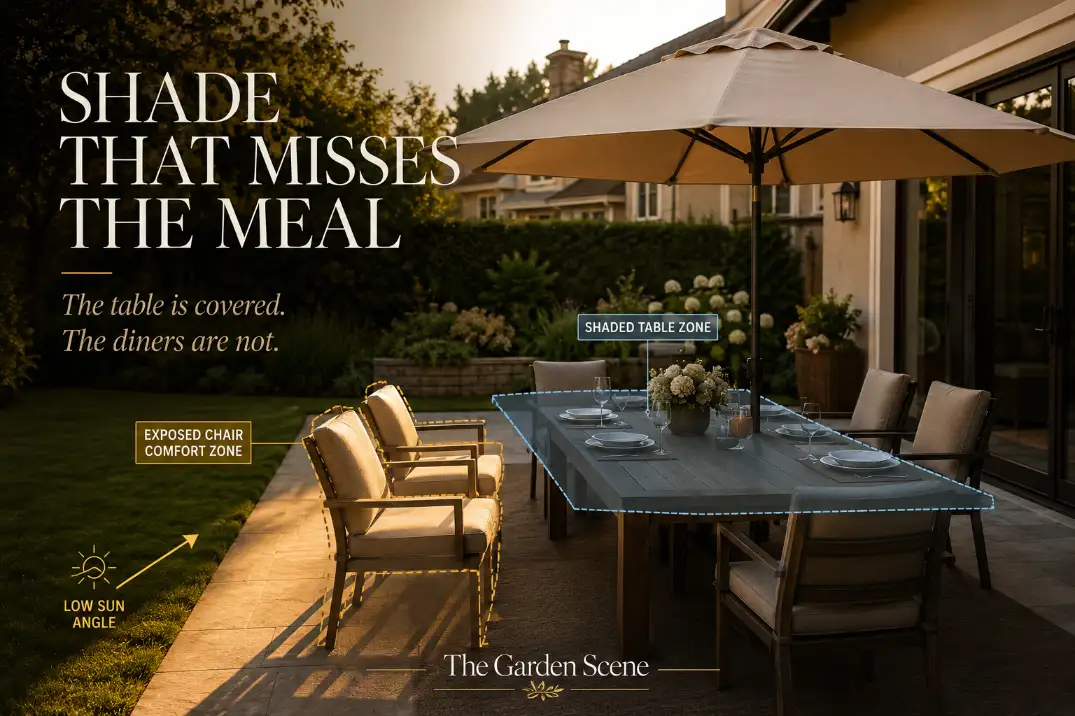
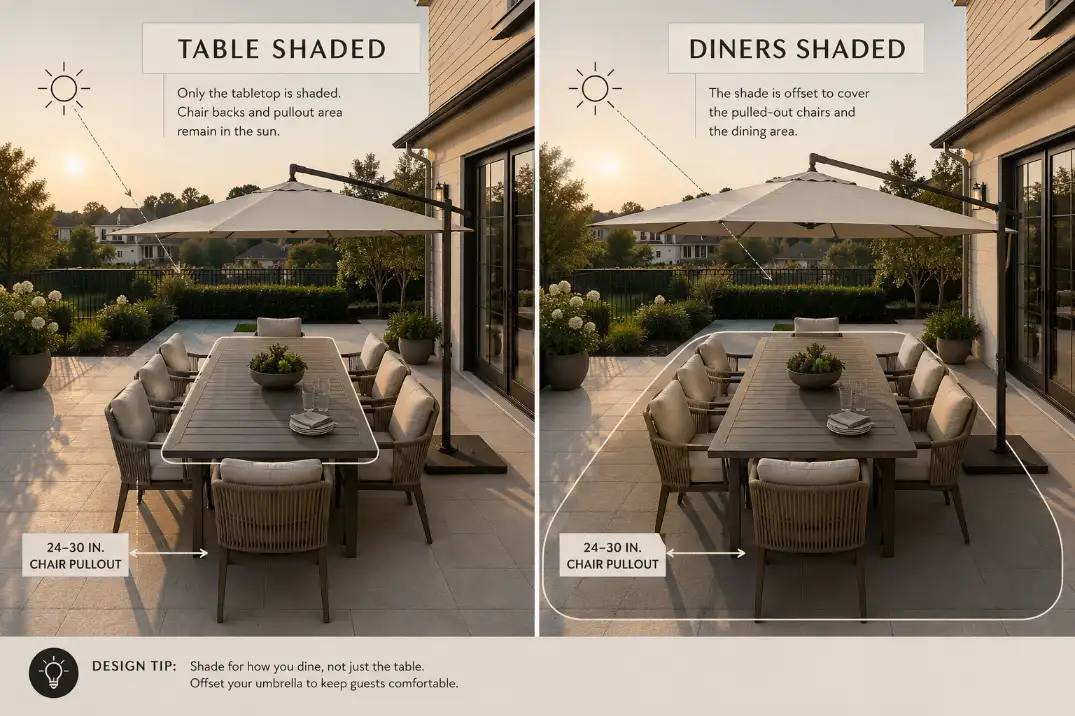
The most common shade mistake is aiming at the tabletop instead of the full dining footprint. A six-person rectangular table may only be 36–42 inches wide, but the usable dining zone often needs 9–10 feet across once chairs are pulled out and people walk behind them.
The chair zone is the comfort zone
A shade plan that covers the center of the table but leaves chair backs in sun will still feel harsh. People do not sit in the middle of the umbrella pole; they sit around the edges. On a hot patio, even 12–18 inches of exposed sun on someone’s shoulders can make a seat feel unusable before the meal is over.
This is why small umbrellas disappoint so often. A 7.5-foot umbrella may work for a compact bistro table, but it rarely protects a full dining set once the sun drops lower.
For a six-person table, a 9- to 11-foot umbrella or offset canopy is often more realistic, and even then, placement matters more than diameter alone.
Rectangular tables add another problem: round umbrellas often shade the middle while the long ends remain exposed. If the table shape is long, the canopy has to protect the pulled-out end chairs, not just look centered over the tabletop.
Noon shade is the wrong test
The useful test is not “Is the table shaded at noon?” It is “Is the seating shaded when we actually eat?” In much of the US, the uncomfortable period is late afternoon into early evening, especially on west-facing patios. If the sun hits diners from the side between 4 and 6 p.m., overhead shade alone will not solve it.
A better starting point is to map the shade at noon, 3 p.m., and 5 p.m. If one side of the table becomes exposed for more than 30–45 minutes during your normal meal window, treat that as a layout problem, not a minor inconvenience.
The same issue shows up in broader patio planning, where shade, seating, and circulation have to work together rather than as separate purchases. That is why a dining setup often improves faster when you look at backyard layout, shade, seating, and airflow as one system.
What People Usually Misread About Shade Comfort
Shade can reduce glare, lower surface temperature, protect diners from direct sun, or make the whole patio feel cooler. Those are related, but they are not the same. A setup can fix one problem while leaving the others untouched.
Cosmetic shade is not comfort shade
A pergola with widely spaced rafters may photograph beautifully while doing little at dinner hour. If it blocks 30–40 percent of overhead light but lets low sun hit faces, it is more decorative than functional. The symptom is glare and squinting. The mechanism is not “too little shade everywhere”; it is the wrong shade angle.
This is also where homeowners often overestimate young trees and light vines. They soften the patio visually, but they may need 3–7 growing seasons before they cast useful dining shade. Living shade is valuable, but it rarely solves this weekend’s dinner problem.
For patios where the issue is specifically late-day exposure, it is worth separating general coverage from the more targeted problem of patio shade problems in afternoon sun. The fix is often angle control, not simply more overhead coverage.
Shade can trap the discomfort it was supposed to solve
Shade that blocks sun but stops air movement creates a different kind of discomfort. Solid side curtains, dense screens, and low canopies can reduce direct sun while making the dining area feel still and humid.
In Florida, the Gulf Coast, and parts of the Southeast, a shaded patio with poor airflow can feel sticky even when direct sun is gone.
A useful threshold: if smoke from a grill, citronella candle, or blown-out match hangs around the dining area for more than 20–30 seconds on a mild day, airflow is probably too restricted. That matters more than adding another fabric panel.
Pro Tip: Leave at least two open sides whenever possible. Shade above and one screened side usually feels better than shade above plus three blocked sides.
Use the Seat Test Before Buying More Shade
A good dining shade plan should be tested from the chair, not from the doorway. The view from inside the house often makes the patio look more functional than it feels once someone is actually sitting there.
Test every seat at the real meal time
Pull each chair out 24–30 inches and sit there for 10 minutes during the hour you normally eat. Ten minutes matters because glare, stored heat, and still air often feel tolerable for the first minute, then become obvious once you stop moving.
Mark the first seat that fails. Does it fail because sun hits the face? Because shoulders are exposed? Because the paving radiates heat from below? Because the chair blocks the walkway? Or because the air feels dead under the canopy?
Those answers point to different fixes. Face glare usually needs side shade. Shoulder sun usually needs a larger or better-positioned canopy. Heat from below usually means the patio surface absorbed too much sun earlier. Blocked circulation means the furniture and shade hardware are competing for the same space.
Do not confuse a bad seat with a bad table
If only one or two seats fail, the table size may be fine. The more likely problem is shade position. If all seats feel hot even in shade, the stronger suspect is surface heat or trapped air. That distinction saves money because replacing the dining set rarely fixes a shade-angle problem.
If This Is the Problem, Start Here
The fastest way to avoid wasting money is to match the fix to the failure pattern.
| What happens during dinner | Most likely mechanism | Start with this fix |
|---|---|---|
| Table is shaded, but chairs are exposed | Shade footprint is too small or centered wrong | Larger canopy, offset umbrella, or shifted shade position |
| Faces are still in sun after 4 p.m. | Low-angle side glare | Side screen, west-side planter, angled shade, or cantilever umbrella |
| Everyone feels sticky under cover | Airflow is blocked | Open one or two sides before adding more fabric |
| Patio stays hot after sunset | Surface stored heat earlier | Earlier shade over paving, lighter surface, or planted edge |
| Umbrella keeps rotating or lifting | Wind exposure exceeds the setup | Better anchoring, heavier base, retractable shade, or different shade type |
| Chairs fit only when pushed in | Dining footprint is underestimated | Rework table position before adding posts or bases |
Which Shade Type Fits the Problem?
Most shade products can work in the right situation. The mistake is treating them as interchangeable. A market umbrella, cantilever umbrella, sail, pergola, awning, tree, and side screen solve different problems.
| Shade type | Best for | Usually fails when |
|---|---|---|
| Market umbrella | Small round or square dining sets | Low sun reaches chair backs |
| Cantilever umbrella | Rectangular tables and flexible coverage | Base blocks circulation or is underweighted |
| Shade sail | Larger dining footprints | Anchors are too low or fabric sags |
| Pergola | Permanent structure and visual definition | Slats do not match the sun angle |
| Retractable awning | House-adjacent dining | Wind exposure or shallow projection limits coverage |
| Tree shade | Long-term cooling and surface comfort | Immediate dinner-hour shade is needed |
| Side screen | Low-angle glare from west or southwest | It blocks the only breeze |
The fix that often wastes time
Tilting a too-small umbrella is usually a temporary patch, not a real solution. It may shade one diner while exposing another, and it often narrows the walking route around the table. Once the umbrella has to be tilted every 15 minutes to keep people comfortable, the issue is scale, placement, or sun angle.
A more useful move is shifting the shade source toward the incoming sun so it intercepts light before it reaches the chairs. For some patios, that means a cantilever umbrella. For others, it means a sail shade or vertical screen at the edge of the patio.
If the entire shade structure makes the patio feel tighter, the problem may not be heat alone. Some layouts create discomfort because the shade visually lowers the space or crowds the route around furniture, which is common in patio shade setups that make a patio feel smaller.
Fabric Choice Can Fix Glare but Worsen Heat
Shade fabric is not just a color choice. It affects glare, heat, airflow, UV exposure, and maintenance.
Dark fabric is not automatically more comfortable
Dark canopy fabric often cuts glare better than pale fabric, but it can make the area underneath feel heavier if the patio has poor airflow. Light fabric may feel brighter and cooler, but if it is too translucent, diners may still squint through it.
The better question is not simply “light or dark?” It is whether the fabric blocks enough direct sun without turning the dining zone into a low, stagnant pocket. Breathable outdoor fabric often feels better over a dining area than stiff, plastic-like material, especially in humid climates.
UV protection does not fix bad placement
A high-UPF canopy can protect the area it covers, but it does not help the chair that sits outside the shade line at 5 p.m. Product specs are useful only after the footprint and sun angle are right.
Water-resistant fabric also needs realistic expectations. In rainy Midwest springs, coastal California moisture, or humid southern summers, fabric that stays damp can mildew if it is folded or stored wet.
If the canopy cannot dry within a day after rain, removable fabric and seasonal storage become part of the maintenance plan, not an optional detail.
The Real Comfort Problem Is Often Underfoot
A shaded dining area can still feel hot if the surface around it keeps radiating heat. Concrete, pavers, and dark composite decking can store heat for hours. In Arizona, inland California, Texas, and other hot-summer regions, the patio surface may keep releasing warmth long after the sun moves away.
Surface heat lingers after shade arrives
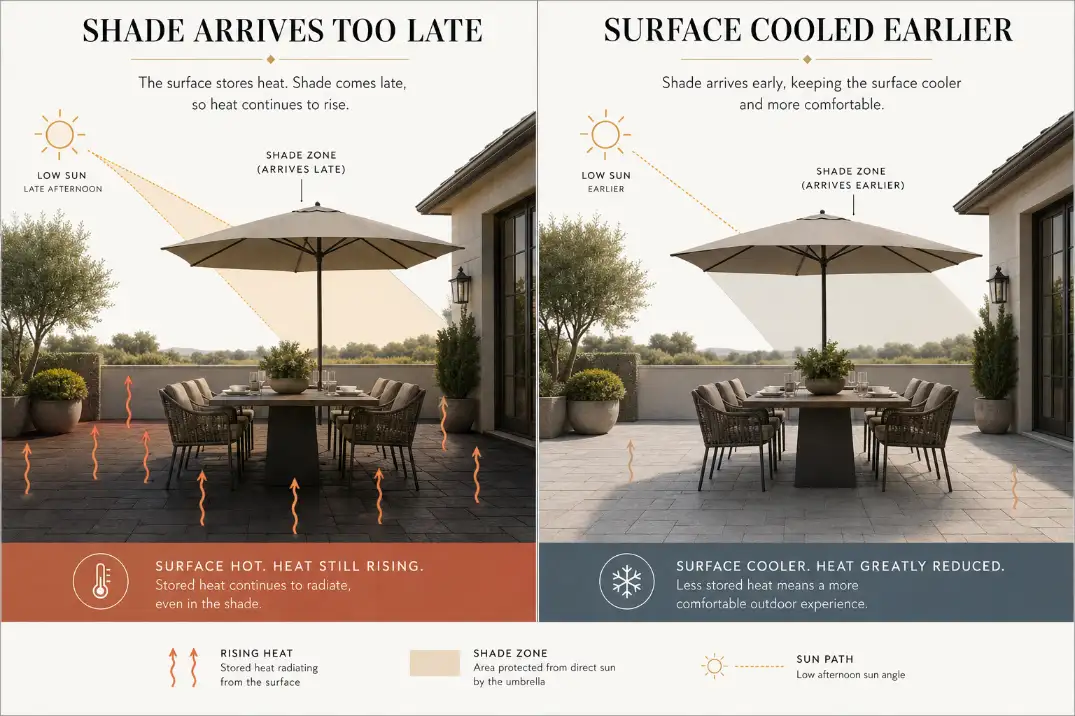
This is where people underestimate thermal mass. Shade at 5 p.m. does not instantly cool a patio that has baked since noon. A dark hardscape can remain uncomfortable for 1–3 hours after direct sun ends, especially if there is no breeze.
A practical comparison: a shaded planting bed or lawn edge may feel comfortable underfoot while nearby dark pavers still feel hot through sandals. That does not mean the shade failed. It means the shade arrived too late to prevent heat storage.
Living shade cools differently than fabric shade
Fabric shade mainly blocks direct radiation. Trees and planted areas also cool through evapotranspiration, which is why a tree-shaded edge can feel different from a fabric-covered slab. Living shade can reduce both direct exposure and the heat held by nearby surfaces, but it is a long-term comfort strategy rather than an instant fix.
If diners are shaded but still feel heat rising from below, another overhead canopy may not change much. The better fix is earlier shade, lighter surface materials, a breathable outdoor rug rated for drainage, or moving the dining area away from the hottest paving.
Wind and Anchoring Can Change the Right Answer
Wind is not a side issue. It determines whether a shade choice stays comfortable, safe, and usable.
A moving umbrella is not a minor annoyance
If an umbrella shifts, rotates, or lifts during ordinary afternoon gusts, the base is undersized or the site is too exposed. A heavier base may help a small market umbrella in a sheltered patio, but it is not always enough for a cantilever umbrella in an open yard.
Open patios, corner lots, coastal backyards, and desert areas with gusty afternoons need more serious anchoring decisions. Shade sails need properly placed anchor points with enough height and tension.
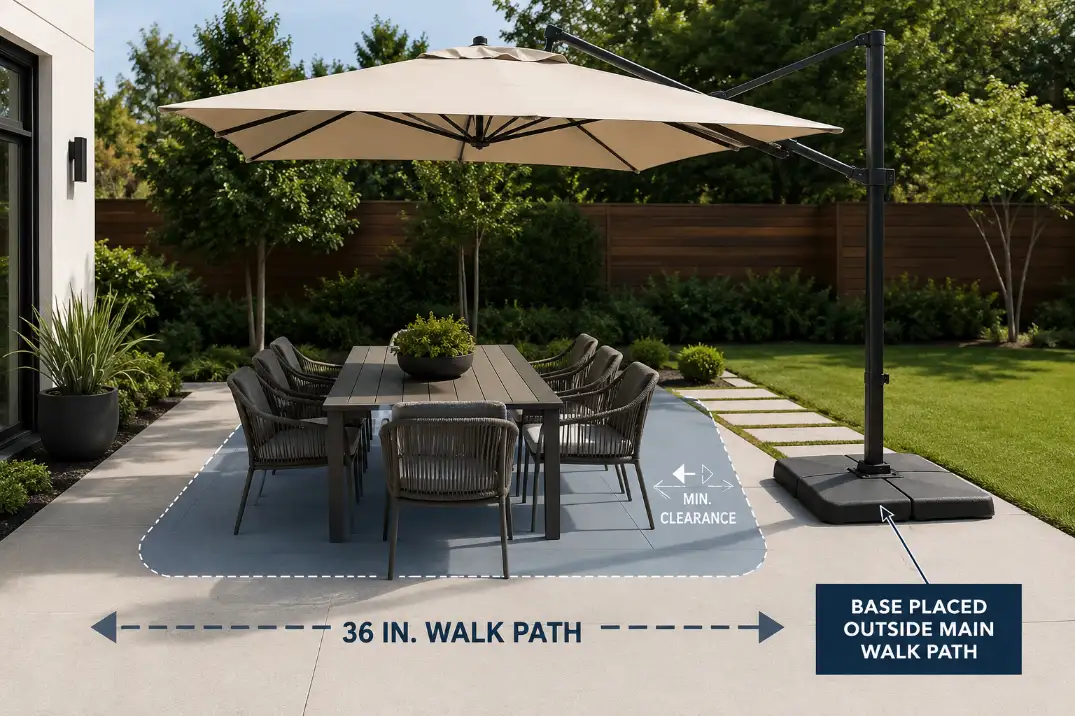
Cantilever umbrellas need a base that does not steal the main walking path. Retractable awnings need to be used within their wind limits, not treated like permanent roofs.
Know when the DIY fix stops making sense
A small freestanding umbrella is one thing. A high-tension shade sail, wall-mounted awning, permanent post, or large cantilever umbrella in an exposed yard is another. If the shade depends on structural attachment points, footings, or hardware mounted to the house, manufacturer instructions and local wind exposure matter more than guesswork.
This is where a routine fix stops making sense: if you have to add more straps, weights, clips, and tie-downs every month, the shade type is probably wrong for the site. In storm-prone areas, a removable canopy or retractable setup may outperform a fixed fabric installation that spends half the season at risk.
For patios where afternoon sun is the main trigger, the strongest solutions are usually angled, side-positioned, or adjustable — not generic all-day shade.
How to Fix the Shade Without Making Dining Harder
The right fix should improve comfort without blocking chairs, doors, grill paths, or air. If the shade solution makes serving food or moving around the table harder, it is only solving half the problem.
Start with the dining footprint
Measure the table with chairs pulled out, not pushed in. Most dining chairs need about 24 inches just to pull back and 36 inches if someone needs to pass behind. A table that technically fits under a canopy may still fail if the shade pole lands in the main walking route.
If space is already tight, review the dining layout before buying a bigger shade structure. The clearance logic in how much space a patio dining set needs matters because shade hardware can steal the exact inches people need most.
Prioritize side control before more overhead cover
For outdoor dining, side exposure often deserves more attention than the roofline. A roof overhang or pergola may handle midday sun but do very little when the sun drops below the shade edge.
A vertical screen, tall planter, hedge, exterior shade panel, or offset umbrella can outperform a larger overhead cover when glare is coming from the side.
That does not mean closing the patio in. The goal is to block the sun path, not build a box.
Keep shade hardware out of the work zone
Dining comfort includes serving, refilling drinks, pulling chairs out, and walking between the table and kitchen. A center umbrella pole can be fine for a round table, but it often gets awkward with rectangular dining sets.
Offset umbrellas and sail shades can free up the table surface, though they need proper anchoring and enough room outside the dining footprint.
Pro Tip: Before installing permanent shade, mark the posts, pole, or anchor points with buckets or painter’s tape for one meal. If people walk into that zone twice, the layout is wrong.
When the Standard Fix Stops Working
A bigger umbrella is the obvious fix, but it stops working when the discomfort comes from direction, heat storage, wind exposure, or poor air movement.
Use a bigger shade only when coverage is the problem
Upsizing works when the shade shadow is simply too small. It does not solve side glare by itself unless the canopy can tilt or sit in the right position.
It also does not solve a still, humid patio. In covered patios, the better answer may be opening the sides, raising the canopy effect, or improving ventilation.
That is especially true under roofs, awnings, and enclosed structures. If the space feels heavy and stagnant, the better next read is often covered patio ventilation mistakes rather than another shade-buying guide.
Use side shade when the sun is hitting faces
If the table is shaded but people still squint, the problem is usually side glare. A 4- to 6-foot-tall screen, vine panel, slatted fence section, or tall planter can be more effective than adding more overhead fabric. Keep it offset enough that it does not trap heat or block the main breeze.
Use earlier shade when the surface stays hot
If the patio remains uncomfortable after sunset, the surface absorbed too much heat earlier in the day. In that case, a shade sail, awning, or tree canopy that starts shading the paving by early afternoon may outperform a dinner-only umbrella. Lighter paving, rugs, or nearby planting can also reduce the heat load, but only if drainage and maintenance still work.
Quick Diagnostic Checklist
Use this before buying another umbrella or adding permanent posts:
- At your normal dining time, are all chairs shaded when pulled out 24–30 inches?
- Does low sun hit faces from the west or southwest for more than 30 minutes?
- Does air feel still under the shade, especially on humid evenings?
- Is the patio surface still radiating heat 1–2 hours after direct sun leaves?
- Do shade poles, posts, or anchors interfere with a 36-inch walking path?
- Does the shade fabric reduce glare without making the dining zone feel stagnant?
- Does the shade choice match the site’s ordinary wind exposure?
The Bottom Line
The shade mistake that matters most is misreading the comfort problem. Outdoor dining needs shade over people, not just furniture; side protection when the sun is low; enough open space for airflow; and surface cooling early enough that the patio does not keep giving heat back during dinner.
Start with the hour you actually eat, the seats people avoid, and the direction of the sun. If one side of the table fails every evening, fix the angle.
If everyone feels sticky under the cover, fix airflow. If the whole patio still feels hot after the sun moves, shade the surface earlier or reduce heat-holding materials.
That sequence prevents the common mistake of buying more shade while leaving the real discomfort untouched.
For broader official guidance on how landscape shade affects outdoor heat, see the U.S. Department of Energy.