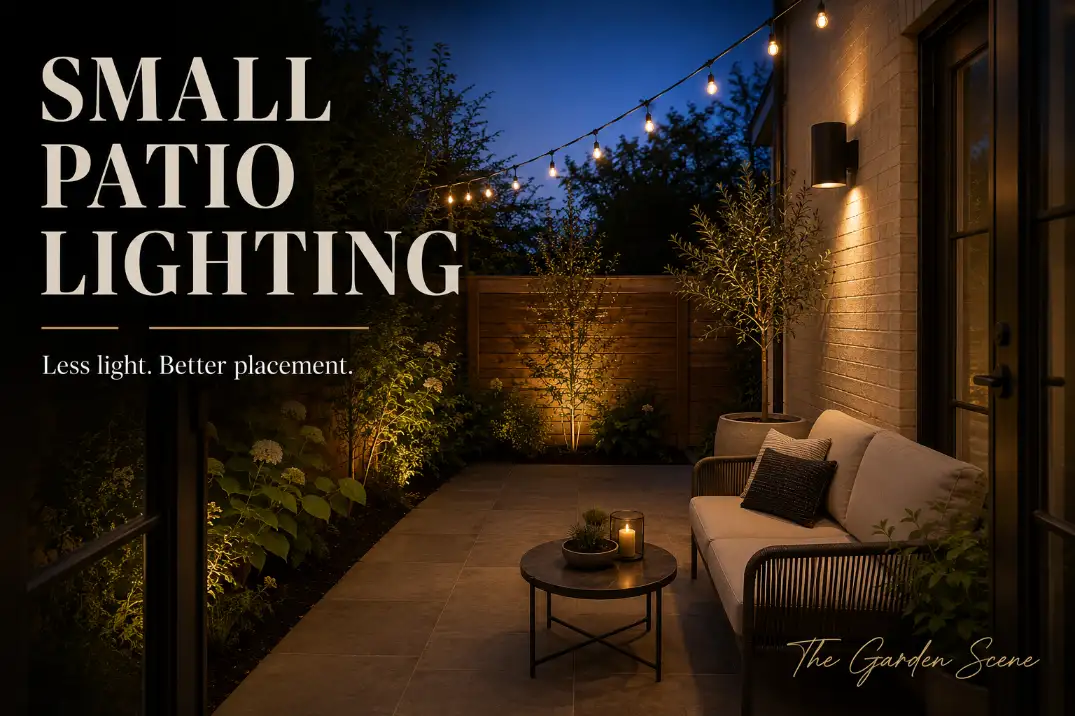
A small patio usually feels cluttered at night for one of three reasons: too many visible fixtures, light aimed into people’s eyes, or lamps placed where the furniture already needs breathing room.
The fix is not simply “use fewer lights.” It is to put light on the edges, walls, posts, railings, or overhead structure so the patio reads as one calm outdoor room instead of a collection of glowing objects.
Start with three checks: whether any bulb is visible at seated eye level, whether cords or lamps steal more than 10–15% of the usable floor edge, and whether the brightest thing you notice is the fixture instead of the table, step, doorway, or seating area.
A small patio under 150 square feet often needs only 2–4 light sources. It starts to feel busy when every corner gets its own lantern, stake light, or decorative accent.
This is different from a patio that is simply too dark. Darkness is a brightness problem. Clutter is a layout problem that lighting makes more obvious.
The Rule That Keeps Small Patio Lighting Clean
Use the edges before the floor
On a compact patio, the floor is the most expensive real estate. A 9×12 or 10×12 patio may only have 90–120 square feet for seating, door swing, circulation, planters, and maybe a grill.
Freestanding lanterns, solar stakes, and decorative lamps look harmless in the store, but once chairs are pulled out and people are moving around, they become obstacles.
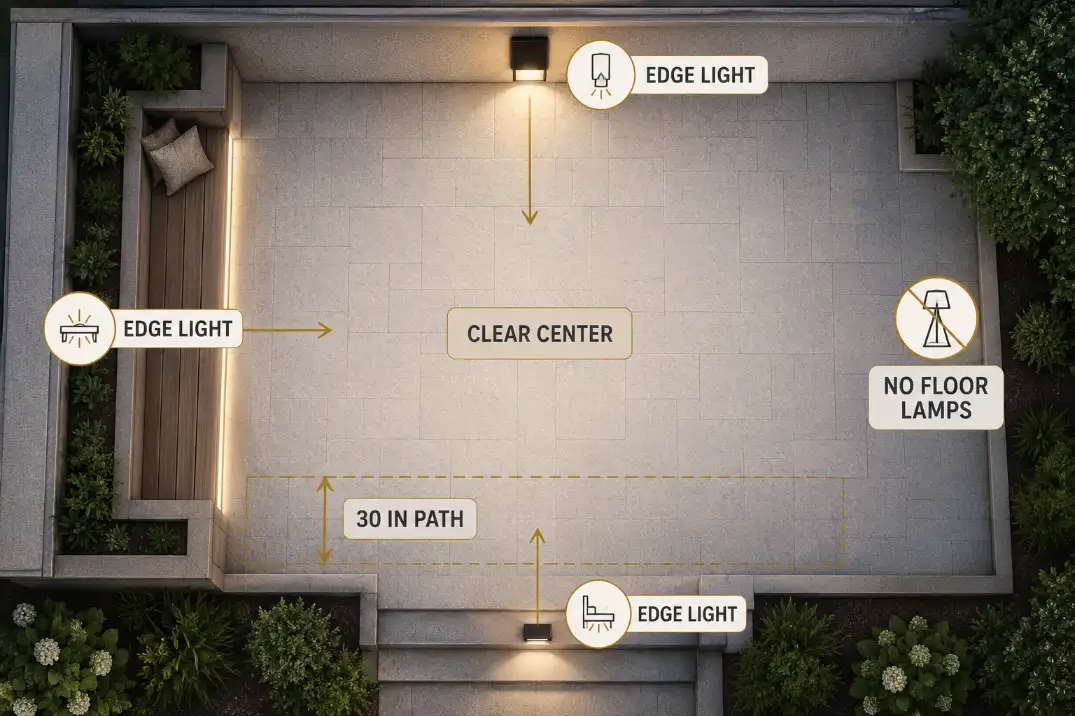
The cleaner strategy is to light from the perimeter inward. Wall sconces, under-bench lighting, small post-mounted fixtures, rail lights, and one controlled string-light run preserve walking space.
Even one warm fixture near the door can do more than three little floor lanterns because it gives the eye a stable reference point.
If the patio already feels tight during the day, solve the furniture layout before adding more lighting.
A narrow walkway or blocked chair path will feel even more cramped after dark, and the same spacing logic covered in Patio Furniture Layout by Size matters more once shadows hide the edges.
Keep the brightest point out of eye level
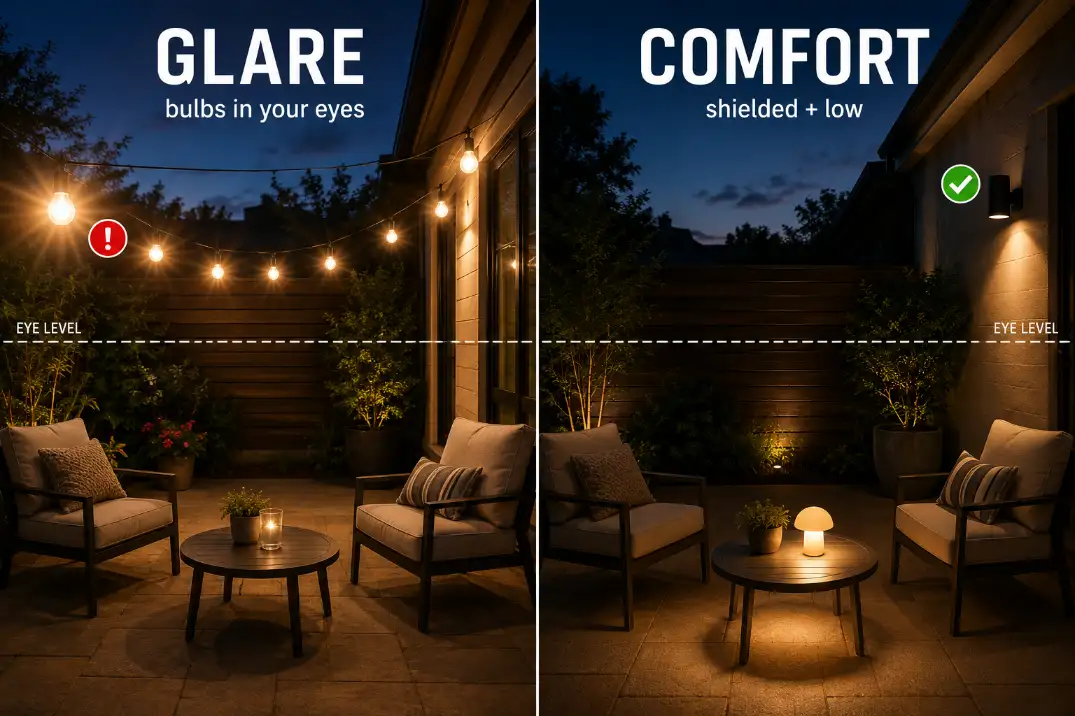
The most common small-patio lighting mistake is placing the brightest source where people look across the space. Bare string bulbs at face height, an exposed wall light beside a chair, or a lantern sitting on a small side table can make the patio feel busier than it really is.
For seated areas, keep most light either above the normal line of sight, below the tabletop, or shielded so the bulb itself is not the main thing people see. In many small patios, 100–300 lumens per decorative source is enough.
A single exposed 800-lumen bulb near eye level can overpower the entire setup.
Pro Tip: Sit in the main chair after dark before deciding a light works. A fixture that looks tasteful from the doorway may glare badly once someone is seated 5–7 feet away.
Best Lighting Setups for Different Small Patios
For a patio against the house
This is usually the easiest small patio to light cleanly. Use the house wall as the main lighting surface. A shielded wall sconce near the door plus one low table light is often enough for a 10×12 patio used for dining or drinks.
Avoid adding a floor lamp just because the far corner feels dim. If the seating area is visible and the doorway is safe, a slightly darker corner is usually better than another visible fixture. Small patios need contrast, not full brightness everywhere.
For a fence-side patio
A fence-side patio works best when the lighting follows one boundary. One string-light run along the fence, two small fence-mounted sconces, or a soft downlight on a post can define the space without filling the floor.
Do not wrap every fence section with lights. That creates visual noise and makes the patio edge feel busy. If the fence is close to the seating area, choose downward or inward-facing fixtures so light does not spill into a neighbor’s yard or window.
For a covered patio
A covered patio can handle overhead lighting, but it needs restraint. A dimmable ceiling fixture, two small recessed lights, or a pendant over the table can work if the source is warm and not harsh. The mistake is treating the covered patio like a garage or utility area.
A covered patio often feels better with one dim overhead layer and one lower task layer. For example, use a warm ceiling fixture at low brightness, then add a small rechargeable table lamp for dinner.
If the patio also has a grill, do not let the grill light become the main seating light.
For a rental patio or balcony
Renters should avoid lighting plans that depend on drilling, trenching, or permanent wiring. Clamp lights, railing-mounted lights, battery lanterns, rechargeable table lamps, and no-drill hooks can work well if the number of visible pieces stays low.
The biggest rental mistake is running cords across the floor. If a cord crosses the walking path or sits where chair legs move, the setup will look temporary and become annoying fast. On balconies and townhome patios, keep light low, warm, and aimed inward.
For a patio with no wall, pergola, or fence
If the patio sits in open yard space, resist the urge to scatter lights around the perimeter. Instead, create one simple anchor. Two slim posts supporting a single string-light run, a nearby tree used for soft downlighting, or one low-voltage fixture aimed at planting can give the patio enough definition.
If the patio connects to a walkway, keep path lighting outside the seating zone. The principles in Path Lighting for Steps, Slopes, and Walkways apply better to the route than to the patio itself.
What Makes Patio Lighting Feel Cluttered
Too many small glowing objects
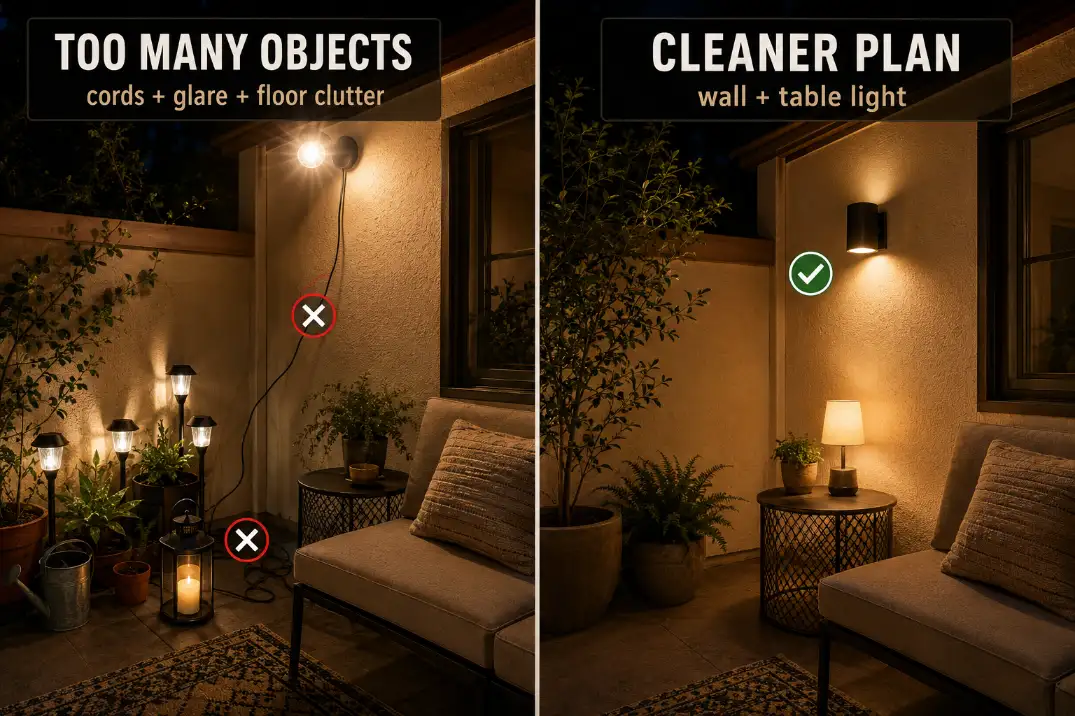
Small lights multiply quickly. A string of bulbs, two lanterns, four path lights, a tabletop lamp, and a glowing planter may sound cozy, but the eye reads all of those as separate objects. The problem is not always brightness. It is fragmentation.
A better rule is to make one lighting element visually dominant and let the others disappear. String lights can be the atmosphere layer while a shielded step light handles safety.
Wall sconces can define the patio while one small table lamp supports dining. What rarely works is giving every lighting type equal importance.
This is where people often overestimate decoration and underestimate placement. A beautiful fixture in the wrong line of sight still adds clutter. A plain, shielded fixture tucked under a rail may perform better because it visually disappears.
Cords, stakes, and oversized lanterns
Cords are one of the fastest ways to make a patio feel unfinished. Even a thin black cord becomes noticeable when it crosses pavers, loops behind chair legs, or runs around planters. If a plug-in light is temporary, keep the cord tight to the patio edge and away from the main 30–36 inch walking path.
Solar stake lights also tend to crowd small patios because they were designed for beds and paths, not tight seating zones. They work better along a walkway or planting edge than inside the patio footprint.
Oversized lanterns create a similar problem. A lantern that looks charming on a large deck can feel like another furniture piece on an 8×10 patio. If it forces a chair inward, it is no longer decor. It is taking usable space.
Mixed color temperatures
A patio can handle mixed fixture styles if the light quality is consistent. It struggles when one light is warm and soft while another is cool and sharp. A 5000K security light beside warm string lights makes the patio feel exposed, even if the string lights are attractive.
For relaxed evening use, warm white light around 2200K–3000K usually works best. Cooler light can be useful for cleanup or security, but it should not be the main mood layer.
Brightness, Color, and Fixture Choices
| Patio condition | Good starting point | Why it works | Avoid first |
|---|---|---|---|
| 8×8 lounge patio | 1 warm wall or overhead source plus a small table lamp | Keeps the setup simple and floor clear | Several floor lanterns |
| 10×12 dining patio | 2–3 sources, mostly shielded | Gives enough visibility without lighting every corner | One exposed bright bulb |
| Covered patio | Dimmable ceiling light plus threshold or step light | Separates mood from safety | Harsh utility-style fixture |
| Rental patio or balcony | Rechargeable lamp plus railing or fence-line light | Avoids cords and permanent wiring | Cord runs across the floor |
| Patio near neighbors | Downward, shielded 2200K–3000K light | Reduces glare and light spill | Bare bulbs facing windows |
| Patio with steps | Low step light plus soft area light | Marks level changes without flooding the patio | Bright overhead-only lighting |
Dimmers beat extra fixtures
If the patio has enough light but still feels uncomfortable, adding another fixture is usually the wrong move. A dimmer, lower-output bulb, shield, or warmer color temperature may solve the issue with less visual clutter.
This is especially true when glare is being mistaken for dimness. The symptom is discomfort or poor visibility. The mechanism is excessive contrast. A glaring patio can still feel dark because the bright source makes everything around it look darker.
If glare keeps coming back, the issue may be fixture direction rather than fixture count. Patio Lighting Glare Mistakes is a better next step than buying another decorative lamp.
Use light where it touches surfaces
Light looks calmer when it lands on a wall, tabletop, step, plant mass, or paving surface instead of floating as a bright bulb in space. A small wall washer, shielded sconce, or downlight under a pergola beam can make a patio feel larger because it reveals boundaries without adding objects.
This is why the obvious fix often fails. People add a brighter table lamp when the real problem is that the patio has no softly lit edge. The table gets brighter, but the surrounding space still feels undefined.
Safety, Weather Ratings, and Neighbor Glare
Match the fixture rating to exposure
A covered patio is not the same as an indoor room. Humidity, wind-driven rain, coastal moisture, and condensation can still affect fixtures.
Open patios need fixtures rated for wet locations. Covered patios usually need damp-rated fixtures at minimum, especially in humid places such as Florida or along the Gulf Coast.
Battery lamps and decorative plug-in pieces can work, but they should not become the permanent plan if they are not made for outdoor use.
In northern states with freezing winters, removable lamps may also need seasonal storage so batteries, finishes, and seals last longer.
Keep cords and transformers out of traffic
A lighting plan that creates a trip hazard has failed, even if it looks good in photos. Keep cords along the patio edge, not across the main walking route.
If the patio has a door-to-table or door-to-grill path, preserve at least 30 inches of clear movement. A 36-inch path feels noticeably easier when people are carrying plates, drinks, or grill tools.
Plug-in fixtures should use outdoor-rated cords and GFCI-protected outlets. Hardwired lighting should be treated as electrical work, not casual decor.
Aim light down and inward
Small patios often sit close to fences, neighboring windows, or shared side yards. A bright bulb aimed outward can make your patio feel exposed and irritate neighbors at the same time.
If a bulb is visible from a neighbor’s bedroom window, shield it, lower the output, or change the angle. Along property edges, downward-facing fixtures are usually safer than exposed bulbs. This is not only polite; it also makes the patio itself feel calmer.
What Not to Buy First
A set of solar stakes
Solar stakes are tempting because they are cheap and easy, but they usually solve the wrong problem on a small patio. They mark edges.
They do not create a comfortable seating zone. If placed inside the patio, they add little vertical objects where the space needs to stay open.
Use them near a path or planting bed instead. For the patio itself, prioritize a wall, fence, post, rail, or overhead source.
A bright security light
A security light can help with access, but it should not be the main patio light. Motion floods and bright wall packs create harsh contrast, especially on pale concrete or light pavers. They make people feel watched rather than comfortable.
If security lighting is needed, keep it separate from the patio mood layer. Use it for arrival, cleanup, or side-yard access, not for dinner or conversation.
More string lights before fixing glare
String lights can be excellent on a small patio, but more strands are not always better. If the first run is too low, too bright, or too visible from every seat, adding a second run doubles the problem.
For patios only 8–10 feet wide, one clean line along a fence, eave, or pergola beam is often better than a crisscross canopy. Bulbs spaced 12–24 inches apart usually feel calmer than dense, closely packed bulbs.
Quick Diagnostic Checklist
- Can you see bare bulbs from the main chair?
- Do cords cross the walking path or run behind chair legs?
- Is there at least 30 inches of clear movement from door to seating?
- Are there more than 3–4 separate light sources on a patio under 150 square feet?
- Does one cool, bright light overpower the warmer decorative lights?
- Is the patio edge completely dark while the table is overly bright?
- Does any fixture shine toward a neighbor’s window or seating area?
When the Standard Fix Stops Working
The standard fix is to add another small light where the patio still feels dark. That stops making sense once you already have three or four separate sources in a compact area and the space still feels uncomfortable. At that point, the likely problem is aim, shielding, color temperature, or layout.
Another cutoff: if lighting hardware is forcing furniture inward, the patio is losing function to decoration. A small space cannot afford that trade for long. Wall-mounted, rail-mounted, post-mounted, or overhead lighting is usually the better move.
The same applies when the patio feels like a bright box surrounded by darkness. You do not need to light the whole yard, but one soft landing point beyond the patio can help.
A low light on a nearby planting bed, tree trunk, or path can extend the visual boundary without crowding the seating area.
For broader placement logic, Best Backyard Lighting Layout for Patios at Night explains why the zones around the patio matter as much as the fixtures on it.
Questions People Usually Ask
How many lights does a small patio need?
Most small patios under 150 square feet work with 2–4 light sources: one orientation light, one seating or table light, and one safety light if there is a step or threshold. More than that can still work, but only if some sources are hidden, shielded, or very low output.
Are solar lights enough for a small patio?
Solar lights are usually enough for accents, not the whole patio. They can help mark a path or planting edge, but many small solar fixtures fade after a few evening hours, especially after cloudy days. For regular dining or seating, use at least one more reliable wall, plug-in, rechargeable, or low-voltage source.
What color temperature is best for a small patio?
Warm white light around 2200K–3000K usually feels best for small patios. It softens hard surfaces, reduces the “parking lot” feeling, and blends better with string lights, candles, and outdoor furniture.
Cooler light may help for cleanup or security, but it should not dominate the sitting area.
Should small patios use smart lights?
Smart plugs, timers, and dimmable bulbs are useful when they reduce attention, not when they add complexity. A timer can keep lights from running all night, and a dimmer can lower brightness after dinner.
Motion lighting is better for access routes than conversation zones.
For a closer look at why outdoor fixtures often miss the area they are supposed to help, see this guide to outdoor lighting placement problems.