
Backyard improvements waste money when they start with the visible want instead of the limiting problem.
A new patio set, gravel area, fire pit, pergola, or privacy screen can look like the answer, but the first checks should be more basic: where water goes after rain, where people actually walk, and which area becomes uncomfortable after 20–30 minutes of use.
If soil stays soft more than 48 hours after normal rain, if a main path is under about 36 inches wide, or if furniture has to be moved every time someone walks through, the problem is not style. It is function.
Most budget backyard advice starts with things to add. A better plan starts with what would make those additions fail. The point is not to find cheaper features. It is to avoid buying features that the yard’s water, traffic, heat, slope, or sizing will defeat.
The Money-Saving Rule: Spend First on What Other Upgrades Depend On
The smartest backyard plan starts with dependency. Some improvements support everything that comes after them. Others only make the space look more finished. Confusing those two categories is how homeowners spend twice.
Fix water, safety, and access before atmosphere
Drainage, grading, stable walking surfaces, step safety, and clear circulation should outrank furniture, decor, and most planting. A patio surface can be upgraded later. A chair set can be replaced. But if runoff crosses the sitting area or water moves toward the house, almost every later improvement becomes vulnerable.
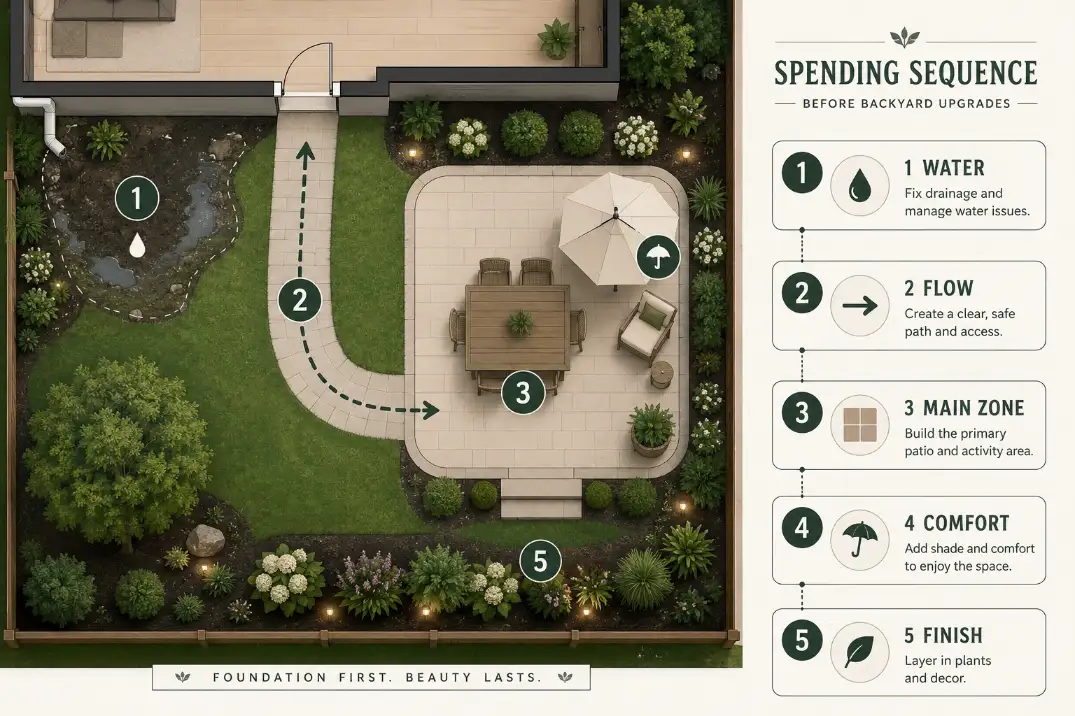
This is the useful order:
- Drainage, slope, and unsafe surfaces
- Main walking routes and access
- The primary outdoor living zone
- Shade, lighting, wind, and comfort
- Planting, privacy, and edge definition
- Decor, cushions, containers, and seasonal finish
That order is not glamorous, but it prevents expensive rework.
Separate symptoms from mechanisms
The symptom is the ugly thing you notice: mud, dead plants, loose gravel, a cramped patio, or a puddle by the walkway. The mechanism is what keeps causing it: water movement, compacted soil, shade, traffic pressure, poor sizing, or bad base prep.
Money is wasted when the fix only covers the symptom. Adding mulch to an eroding bed may look better for a few weeks. It does not fix the water path. Buying smaller chairs may help a patio feel less crowded, but it will not solve a door-to-lawn route that cuts through the seating area. When the same repair comes back twice in one season, stop treating it as maintenance and start treating it as diagnosis.
Check the Base Conditions Before Buying Anything
Before pricing pavers, plants, privacy screens, or outdoor kitchens, look at the yard when it is least flattering: after rain, during hot afternoon sun, and during normal daily movement.
Drainage outranks almost everything
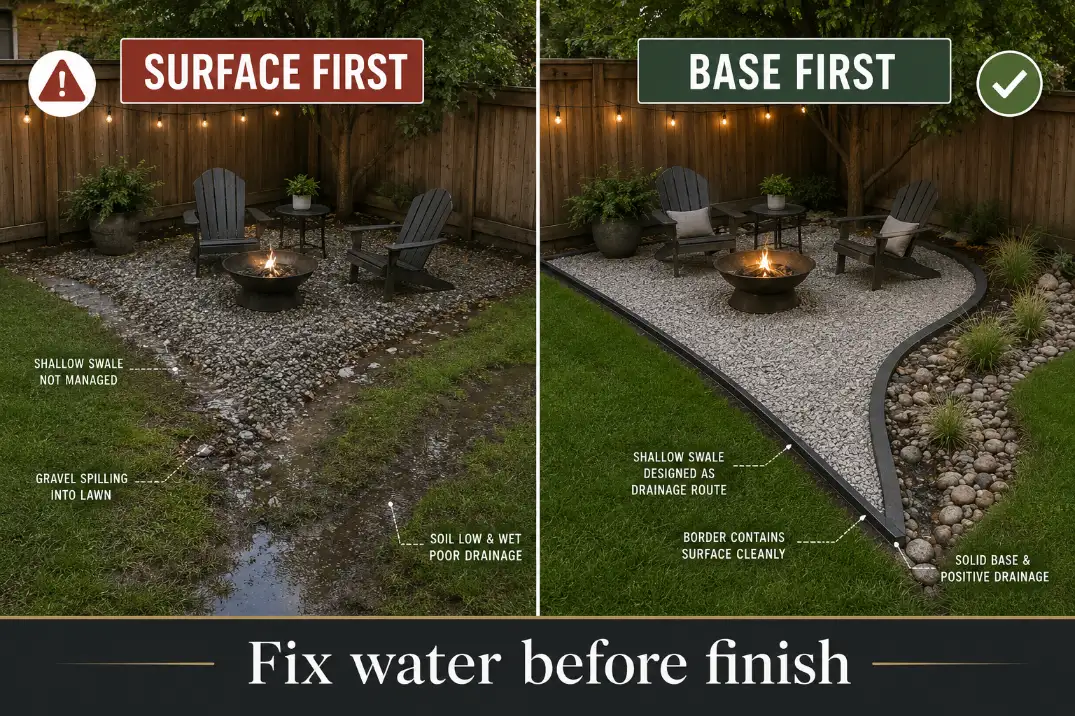
Water problems move to the top because they damage other improvements. Watch the yard during or right after a steady rain. Useful signs include puddles, thin flow lines, mulch washout, algae on hardscape, soft patio edges, and soil that stays tacky while nearby areas dry.
A temporary puddle is not automatically a major problem. The threshold is persistence and direction. Water that disappears within a few hours is different from water that remains after 48 hours or moves toward the foundation.
If runoff crosses the patio or collects near the house, the planning sequence should look more like Fix Drainage or Layout First than a shopping trip for outdoor furniture.
Access comes before amenities
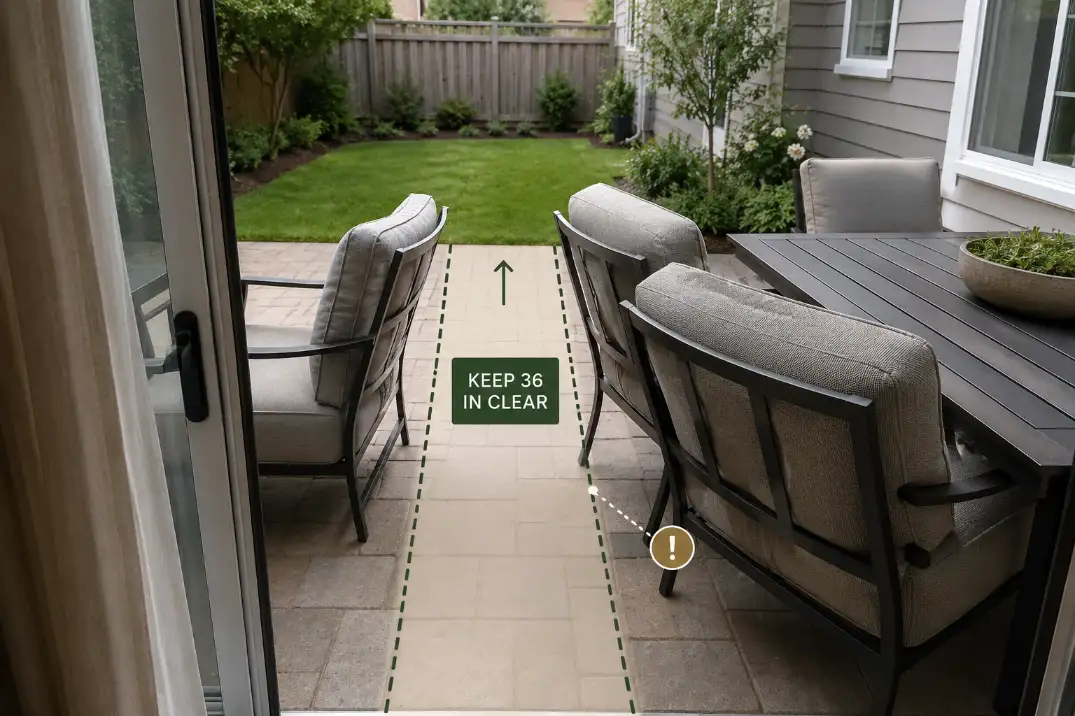
A backyard can have enough square footage and still feel hard to use. The reason is usually circulation. Main walking routes usually need about 36 inches of clear width.
Around dining chairs, plan closer to 48 inches where people need to pull chairs back and pass behind them.
This is where many budgets drift. A larger dining set, deeper sectional, oversized grill island, or wide fire pit ring can make a yard less useful if it consumes the path that made the space work.
Comfort decides whether the yard gets used
Shade, glare, wind, mosquitoes, reflected heat, and privacy decide whether people stay outside. A patio can look finished and still be abandoned if it bakes at 95°F, traps grill smoke, faces a neighbor’s upper window, or has no comfortable route from the kitchen.
Homeowners often overestimate decor and underestimate exposure. String lights and cushions improve a working space; they do not fix a patio that becomes unusable after 3 p.m. in a hot climate or stays damp and buggy in humid areas such as Florida.
How to Split the Budget Without Overbuilding
A budget should reflect risk, not excitement. The improvements that are hardest to undo deserve the most planning and often the most money. Loose furniture is low-risk because it can be moved, sold, or replaced. Drainage lines, concrete, paver bases, retaining edges, gas lines, electrical runs, and built-ins are high-risk because mistakes get buried into the yard.
| Budget category | Practical share of budget | Why it deserves that priority |
|---|---|---|
| Drainage, grading, base prep, safety | 30–45% | Prevents rework and protects later upgrades |
| Main usable zone | 25–35% | Creates the daily value of the backyard |
| Shade, lighting, and comfort | 10–20% | Extends how long the space can be used |
| Plants, privacy, and edge definition | 10–20% | Adds finish after function is settled |
| Flexible decor and seasonal updates | 5–10% | Easy to change without major loss |
These ranges are not rigid. A flat, dry yard may need less site correction. A sloped yard, clay soil yard, or yard with runoff from an uphill neighbor may need more. In northern states, freeze-thaw cycles make base prep and drainage more important because trapped water can heave pavers or crack weak concrete over winter.
Pro Tip: Spend more time deciding anything that requires demolition to undo. Movable pieces can be adjusted later; buried mistakes usually cost twice.
Phase the Backyard So Each Step Teaches You Something
The best backyard plans are often phased, not because the homeowner lacks imagination, but because the yard gives better information once it is used.
First weekend: observe and measure
Do not start with a shopping cart. Start with the yard itself. Check the space after rain, during the hottest part of the day, and at night. Measure the patio, door swing, walkway width, gate access, and the flat area that is actually usable. A 25-by-30-foot backyard may only have one 10-by-14-foot zone that is dry, level, private, and close enough to the house to use every week.
Mark the main routes with stakes, chalk, string, or a garden hose. If a dirt path has already formed across the lawn, that is not a behavior problem. It is the yard showing the route people prefer.
First 30 days: test before building
Use temporary furniture, tape outlines, folding chairs, umbrellas, and movable planters before building permanent features. If the layout feels annoying for 48 hours, real furniture will not improve it.
For a small dining zone, a compact table and chairs often need at least 8 by 10 feet to work. A lounging setup may need 10 by 12 feet or more if it includes deep seating and a coffee table. A grill needs working clearance, a safe surface, and a route to the kitchen, not just an empty corner.
This season: fix the base and main zone
Once the yard’s real limits are clear, spend on the base conditions and the main outdoor room. That may mean correcting downspout discharge, stabilizing a patio edge, improving a worn walkway, adding shade where people actually sit, or choosing one strong dining or lounging zone instead of several weak ones.
For yards where the surface itself is the weak link, Backyard Surface Choice and Usability should come before color, pattern, or furniture style. The right surface is the one that stays usable under your traffic, weather, drainage, and maintenance conditions.
Later: add permanent features only after the layout proves itself
Built-in benches, pergolas, outdoor kitchens, gas fire pits, and large privacy structures should come after the layout has proven itself. These features can be excellent, but they are expensive to relocate.
If the patio is already tight, one good zone often beats a crowded mix of dining, grilling, lounging, fire pit, garden beds, and storage. This is especially true in small backyards, where every added feature steals space from circulation or open ground.
Where DIY Saves Money and Where It Usually Backfires
DIY is not automatically cheaper. It saves money when the work is simple, visible, reversible, and not tied to drainage, structural support, electrical, gas, or major grade changes. It backfires when a cheap installation creates failure that must be removed before the real fix can happen.
| Project type | Usually DIY-friendly | Better to price professionally |
|---|---|---|
| Furniture layout testing | Yes | Rarely needed |
| Mulch refresh | Yes | If erosion keeps returning |
| Small planting updates | Yes | If grading or irrigation changes are involved |
| Gravel seating area | Sometimes | If slope, edging, or runoff is unresolved |
| Patio drainage correction | Sometimes | If water moves toward the house |
| Paver or concrete patio | Only small, simple areas | If base prep, slope, or freeze-thaw risk matters |
| Retaining walls | Rarely for serious slopes | If over 2–3 feet high or holding back soil |
A simple mulch refresh, small planting bed, or loose gravel path can be reasonable DIY. But if gravel spreads into the lawn within one season, pavers shift after every winter, or mulch washes away after each storm, the cheap fix is not saving money anymore. The issue may be edging, runoff, base prep, slope, or traffic concentration.
The clearest warning sign is repetition. If you have topped up gravel twice in one year, reset pavers after every winter, or replaced dead plants in the same bed for two seasons, the routine fix has stopped making sense. The deeper logic in When a Cheap Backyard Fix Stops Making Sense applies whenever a low-cost repair keeps returning.
What Usually Wastes Money
The biggest waste is not always the most expensive project. It is the project done in the wrong order.
Buying the feature before sizing the space
A fire pit area, dining set, sectional, or grill station can be useful only if the yard has room for people to move around it. A common mistake is measuring the object but not the use zone around it.
Dining chairs need pullback room. Grill areas need prep and landing space. Fire pits need seating distance and clear overhead space. If the yard only works when every chair is pushed in and no one is walking, the layout is too tight.
Treating planting as cheap filler
Plants are easy to overspend on because small nursery pots look harmless. A shrub that is 2 feet wide at purchase may mature to 5 or 6 feet wide. If it is planted 18 inches from a path, it will eventually narrow the walkway, trap moisture, scratch legs, or require constant pruning.
People commonly underestimate mature width and overestimate how much planting a small backyard needs. A few plants that screen a view, define a corner, or soften a hard edge often do more than a crowded border that steals usable space. When shrubs or beds are already crowding the patio, Backyard Problems Worth Fixing First is a better guide than adding more layers.
Solving comfort with decoration
Decor can improve a working space, but it cannot rescue the wrong exposure. If the patio faces harsh west sun, shade matters more than cushions. If wind blows smoke into the seating area, a larger grill station will not solve the experience. If mosquitoes gather because the space stays damp and still, more planting may make the problem worse.
In dry desert conditions, lighter surfaces and shade can matter more than extra furniture. In coastal California, moisture and salt air may make material durability more important than the exact look. In Midwest yards with seasonal downpours, drainage capacity can matter more than how the space looks during a dry spring week.
Do Not Buy Yet If These Are Still Unknown
Use this as a pause point before committing to materials, furniture, plants, or contractor work:
- You have not checked the yard 24 and 48 hours after rain.
- You do not know the main walking route from the house to the yard.
- You have not measured the usable flat area separately from total yard size.
- You have not taped the furniture footprint and chair pullback space.
- You have not checked mature plant width against paths, fences, windows, and seating.
- You are buying a feature mainly because the yard feels unfinished.
- The same muddy, loose, dead, or cramped area has failed twice already.
This checklist is intentionally short because the decision is simple: do not spend heavily until the yard has revealed the condition most likely to waste the money.
Check Rules, Utilities, and Access Before Locking the Plan
Backyard plans can fail before construction starts if they ignore rules and physical access. This matters most for fences, pergolas, decks, sheds, retaining walls, outdoor kitchens, electrical work, gas lines, drainage changes, and anything near property lines.
The expensive “no” is usually discovered too late
Before digging, check utility locations. Before designing a structure, check setbacks, easements, HOA rules, and local permit requirements. Before planning drainage changes, make sure water will not be directed onto a neighbor’s property or toward the house.
Access is another overlooked cost. A narrow side yard, steep slope, tight gate, mature tree roots, or limited equipment access can change labor costs and installation options. A design that looks affordable on paper can become expensive if every material has to be carried by hand.
Choose the Smaller Plan When It Solves the Real Problem
A sharper backyard plan often reduces the project. It chooses one strong outdoor room instead of three weak zones. It fixes water before upgrading surfaces. It leaves enough open space for movement. It uses plants where they solve privacy, shade, or edge definition instead of filling every border.
For smaller properties, Small Backyard Fix Priorities can help separate the fix that changes daily use from the upgrade that only adds another thing to maintain.
The best tradeoffs are usually clear once the real problem is named:
- Choose drainage before new pavers if water sits longer than 48 hours.
- Choose shade before a larger dining set if the patio is unusable after midafternoon.
- Choose a smaller seating layout before adding a second zone.
- Choose step and path lighting before decorative lighting.
- Choose one durable surface before mixing several cheap materials.
- Choose open space before another feature in a crowded yard.
This is the part many people resist because it feels like doing less. In practice, it is often what makes the backyard feel more expensive, not less. A yard with one dry, comfortable, well-sized sitting area will usually be used more than a yard filled with underperforming features.
The Best Backyard Plan Makes the Next Purchase Safer or Unnecessary
Planning backyard improvements without wasting money is mostly about sequence.
Fix the conditions that control everything else: water, movement, surface stability, shade, safety, and usable size. Then buy the pieces that support the way the yard is actually used.
The strongest plan is not the one with the most features. It is the one that makes each later purchase easier to choose, easier to maintain, and less likely to fail.
Buy the movable things last. A backyard plan saves money when it makes the next purchase safer, smaller, or unnecessary.
For broader official guidance on water-smart outdoor planning, see the U.S. Environmental Protection Agency WaterSense outdoor resources.