Last updated: June 19, 2026
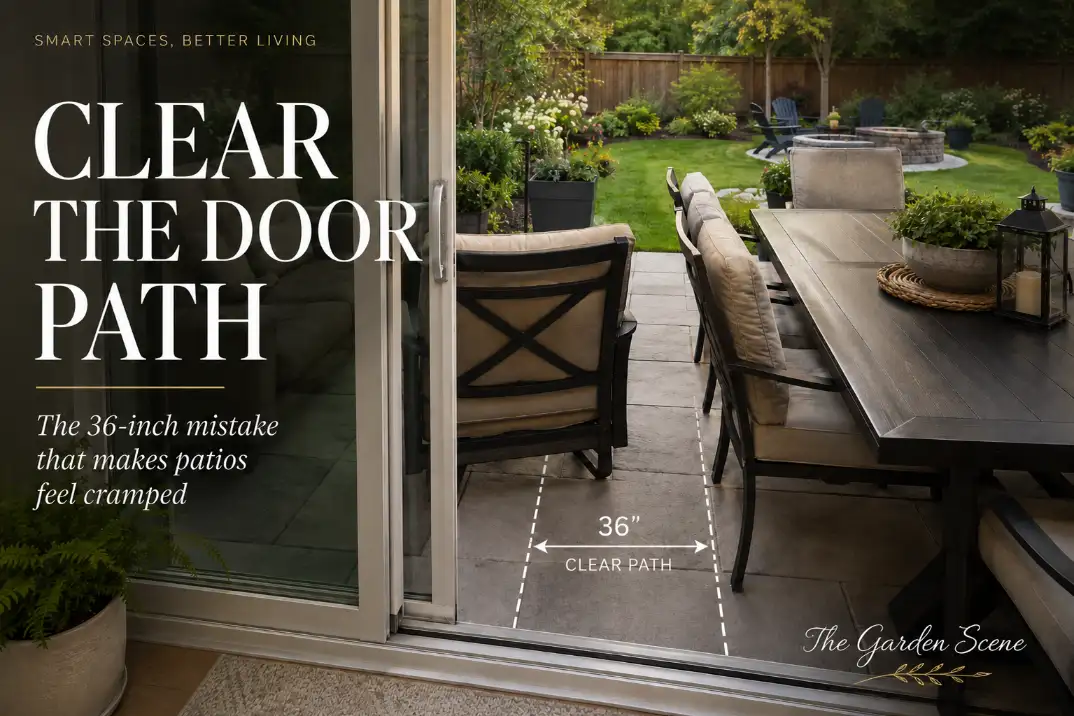
The best patio layout for sliding glass doors keeps the active door panel open, preserves a 36-inch clear walkway from the door to the yard, and places dining or lounge furniture to one side instead of centered on the glass. If the patio is tight, protect the walkway first and reduce furniture depth second.
Most sliding-door patios do not feel cramped because the patio is automatically too small. They feel cramped because the door landing, chair pullback space, grill route, and yard access all fight for the same 3 to 5 feet.
Start with three checks: keep at least 36 inches of clear landing space outside the active panel, aim for a 36- to 42-inch main walkway, and make sure dining chairs can pull back without entering the door path.
This is different from a general small-patio problem. A patio can have enough square footage and still fail if every trip outside cuts through furniture.
Start With the Door Path, Not the Furniture
Sliding glass doors create a stronger traffic pattern than most people expect. They are usually the main route to the grill, lawn, dog area, trash side path, pool gate, or outdoor dining space. If that route is interrupted, the patio feels awkward even when there is technically room to sit.
Protect the active sliding panel first
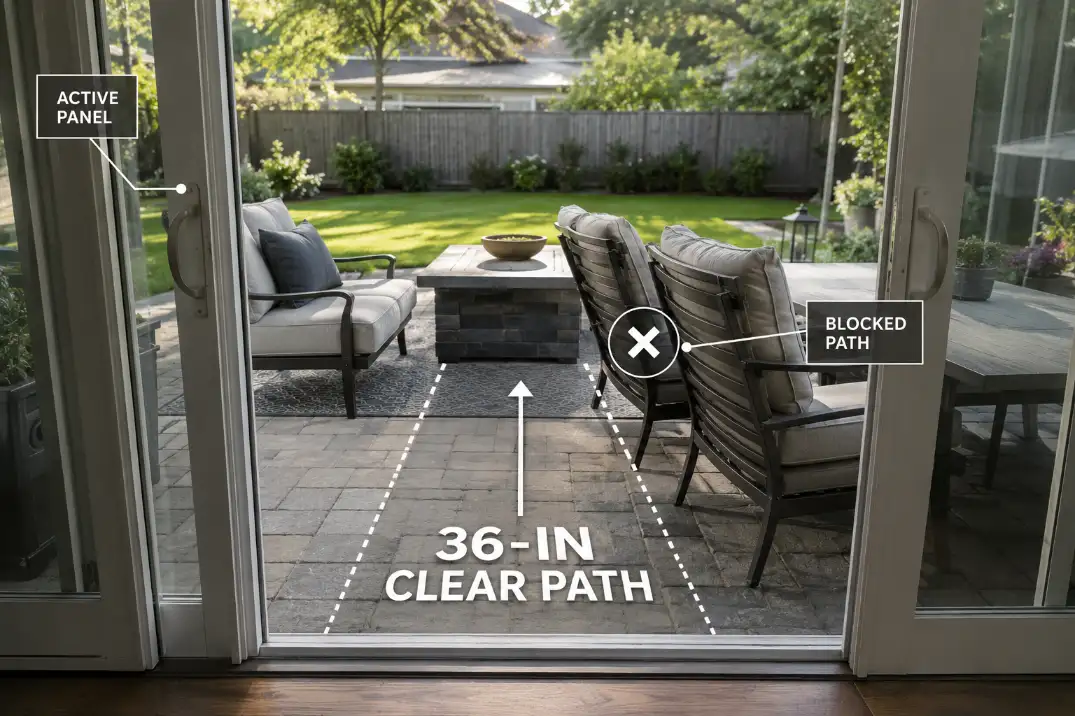
A two-panel slider usually has one active panel and one fixed panel. The active side is the one that needs the cleanest landing, turn space, and walking route.
Furniture in front of the fixed glass may work if it does not block views, cleaning access, or the screen track. Furniture in front of the active panel is different: it turns every exit into a squeeze.
This is where many patio layouts go wrong. People center a table or sofa on the full glass opening, but the usable door is only one side of that opening. Measure from the panel people actually walk through, not from the center of the overall door unit.
The first 5 feet matter most
Treat the first 5 feet outside the slider as transition space, not prime furniture space. That does not mean it must stay empty, but anything placed there should be slim, fixed, or easy to pass.
A narrow console, wall-side bench, or planter along the house may work. A deep lounge chair, round dining table, or sectional corner usually will not.
The door opening itself is not the only clearance that matters. Someone steps out, turns, carries a tray, opens a screen, or walks around another person.
A 28-inch pinch point may look passable when the furniture is staged, but it becomes irritating during daily use.
Separate the landing from the walking lane
A useful slider layout has two pieces: a landing zone immediately outside the door and a continuing lane that leads somewhere.
The landing is where people pause. The lane is where people move. When one chair leg, ottoman, or grill cart steals from both, the patio starts feeling like an obstacle course.
If the patio is rectangular, the cleanest move is usually to run the walkway along one side and place the seating or dining zone on the opposite side.
For narrow spaces, the flow logic in Small Rectangular Patio Layout Ideas for Better Flow applies especially well because the walkway has to be protected before the patio can feel generous.
Quick Clearance Rules That Actually Change the Layout
Use these measurements before buying or moving furniture. They are not decorative design rules; they decide whether the patio works when people are carrying food, letting the dog out, or walking through at night.
| Patio element | Minimum that may work | Better target | What goes wrong when ignored |
|---|---|---|---|
| Main walkway from slider | 30 inches | 36–42 inches | People turn sideways or step into seating |
| Door landing outside active panel | 36 inches deep | 48 inches deep | Entry feels blocked immediately |
| Dining chair pullback | 30 inches behind chair | 36 inches | Chairs enter walkway when occupied |
| Lounge chair depth | 32–36 inches | 36–40 inches with side clearance | Lounging steals the route to the yard |
| Grill working clearance | 3 feet | 4 feet near doors | Heat, smoke, and foot traffic overlap |
The useful comparison is this: a 10-by-12-foot patio with one protected 36-inch lane often works better than a 12-by-14-foot patio where every route cuts diagonally through chairs.
More area helps only after the traffic pattern is solved.
Pro Tip: Tape the walkway on the patio before moving furniture. Painter’s tape, chalk, or a garden hose makes it obvious which pieces are stealing space.
Best layout moves by patio condition
| Patio condition | Best layout move | Avoid |
|---|---|---|
| 8-foot-deep patio | Wall bench, bistro set, or slim dining table to one side | Full dining set centered on the slider |
| 10- to 12-foot-deep patio | Offset rectangular table with chairs pulling away from the path | Round table directly outside the active panel |
| 12-by-16-foot patio or larger | Split dining and lounge zones with a protected lane between or beside them | Centering both zones on the doors |
| Long narrow patio | One-side walkway with furniture along the opposite edge | Opposing chairs across the narrow width |
| Patio with grill access | Separate grill edge or pad outside the door landing | Grill cart in the slider-to-yard route |
This table matters because patio shape changes the right fix. A narrow patio usually needs orientation changes.
A deeper patio may need zone separation. A grill-heavy patio may need a new cooking edge before any seating layout will feel right.
Layout Ideas That Work With Sliding Glass Doors
There is no single correct layout, but a few patterns consistently work because they respect how people actually move through the door.
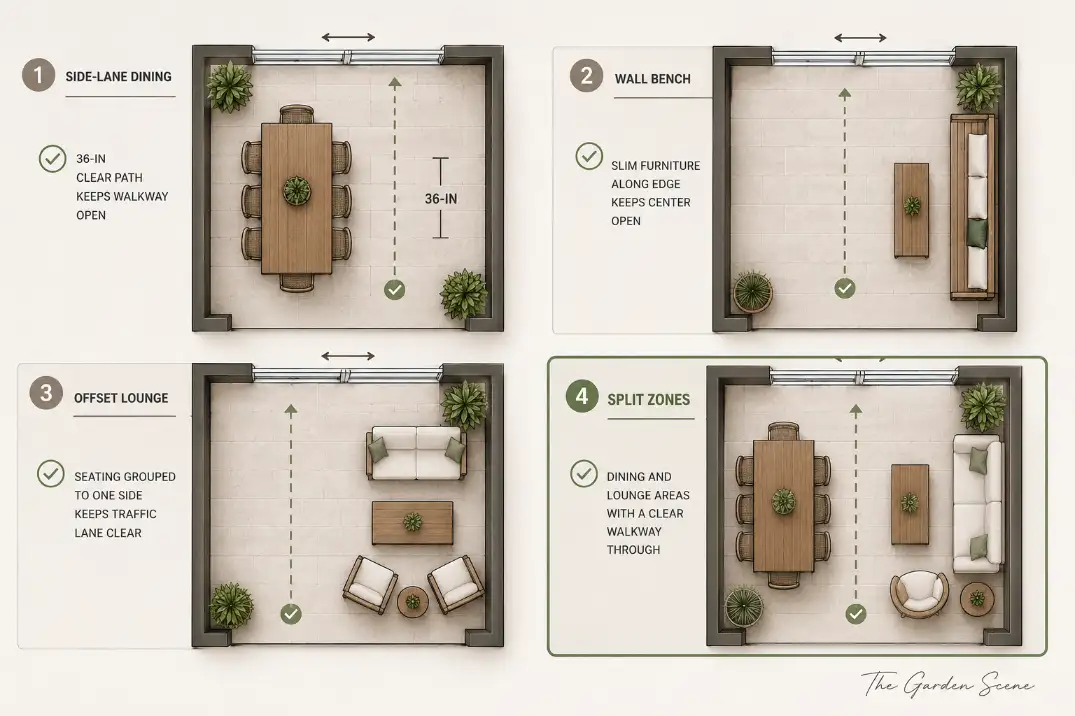
Side-lane dining layout
This is the safest layout when the patio needs both eating space and easy yard access. Place the dining table to one side of the slider, not centered directly in front of it.
Keep the long side of the table parallel to the house or patio edge so chairs pull away from the main route instead of into it.
A rectangular table usually beats a round one near sliding doors. Round tables look softer, but their chair positions spread in every direction.
A 60-inch round table can consume more usable circulation than a 60-by-36-inch rectangular table because there is no clean side for traffic.
If dining is the priority, measure the chair zone before choosing the table. The spacing guidance in How Much Space a Patio Dining Set Really Needs is especially relevant near sliders because the pulled-out chair, not the tabletop, is what blocks the walkway.
Wall-bench breakfast layout
For an 8-foot-deep patio, a wall-side bench or slim bistro table is usually more useful than a full dining set. The bench keeps seating against the house or patio edge while the center route stays open.
This is the layout to consider before buying smaller versions of the same bulky furniture. A compact table centered in the door path still creates the same problem.
A bench changes the geometry by moving seated bodies, chair legs, and pullback space away from the active panel.
Offset lounge layout
For a casual seating patio, place the deepest lounge piece along the non-traffic edge and angle one or two chairs inward. The active panel should still open into a clear walking route, not into the back of a chair.
This is where a loveseat often beats a sectional. A sectional can work, but only if the chaise does not point toward the slider-to-yard route.
If the chaise blocks the first 36 inches of movement, the layout will feel cramped even if the patio looks stylish.
Split-zone dining and lounge layout
On patios around 12 by 16 feet or larger, the best layout may be two offset zones: dining closer to the kitchen side of the slider and lounging farther toward the yard. The key is not to center both zones on the door. Give the door a route between or beside them.
This works especially well when the patio has a second destination, such as a grill pad, side gate, or lawn steps. If the destination is off to one side, make the walkway honest. A clean L-shaped route is better than a fake open center that forces people around chair corners.
Continue the indoor traffic line outside
The outdoor route should start inside the house. If people approach the slider from a kitchen island, dining table, or living room walkway, continue that same movement outside instead of forcing a sharp turn at the threshold.
This is especially useful for patios off kitchens. A person carrying plates or a tray needs a simple line from counter to door to table. If the outdoor table is technically close but requires a turn around a chair back, the layout will feel worse than a slightly farther table with a cleaner route.
What People Usually Misread First
The symptom is a cramped-looking patio. The mechanism is interrupted movement. Those are not the same problem.
Empty center space can be misleading
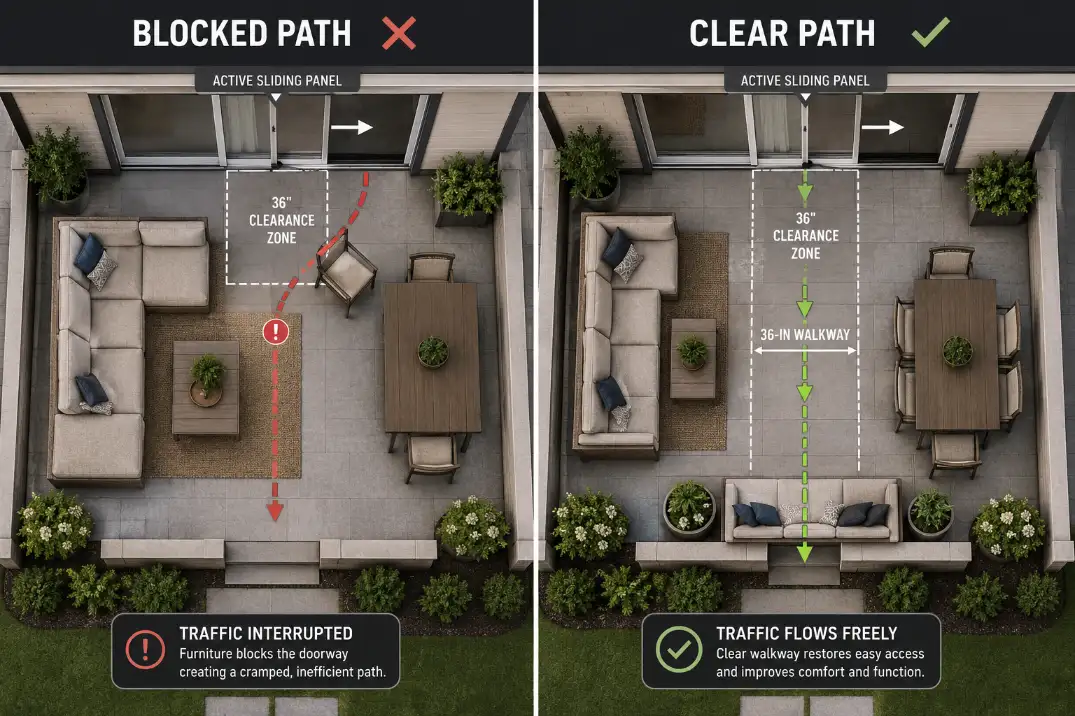
Many homeowners leave the middle of the patio open and assume that means the layout has flow. But if every chair backs into the slider route, the open center is just leftover space, not useful circulation.
A clear walkway should connect the door to the next destination without requiring a zigzag.
This is why removing a random chair often disappoints. If the wrong piece stays in the path, the patio still feels cramped.
The better move is to identify the traffic lane first, then decide which furniture deserves the remaining footprint.
For patios that already feel overfilled, What to Remove First When Patio Furniture Makes a Space Feel Cramped is a more practical starting point than shopping for smaller decor.
Door-centered layouts often fail
Centering a table, sofa, or fire pit on the sliding glass doors may look balanced from inside the house. It also often puts the largest object directly in the most important path. Symmetry is less important than a clean exit.
The condition people underestimate is chair movement. A dining chair may sit neatly under the table in a photo, but in use it moves 24 to 36 inches. Add a person standing behind it, and the blocked zone grows again. That is why a layout can look fine when staged and fail during dinner.
Keep hard corners out of the glass approach
The area outside the active panel should not be crowded with metal chair backs, fire pit corners, grill carts, ceramic planters, or low tables. This is not just about breakage. In low evening light, people step through the slider and turn before their eyes adjust, especially when indoor lights reflect on the glass.
A soft chair edge beside the fixed panel is one thing. A hard table corner 18 inches from the active opening is another. Treat the door approach as a movement zone, not a display area.
When the Obvious Fix Wastes Time
The usual fix is to buy smaller furniture. Sometimes that helps, but it is not the first move. A smaller table in the wrong place still blocks the door. A compact sectional can still trap the walkway if the chaise points into the exit route.
Rearranging beats downsizing when the path is wrong
Before replacing furniture, test a new path. Move the largest piece away from the direct slider-to-yard route and give the walkway one uninterrupted edge. If the patio immediately feels calmer, the problem was layout, not furniture size.
Downsizing makes sense only when the corrected layout still leaves less than about 30 inches for walking or less than 30 inches behind dining chairs. Below that, the patio may function for one person but will feel tight for families, guests, pets, or anyone carrying food.
Covered patios need a stricter layout
Posts, roof supports, door trim, and outdoor curtains can turn a decent plan into a narrow squeeze. A support post 18 inches from the door may force the walking lane to one side, which means furniture has to respect that fixed pinch point.
Covered patios also make people overuse the protected area closest to the house. That is understandable, especially in rainy parts of the Southeast or hot desert afternoons in Arizona, but crowding everything under cover can leave the actual doorway unusable. If posts or doorways are shaping the traffic pattern, Covered Patio Furniture Layouts Around Doors and Posts fits this situation better than a general furniture plan.
Layout Choices by Patio Shape
The shape of the patio matters less than the direction of travel, but some patterns repeat often enough to be worth calling out.
Narrow patio outside a wide slider
For a patio that is 8 to 10 feet deep, avoid placing a full dining set straight out from the door. Use a bench against the wall, a narrow rectangular table, or a small bistro zone off to one side. Keep the route parallel to the house if the yard access is at the far end.
Long, narrow patios are especially unforgiving because every deep piece steals a large percentage of the width. In that case, Long Narrow Patio Furniture Layout Ideas can help refine the furniture orientation without pretending the patio is wider than it is.
Square patio with the slider on one side
Square patios tempt people into centering everything. Resist that if the slider is the only entrance. Put the main furniture group slightly off-center and let the walkway pass along one edge. The space may look less formal from above, but it will work better from the door.
A square patio also handles a pair of chairs better than a bulky sofa when the door is centered. Two chairs can angle around a small table while leaving a gap. A sofa creates one long barrier.
Patio with grill access
Do not make the cooking route cross the seating route if you can avoid it. The grill needs its own working space, ideally 3 feet or more on the active side, and it should not sit where someone steps out of the slider.
A grill placed too close to the door creates three problems at once: heat, smoke, and traffic conflict.
This is a point where the routine fix stops making sense. If moving furniture cannot create both a door lane and a safe grill zone, the grill may need a separate pad or a different edge of the patio.
Rearranging chairs around a bad grill location rarely solves the underlying conflict.
A Simple Decision Checklist
Use this before buying furniture or committing to a layout:
- Can someone step out of the active slider panel and walk 6 feet without turning sideways?
- Is the main route at least 36 inches wide for normal daily use?
- Do dining chairs stay out of the walkway when pulled back?
- Does the grill have about 3 feet of working clearance without blocking the door?
- Is the largest furniture piece against an edge rather than floating in the traffic lane?
- Can two people pass near the door without one stepping into a planting bed or lawn?
If the answer is no to two or more of these, the layout needs adjustment before it needs more accessories.
Questions People Usually Ask
Can you put a patio table in front of sliding glass doors?
Yes, but it should usually sit in front of the fixed glass panel or off to one side, not directly outside the active panel. Leave at least 36 inches of clear space where people actually step out.
How much space should be left outside a sliding patio door?
A 36-inch-deep clear landing is the practical minimum. A 48-inch landing feels better if people often carry trays, move between indoor and outdoor dining, or let pets through the door.
Is a sectional a good choice near sliding glass doors?
Only if the sectional sits along a non-traffic edge and does not push a chaise, ottoman, or corner seat into the door-to-yard route. On tighter patios, a loveseat and two chairs are usually easier to fit around a clear walkway.
Final Takeaway
A good patio layout for sliding glass doors is not built around the prettiest furniture arrangement. It is built around the route people use dozens of times a week.
Protect the active panel first, keep a 36-inch-plus walkway to the yard, and let furniture occupy the space that remains instead of the space people need to move through.
The patio will feel larger not because it gained square footage, but because it stopped fighting the door.
For broader official guidance on accessible route clearances, see the U.S. Access Board.