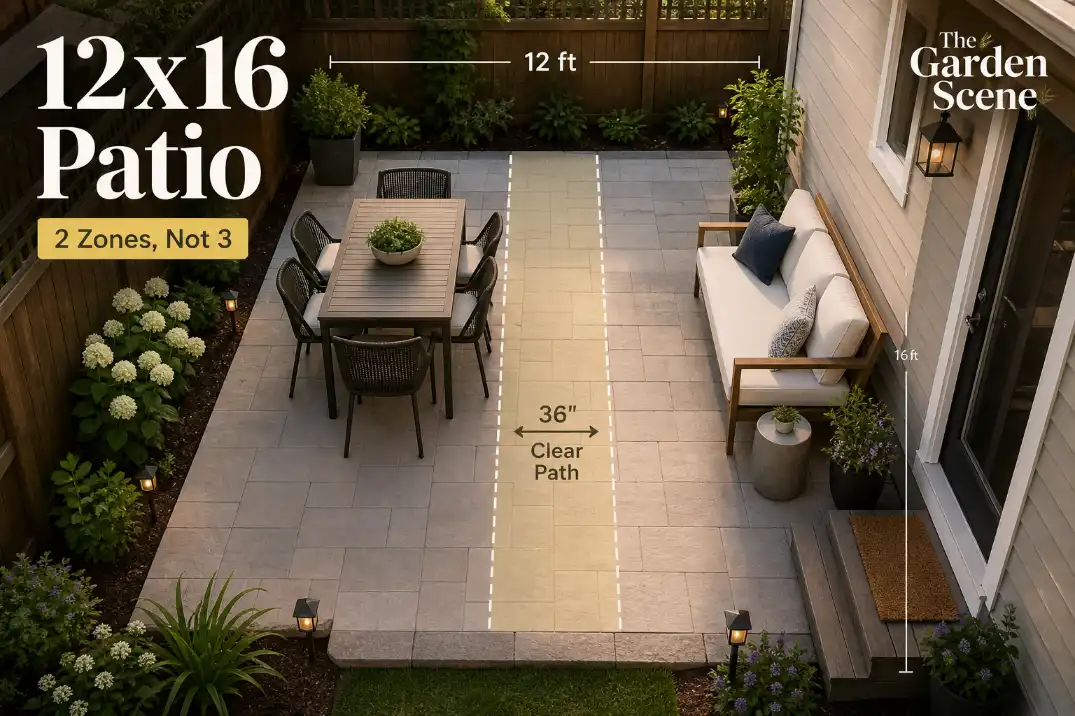
A 12×16 patio is not just a slightly larger small patio. At 192 square feet, it has enough room for two useful outdoor zones, but the 12-foot width is still the hard limit.
The most reliable layout uses the 16-foot direction for the main arrangement, keeps one 30- to 36-inch walking lane open, and treats the patio as a two-zone space rather than a miniature outdoor living room with every feature included.
Start with three checks before choosing furniture: dining chairs need about 42 to 48 inches behind them when pulled out, lounge seating needs 14 to 18 inches from a coffee table, and a grill needs roughly 3 feet of working clearance away from regular traffic.
If the layout only works when chairs are pushed in and no one is cooking, it does not really work. That is the difference between furniture that technically fits and a 12×16 patio that functions well.
Why 12×16 Patios Behave Differently
The best 12×16 patio layouts come from understanding the rectangle, not from starting with a furniture set. The 16-foot side is the opportunity. The 12-foot side is the constraint.
The 12-foot width fills faster than expected
Twelve feet sounds generous until the furniture is placed across it. A 36-inch-deep outdoor sofa, a 24-inch coffee table, 14 to 18 inches of reach space, and a 36-inch walking lane already consume most of the width. Add another chair, planter, or storage box and the patio becomes a squeeze path.
This is why many 12×16 layouts fail when people try to arrange furniture across the short direction. It may look balanced in a product photo, but in daily use the chair legs, table corners, and walking route all compete in the same 12-foot span.
The key is not filling 192 square feet. It is protecting the 12-foot cross-section from too many competing depths.
The 16-foot length should do most of the work
The longer side allows the patio to be divided into zones without making each zone too shallow. In this guide, the 10-foot and 6-foot zones refer to the 16-foot direction of the patio, not the 12-foot width.
A practical split is often about 9 to 10 feet for the main activity and 5 to 6 feet for the secondary activity. That does not mean every inch gets assigned to furniture. Some of that length is absorbed by chair pullback, door clearance, and the route from the house to the yard.
On a 12×16 patio, open space is not wasted space. It is what lets the furniture work.
Two zones are realistic; three full zones usually are not
A 12×16 patio can handle dining and light lounging, lounging and a small bistro setup, or grilling and dining. It usually cannot handle a full dining set, full lounge set, grill station, and separate fire pit without turning into a furniture showroom.
The common mistake is asking a 12×16 patio to behave like a 14×20 patio. The symptom is crowding. The mechanism is too many zones competing for the same circulation space.
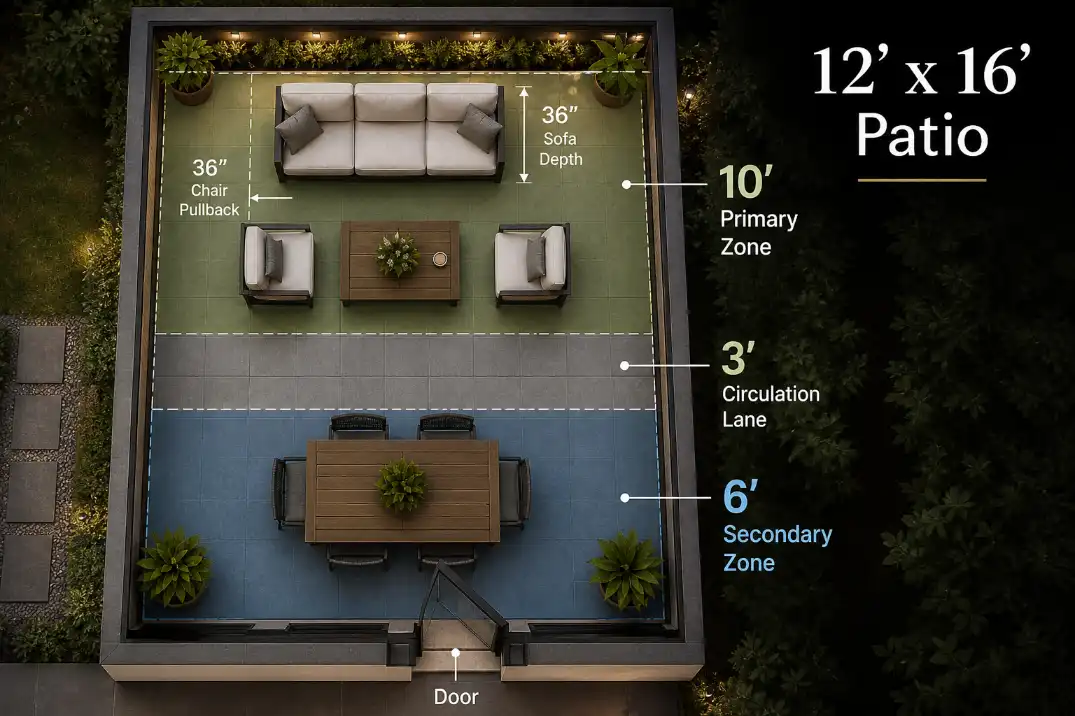
Start With Door Position Before Choosing Furniture
Door position decides where the walking spine goes. If that path is wrong, even good furniture will feel awkward.
Centered sliding door
A centered sliding door usually needs a clear route straight into the patio. On a 12×16 patio, that often divides the 16-foot length into two usable sides, so the mistake is placing the largest furniture piece directly on that centerline.
The better arrangement is often a lengthwise layout: dining on one side of the route and lighter seating or planters on the other. This keeps the patio from feeling blocked the moment someone steps outside.
Side kitchen door
A side kitchen door favors a dining-first layout. Place the table along the 16-foot direction, close enough for carrying food but not so close that pulled-out chairs block the threshold.
This is the layout where a 6-person rectangular table can work, but only if the rest of the patio stays restrained. If the product page says the set fits six, that only describes seating count, not whether you still have enough pullback space. The more detailed spacing logic in Patio Dining Set Space is useful when a dining set looks close but not obviously safe.
Corner door or side-yard access
A corner door often works best with an L-shaped or edge-based layout. Put the main furniture along one long side and preserve a diagonal or side route toward the yard, gate, hose bib, or steps.
This is not the place for a large center coffee table. A round or oval table, two side tables, or a narrow bench usually keeps the patio easier to move through.
Four Core 12×16 Patio Layout Ideas
Before choosing individual furniture pieces, it helps to see the 12×16 patio as four possible layout directions. The same 192 square feet can behave very differently depending on whether dining, lounging, grilling, or open movement gets priority.
The important point is that these are not four ways to fill the patio. They are four ways to choose what the patio is mainly for. On a 12×16 footprint, the layout gets stronger when one idea leads and the other furniture supports it.
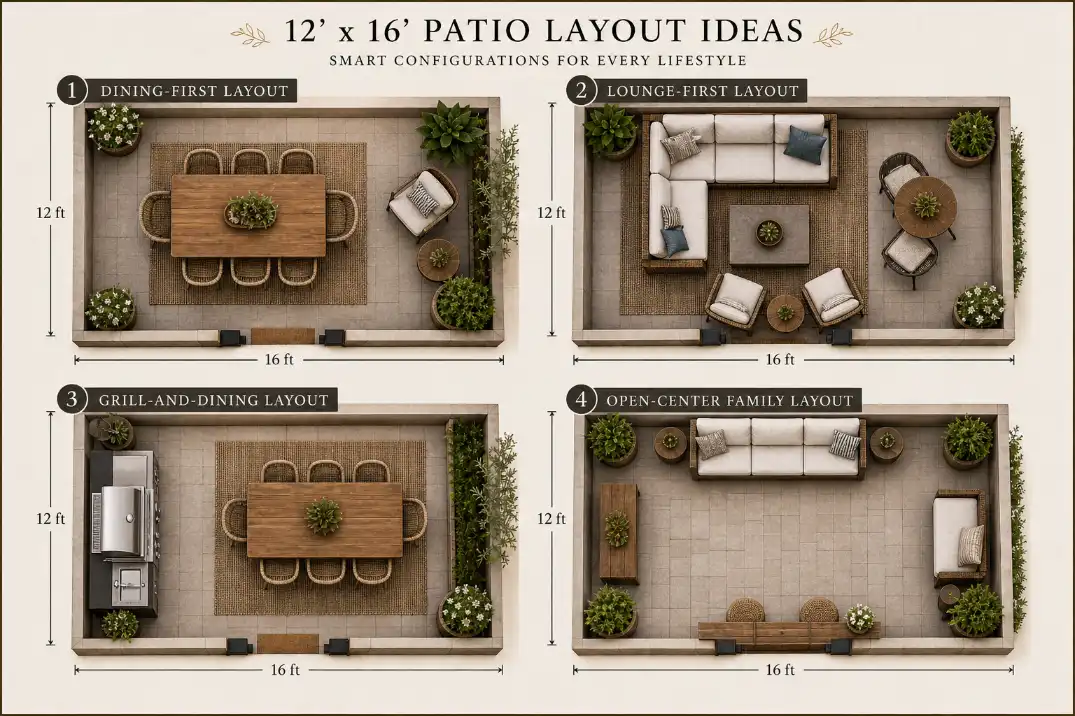
1. Dining-first layout
This is the strongest choice when meals are the main use. Run a rectangular dining table with the 16-foot direction and give it roughly 9 to 10 feet of usable length, including chair pullback. At the far 12-foot end, use a bench, compact loveseat, or two slim chairs as the secondary zone.
This layout works because the dining area gets the depth it needs, while the smaller lounge zone does not pretend to be a full outdoor living room. The failure sign is easy to spot: if people must push in dining chairs before anyone can pass, the table is too large or too centered.
2. Lounge-first layout
This layout fits patios that open from a living room or family room. Place a loveseat or compact sofa along the long side, add two chairs only if the path remains open, and use a small bistro or 4-person dining table farther out.
The safe version keeps the coffee table modest, usually 24 to 30 inches wide. A large rectangular coffee table often creates the exact blockage people were trying to avoid. For broader furniture-pairing decisions, Outdoor Seating, Dining, and Lounging helps separate what looks complete from what actually works.
3. Grill-and-dining layout
A grill can fit on a 12×16 patio, but it should behave like a work zone. The best spot is often a short end or outside corner, not the middle of the social path. This keeps heat, smoke, and the open lid away from dining chairs.
Pair the grill with a 4-person table or a compact 6-person table, not a full grill island and full lounge set. A movable prep cart is usually more realistic than a built-in station on this footprint.
4. Open-center family layout
For families, pets, or frequent movement between the house and yard, an open-center layout can beat a more styled arrangement. Place seating along the edges, keep the middle route open, and use one small table instead of several accent pieces.
This layout may look slightly under-furnished at first. In practice, it often feels better because it absorbs real movement: kids crossing the patio, someone carrying food, a dog walking through, or guests stepping around chairs.
What Usually Fits on a 12×16 Patio
The furniture count matters less than the clearance around it. A smaller set with usable space around it will feel better than a larger set that only looks good when no one is seated.
| 12×16 Patio Goal | Usually Works | Usually Fails |
|---|---|---|
| Dining + light lounging | 6-person table plus bench edge | 6-person table plus full sofa set |
| Lounge + small meals | Loveseat, 2 chairs, bistro table | Sectional plus full dining table |
| Grill + dining | Grill on short end plus 4-person table | Grill island plus 6-person dining |
| Fire feature | Fire table replacing coffee table | Separate fire pit circle plus dining |
| Family traffic | Edge seating and open center lane | Furniture grouped in all four corners |
| Storage + decor | Vertical storage or one edge cabinet | Long deck box plus planters on traffic edge |
The most important distinction is between a secondary zone and a full second room. A bench, bistro table, or small pair of chairs can support the main zone. A full lounge set competes with it.
Furniture Sizes That Fit Best
Dining tables
A 4-person round table, usually 42 to 48 inches wide, is the safest dining choice if you also want lounge seating. A 6-person rectangular table can work when it runs with the 16-foot length, especially around 72 inches long, but it needs room behind the chairs.
The table itself is rarely the problem. The pulled-out chairs are. A table that leaves only 24 inches behind the chairs will feel tight every time someone sits down or stands up.
Sofas, loveseats, and sectionals
A loveseat is often better than a full sofa on a 12×16 patio because it gives the lounge zone a clear role without swallowing the width. A compact sofa can work along the 16-foot side if the opposite side stays light.
Sectionals are the most commonly overestimated furniture type. Many outdoor sectionals look efficient because they use a corner, but one 8- to 10-foot side can take over the patio. If you are using a sectional, the dining area should usually shrink to a bistro table or disappear entirely.
Pro Tip: Tape the exact furniture footprint on the patio and leave it there for 24 hours. Walk through it with chairs “pulled out,” the door open, and the grill zone marked before buying anything large.
Coffee tables, side tables, and storage
Outdoor coffee tables should usually stay smaller than indoor ones. A 24- to 30-inch table is often enough for drinks and snacks. If the lounge zone sits near the main path, side tables may work better than one center table.
Storage boxes are another quiet space thief. A 50-inch deck box placed inside the main patio rectangle can erase the flexibility of an entire edge. If storage is needed, use vertical storage, built-in bench storage, or a spot just outside the patio footprint.
More 12×16 Patio Ideas That Stay Within the Footprint
Once the main zone is chosen, the next decision is how much furniture the patio can carry without losing the walking route. This is where many 12×16 patios go wrong. The problem is rarely one single chair or table. It is the combination: a table that is slightly too long, a sofa that is slightly too deep, and a storage piece that takes the last open edge.
The ideas below stay closer to the real limits of a 12-foot by 16-foot patio. They give the patio a clear use without pretending there is room for every feature at once.
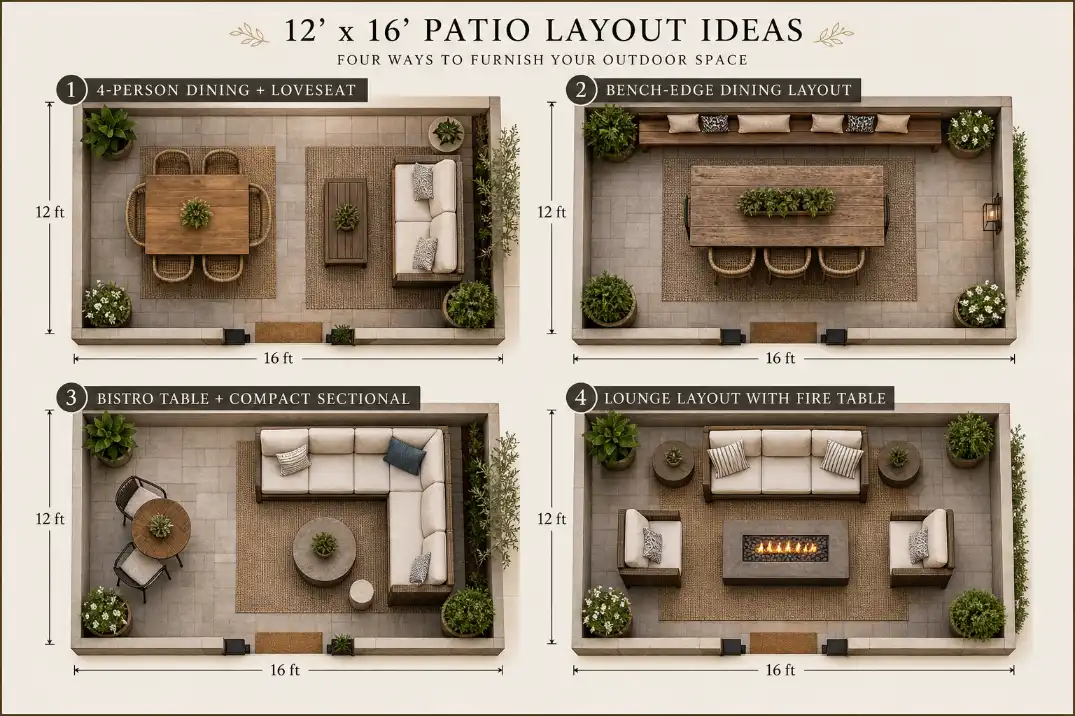
5. Four-person dining with a loveseat
This is one of the safest mixed-use ideas for a 12×16 patio. A 42- to 48-inch round table keeps dining compact, while a loveseat gives the patio a real lounge function without taking over the 12-foot width.
The important tradeoff is capacity. This idea does not try to seat eight people. It gives four people a comfortable meal setup and two people a relaxed place to sit before or after dinner.
6. Bench-edge dining layout
A bench-edge dining layout works because the bench supports the dining zone without demanding the same pullback space as individual chairs. It is especially useful along a wall, planter edge, low retaining wall, or fence-side patio border.
This idea is strongest when the bench is part of the dining area, not a separate lounge zone. Once the bench gets paired with extra chairs, a coffee table, and planters, it stops saving space.
7. Bistro table with compact sectional
A compact sectional can work on a 12×16 patio when dining shrinks to a bistro table. The sectional becomes the main idea, and the bistro table becomes the support piece.
This is the right tradeoff for homeowners who use the patio more for coffee, reading, and evening conversation than full meals. It is not the right setup if outdoor dinners are the main event.
8. Fire-table lounge instead of a separate fire pit
A fire table can work because it replaces the coffee table. A separate fire pit circle usually fails because it tries to become a third zone.
This distinction matters. On a 12×16 patio, a fire feature should do double duty or stay out of the plan. A standalone fire pit with chairs around it often consumes the space that dining or movement needs.
Where a Grill Belongs on a 12×16 Patio
The grill should not be treated like leftover furniture. It changes heat, smoke, traffic, and safety clearances.
Best grill location
The best grill position is usually one short end of the patio or an outer corner with a clear 3-foot working zone. Ideally, the cook can stand without blocking the route from the house to the dining area.
If the patio is covered, be more cautious. Smoke and heat linger under roofs, pergolas, and low overhangs. A grill that feels fine on an open patio may become uncomfortable under a cover, especially in humid areas where air movement is already weak.
For tight patio cooking setups, Small Patio Grill Placement Near a Dining Area goes deeper into the conflict between heat, chair pullback, and walking lanes.
When the grill should move off the patio
Moving the grill to a corner is not always a fix. If that corner is also the only path to the yard, steps, hose, or side gate, the grill is still in the wrong place.
A separate grill pad beside the 12×16 patio can be the better decision. It protects the two-zone patio layout and keeps cooking from taking over the social space.
Patio-Specific Details That Change the Layout
A 12×16 patio is not the same as a 12×16 deck. Deck layouts often use railings to define edges. Patios usually need furniture, rugs, planters, or built-ins to create that sense of boundary.
Surface slope can affect furniture placement
Most patios have some slope for drainage. That is good for water, but it can make tables wobble or chairs feel uneven if furniture is placed across the pitch. A slight slope may not matter for a bench, but it can be noticeable under a dining table.
If water regularly pools near the house or across the main furniture area, layout changes will not solve the underlying problem. In that case, the issue is drainage, not furniture, and Patio Water Pooling Against the House is a better next step than rearranging chairs again.
Paver joints and concrete heat matter
On paver patios, chair legs can catch in joints if the dining area gets heavy use. On concrete or dark pavers, summer heat can make the lounge zone uncomfortable during late afternoon. In hot climates, shade may matter more than the best view.
This is one condition people often underestimate. A lounge zone that looks perfect in April may be the least-used part of the patio in July if it sits on the hottest surface with no shade. If that area stays too hot to use for 2 to 3 afternoon hours, shade placement matters more than adding another seating piece.
Mistakes That Make a 12×16 Patio Feel Smaller
Dividing the patio evenly
An even split sounds fair but often creates two zones that are both slightly too small. A 60/40 split works better because one activity gets enough room to function, while the smaller zone supports it.
In most successful 12×16 layouts, the main furniture runs parallel to the 16-foot side, while the 12-foot side stays visually lighter.
Buying by seat count
A 7-piece set does not mean the patio can comfortably seat seven people. Seat count ignores pullback, walking space, table reach, grill clearance, and door swing. On a 12×16 patio, those invisible spaces decide the layout.
This is where people commonly overestimate the patio’s capacity. The space looks large when empty, but occupied chairs and walking lanes use more room than the furniture footprint suggests.
Adding decor before editing furniture
Outdoor rugs, lanterns, side tables, and planters can help define zones, but only after the furniture size is right. If the main table and seating are already too large, decor will make the conflict prettier, not better.
This is where removing one piece can outperform rearranging everything. The logic in Remove Patio Furniture From a Cramped Space applies especially well to 12×16 patios because one oversized piece can break the whole rectangle.
Nearby Patio Sizes That Can Borrow the Same Logic
This article is built for 12×16 patios, but nearby rectangular sizes can borrow some of the zoning logic. They should not copy the same furniture count automatically.
| Patio Size | Can Use Similar Logic? | What Changes |
|---|---|---|
| 10×16 | Partly | Keep lengthwise zoning, but reduce dining or lounge depth. |
| 12×14 | Mostly | Same 12-foot width limit, but the secondary zone gets smaller. |
| 12×18 | Yes | Same width constraint, but the extra 2 feet helps the support zone. |
| 14×16 | Partly | The wider side allows more crosswise layouts, so it behaves differently. |
| 10×12 | Only loosely | This becomes a small-patio problem, not a true two-zone layout. |
The useful takeaway is not that all these patios can use the same plan. It is that the 12-foot side remains a major constraint, while the longer side determines how much zoning is realistic.
Questions People Usually Ask
Can a 12×16 patio fit dining and lounging?
Yes, if one zone is clearly smaller. A 6-person dining table with a bench or compact loveseat can work. A 6-person dining table plus a full lounge set usually feels crowded.
Can a 12×16 patio fit a sectional?
Sometimes, but the sectional should usually replace full dining rather than sit beside it. A corner sectional with a bistro table is more realistic than a sectional plus a 6-person table.
What is the best layout for a 12×16 patio with a grill?
Put the grill on a short end or outside corner, keep about 3 feet of work clearance, and avoid placing dining chairs directly behind the cook. If the grill blocks the only traffic route, it should move off the main patio.
Is a fire pit practical on a 12×16 patio?
A fire table can be practical if it replaces the coffee table in a lounge layout. A separate fire pit circle plus dining area usually asks too much from 192 square feet.
Final Takeaway
The best 12×16 patio furniture layout uses the rectangle honestly. Let the 16-foot side organize the zones, protect the 12-foot width from crosswise crowding, and keep one clear 30- to 36-inch route through the space.
Two outdoor jobs can work beautifully on this footprint. Three full jobs usually turn the patio into a negotiation.
For official outdoor fire safety guidance, see the U.S. Fire Administration.