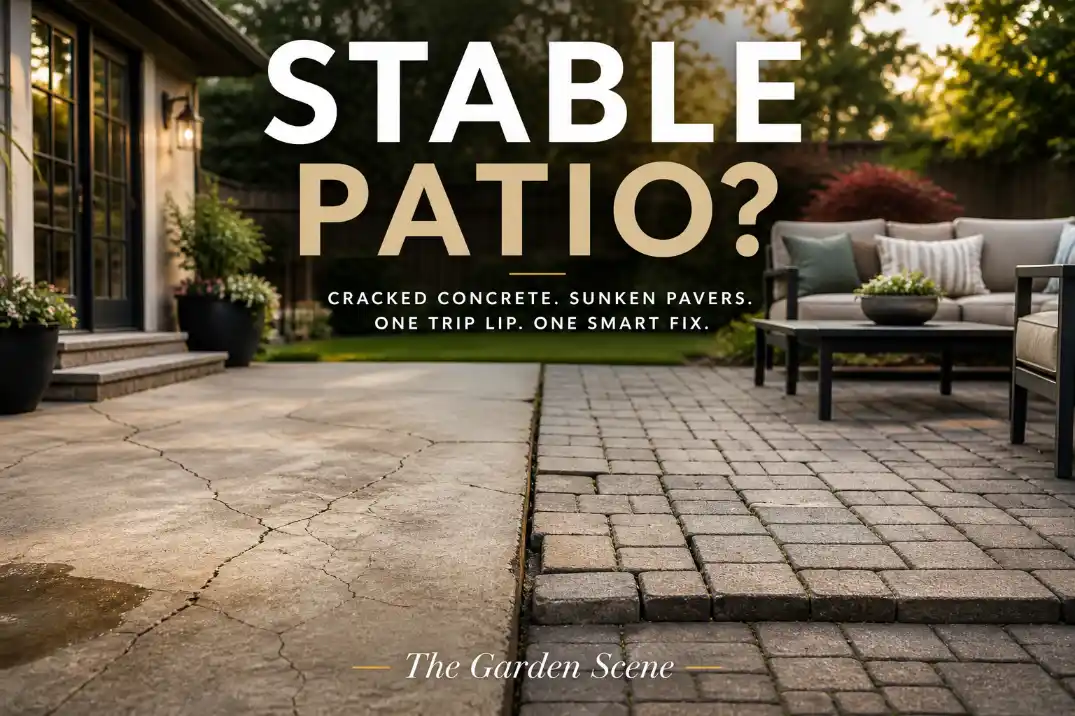
Concrete and pavers can both make a stable patio, but neither material is stable by itself. A patio stays flat because the soil is firm, the base drains, the surface sheds water, and small movement is controlled before it becomes visible.
If a patio settles more than about 1/4 inch across a few feet, holds water for more than 24–48 hours after normal rain, or develops lips high enough to catch a shoe, the problem is usually below the surface rather than in the surface choice.
Best choice for stability: pavers are usually better on clay soil, wet yards, freeze-thaw sites, or patios likely to need future repair. Concrete is better on dry, well-compacted, well-drained sites where a smooth, continuous surface matters more than repair flexibility.
The sharper way to think about it is this: concrete tends to fail as one connected slab, while pavers usually fail in smaller, repairable sections.
The more unpredictable your site is, the less this is a concrete-vs-pavers decision and the more it becomes a repairability decision.
Quick Stability Decision
Choose pavers when the site is unpredictable
Pavers are usually the safer stability choice when the yard has heavy clay, seasonal saturation, nearby roots, poor drainage history, or freezing winters. In northern states and parts of the Midwest, repeated freeze-thaw cycles can lift and relax small areas over winter.
A flexible paver system can handle that movement better than one rigid slab, as long as the base is deep, compacted, and restrained at the edges.
That last part matters. Pavers are not automatically stable because they are segmented. A patio with a thin base, weak edge restraint, or loose bedding layer can shift within the first season.
Choose concrete when the site is controlled
Concrete makes more sense when the patio area is already predictable: compactable soil, simple grade, controlled downspouts, and a clear slope away from the house. A 4-inch concrete patio over a properly prepared base can feel solid under dining furniture, grills, and daily foot traffic.
Concrete’s advantage is continuity. Its weakness is also continuity. Once the base settles unevenly, the slab has fewer ways to absorb that movement without cracking, lifting, or breaking into sections.
What Stability Really Depends On
The surface is only the visible layer
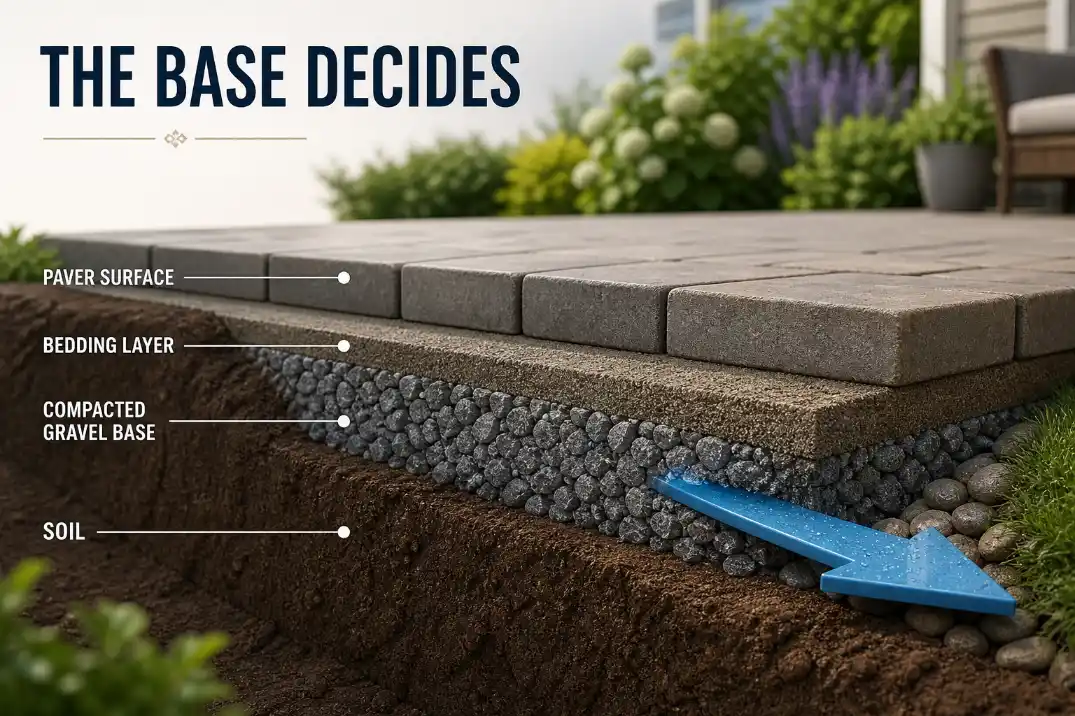
Homeowners often compare concrete and pavers as if the top material does most of the work. It does not. The base and subgrade decide whether the patio stays flat.
A stable paver patio typically needs compacted aggregate, a thin bedding layer, locked joints, and firm edge restraint. In many pedestrian patio settings, 4–6 inches of compacted aggregate is common, with more needed where soil is weak, wet, or frost-prone. Concrete patios rely on uniform support below the slab, usually with compacted soil and a gravel base so the slab is not bridging soft pockets.
The symptom is the crack, dip, wobble, or open joint. The mechanism is usually soil movement, poor compaction, trapped water, or base washout. That distinction matters because filling the symptom rarely fixes the patio.
If your current patio feels unstable because the ground was uneven from the beginning, the deeper issue may look more like the problems described in Uneven or Sloped Ground? Here’s Why Your Patio Feels Unstable, where the surface material is only one part of a grading problem.
Water is the quiet stability test
Water exposes weak patios faster than foot traffic does. A patio that sheds rain cleanly dries more evenly, keeps the base from softening, and reduces freeze-thaw stress in colder regions. A patio that holds water sends moisture into joints, slab edges, low spots, or the soil below.
For most patios, a slope of about 1/8 to 1/4 inch per foot away from the house is a practical target. Less than that can leave puddles. More than that may feel noticeably tilted under furniture.
This is where people often overestimate concrete. Because it looks solid, they assume it resists water better. But a concrete slab with poor slope can trap water just as effectively as a poorly set paver patio. Once water starts undermining one edge, the slab cannot be reset in small pieces.
The Site Condition Matrix: What Should Actually Decide It
| Site condition | Concrete stability outlook | Paver stability outlook | Better bet |
|---|---|---|---|
| Dry, compacted, simple grade | Strong if jointed correctly | Also strong with good base | Concrete if smoothness matters |
| Wet or slow-draining yard | Risk rises if water sits near slab edges | Better if base drains properly | Pavers |
| Freeze-thaw climate | More crack-sensitive | More tolerant of small movement | Pavers |
| Nearby tree roots | Can lift larger slab sections | Local units can often be reset | Pavers |
| Tight budget, low-risk site | Strong value upfront | Higher labor and material cost | Concrete |
| Likely future repair | More disruptive to fix | More localized to repair | Pavers |
Cracking is not the same as instability
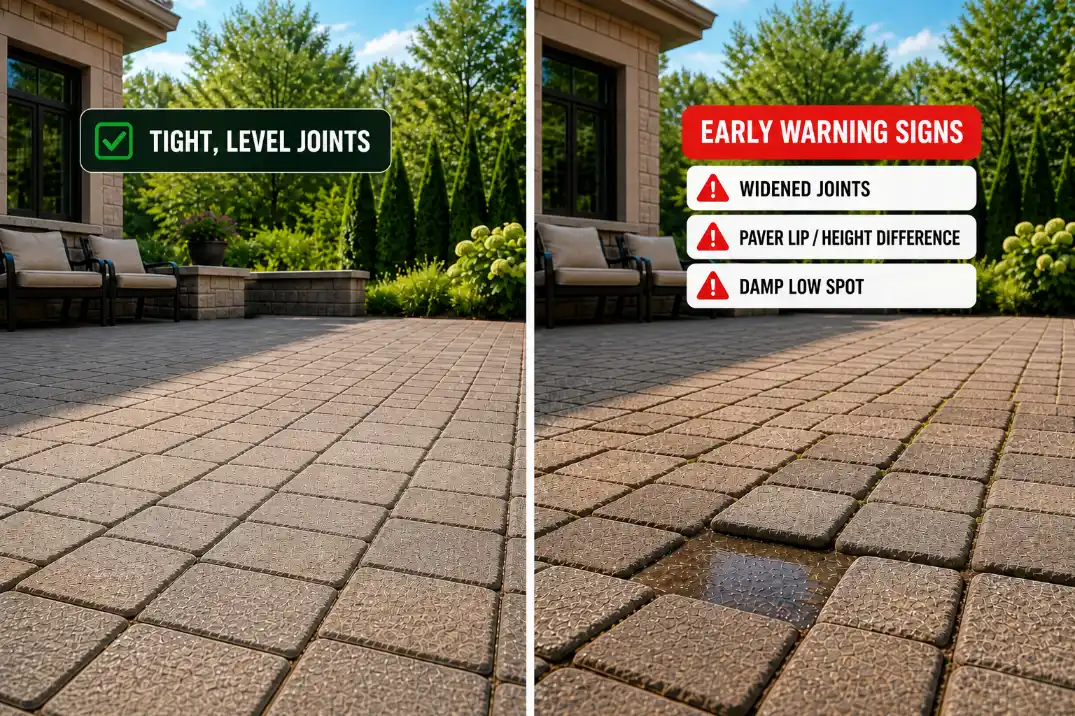
Concrete cracks. That alone does not mean the patio is failing. A tight hairline crack that stays level on both sides may be mostly cosmetic. The more important warning signs are vertical displacement, widening gaps, water entering the crack, or one section settling lower than the other.
Control joints are supposed to manage cracking. For a 4-inch slab, joints are often spaced roughly 8–12 feet apart, depending on slab design and site conditions. If joints are missing, too shallow, or badly placed, concrete may crack where it wants instead of where the installer planned.
The fix that often wastes time is sealing every crack as if water entry is the main problem. Crack sealant may slow surface water, but it does not correct a soft base, a low corner, or runoff flowing toward the slab. Once the patio has vertical movement, not just surface wear, the fix has moved below the finish layer.
Shifting pavers are often a base or edge problem
With pavers, the first visible failure is usually a widened joint, a rocking unit, or a small sunken area. People often blame the paver itself or the sand between the joints.
Sometimes joint sand is part of the issue, but the more likely causes are base movement, missing edge restraint, or water moving through the patio faster than the base can handle.
Polymeric sand can help lock joints once the patio is properly set. It cannot rescue pavers that are already sinking into a poorly compacted base.
If you can lift several pavers and see loose, muddy, or uneven bedding underneath, new sand on top is a temporary cosmetic move.
For a patio that is already shifting, the repair logic in Polymeric Sand and Paver Repair for Shifting Patios is more relevant than simply comparing product labels.
Cost Matters Less Than Repair Risk
Concrete often wins the estimate
On a simple, low-risk patio, concrete often wins on upfront cost because the installation is more continuous and usually less labor-intensive than placing individual pavers. That matters when the site is dry, flat, and unlikely to move.
But cheaper does not mean safer on unstable ground. If the patio has poor drainage, soft soil, or runoff from a roofline or slope, the lower initial cost can become a weaker long-term value. Concrete is not hard to maintain when it performs well. It is hard to correct when the ground under one area starts moving.
Pavers often win the repair conversation
Pavers often cost more at installation because the system has more pieces: excavation, aggregate base, bedding layer, edge restraint, pavers, joint material, and compaction. The payoff is repairability.
If a 3-foot by 3-foot area settles, pavers can usually be lifted, the base corrected, and the same units reinstalled. With concrete, the repair may involve cutting, patching, mudjacking, grinding, resurfacing, or replacing a larger slab section. That difference is why pavers are usually the stronger choice where future movement is realistic.
Pro Tip: If your budget is tight, do not save money by thinning the base. Choose a smaller patio before choosing a weaker foundation.
Where Stamped Concrete Fits
It may look like pavers, but it repairs like concrete
Stamped concrete often enters the conversation because it can imitate stone or pavers while keeping a continuous slab. That can look good, but it does not give concrete the segmented repair advantage of pavers.
Stamped concrete is still poured concrete. If the slab cracks or settles, the repair may be more noticeable because the pattern and color are harder to match. It can also become slippery if the finish, sealer, drainage, or maintenance routine is wrong, especially in humid climates or shaded patios that dry slowly.
Stamped concrete makes sense when the site is already well controlled and the homeowner wants a decorative slab. It is not a shortcut around base preparation, drainage, or joint planning.
Standard Pavers Are Not Automatically Drainage Pavers
Permeable systems are different
A common mistake is assuming all paver patios drain through the surface. Standard pavers still need slope. Water may enter the joints, but that does not mean the patio is designed to absorb and manage stormwater.
Permeable paver systems are built differently. They typically use wider joints and open-graded aggregate layers so water can move down through the surface and into the base. That system can be useful in wet yards, but it has to be designed as a permeable system from the beginning.
If the patio decision is being driven by a wet backyard rather than appearance, compare the surface choice with the broader material guidance in Best Patio Materials for Wet Backyards. The right answer may depend more on drying behavior than on style.
When the Standard Fix Stops Working
Surface fixes stop making sense when movement is vertical
Small maintenance can help a stable patio last longer. Concrete can be cleaned and sealed. Paver joints can be topped up. Minor edge gaps can be corrected before they spread.
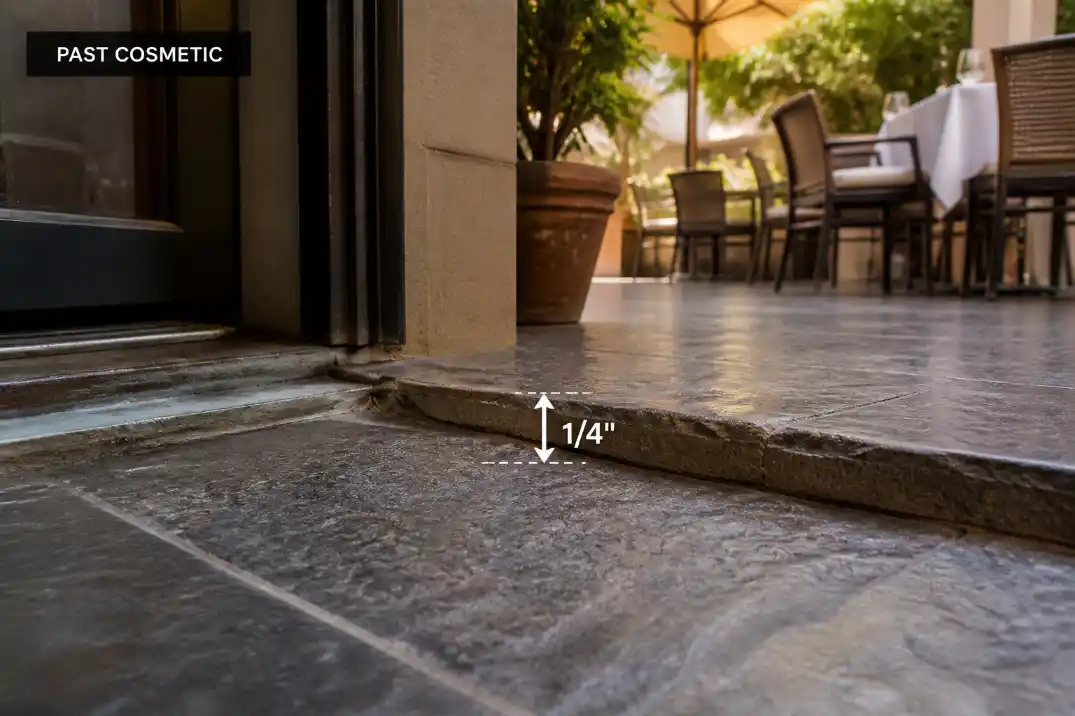
But routine fixes stop making sense when the patio is no longer level. If one slab section is higher than another, if pavers rock underfoot, or if water always returns to the same low spot, the issue is no longer surface wear. It is support failure.
A practical repair threshold is about 1/4 inch of vertical displacement in walking paths, doorway transitions, or dining areas. Below that, monitoring may be reasonable if the area is stable and drains well. At or above that point, the patio begins to affect safety, furniture stability, and long-term repair cost.
The house edge deserves priority
The highest-risk area is often the edge near the house. If water pools there, both concrete and pavers become risky choices until grading is fixed. A patio that pitches toward the foundation or traps water against siding is not just unstable; it can create a more expensive moisture problem.
After a normal rain, the patio edge near the house should not stay visibly wet long after the open yard has dried. If that area remains damp for a full day or more, solve the water path first. Patio Water Pooling Against the House covers that specific failure pattern more directly than a material comparison can.
Practical Questions Before You Choose
Are pavers always more stable than concrete?
No. Pavers are more forgiving, not automatically stronger. A poorly compacted paver base can fail faster than a well-built concrete slab.
Is cracked concrete worse than uneven pavers?
Not always. A level hairline crack may be cosmetic. Raised pavers can be more urgent if they create a trip edge, show widening joints, or rock underfoot.
Should you pour concrete under pavers for stability?
Usually not for a normal patio. A flexible aggregate base is one of the main reasons pavers handle small movement well. A concrete base under pavers can make sense in specific engineered overlays, but it is not the default fix for a backyard patio.
The Best Stability Decision
For most homeowners choosing strictly for long-term stability, pavers are the more forgiving choice on imperfect sites, while concrete is the cleaner choice on well-drained, predictable sites.
If your yard is wet, clay-heavy, frost-prone, or uneven, pavers usually give you better repair options and less dramatic failure. If your site is dry, compacted, well-sloped, and unlikely to move, concrete can stay stable with fewer small maintenance tasks.
The mistake is choosing based on the top surface before judging the site. A stable patio is built from the ground up: soil first, water second, base third, surface last.
Reverse that order and both concrete and pavers can fail in ways that look like bad material but are really bad preparation.
If the ground is predictable, concrete can be the cleaner answer. If the ground is not predictable, pavers usually buy you something concrete cannot: a second chance.
For broader technical guidance on concrete slab jointing, see the National Ready Mixed Concrete Association.