Last updated: May 2, 2026
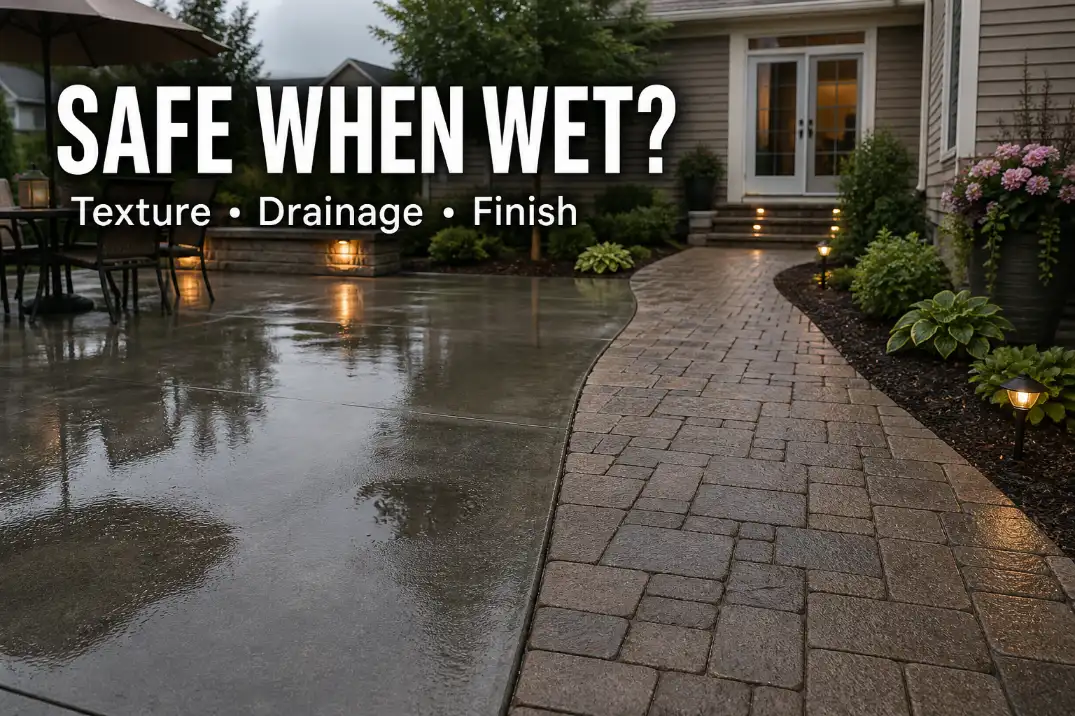
The best low-slip patio surface for a family backyard is usually textured concrete pavers because they balance grip, drainage, repairability, and everyday durability. Broom-finished concrete is the best simple option when the patio has proper slope.
Permeable pavers are the better choice when water is the real slip problem. The surfaces to treat carefully are glossy sealed concrete, smooth porcelain tile, polished stone, and loose pea gravel in active play or dining zones.
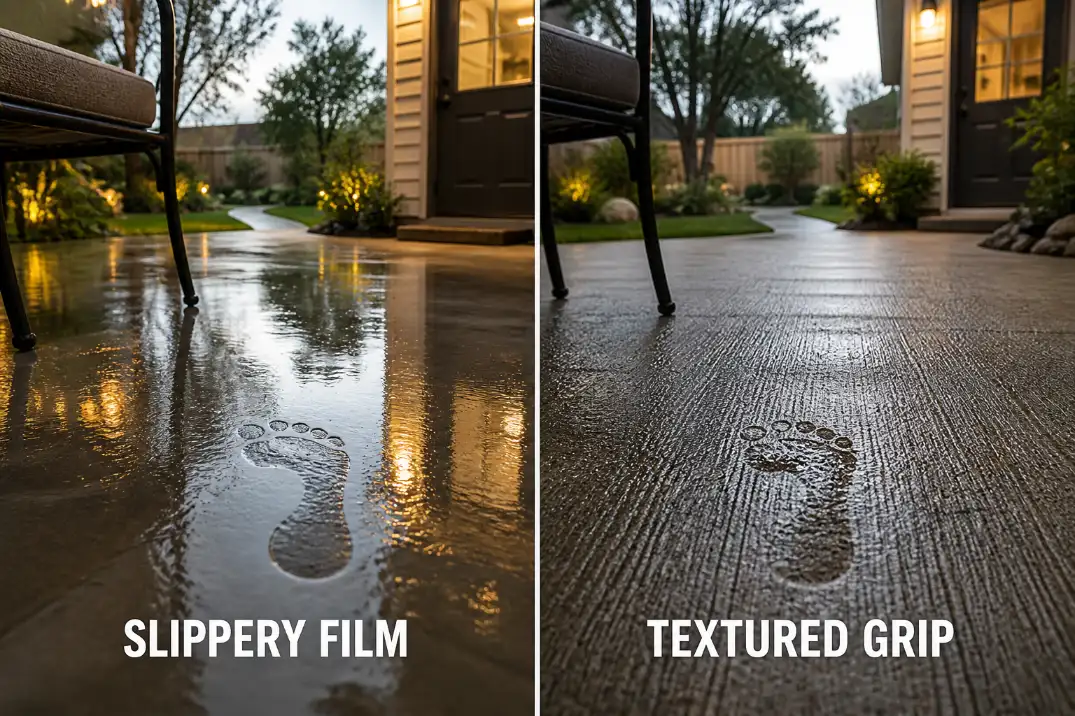
A safe family patio is not just “rough.” It needs enough texture to grip when wet, enough slope to drain at about 1/8 to 1/4 inch per foot, and a finish that does not turn slick after sealing.
If water is still sitting after 30 to 60 minutes, the issue may be drainage more than material. If edges rise more than 1/4 inch, the hazard shifts from slipping to tripping.
What Actually Makes a Patio Low-Slip?
Low-slip performance comes from the surface, the water behavior, and what builds up over time. A patio can be made from a good material and still become slippery if it is sealed too glossy, shaded all day, sprayed by sprinklers, or coated with algae, sunscreen, grease, or fine dust.
Texture is the first filter
The finish matters more than the material name. “Concrete,” “paver,” “stone,” and “porcelain” are broad categories. A broom-finished concrete slab can be much safer than smooth troweled concrete.
A textured concrete paver can be safer than polished stone. A matte outdoor porcelain paver may work well, while a smooth indoor-style porcelain tile can be risky outside.
For family use, the best texture is usually moderate. It should grip under shoes and bare feet without feeling sharp. Very rough surfaces can be unpleasant for barefoot kids, harder to clean, and uncomfortable around pool or sprinkler zones.
Even a low-slip surface can become slick over time, so it is worth knowing which non-slip cleaners and treatments for patios make sense before replacing the surface.
Drainage decides whether texture keeps working
Even a grippy surface becomes less reliable when a thin water film stays on top. That is why slope, base preparation, and nearby runoff matter so much. A patio that sheds water within 5 to 10 minutes after a light rain behaves very differently from one that stays damp for an hour.
If the patio already has drainage problems, choosing a low-slip surface alone will not solve the underlying issue.
In that case, the decision overlaps with base material and runoff control, which is why Pavers vs Gravel for Backyards With Drainage Problems is a useful companion topic before committing to a surface.
Best Low-Slip Patio Surfaces for Family Backyards
The safest choice depends on how the backyard is used. A patio outside a sliding door has different demands than a grill zone, shaded seating corner, pool edge, or route where kids and pets move between the lawn and the house.
| Surface | Best family use | Main slip-risk trigger | Maintenance reality |
|---|---|---|---|
| Textured concrete pavers | Main patios, walking routes, dining areas | Settled joints or algae in shade | Resettable, cleanable, strong all-around choice |
| Broom-finished concrete | Simple patios, play routes, budget-stable installs | Glossy sealer or poor slope | Low maintenance if finish stays matte |
| Permeable pavers | Wet yards, runoff-prone patios | Clogged joints | Needs periodic joint cleaning |
| Textured porcelain pavers | Modern patios, covered areas, pool-adjacent spaces | Smooth or indoor-rated finish | Easy to clean if outdoor-rated |
| Natural cleft stone | Garden patios, informal seating areas | Raised edges or wide joints | Beautiful but less uniform |
| Compacted decomposed granite or angular gravel | Secondary paths, quiet sitting areas | Loose movement underfoot | Not ideal for active play or dining zones |
Textured concrete pavers: best overall
Textured concrete pavers are the strongest all-around low-slip choice for most family backyards. They offer better repairability than poured concrete, more surface grip than many smooth slabs, and better design flexibility than plain concrete. If one area settles, stains, or gets damaged, individual pavers can often be lifted and reset.
For family use, tight joints matter. Wide gaps may drain well, but they can catch chair legs, scooter wheels, stroller wheels, and small feet. A textured paver with narrow, stable joints usually gives the best mix of safety and everyday usability.
If the pooled area has started to feel slick underfoot, check whether drainage, algae, or surface finish is the real issue before buying non-slip patio cleaners or treatments.
Broom-finished concrete: best simple option
Broom-finished concrete is a practical low-slip surface when the patio is properly sloped and not over-sealed. The broom lines give shoes and bare feet enough grip without creating a surface that feels jagged.
The problem usually begins later, when a glossy film-forming sealer is added to “freshen up” the patio. If the slab looks shiny from 10 feet away, test it wet before trusting it around kids. Shine does not always mean danger, but it is a warning sign.
Pro Tip: For family patios, a matte or penetrating sealer is usually safer than a glossy decorative sealer. Appearance should not outrank wet traction.
Permeable pavers: best when water is the hazard
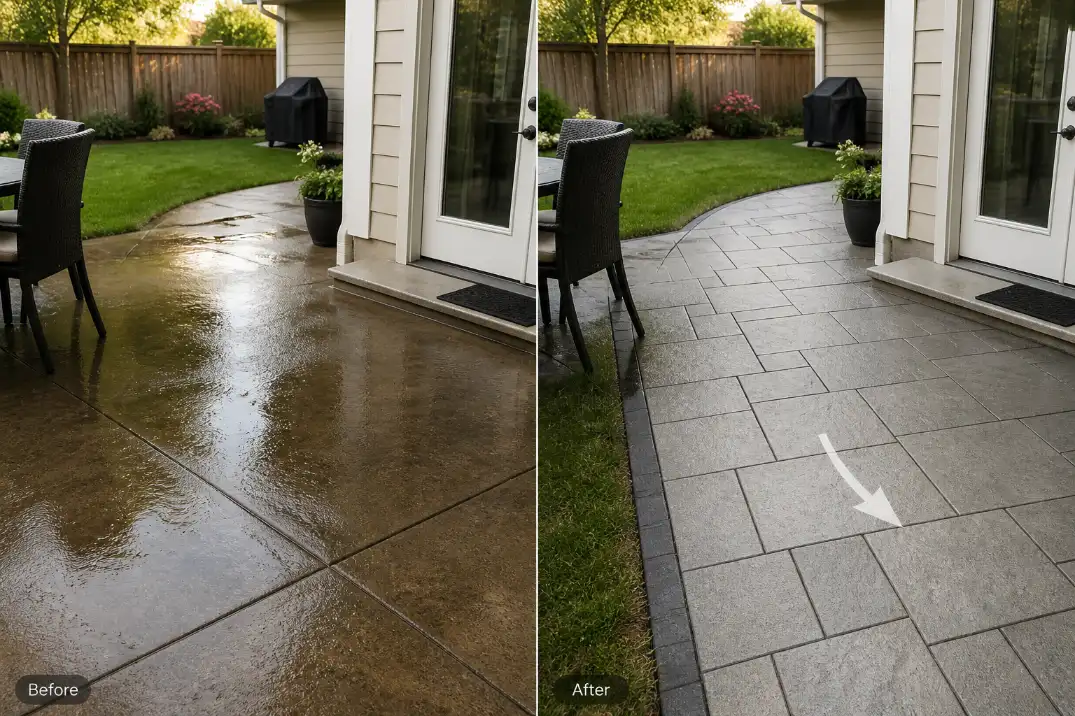
Permeable pavers are useful when the patio becomes slippery because water lingers. Their benefit is not that they are magically grippier; it is that they let water move through the joints into the stone base instead of staying on the surface.
They need maintenance. Leaves, soil, and fine debris can clog the joints. If a permeable patio used to dry in 10 minutes but now stays damp for 45 minutes or longer, the surface may not be failing. The joints may need cleaning.
If water is moving toward the foundation, solve that before choosing a prettier surface. Patio Water Pooling Against the House explains why that situation is more urgent than a simple slip-resistance upgrade.
Textured porcelain pavers: good only when properly rated
Porcelain gets misunderstood because there are two very different versions in the market. Smooth indoor-style porcelain tile is a poor patio choice in wet family areas. Textured outdoor porcelain pavers, especially thicker exterior paver formats, can work well when the manufacturer provides wet-use data.
This is where homeowners often overcorrect. They hear that porcelain can be slippery and reject it entirely, or they see a beautiful “outdoor look” tile and assume it is safe. The better move is to ask for outdoor floor suitability, wet traction information, and whether the product is intended for patio or pool-adjacent use.
Natural cleft stone: attractive but less predictable
Natural stone can be low-slip when it has a cleft, flamed, or textured surface. Bluestone, flagstone, and some limestones can look excellent in a family backyard while offering decent wet grip.
The risk is unevenness. A beautiful irregular stone patio may create more tripping points than a flatter paver surface. If raised edges vary by more than about 1/4 inch along a main walking route, the issue is no longer just slip resistance. It is a layout and installation problem.
How to Read Slip Ratings Without Overtrusting Them
Slip ratings can help, but they should not be treated as a guarantee. A surface tested in one condition may behave differently with rainwater, sunscreen, grill grease, soap residue, algae, or dust.
DCOF is useful, not absolute
DCOF stands for dynamic coefficient of friction. It describes friction while movement is happening, which makes it more relevant than a purely static number. But DCOF does not automatically answer the real backyard question: “Will this feel safe when my kids run across it after sprinklers?”
A wet DCOF value can help compare tile and paver options, but it is not a complete safety label. Outdoor patios have changing conditions: rain, organic film, shade, mud, pool splash, and cleaning products. The surface still needs practical texture, drainage, and maintenance.
Ask for wet-use information on porcelain and tile
If you are considering porcelain or tile outdoors, do not rely on photos or showroom feel. Ask whether the surface is rated for exterior floors, whether it is appropriate for wet areas, and whether it has a textured or matte finish. A tile that feels smooth in a dry showroom can feel very different after a summer thunderstorm or sprinkler cycle.
This matters most near pools, back doors, outdoor showers, and shaded patios where bare feet and water meet.
Surfaces Families Often Overestimate
Some surfaces look durable or premium but perform poorly in active family spaces. The issue is usually not that the material is always wrong. It is that the wrong finish is used in the wrong zone.
Glossy stamped concrete
Stamped concrete can look like stone or pavers, but the texture is sometimes shallow. When it is sealed with a glossy coating, water can sit on the high points and create a slick film.
The symptom is slipping. The mechanism is smooth sealed texture plus water film. Adding more sealer often makes the problem worse instead of fixing it.
Smooth porcelain tile
Smooth porcelain is one of the most common mistakes in covered patios and outdoor rooms. It may look clean and modern, but if it is not made for wet exterior floor use, it can become slick with rain, pool splash, morning dew, or wet grass tracked in from the lawn.
Textured outdoor porcelain pavers are a different category. They can be a good choice, but only when the finish and rating match the use.
Loose pea gravel in active zones
Pea gravel drains well, but rounded stones roll underfoot. That rolling movement is not ideal where children run, dining chairs move, or people carry plates from the grill.
Angular gravel locks together better, and compacted decomposed granite can be useful in secondary paths or quiet sitting areas. But for a main family patio, loose stone is usually less stable than a textured hard surface.
What Makes a Patio Slippery After Installation?
Many patios start out safe and become slick later. That is why replacement is not always the first fix.
Shade and algae are underestimated
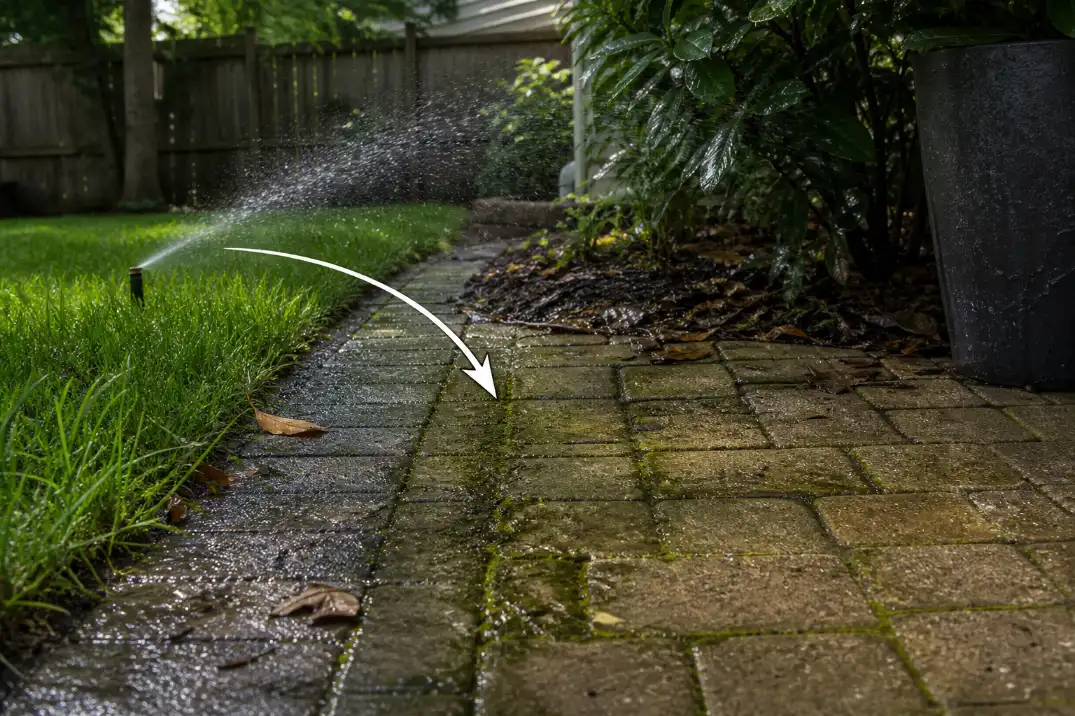
Shaded patios dry slowly. Add sprinkler overspray, leaf litter, and humid weather, and the surface may develop a thin green or black film. This is especially common in humid areas such as Florida, the Gulf Coast, and shaded Midwest backyards after rainy stretches.
A useful test is to compare the sunny center with the shaded edge after a dry 24-hour period. If the sunny section feels fine but the shaded edge feels slick, the material may not be the main problem. Moisture retention and biological buildup are.
This also connects to comfort. A patio can be low-slip but still unpleasant in summer heat, especially for barefoot kids. Why Some Patio Surfaces Get Too Hot in Summer is worth considering when a surface needs to be safe and comfortable.
Sealer buildup is a common wrong fix
When a patio looks worn, resealing feels logical. But if the existing problem is slick film, another coat may only thicken that film. This is especially true on stamped concrete, decorative concrete, and some stone surfaces.
Routine sealing stops making sense when the patio becomes slippery after every rain even though it has already been cleaned and sealed. At that point, the better question is whether the old coating needs to be stripped, whether a traction additive is appropriate, or whether the finish itself is wrong.
For this kind of diagnosis, Is Your Patio Slippery Because of the Finish, Cleaning, Sealer, or Drainage? goes deeper into the difference between surface finish and surface contamination.
Family use creates localized slick spots
A patio does not always become slippery everywhere. Family backyards often develop small high-risk zones: the path from the lawn to the back door, the area around the grill, the splash zone near a kiddie pool, and the shaded corner where toys and wet towels collect.
Sunscreen, bubble solution, spilled drinks, grill grease, wet grass clippings, and dust can all create a thin film. Dogs tracking wet grass back onto the patio can create the same problem in a narrow route near the door. Around cooking areas, surface choice should also account for stains and heat. Best Surfaces Around a Backyard Grill is useful because grill zones need more than just traction.
How to Choose the Right Surface for Your Backyard
The safest choice depends on the highest-risk route, not the prettiest sample. In a family backyard, that route is usually from the back door to the lawn, from the patio to the grill, or from the pool or sprinkler area to the seating zone.
For wet or shaded yards
Choose textured pavers, permeable pavers, or broom-finished concrete with a matte finish. Avoid glossy sealers and smooth stone. Keep mulch, soil, and leaves from washing onto the patio.
If the patio stays damp for more than 24 hours after moderate rain, do not treat surface texture as the whole fix. Look at slope, airflow, shade, irrigation, and drainage first.
For pool, sprinkler, or barefoot use
Choose moderate texture. Very rough exposed aggregate may grip well but feel harsh under bare feet. Smooth porcelain may look refined but become risky when wet. Textured pavers, textured outdoor porcelain, or broom-finished concrete usually create a better balance.
Around pools or splash zones, treat the patio more like a small pool deck than a dry seating area. The best barefoot family surface is not the roughest one. It is the one that stays predictable when wet and still feels comfortable enough to use daily.
For freezing winters
In northern states, freeze-thaw movement changes the safety equation. A surface that absorbs water, shifts, or heaves can create raised edges after one or two winters. Concrete pavers and permeable pavers can perform well when installed over a proper compacted base. Natural stone must be selected carefully because some stones handle freeze-thaw cycles better than others.
If the surface becomes uneven, that is no longer only a slip problem. It becomes a trip problem, a drainage problem, and sometimes a base failure.
Quick Decision Checklist
Use this before choosing or replacing a patio surface:
- Water remains after 30–60 minutes: check slope and drainage before blaming material.
- Raised edges exceed 1/4 inch: treat it as a trip hazard.
- Surface looks glossy when dry: wet-test it before trusting it around kids.
- Slickness appears only in shade: clean algae and reduce moisture first.
- Barefoot use is common: avoid extremely rough textures.
- Kids run through the area daily: avoid loose pea gravel and polished finishes.
- Grill or dining zones feel slick: look for grease, food film, or sealer buildup.
Questions People Usually Ask
Are porcelain pavers slippery when wet?
They can be, but not always. Smooth indoor-style porcelain is risky outside. Textured outdoor porcelain pavers can be suitable when they are made for exterior wet-use conditions and have manufacturer traction data.
Is rougher always safer?
No. Rougher surfaces may grip better, but they can be uncomfortable for bare feet, harder to clean, and more likely to hold dirt. For family patios, moderate texture usually performs better than extreme roughness.
What is the safest patio surface for kids running from the lawn to the house?
A tight-joint textured concrete paver path or broom-finished concrete route is usually safer than loose gravel, polished stone, or glossy sealed concrete. The route should drain quickly and avoid raised edges.
The Best Overall Choice
For most family backyards, textured concrete pavers are the best overall low-slip patio surface. They handle everyday traffic, wet shoes, furniture movement, seasonal repairs, and design flexibility better than most alternatives.
Broom-finished concrete is the best simple option when the patio has good drainage and a matte finish. Permeable pavers are the better upgrade when standing water is the main reason the patio gets slick. Textured outdoor porcelain can work well for a modern look, but only when it is truly made for wet exterior floor use.
The surfaces to avoid in active family zones are glossy sealed concrete, smooth tile, polished stone, and loose pea gravel. They can work in controlled decorative areas, but family patios are not controlled spaces.
They get rain, sprinkler water, sunscreen, crumbs, mud, pets, toys, and fast-moving kids. The right surface is the one that stays predictable after all of that.
For broader technical guidance on tile slip-resistance language, see the Tile Council of North America.