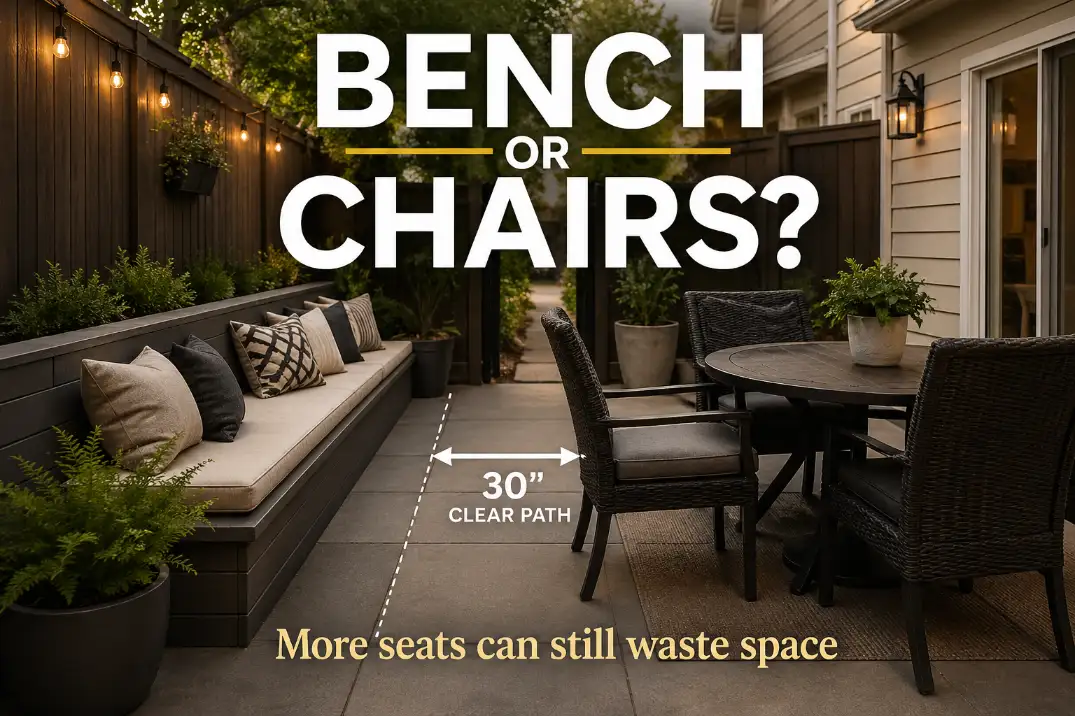
Bench seating usually saves space on a small patio only when it sits against a quiet edge. Patio chairs usually work better when the layout needs comfort, flexibility, or frequent cleaning. The mistake is judging the choice by how many people can sit down. The better test is what happens after they sit down.
Start with three checks: the main walking path, the chair pullback zone, and whether one patio edge can hold seating without blocking a door, grill, gate, or storage lid.
If the usable route drops below about 30 inches during normal use, the patio will feel cramped even if the furniture technically fits. A bench can remove chair movement from one side of the table, but it becomes a problem if it traps people in a corner or locks the patio into one rigid layout.
The Real Difference Is Movement, Not Seat Count
Bench seating and patio chairs solve different problems. A bench compresses people along one edge. Chairs give each person their own access, comfort, and exit path. On a small patio, that difference matters more than style.
A bench saves space when one edge is inactive
Bench seating is strongest when the patio has one boundary that does not need to do much else: a fence, railing, house wall, planter edge, or privacy screen.
A straight 5- to 6-foot bench can seat two adults comfortably and sometimes three people briefly, while keeping chair legs and chair backs out of the walkway.
That is the best-case version of bench seating. It turns a dead edge into usable seating.
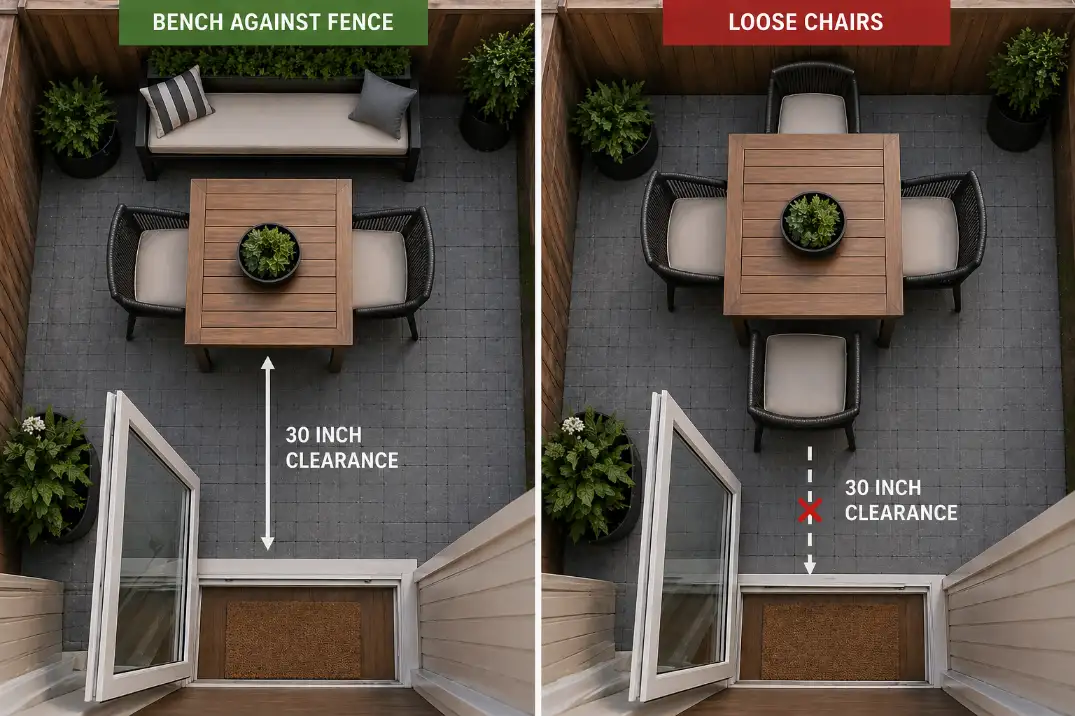
A normal dining chair often needs 24 to 30 inches behind it to pull out. A bench against a wall may need about 18 inches of seat depth plus enough knee room at the table. On a tight 9-by-10 or 10-by-10 patio, that difference can decide whether the space feels usable or constantly pinched.
Chairs win when the patio has changing jobs
Chairs are less efficient on paper, but more forgiving in real life. They can move for shade, guests, cleaning, grilling, or storage access. That matters when the patio is not just a dining zone.
If the same patio handles morning coffee, a portable grill, kids walking through, and weekend guests, fixed seating can become too committed. Chairs may take more space during use, but they do not force the patio to stay arranged for its busiest moment all week.
For compact square layouts, this is why the furniture plan has to be judged by clearance, not just footprint. A 10×10 patio furniture layout can look roomy before chairs are pulled out and awkward five minutes later.
Match the Seating to the Patio Type
The best choice changes by patio shape. This is where many generic bench-versus-chair comparisons fall short.
Narrow patios favor one compressed side
A narrow patio usually benefits from a bench because the center path is already fragile. A straight bench along the long edge can keep the table from floating in the middle and reduce furniture movement on one side.
The bench should not be too deep. Around 16 to 18 inches of seat depth is usually enough for dining. Much deeper than that, and people perch forward or the table has to move farther into the walkway.
Square patios need a hybrid
A square patio often looks easier than it is. Because the shape feels balanced, people tend to place a table in the center and surround it with chairs. That works only if there is still room for pullback on every side.
A better small-patio formula is usually:
| Patio Setup | Best Seating Choice | Why It Works |
|---|---|---|
| 8×10 or narrow patio | Straight bench plus 1–2 chairs | Keeps one side compressed |
| 10×10 square patio | Bench on one side, two slim chairs | Balances capacity and movement |
| Apartment patio | Folding bench or stackable chairs | Easy to remove and store |
| Grill + dining patio | Mostly chairs, or bench outside traffic path | Protects cooking access |
| Covered patio | Chairs or removable-cushion bench | Easier drying and cleaning |
This is not about filling every edge. It is about choosing the side of the patio that can afford to become fixed.
Grill-and-dining patios need extra caution
If the patio also holds a grill, prep cart, or storage box, bench seating becomes riskier. A bench that blocks the cooking route is not saving space. It is creating a permanent obstacle.
Seating should stay out of the hot zone, door swing, and prep path. The same movement logic used in small patio grill placement and dining area planning applies here: a layout that looks efficient from above can still fail when someone has to carry food, open a lid, or walk behind a chair.
What People Usually Misread First
The most common mistake is choosing the option that appears to seat more people. Small patios punish that kind of math.
Seating capacity is not usable capacity
A six-foot bench may look like a three-person seat. In normal adult use, it is usually more comfortable for two. Adults generally need about 22 to 24 inches of width for relaxed seating. Tighter spacing can work for kids or quick meals, but it should not define the main layout.
Chairs are easier to count because one chair equals one person. But each chair also needs space to slide, angle, and pull back. Four chairs around a compact table can consume more working space than a bench-and-two-chair setup.
Clutter is the symptom, movement conflict is the mechanism
A crowded patio is not just visually busy. The real problem is that furniture moves into the same area people need to walk through.
With chairs, the conflict appears when someone pulls back from the table. With benches, the conflict appears when someone has to slide out from the inside seat or when the bench blocks access behind it.
The better option is the one that creates fewer conflicts during normal use, not the one that looks cleaner when empty.
Not Every Bench Solves the Same Problem
Bench seating sounds like one category, but different benches behave very differently on a small patio.
| Bench Type | Best Use | Watch Out For |
|---|---|---|
| Backless bench | Light footprint, casual dining | Less support for long meals |
| Built-in bench | Permanent edge seating | Hard to fix if placement is wrong |
| Storage bench | Cushions, covers, small tools | Bulky body and lid clearance |
| Corner bench | Uses a dead corner | Trapped inside seat |
| Folding bench | Rental or occasional seating | Lower comfort and stability |
| Bench with back | More support | Visually heavy in tight patios |
A storage bench is the one people often overestimate. It sounds efficient because it combines seating and storage, but it can be bulky. If the lid needs 18 to 24 inches of open clearance, or if cushions must be removed every time it opens, the storage feature may not feel convenient.
Pro Tip: Treat a storage bench as furniture first and storage second. If it is too bulky to sit well at the table, the hidden storage does not rescue the layout.
Where Bench Seating Fails
Bench seating usually fails when it is installed like indoor booth seating. Outdoor patios need more tolerance for movement, weather, cleaning, and mixed use.
The bench is too deep
A dining bench usually works best around 17 to 19 inches high and 16 to 18 inches deep. If the bench is much deeper, people sit too far back or lean forward to reach the table.
That wasted inch count matters. A bench that is 22 inches deep instead of 17 inches may not sound excessive, but it can steal 5 inches from a walkway that was already barely working.
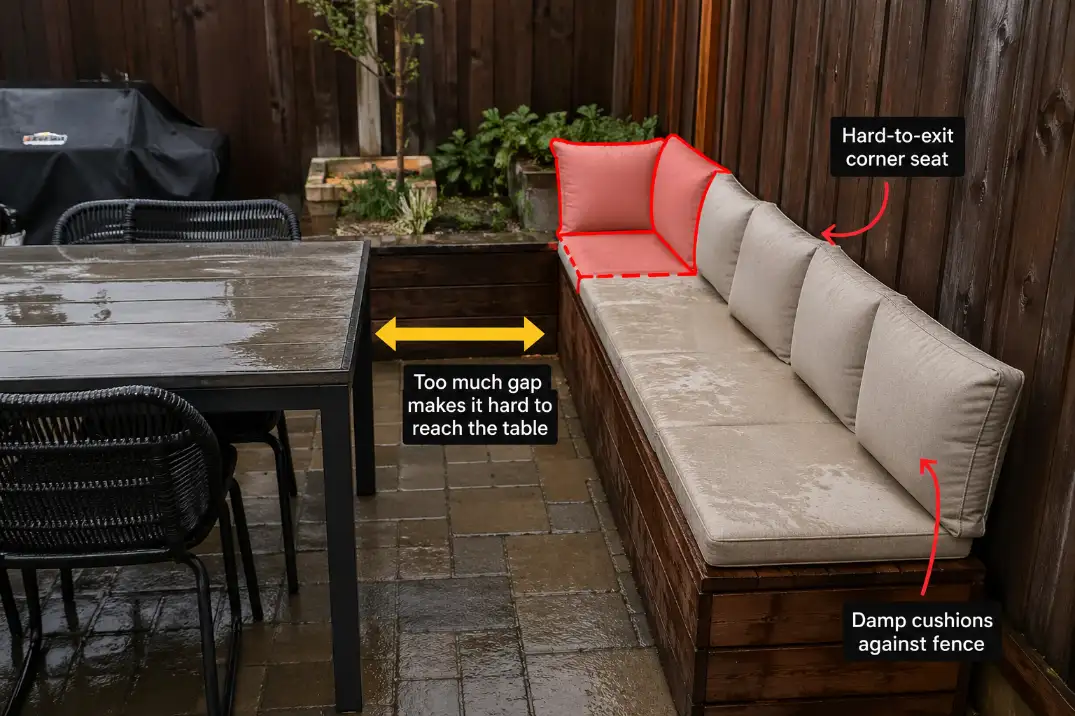
The table is too far away
The table edge needs to be close enough for eating without leaning. If the bench is fixed and the table has to float too far forward, the patio may lose the space the bench was meant to save.
This is the point where the routine fix stops making sense. A bench cannot rescue a table that is too large or poorly placed.
The corner seat becomes dead space
L-shaped benches are popular because they photograph well, but the corner seat is often the least useful seat. It is harder to enter, harder to exit, and sometimes too far from the table.
On a small patio, a straight bench is usually safer than an L-shaped bench unless the layout has enough width to keep the table accessible from the open side.
Cushions dry too slowly
Benches often keep cushions against a wall or fence. In humid climates, coastal areas, or covered patios with weak airflow, cushions can stay damp longer than expected. If cushions remain wet for more than 24 to 48 hours, mildew and odor become more likely.
Chairs are easier to tip, move, or place in sun. That practical advantage matters more than people expect.
Where Patio Chairs Waste Space
Chairs fail in a different way. They are flexible, but too many of them can make the patio feel restless and crowded.
Oversized lounge chairs are not dining chairs
A compact dining chair may be 20 to 24 inches wide. A deep lounge chair can be 28 to 34 inches wide and may need more space behind it because of the reclined back.
Four lounge-style chairs around a dining-height table can make a small patio feel blocked before anyone sits down. If the patio is under about 100 square feet, slim armless chairs usually work better than bulky club chairs.
Matching patio sets are often too much
Small patios rarely need every piece in a set. A loveseat, two chairs, and a coffee table may look coordinated online, but on the patio it can consume the middle and leave no clean route from the door.
Even larger compact patios need restraint. A 12×12 patio furniture layout can handle more seating than a 10×10, but only if the walking paths stay open after chairs move.
Stackable chairs are underrated
Stackable chairs solve a problem fixed seating cannot: occasional capacity. If two people use the patio most weekdays and four people use it on weekends, stackable chairs keep the daily layout lighter.
That flexibility may outperform a bench that is always present. A chair that disappears when not needed can be more space-efficient than furniture that is technically compact but permanent.
The Best Answer Is Often a Mixed Layout
The strongest small-patio layouts rarely choose all bench or all chairs. They use a bench to calm one side and chairs to keep the open side flexible.
Bench plus two slim chairs
This is the safest default for many small dining patios. Place the bench along the least active edge. Use two slim chairs on the open side. Keep the main route clear.
A strong formula is a 5- to 6-foot bench, a rectangular table around 30 by 48 inches, and two chairs no wider than about 22 inches each.
Backless bench plus small round table
A 36- to 42-inch round table can work with a backless bench because the rounded edge softens movement. Once the table gets larger than about 42 inches, the bench side often feels awkward because the seat no longer lines up naturally with the curve.
Chairs only, but fewer and better
Sometimes the right answer is not bench seating at all. Two comfortable chairs with a small table may beat four tight seats that nobody enjoys using.
This is especially true when the patio also needs a grill zone, prep cart, or clear route to the yard. A crowded plan often creates the same problem described in patio furniture layout fixes that make a big difference: the patio has enough furniture, but not enough usable space between the pieces.
Pro Tip: Before buying, tape the table footprint, chair footprint, and a 24-inch chair pullback zone on the patio. If the main route disappears, the furniture is too large.
Quick Decision Checklist
Choose bench seating if:
- The patio has one quiet edge at least 5 to 6 feet long.
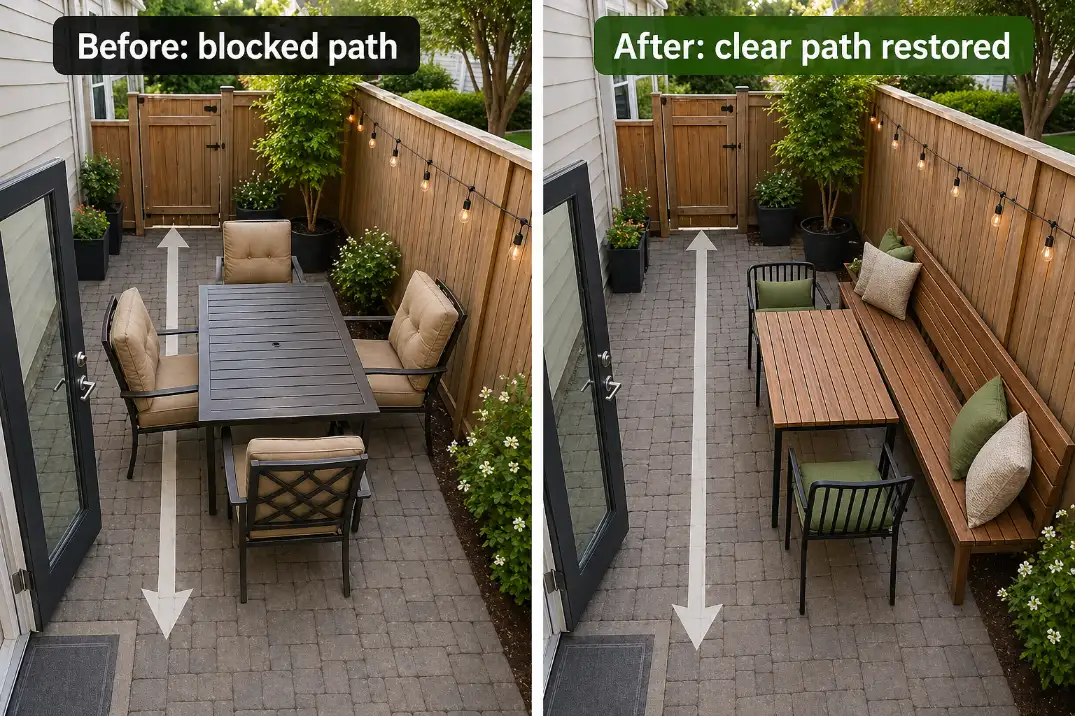
- Chair pullback would shrink the walkway below 30 inches.
- Seating is mostly for coffee, casual meals, or short visits.
- The bench will not block a grill, gate, storage lid, or door path.
- You can clean behind or under it without moving half the patio.
Choose patio chairs if:
- Guests need easy individual access.
- The layout changes between weekdays and weekends.
- Comfort matters more than maximum seat count.
- The patio gets frequent leaves, pollen, dust, or damp cushions.
- The table can still keep 30 to 36 inches of working clearance along the main path.
Questions People Usually Ask
Is bench seating always better for a small patio?
No. Bench seating is better only when it can sit on a quiet edge and protect the main path. If every edge is active, movable chairs usually work better.
Are benches comfortable enough for dining?
They can be comfortable for short meals if the height, depth, and table distance are right. For meals longer than about 45 minutes, chairs or benches with backs usually feel better.
Should a small patio use a round or rectangular table with a bench?
A rectangular table usually pairs better with a straight bench. A small round table can work, but once it gets wider than about 42 inches, the bench side often feels less natural.
Final Verdict
Bench seating is better for small patios when the patio has one quiet edge and the main problem is clearance. Patio chairs are better when the space needs comfort, movement, and flexibility. For many small patios, the best answer is a straight bench on the least active side, two slim chairs on the open side, and a table small enough to keep the walking route usable.
Do not choose the option that seats the most people in a product photo. Choose the one that still works after people sit down.
For broader official accessibility guidance on clear routes and usable space, see the U.S. Access Board.