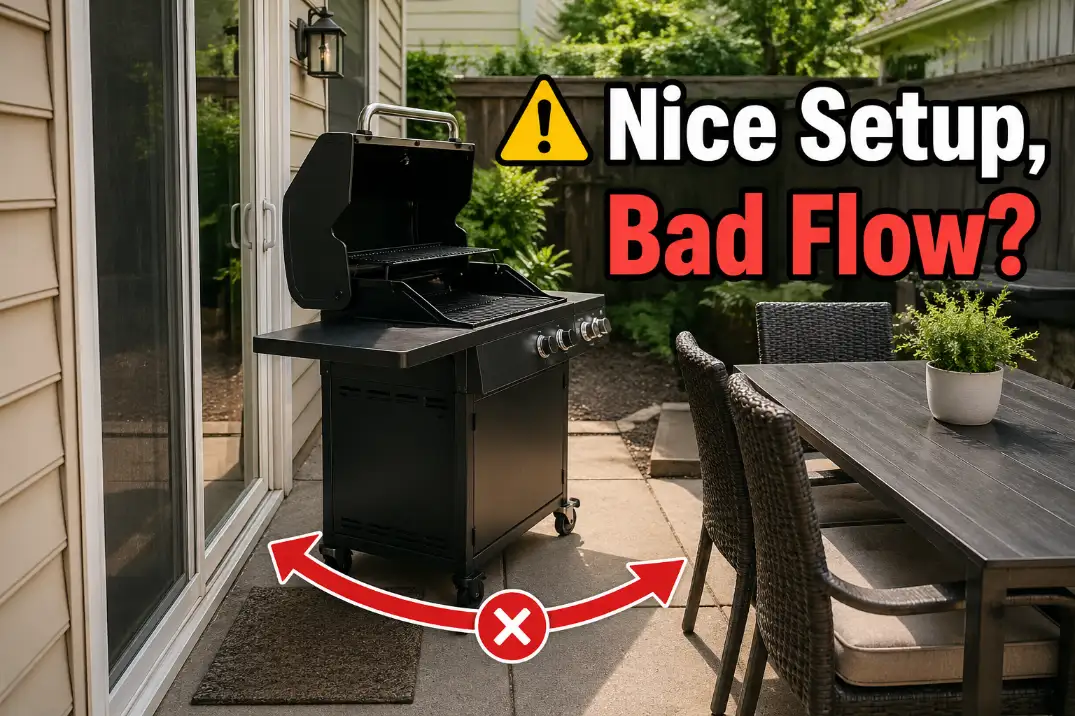
Most outdoor cooking layout mistakes are not really design mistakes. They are movement mistakes. The grill, prep surface, serving spot, dining chairs, and walking lane all need space at the same time.
When those zones overlap, the patio may look finished but feel awkward within 10 minutes of actual cooking.
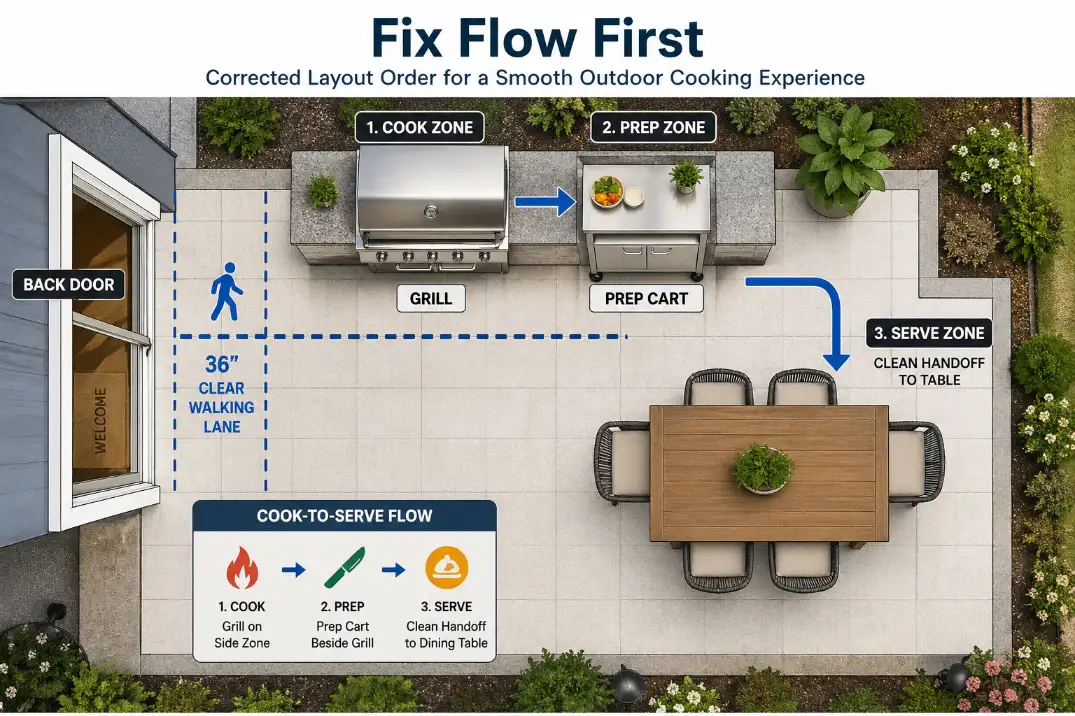
Start with three checks: the hot zone, the walking lane, and the landing zone. A usable cooking patio should keep about 36 inches of clear movement space, at least 24–30 inches of landing surface near the grill, and enough room for the cook to open the lid without backing into chairs.
This is not the same as simply having a small patio. A small patio can work well when the cooking path is clean. A larger patio can still fail if every trip from grill to table crosses the same cramped 3 feet.
Quick Diagnostic Checklist
- The grill lid opens into the main walking path.
- Guests pass within 24 inches of the cook while the grill is hot.
- Cooked food has no clean landing surface.
- Chairs must be pushed in every time someone walks through.
- Smoke moves toward the table during a 15–20 minute cook.
- The cook walks more than 6–8 feet repeatedly between prep and grill.
- The patio works when empty but fails once people sit down.
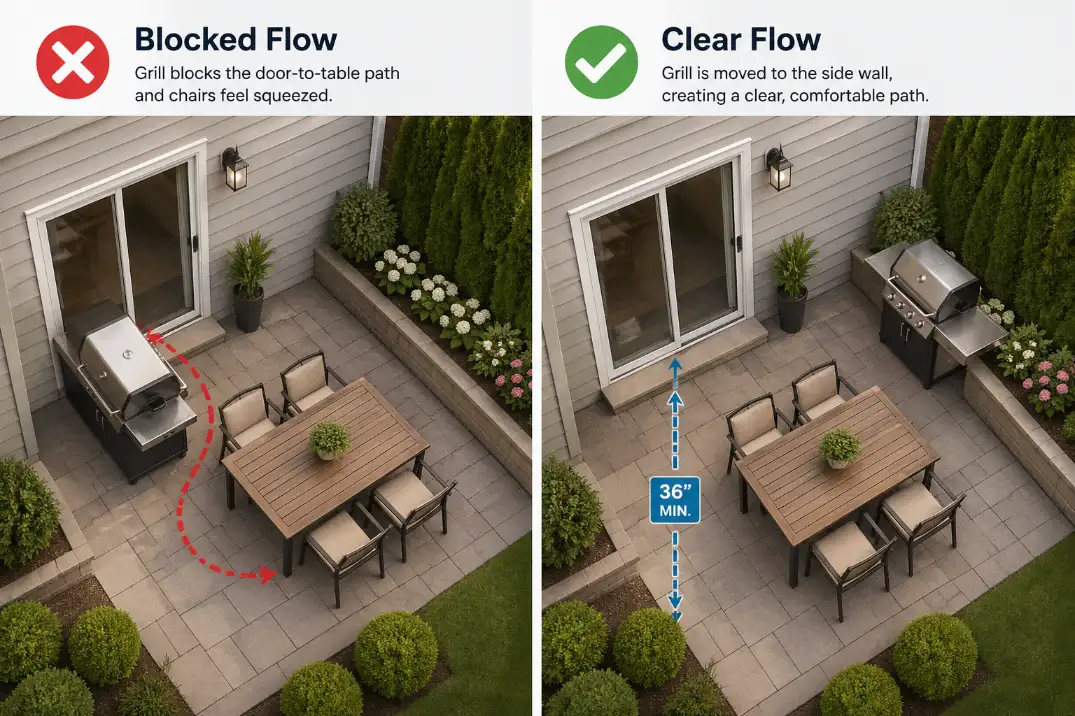
Mistake 1: Making the Grill the Visual Centerpiece
The grill feels important, so it often gets the most visible spot: centered on the patio edge, close to the door, or lined up with the dining table. That may look balanced, but it usually creates the first serious conflict.
The real issue is not size
A closed grill can look compact. In use, it needs extra depth for the lid, the cook, tools, plates, and heat clearance. Once someone has to walk behind the cook, that small appliance can turn into a 5–6 foot conflict zone.
This is why the grill should be placed by function first, not symmetry. The stronger layout is usually off to one side, with a clean path behind or beside it. For a fuller sequence, Best Patio Layout for Grill, Prep Space, and Dining explains how to place the cooking area before sizing the dining zone.
Mistake 2: Blocking the Back Door Transition Zone
The first 6–8 feet outside the back door are not bonus patio space. They are the transition zone. People step out, pause, carry trays, move chairs, return indoors, and pass through this area constantly.
Putting a grill, large dining table, storage box, or bulky cart directly there makes the patio feel tight before anyone even starts cooking.
Small patios fail here first
A small patio has very little forgiveness near the door. If the door path, grill position, and chair pull-back all collide, the rest of the layout cannot compensate. Keep the door path clean first, then build the cooking zone around the remaining usable edge.
Mistake 3: Skipping the Clean Handoff Zone
Prep space matters, but the serving handoff matters just as much. Many outdoor cooking layouts fail at the exact moment food comes off the grill and needs a clean plate, tray, or resting spot.
Without that surface, cooked food lands on the dining table too early, raw trays get reused, or someone carries hot food back through the door. That is not just inconvenient. It makes the entire patio feel unfinished.
Landing space beats extra storage
Even 24 inches of stable landing space helps. A 36–48 inch surface is better if you cook for four or more people. The key is location: the surface should be close enough that the cook does not have to cross the walking lane.
This is where a flexible cart often beats a built-in counter. A Compact Prep Table or Grill Cart for a Small Patio can create a real landing zone without permanently stealing dining space.
Pro Tip: Keep one side of the prep surface clean for cooked food only. Raw trays, tools, and seasoning bottles should not take over the whole landing area.
Mistake 4: Forcing the Indoor Kitchen Triangle Outside
The indoor kitchen triangle does not translate perfectly to a patio. Indoors, the classic logic is sink, refrigerator, and range. Outside, the more important sequence is usually prep, grill, clean landing, serving, and traffic.
A sink is nice. A refrigerator is convenient. But neither fixes a patio where the cook has no landing surface and guests keep walking through the heat zone.
Outdoor cooking has more interference
Wind, smoke, heat, chair movement, door traffic, and surface stability all affect the layout. That means the best outdoor cooking setup is not always the one with the most features. It is the one with the fewest interruptions.
If the layout cannot hold a clear walking lane and a clean grill-side landing area, adding another appliance usually makes the patio harder to use.
Mistake 5: Letting Dining Furniture Invade the Heat Zone
Dining sets are often chosen by seat count first. That creates trouble on cooking patios. A six-seat table may fit on paper, but if chairs back into the grill zone, it will not function like a six-seat space during cooking.
A dining chair usually needs about 24 inches to pull out and closer to 36 inches to pull out comfortably while someone walks behind it. If that pull-back area overlaps the grill, the cook and guests will keep negotiating the same space.
For small patios, the better question is not whether dining and grilling both fit. It is which one deserves the prime zone. Should a Small Patio Prioritize Dining Space or a Better Grill Zone? is the more useful decision when the patio cannot give both areas equal comfort.
Mistake 6: Ignoring Smoke and Wind Direction
Smoke problems are often blamed on the grill, but layout usually decides whether smoke becomes a patio problem. A grill placed in a corner, under a low roof, beside a privacy wall, or near the dining table can trap smoke even when the grill itself is working normally.
Watch the grill during a real 15–20 minute cook. If smoke repeatedly moves toward the table, back door, or covered area, the problem is airflow, not just smoke.
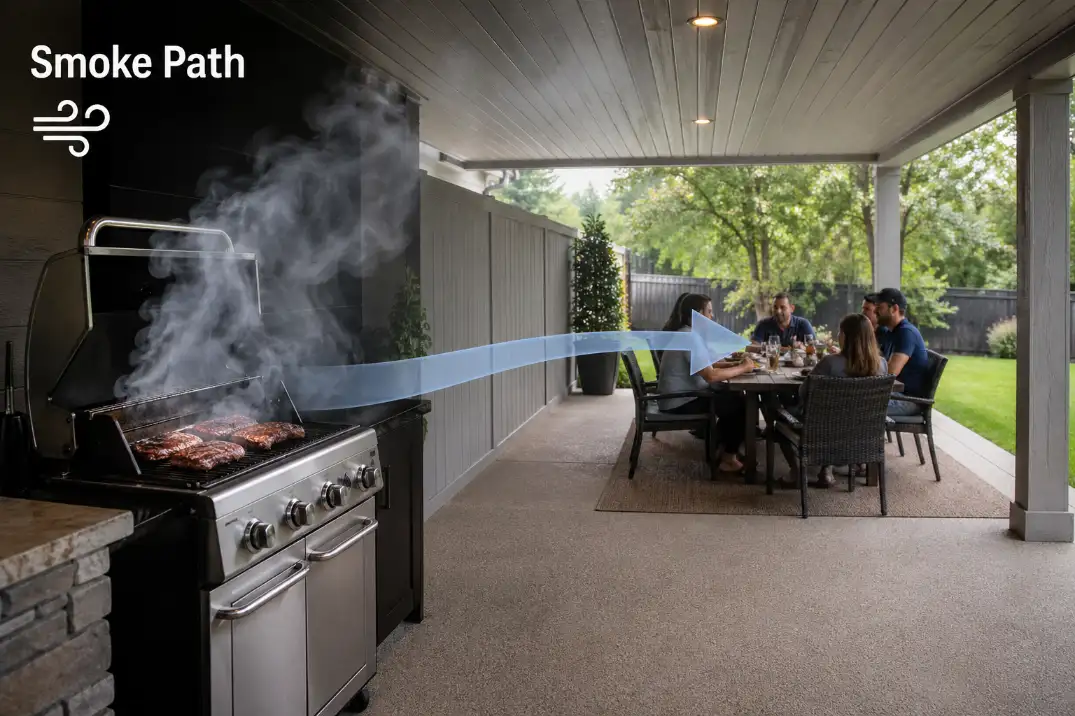
In humid areas like Florida, still air can make smoke linger. In dry, breezy places like Arizona, sudden gusts may push heat and smoke sideways across the patio. The same grill can behave very differently depending on exposure.
If smoke direction changes quickly, one side of the grill runs hotter, or the dining area gets smoky before the food is done, airflow deserves attention before furniture placement. Why Wind Ruins Backyard Cooking goes deeper into those failure patterns.
Mistake 7: Choosing the Wrong Surface Around the Grill
The surface around the grill affects stability, cleanup, heat exposure, and comfort. Uneven pavers, slick tile, soft deck boards, and poorly draining concrete can all make a layout feel worse than it looks.
Cosmetic marks are not functional failure
Grease spots are annoying, but they are usually cosmetic. A rocking grill, curling mat, heat-sensitive deck board, or slippery surface is functional. That distinction matters because people often spend time hiding stains when the real problem is stability or clearance.
For material tradeoffs, Best Surfaces Around a Backyard Grill Area is more useful than guessing by appearance alone.
If the surface needs protection, Best Grill Mats and Protective Pads for Small Patios makes sense as support, not as a cure for a bad layout.
Mistake 8: Buying a Grill Station the Patio Cannot Support
A bigger grill station feels like an upgrade because it adds shelves, burners, storage, and presence. But it also adds width, depth, heat spread, and permanent dead space.
A larger station is only an upgrade if the patio already has unused circulation space. If it steals the only 36-inch walking lane, it is not an upgrade. It is a permanent blockage.
When scaling down is smarter
If the patio is under about 10 feet deep, a bulky station can quickly dominate the entire outdoor room. The cook may gain counter space but lose movement, dining comfort, and flexibility.
In that situation, a smaller grill with one excellent prep cart often works better than a large station with built-in features.
When a Grill Station Is Too Big for the Patio is the right next read when the equipment itself is starting to control the layout.
Mistake 9: Locking In Utilities Before Testing the Flow
Fixed utilities can turn a bad layout into a long-term problem. Gas lines, outlets, lighting, sinks, and drains all make the cooking zone harder to move later.
This matters most with built-in outdoor kitchens. Before committing, test the layout with temporary pieces for at least one full cook. Grill, prep, serve, sit, and walk the patio the way you actually use it. If the cook has to dodge chairs or carry hot trays across traffic during that test, permanent utilities will not fix the problem.
Pro Tip: Test the patio at night before finalizing lighting. A grill light may help the cook but still leave the serving surface or walking lane too dark.
What to Fix First
Do not start with accessories. Start with the conflict that creates the most risk or friction.
Move the grill first if heat, lid swing, or the cook’s standing space blocks the walking lane. Add a landing surface next if food has nowhere clean to go. Resize or shift the dining setup after that. Surface mats, storage upgrades, and decorative pieces should come last because they cannot rescue a layout where the cook, guests, chairs, and smoke all compete for the same space.
Better Priority Order for a Working Outdoor Cooking Layout
The strongest patio layouts solve conflicts in the right order. Safety and flow come before storage, decor, or appliance count.
| Layout issue | What it feels like | Real cause | Fix priority |
|---|---|---|---|
| Grill blocks movement | People squeeze behind the cook | Hot zone overlaps traffic lane | Move grill first |
| No landing space | Food ends up on chairs or dining table | Missing clean handoff surface | Add prep or serving surface |
| Dining feels tight | Chairs constantly shift | Pull-back space overlaps grill zone | Resize or reposition table |
| Smoke crosses seating | Guests avoid the table | Grill sits in bad airflow path | Change orientation or location |
| Surface feels unsafe | Grill rocks or area gets slick | Poor base or wrong protection | Stabilize and protect surface |
| Station dominates patio | Layout feels permanent and cramped | Equipment scale exceeds patio depth | Downsize or simplify |
Final Takeaway
The biggest outdoor cooking layout mistakes are usually small overlaps: the chair that blocks the cook, the missing landing surface, the grill lid that opens into traffic, the smoke path that crosses the table, or the oversized station that steals the only flexible space.
Fix the conflicts in this order: heat clearance, walking lane, clean landing space, smoke direction, dining pull-back, and surface stability. Once those are right, the patio does not need to be large to work well. It only needs to stop making every movement compete for the same space.
For broader official grilling safety guidance, see the National Fire Protection Association.