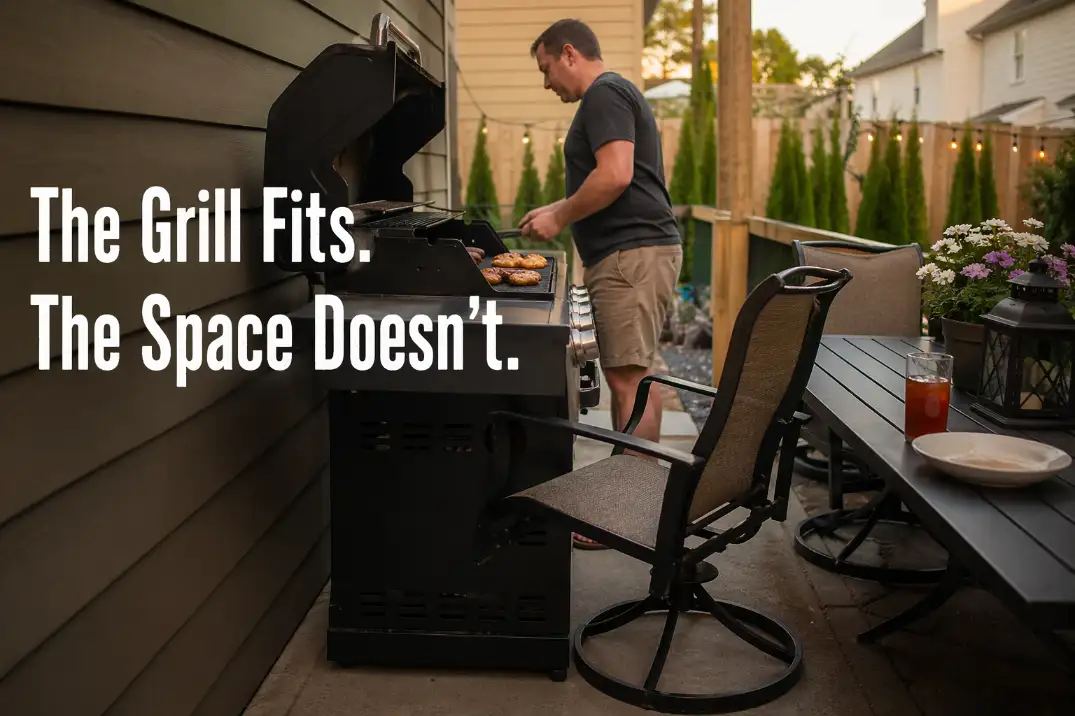
A grill area usually needs more space than the grill’s footprint suggests. For a simple freestanding grill, 6 by 8 feet is about the smallest zone that can work, while 8 by 10 feet feels more comfortable.
If the grill shares space with a dining table, start thinking closer to 10 by 12 feet, because chairs, serving space, and walking paths quickly steal the room the cook needs.
The first checks are simple: keep about 36 inches of clear working room in front of the grill, protect a 3-foot safety zone around hot surfaces where possible, and leave 42 to 48 inches if people need to pass behind the cook.
This is not the same as asking whether a patio is “big enough.” A patio can look roomy when the chairs are pushed in and the grill lid is closed, then fail as soon as dinner starts.
The Real Grill Area Is Bigger Than the Grill
Most grill layouts fail because people measure the object, not the activity. A closed grill against a patio edge may look fine. But once the lid opens, the cook steps back, a tray comes out, and someone walks through with drinks, the usable footprint expands.
A typical freestanding gas grill may be 4 to 5 feet wide, but that does not mean a 5-foot wall section is enough. The grill needs heat clearance, a standing zone, a landing surface, and a path that does not push guests into the hot area.
Grill Area Space Cheat Sheet
| Setup | Minimum That Can Work | Better Target | What Fails First |
|---|---|---|---|
| Grill only | 6×8 ft | 8×10 ft | Cook stands in the walkway |
| Grill near dining | 10×12 ft | 12×14 ft | Chairs enter the grill zone |
| Grill with prep cart | 8×10 ft | 10×12 ft | Cart blocks traffic |
| Built-in grill island | 8×10 ft | 10×12+ ft | Aisle drops below 42 inches |
| Covered grill area | Only if manual and ventilation allow it | Open-sided with generous clearance | Heat and smoke collect overhead |
The “better” target matters because grill areas are active spaces. A minimum layout can work for one person cooking quietly. It often breaks down when two people are serving, kids are moving around, or guests pull chairs back from the table.
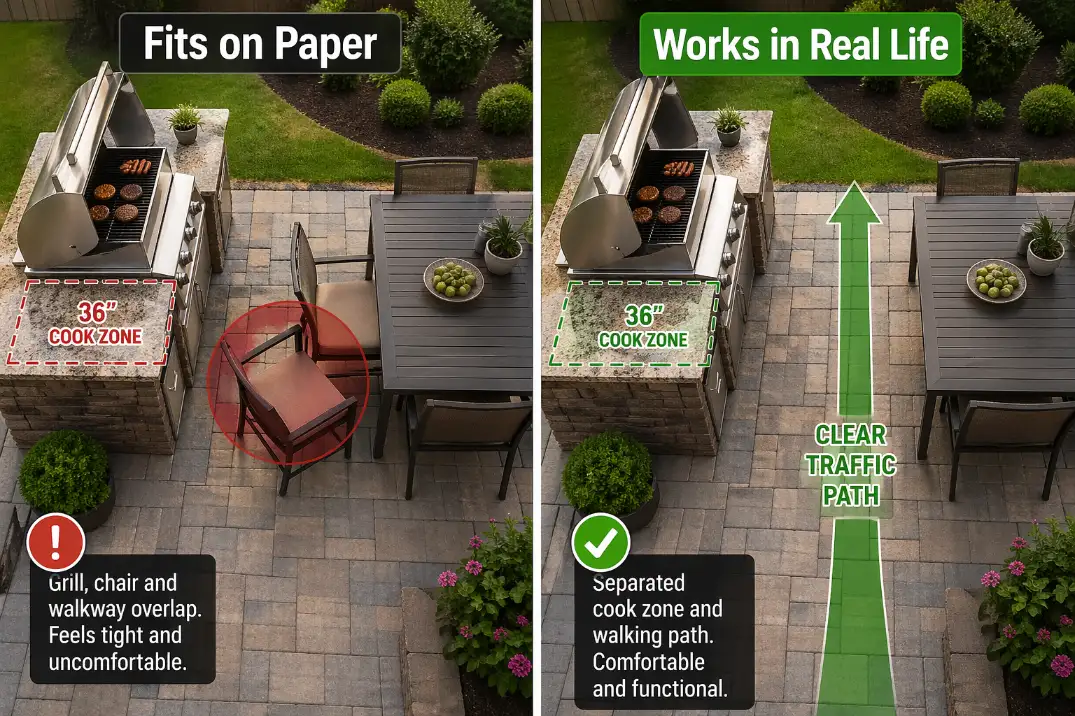
If the grill shares a tight patio with a table, the problem usually shows up as overlap. That is why small patio grill placement near a dining area matters more than choosing a grill that is only a few inches narrower.
What People Usually Misread First
The most common mistake is measuring the patio when everything is at rest. Chairs are tucked in. The grill is closed. No one is standing at the cooking surface. No one is carrying a hot tray.
That version of the patio is not the version that has to work.
Dining chairs are often the hidden space thief
A dining chair can use 24 to 30 inches when occupied and more when pulled back. Around a table, that can consume 3 to 4 feet on the active sides. If the grill is too close, the cook ends up standing where a chair needs to move.
This is why a patio may feel fine while people are seated but become awkward the moment the grill is in use. The symptom is crowding. The mechanism is competing clearance zones.
A four-person outdoor dining setup often needs about 10 by 10 feet to work comfortably on its own. Add a grill too close to that footprint, and the patio may technically fit the furniture while still failing in real use.
Walkways get counted twice
Another mistake is letting the same strip of patio serve as the grill work zone, chair pull-out area, and route from the house. That looks efficient on paper, but it is usually the reason the space feels tense.
A 24-inch gap may be passable when empty. It is not comfortable when someone is carrying food past a hot grill. Treat 36 inches as the practical minimum for a walking path, and use 42 to 48 inches where people pass behind the cook.
This is the same kind of layout failure that shows up when a small patio grill, table, and seating problem is not really about furniture size. The pieces fit individually. The actions do not.
A Good Grill Area Has Separate Zones
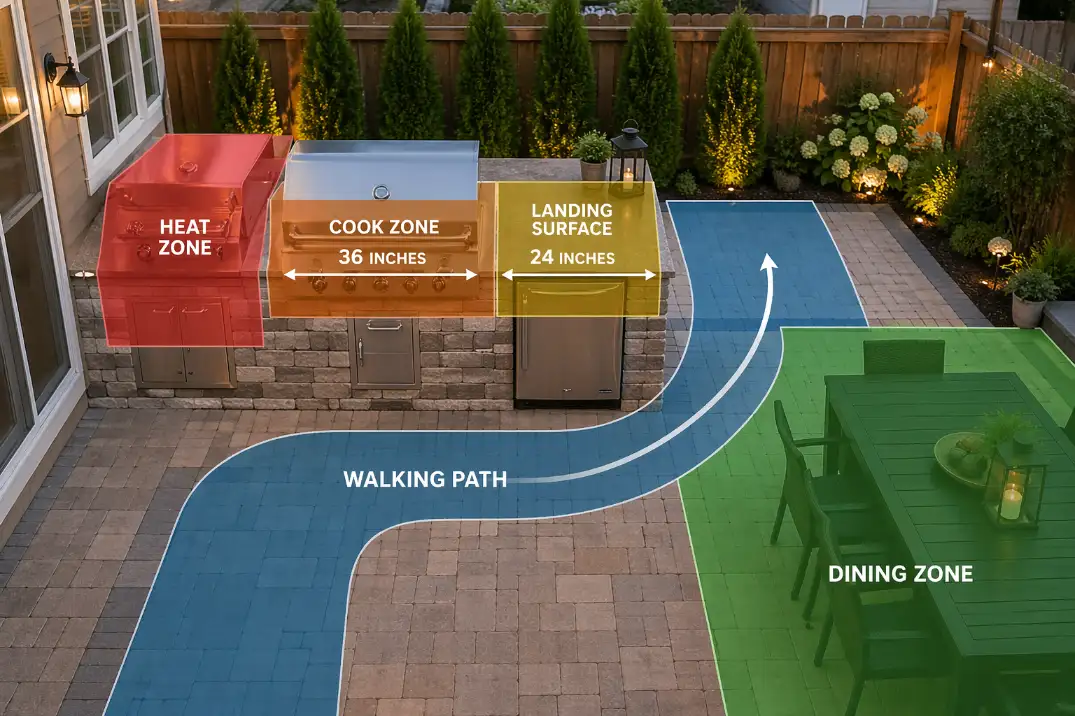
The strongest grill layouts separate five zones: heat, cooking, landing, walking, and seating. They can sit close together, but they should not collapse into the same strip of space.
The heat zone
The heat zone is the area around the grill that should stay clear of siding, railings, cushions, dry plants, umbrellas, and low overhangs. The manufacturer’s manual comes first because grill models vary, but a practical safety mindset is to keep a 3-foot zone around the grill as clear as possible and never treat tight combustible clearance as normal.
Some grill models allow less clearance in certain directions, but that does not make a tight patio corner a good working location. Heat, grease, smoke, and traffic all matter.
The cook zone
The cook zone is the standing and turning space in front of the grill. This area should stay open even when guests are seated. For most freestanding grills, 36 inches in front is the usable minimum. 48 inches is better if the cook needs to turn toward a prep surface or pass behind another person.
This is the zone to protect first. If you lose it, the grill becomes frustrating no matter how polished the patio looks.
The landing zone
A grill without landing space creates unsafe improvisation. Hot trays end up on dining tables, chair arms, planter edges, or the ground.
Plan for at least 12 inches of landing space on both sides of the grill when possible. Better yet, give one side 24 inches so there is room for a tray, tongs, sauce, or a plate of cooked food. A narrow cart or weather-resistant console can solve more than a decorative side table.
Pro Tip: On a small patio, one reliable landing surface is more valuable than another lounge chair.
Grill Type Changes the Space Problem
Not every grill creates the same layout issue. The basic zones stay the same, but the pressure point changes.
| Grill Type | Space Issue That Matters Most | Layout Mistake to Avoid |
|---|---|---|
| Gas grill | Side and rear combustible clearance | Tucking it tightly against siding or railings |
| Charcoal grill | Sparks, ash, and high heat | Placing it beside cushions, dry plants, or fences |
| Pellet grill | Smoke direction and hopper access | Blocking the side that needs refilling |
| Kamado grill | Heavy base and intense retained heat | Setting it on weak, uneven, or crowded surfaces |
| Built-in grill | Fixed aisles and landing space | Locking in a narrow work lane permanently |
Gas grills are often easier to place, but they still need breathing room. Charcoal and kamado grills deserve more caution around combustible materials. Pellet grills need space not only for cooking, but also for hopper access and smoke direction.
Built-ins are the least forgiving. Once a grill island is installed, the mistake becomes permanent.
Covered Grill Areas Need More Than Floor Space
A covered patio changes the question. The grill may fit on the floor, but the real issue is heat, smoke, grease, and overhead clearance.
A grill under a low roof, soffit, pergola cover, or enclosed porch can create problems even when the patio has enough square footage. Smoke lingers. Heat rises.
Grease can collect on nearby surfaces. In humid climates, a poorly ventilated covered cooking area can feel sticky and stale within minutes; in dry regions, nearby combustible materials become the larger concern.
If the area is covered or semi-covered, do not judge it only by width and depth. Check the grill manual, overhead materials, open sides, and airflow. This is where covered patio ventilation mistakes can matter more than the exact patio dimensions.
A covered grill location is not automatically wrong. A low, enclosed, poorly ventilated one usually is.
When a Small Grill Area Can Still Work
A small grill area can work if it makes one clear decision: cooking happens here, and sitting happens there. The trouble starts when the same 6-foot strip is expected to handle cooking, serving, walking, and chair movement.
Put the grill on an edge, not in the crossing path
The best compact layouts usually place the grill along an edge with the cook facing into the patio, while traffic moves beside or behind the zone. That keeps the grill accessible without turning the cook into an obstacle.
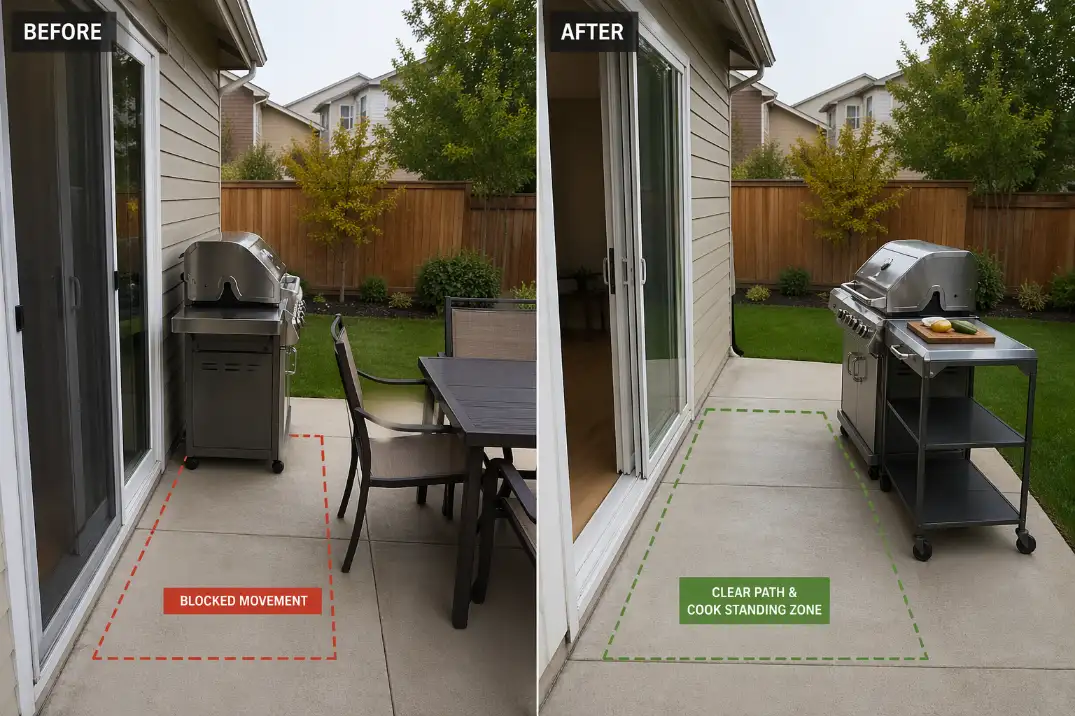
A grill close to the kitchen door is convenient only if the door swing, landing surface, and walking path stay clear. If everyone leaving the house has to pass through the hot zone, the grill is too close or aimed the wrong way.
Keep prep beside the grill
Prep space behind the cook sounds useful, but it often forces the cook to turn with hot food. Side landing space is smoother. Even 18 to 24 inches of side surface can change how the area works.
If the grill is part of a larger outdoor kitchen idea, be careful with upgrades. Extra counters, appliances, and decorative islands can consume the exact space needed for movement. That is why outdoor kitchen mistakes waste backyard space so easily when the layout starts with features instead of clearances.
When the Standard Fix Stops Working
Moving the grill “a little farther over” works only when the new location protects the important zones. If it improves heat clearance but blocks the patio door, the layout is still flawed. If it opens the cook zone but pushes dining chairs into the walkway, the problem has only moved.
A smaller grill is not always the answer
A smaller grill helps when grill width is truly the limiting factor. But many cramped layouts are not caused by the grill body. They are caused by missing aisle space, no landing surface, or dining furniture sitting too close.
Dropping from a 5-foot grill to a 3-foot grill may save wall space, but it does not create a proper 36-inch cook zone if the table is still directly behind the cook.
Built-in islands need stricter judgment
A built-in grill island should not reduce the active aisle below 42 inches. If two people will cook, serve, or pass through the area, 48 inches is a safer target. Anything tighter may look custom but feel worse than a freestanding grill.
Surface stability matters too. A heavy grill or island on shifting pavers can settle, rock, or stain the surrounding patio. If the surface already moves under foot traffic, the issue may connect to the same base problems behind cheap backyard pavers that shift and stain.
Quick Diagnostic Checklist
Use this before buying a smaller grill, moving furniture, or building an island.
- Is there 36 inches of clear room in front of the grill?
- Can someone pass behind the cook without entering the heat zone?
- Do pulled-out chairs stay at least 3 feet from the grill work area?
- Is there at least 12 inches of landing space on both sides, or 24 inches on one useful side?
- Does the grill stay clear of siding, railings, cushions, dry plants, and overhead materials?
- Can the patio door open without pushing traffic into the cooking zone?
- Will plants or containers shrink the clearance within one growing season?
If two or more answers are no, the problem is probably layout, not grill size.
Do Not Let Plants and Storage Shrink the Grill Zone
A grill area that works in April can feel cramped by July if containers, storage bins, or fast-growing plants creep into the clearances.
Shrubs, ornamental grasses, and large pots often get placed near grills to “soften” the patio edge. That can work, but only if mature size is respected. A plant that spreads 12 inches in a season can turn a comfortable path into a squeeze point by the second summer.
This is not just visual clutter. Crowded plants can push people closer to the hot grill, trap moisture near surfaces, and make cleaning harder. The same slow squeeze appears when backyard plants start crowding paths and seating after a layout looked fine at installation.
How Much Space Is Enough?
For a basic freestanding grill, 6 by 8 feet can work if traffic is light and seating is not directly behind the cook. For everyday comfort, 8 by 10 feet is the better target. If the grill shares a patio with a dining table, prep surface, and regular foot traffic, plan closer to 10 by 12 feet or separate the cooking and seating zones.
The real rule is simple: protect the cook zone, the heat zone, the landing surface, and the walking path. A small grill area can work when those spaces stay separate. A larger patio can still fail when they overlap.
For broader official safety guidance, see the U.S. Fire Administration.