Last updated: July 7, 2026
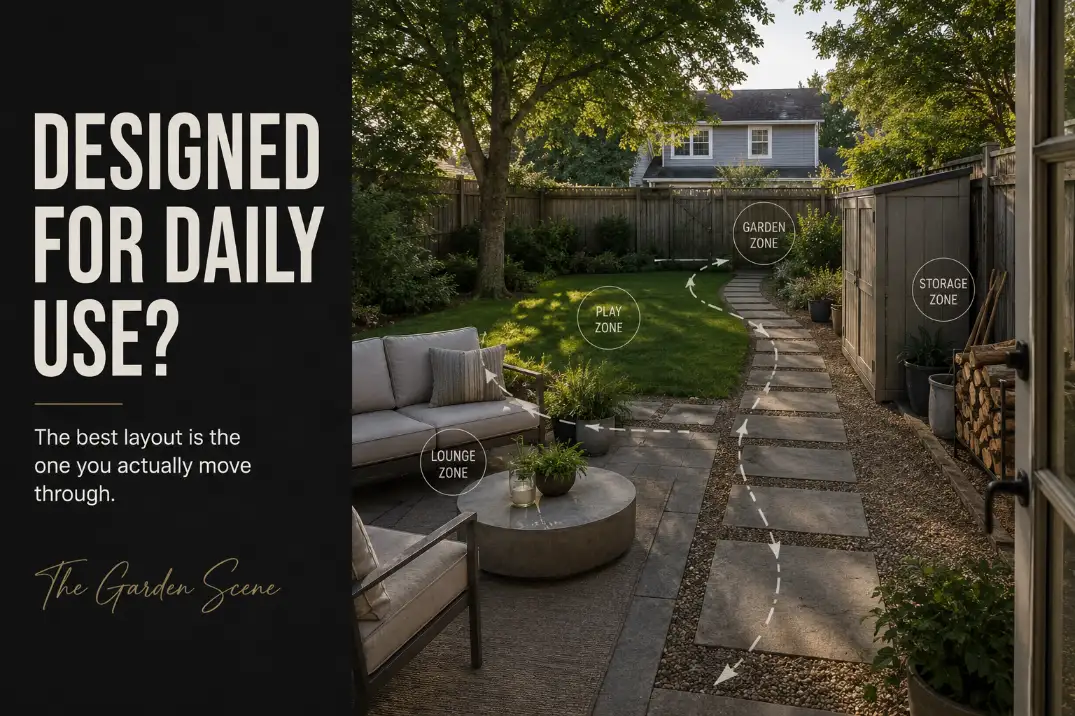
A backyard can look complete and still fail the first normal Tuesday. The chairs are arranged, the patio is swept, the plants are installed, and the lawn looks open. Then someone opens the back door with a tray, a chair gets pulled into the walkway, the sunny corner becomes too hot to sit in, and the storage box is just far enough away that cushions stay piled near the door.
That is the real design test. Not how many features the yard has, but what stays easy after people actually use it.
For everyday use, the backyard should be planned around repeated behavior first. Seating, paths, shade, storage, surfaces, and maintenance are not separate design categories. They are connected friction points. If one is placed without the others, the yard may look finished but feel inconvenient.
This page is the parent framework for those decisions. It will not deeply solve every patio, drainage, shade, or storage problem. Instead, it shows how to make each choice serve normal daily movement before the backyard becomes a collection of nice-looking pieces.
Start With How the Backyard Will Be Used Most Days
The first backyard design decision is not what to add. It is what must stay easy without setup.
A yard used for morning coffee needs a different first move than a yard used for kids, dogs, grilling, gardening, quiet reading, or weeknight dinners. Occasional entertaining can matter, but it should not control the whole layout unless entertaining is truly the main use. Many backyards fail because they are planned for the best-looking weekend scene while ignoring the ordinary weekday pattern.
The everyday pattern usually starts at the back door. Someone steps outside with a cup, plate, phone, garden tool, toy, towel, leash, trash bag, or cushion. From there, the yard either makes the next move obvious or makes every small action slightly awkward.
That small daily friction is what separates a usable backyard from a finished-looking one.
| Decision area | Daily-use question | What goes wrong if ignored |
|---|---|---|
| Seating | Where do people actually pause most days? | Chairs look placed, but no one wants to sit there. |
| Path | Can people move through the yard while it is in use? | Furniture, storage, or planters pinch the route. |
| Shade | Is comfort located where people stop? | The best-looking area becomes too hot to use. |
| Storage | Are daily items close without blocking movement? | Cushions, toys, and tools creep into open space. |
| Surface | Does the ground support weekly use? | Chairs wobble, paths get muddy, or cleanup becomes constant. |
| Maintenance | Can the yard be reset without moving everything? | The layout slowly becomes harder to clean, trim, and use. |
Daily use is not the same as occasional use
A big gathering can tolerate temporary inconvenience. People can walk around a cooler, move chairs, or step across the lawn for one evening. Everyday use is less forgiving. If the route is awkward every morning, the seating gets too hot every afternoon, or the storage is inconvenient every weekend, the yard stops being part of normal life.
That is why everyday design should begin with repeated actions. Where do you sit without setting anything up? Where do you walk when your hands are full? Where does shade actually fall when someone wants to pause? Where do loose items go when the space needs to reset?
Those answers should shape the yard before decorative layers do.
Map the Route Before You Place the Features
Protect the route before you place the features. If people cannot move through the backyard while it is occupied, the rest of the design has to work too hard.
A backyard route is not just a walkway. It is the line people naturally use between the house, seating, grill, garden, storage, side gate, trash area, lawn, and far end of the yard. If that line is unclear or interrupted, the backyard feels harder to use even when there is technically enough space.
The common mistake is placing features first and hoping movement will fit between them. A sofa goes against the patio edge. A planter fills the corner. A storage box lands near the door. A grill gets placed where the patio is strongest. Each decision may seem reasonable alone, but together they can create a route that bends, narrows, or disappears once the yard is occupied.
A route should be tested as if the backyard is already in use. A chair is pulled back. A cooler lid is open. A dog is crossing the patio. Someone is carrying plates. A child leaves a toy near the lawn edge. If the only usable path depends on everything staying perfectly tucked in, the layout is too fragile.
The back door route matters first
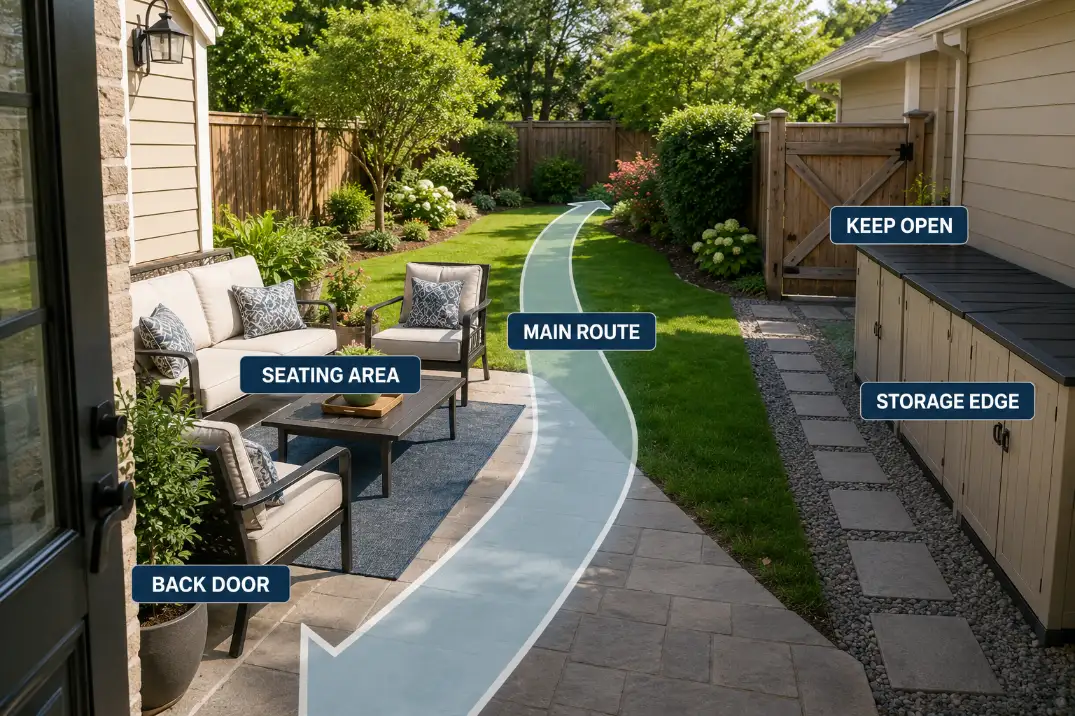
The first few steps outside the house usually decide whether the backyard feels open or annoying. If the door opens into a chair back, a grill corner, a planter cluster, or a storage box, the yard starts with negotiation instead of ease.
The main route does not need to feel oversized. It does need to stay obvious and passable when the yard is being used normally. A useful test is simple: can someone walk from the door to the main seating area while another person is sitting down or pulling a chair back? If not, the features are placed too close to the route.
For deeper house-to-patio movement issues, a dedicated transition guide such as better flow from house to patio can handle the doorway, landing, and first-step problem in more detail. Here, the parent rule is simpler: protect the first movement line before you fill the patio edge.
Secondary routes matter too, but they should not compete with the main one. A route to the side gate, trash bins, grill, storage shed, or garden bed can be less prominent. It still needs to exist. If the only way to reach the hose, mower, or storage area is through the main seating zone, daily use and maintenance will keep colliding.
Give Seating a Daily Job, Not Just a Pretty Position
The most-used seat should get the best working position, not just the prettiest spot in the layout.
One seat may be for morning coffee near the door. Another may face the play area. A dining table may need to connect to the grill and kitchen. A pair of chairs may work better angled toward a garden view than centered on a slab. The right position depends on what the seat is supposed to help someone do.
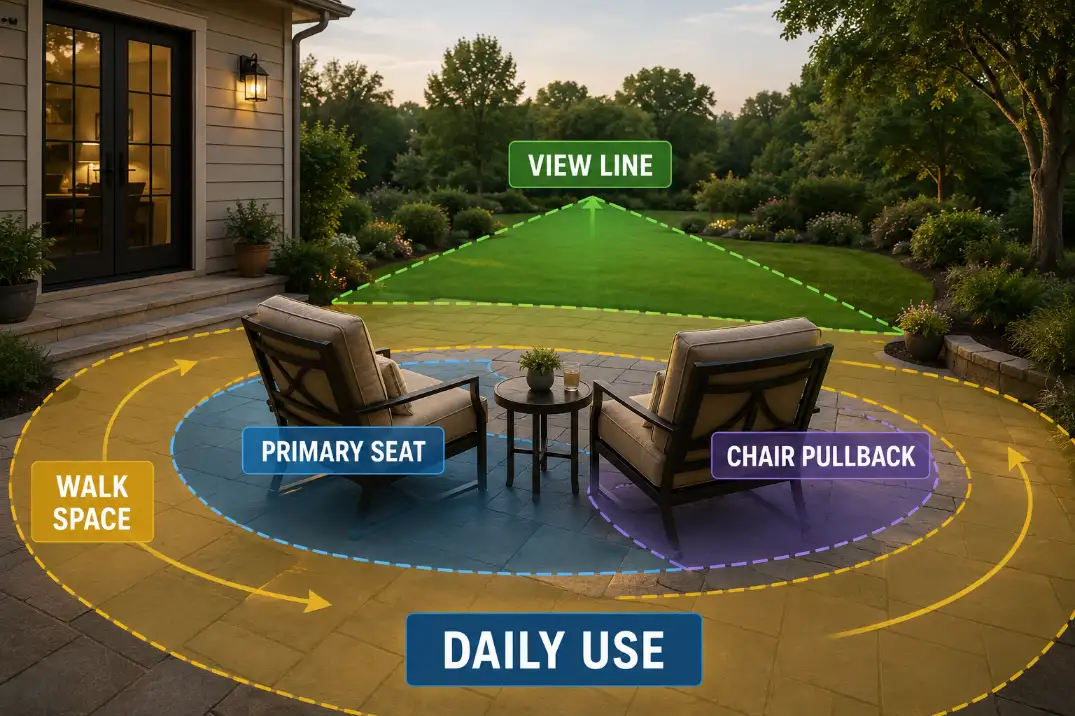
A seating area that photographs well can still fail once people sit down. Chairs pull back. Feet extend. Side tables appear. A bag, book, drink, or cushion lands nearby. The occupied seating zone is always larger than the furniture footprint.
Primary seating should earn the easiest use
The seat used three or four times a week matters more than the extra chairs used once a month. Overflow seating can be flexible. Daily seating should be easy to reach, comfortable at the right time of day, and placed where someone naturally wants to pause.
Many yards reverse that priority. The largest or most formal furniture gets the prime location, while the seat someone would actually use every day ends up exposed, awkward, or too far from the door.
If the backyard is mainly used by one or two people during the week, do not let a full entertaining layout dominate every inch. A compact daily-use seat near shade and a clear route may matter more than a large arrangement that only works when guests come over.
This is especially important on smaller patios, where chair depth and table position can quietly take over the route. A separate guide to patio furniture layout by size can help with tighter dimensions, but the everyday framework is to assign the seating job first. Dining, lounging, supervising, reading, and conversation do not all need the same position.
The best seating plan often leaves one area slightly less decorated so people can actually move around the furniture. Empty space near seating is not wasted. It is the space that lets the seating work.
Put Shade Where People Pause, Not Where It Looks Balanced
Shade fails when it protects the wrong part of the yard. The useful shade is not always the shade that looks centered, symmetrical, or most impressive from the back door.
A shade structure, umbrella, tree canopy, or screen can look balanced on a patio and still miss the seat at the hour people use it. Morning shade may help a coffee spot but do nothing for afternoon dining. A covered edge may protect the walkway while the actual chairs sit in full sun. A symmetrical shade feature can look intentional and still fail the comfort test.
The useful question is not “Where would shade look good?” It is “Where does someone stop long enough to care?”
Shade timing changes the useful layout
Morning, afternoon, and evening sun can create three different backyards in the same space. A west-facing patio may be comfortable at breakfast and punishing by late afternoon. A corner under tree shade may be pleasant at noon but dark and damp after rain. A side-yard seating pocket may seem cozy until the sun angle turns it into a heat trap.
Instead of choosing shade as a decorative layer, place it around the daily pause. That could be the main chair, the dining edge, the door transition, a play-watch spot, or a small work surface. If the shaded area does not cover where bodies actually stop, it is background scenery.
When shade starts blocking the route, crowding the patio, or missing the seats, that becomes a child-level placement problem. A more focused page on how to add patio shade without blocking walkways can go deeper into that conflict. In this parent framework, the rule is to shade the pause before you shade the picture.
Keep Storage Close Enough to Use but Out of the Main Flow
Storage becomes part of the design the moment it changes where people walk. The best storage location is not simply the closest spot; it is the closest spot that does not steal the route.
Cushions, toys, small garden tools, grill items, pool towels, pet gear, and seasonal pieces all need different levels of access. Some belong near the patio because they are used several times a week. Some can live farther away because they are seasonal or messy. The problem starts when everything is treated the same.
A storage box beside the door may seem convenient until it narrows the first step outside. A shed at the back corner may look tidy but be too far away for daily cushions. A side-yard storage area may be practical for tools but useless for things people need while seated. When storage is either too visible or too remote, loose items return to the patio.
Daily storage is different from seasonal storage
Daily storage should sit near the use zone but outside the main movement line. Seasonal storage can be less convenient if it keeps the everyday area cleaner. That distinction matters more than the storage type itself.
Chair cushions used every evening should not require a long walk across wet grass. Garden tools used once a week do not need to sit beside the dining table. Kids’ outdoor toys may need a low, easy drop zone near the lawn, while larger equipment can live near the side gate or garage route.
If the storage itself starts shaping the patio more than the seating does, it has become too dominant. A backyard should not ask people to walk around storage every time they step outside.
For storage-specific layouts, a focused guide to patio storage ideas that stay easy to use can help with closer placement choices. At the framework level, the decision is simple: daily items should be reachable, but the main route should stay open.
Choose Surfaces by What Happens on Them Every Week
Choose the surface by pressure point, not by the material you like in isolation. The ground under repeated use has a job: hold chairs steady, keep walking lines usable, tolerate ordinary water, and avoid turning cleanup into a weekly penalty.
Hard surfaces are useful where furniture needs stability, where people carry food, where grill or dining activity happens, and where the route needs to stay dependable. Softer surfaces can work well for play, planting, quiet edges, or lower-intensity areas. Problems appear when the surface does not match the use.
A chair on soft lawn may be fine once. A dining chair on soft lawn every weekend becomes annoying. A stepping path through mulch may look natural but turn messy if it becomes the main route. Gravel may drain well in one area and scatter into a seating zone in another. Pavers may feel clean until water collects at the edge people cross most often.
Match the surface to the repeated action
The surface under the main seating area should support furniture without wobble. The surface along the main route should remain passable after ordinary rain. The surface near a grill, dining table, or work area should be easy enough to clean that it does not discourage use.
This does not mean every backyard needs more paving. It means the high-use spots need the right support. A small firm landing outside the door can matter more than a large decorative patio in the wrong place. A stable strip to the storage area may solve more daily frustration than adding another seating corner.
For deeper material and usability tradeoffs, a separate page on backyard surface choice and usability can handle the surface decision in more detail. This article’s parent rule is to place firm, cleanable, or drain-tolerant surfaces where weekly behavior demands them.
| Daily-use condition | First design priority | What to avoid |
|---|---|---|
| People carry food from the house | Clear, stable route from door to table | Stepping through lawn or loose material every meal |
| Chairs are used several times a week | Firm surface under the full pullback area | Seating legs half on patio, half on soft ground |
| Kids or pets cross the same line daily | Durable route that tolerates wear | A planted edge that becomes a shortcut |
| Rain leaves one route messy | Drain-tolerant or raised walking surface | Treating mud as a planting problem only |
| Cleanup takes too long | Simple edges and reachable surfaces | Too many tight corners around furniture and beds |
Design Maintenance Into the Layout From the Beginning
Every tight decorative choice creates a future maintenance question. Can you reach it, clean it, trim it, move it, drain around it, and reset it without dismantling the backyard?
Maintenance is often treated as something that happens after design, but it is really part of the design. If the mower cannot pass, the hose is awkward to reach, leaves collect behind furniture, plants crowd the route, or storage has to be moved every time the patio is cleaned, the backyard slowly becomes less usable.
This is where decorative layouts often fail. A tight cluster of pots may look finished until someone needs to sweep behind them. A narrow strip of lawn may look clean until mowing it becomes a chore. A planting bed may soften the patio edge until shrubs start leaning into the chairs.
Leave room to reset the space
Everyday backyard design needs reset space. That means enough room to pull furniture aside, reach planting edges, rinse or sweep hard surfaces, trim plants before they crowd the route, and inspect low spots after heavy rain.
You do not have to design the yard around maintenance equipment. But you should avoid layouts that depend on everything staying perfect. Plants grow. Cushions move. Leaves fall. Kids and pets create wear lines. Outdoor furniture shifts. A layout that cannot absorb those normal changes will feel high-maintenance even if the materials are technically low-maintenance.
At the framework level, maintenance is a placement filter: if an area cannot be cleaned, reached, trimmed, or reset, simplify it before adding more features.
Use Problems as Design Checks Before They Become Projects
A daily-use problem is a clue before it is a project. Treat the first sign of friction as a design check, not as a reason to rebuild the whole backyard.
A blocked route may mean the seating is too deep for the patio edge. Unused seating may mean the view, shade, or access is wrong. Too much sun may mean the pause point is misplaced, not that the whole yard needs a larger shade system. Clutter creep may mean daily storage is too far away. A muddy path may mean the real walking line is different from the planned one. Hard-to-clean corners may mean the layout is too tight.
These problems become child projects when they are persistent, specific, or tied to a larger condition.
For example, if one chair blocks the walkway when pulled back, adjust the seating before redesigning the patio. If a narrow backyard has a dead middle, then a page on backyard layout problems that make spaces hard to use may be the right deeper route. If water repeatedly crosses the patio after storms, that is no longer just an everyday-use issue; it belongs in drainage planning.
The parent framework keeps the first question practical: what daily action is failing? Walking, sitting, shading, storing, cleaning, or crossing the surface?
Once that action is clear, the next decision becomes easier. You either make a small adjustment inside the current layout or move into a specific child problem with a cleaner boundary.
A Simple Everyday Backyard Design Check
Before committing to a backyard plan, walk through it as a normal day, not as a finished photo.
- Can someone step out the back door and reach the main seating without turning sideways around furniture?
- Does the most-used seat have a real daily job, such as eating, reading, watching kids, resting, or conversation?
- Is shade placed over the area where people pause at the time they actually use it?
- Are daily items stored close enough to be used, but not in the main walking line?
- Does the surface support chairs, food, pets, kids, and wet-weather movement where those things happen most?
- Can the yard be swept, mowed, trimmed, rinsed, and reset without moving half the layout?
- Is the first fix obvious, or are too many features competing for the same space?
If the answers feel messy, do not redesign everything at once. Fix the first daily friction point. Clear the route. Move the most-used seat. Shift storage out of the walkway. Add shade where someone actually stops. Stabilize the surface where chairs or feet keep sinking.
A backyard designed for everyday use does not need more features first. It needs a clear daily path, a seating area with a real purpose, comfort where people pause, storage that reduces clutter, surfaces that match repeated use, and a layout that can be maintained without constant rearranging.
That is the parent decision. Once the repeated behavior is clear, the child problems are easier to separate. A shade issue can stay a shade issue. A drainage issue can stay a drainage issue. A storage issue can stay a storage issue. The whole backyard does not have to be rebuilt every time one part of daily use feels off.
For a neutral design reference on connecting residential site planning with useful outdoor areas, see the University of Missouri Extension guide to residential landscaping.