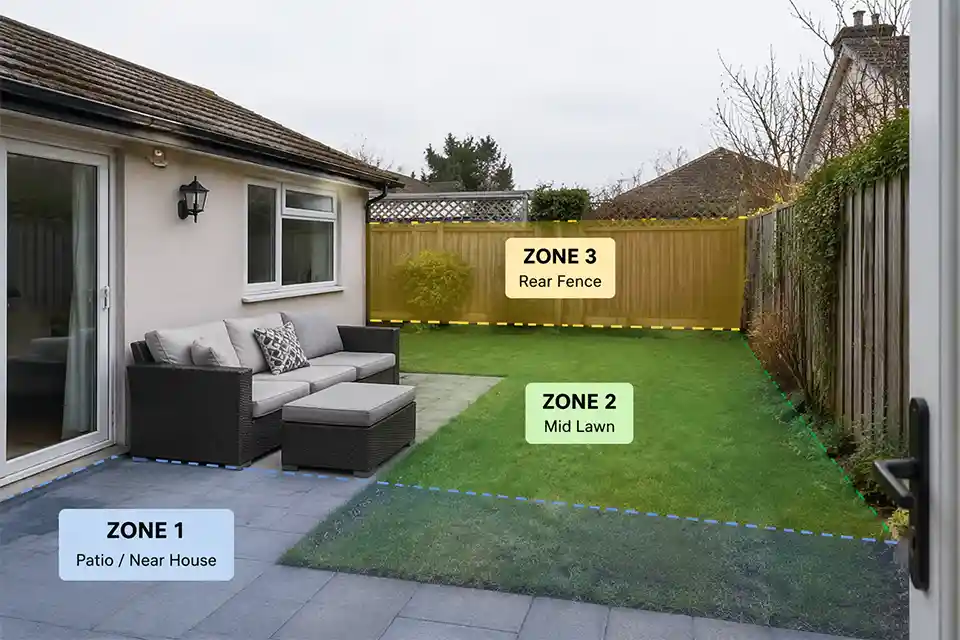
A yard does not have to be large to feel usable, but it does need to read with some depth. When a small house sits close to a compact backyard, the space often looks even tighter because the house feels visually heavy, the patio grabs too much attention, and the first sightline reaches the fence too fast.
Start with three checks. If your main path pinches below about 30 to 36 inches, if the furniture takes up more than roughly half of the hard surface, or if you can step out the back door and visually read the patio edge, seating zone, and rear fence almost at once, the problem is usually layout compression rather than lot size alone.
That distinction matters. A truly undersized yard forces harder decisions about use. A yard that only looks too small usually improves when proportion, sightlines, and visual weight are corrected.
People often overestimate how much “more decor” or “more openness” will help. In compact spaces, what changes the outcome is usually simpler than that: reduce bulk near the house, stop breaking the view too early, and give the eye one clear reason to travel deeper into the yard.
Why a small house can make the yard feel even smaller
When the house becomes the dominant visual mass
A small house does not automatically make a yard feel open. In fact, the opposite often happens. Low rooflines, broad rear walls, short setbacks, and shallow patios can cause the house and yard to read as one compressed layer instead of two separate spaces.
This is the first thing many homeowners misread. They assume the yard feels small because the lot is small. Sometimes that is true. But just as often, the real issue is that the house claims too much of the visual field. If the rear wall, patio setup, and back fence all read together in under about 2 seconds from the door, the yard rarely feels deep, even when the actual dimensions are workable.
When the patio is too attached to the house
This is not just a furniture problem. It is a transition problem. When the patio starts hard against the house and gets filled with deep chairs, bulky tables, storage benches, tall planters, or a grill cluster, the yard loses its first breathing zone.
The result is predictable: the outdoor space feels crowded right where the eye needs calm. That is why accessory-led fixes often disappoint. More lanterns, more cushions, more containers, and more little features tend to make the patio look busier before they make the yard feel better.
A similar scale problem shows up in small patio design mistakes that waste space, where the issue is less the patio size itself and more how oversized pieces collapse movement and visual room.
When the first sightline ends too early
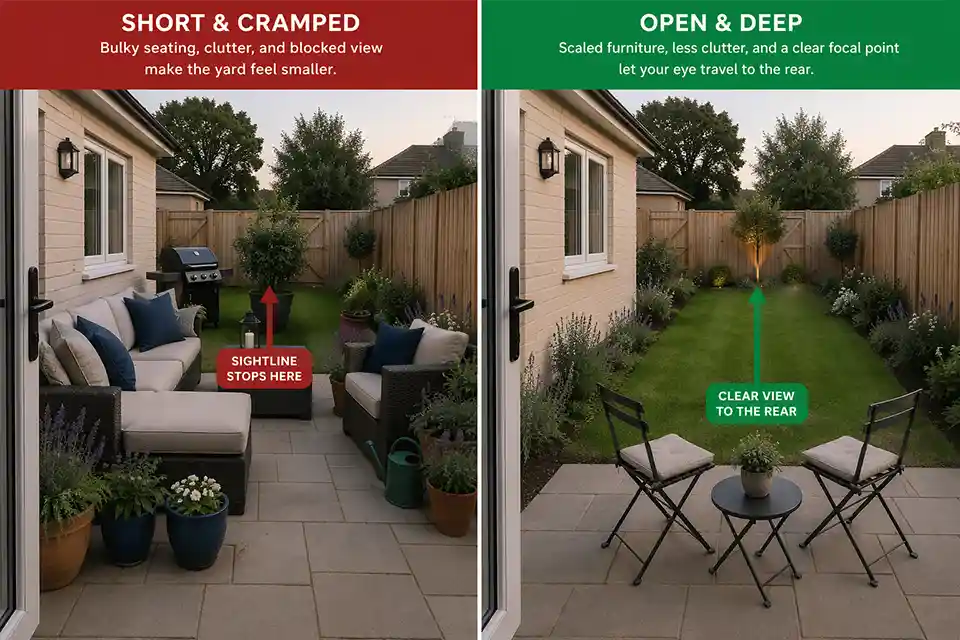
A compact yard needs at least one uninterrupted read toward the far edge. If that line gets broken by chair backs, scattered pots, choppy bed lines, or dense planting in the middle third of the yard, the space feels over almost immediately.
That is different from privacy. A yard can be screened and still feel longer. What shortens it is repeated interruption, especially close to the house.
The failure patterns that usually shrink the yard
Bulky layout near the house
This is the most common failure pattern. Too much mass gets stacked into the first 6 to 8 feet outside the door. Thick-framed seating, broad tables, oversized planters, dense shrubs, or storage pieces create a hard visual stop before the yard has a chance to open.
The symptom is “the yard feels cramped.” The mechanism is different: the eye keeps hitting bulky objects too early.
A practical threshold helps here. If the main view from the house encounters more than three strong visual stops before the midpoint of the yard, the layout is probably compressing the space.
The skinny-edge trap
Many people try to make a small yard feel larger by pushing everything to the perimeter. Sometimes that works. But when the edge treatment becomes a thin, busy ring around the whole yard, the center often feels exposed rather than spacious, and the boundaries become easier to read all at once.
This is one of the most overestimated fixes in compact spaces. A blank middle does not automatically create depth. If the border is only about 8 to 12 inches deep, repeated evenly around the fence, and filled with small decorative elements or mixed single plants, the eye reads the full outline too fast. The yard can look flatter and shallower, not larger.
That same “too many little interruptions” problem is why edge-heavy layouts often age poorly and require constant correction. The maintenance mechanism is different, but the visual clutter logic overlaps with landscape edging keeps shifting tools.
Flat, one-level planting
If everything visually ends below fence height, the yard often reads shorter than it is. The eye travels across the ground plane, hits the fence, and stops. What many small yards need is not “more plants,” but a better height ladder.
That does not mean building a wall of screening. It means creating height contrast without heaviness: a small light-canopy tree, one taller layered corner, a focal planter near the back edge, or selective planting that rises in one zone instead of everywhere.
People often overestimate how enclosing height will feel. Heavy height closes in a small yard. Light vertical structure often does the opposite because it adds scale contrast and keeps the eye moving.
Dark or dead back boundary
The rear edge matters more than most people think. If the far boundary is dark, empty, constantly damp, or visually lifeless, it becomes a hard stopping point. The yard feels shorter because the least inviting area is also the visual endpoint.
A useful time-based clue: if the back edge stays noticeably darker than the rest of the yard through most of the afternoon, or stays wet for 24 to 48 hours after rain while the rest dries sooner, that boundary may be reinforcing the cramped feeling.
If poor drainage or heavy shade is part of the problem, no amount of styling will fully fix the visual compression. In those cases, small garden drainage problems or small garden shade fixes are more relevant than swapping decor.
What people usually get wrong first
“I need more plants”
Usually not. More plants only help if they create structure. In a small yard, scattered singles, mixed leaf shapes, and decorative filler often make the space feel smaller because the eye has to process too many separate objects.
A good rule: if you can count every plant as a separate item from the main patio view in about 2 seconds, the planting is probably too fragmented.
“I need to open everything up”
Not always. Too much openness can make a yard feel shallow because nothing pulls the eye forward. A good compact yard is not empty. It is edited.
One destination near the back edge often helps more than stripping everything out. That destination might be a bench, a specimen pot, a small tree, or one clear layered planting moment.
“Curves always make a small yard feel bigger”
Only when they do real work. A gentle directional shift can lengthen the experience of moving through the yard. But fussy curves in edging, pavers, or bed lines usually add visual chatter without creating meaningful depth.
The useful distinction is simple: directional change can help; decorative wiggling usually does not.
Pro Tip: In a compact yard, every line should either extend a view, guide movement, or quiet the layout. If it does none of those, it is probably making the yard feel smaller.
What actually changes the outcome
Remove bulk closest to the house first
The fastest win is usually subtraction, not addition. Remove one oversized chair, replace a deep coffee table with a narrower one, reduce the number of pots, or move the grill and storage pieces if they are clogging the first view.
Even recovering 12 to 18 inches of openness near the patio edge can change how the whole yard reads.
Build one longer sightline
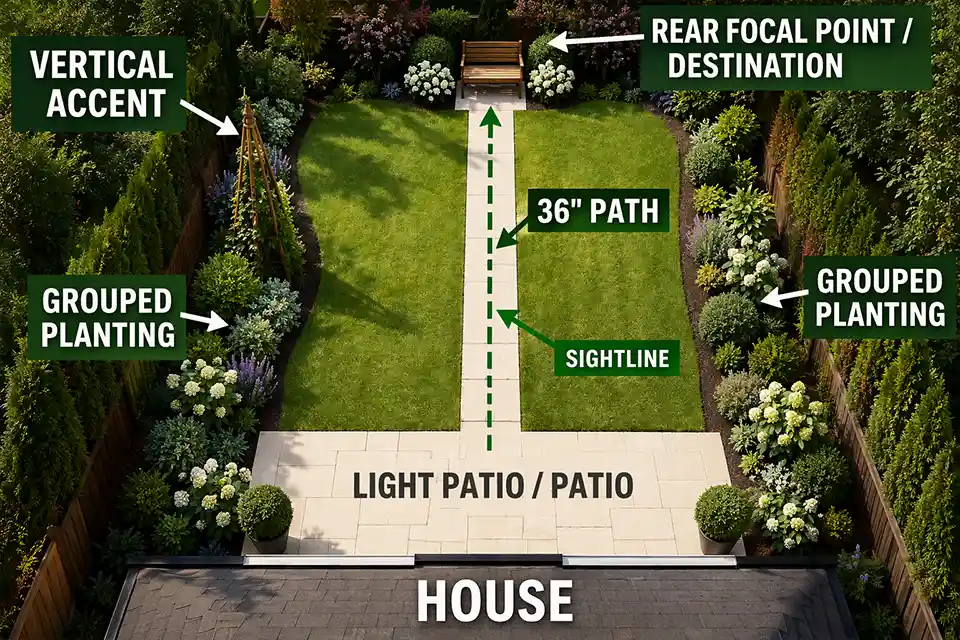
A small yard does not need multiple competing features. It needs one readable route outward. That can come from the paving direction, a path, a bed edge, or the placement of one focal point near the rear boundary.
Continuity matters more than decoration here. If the line gets interrupted every few feet, the effect is mostly lost.
This is really a zoning issue before it becomes a styling issue. Backyard zoning mistakes that hurt outdoor flow is about usability, but the same layout discipline is what helps a yard feel less compressed.
Add height without building a wall
This is where many small yards either improve quickly or get worse fast. A light-canopy small tree, a slim vertical accent, or one taller planting cluster can stretch the yard upward and outward. A thick hedge wall or multiple bulky tall planters usually just create enclosure.
The goal is not height by itself. The goal is height contrast that keeps the space readable.
Group plants instead of peppering them
Five plants functioning as one mass are often far more effective than five plants functioning as five separate statements. Grouping reduces visual clutter and gives the yard stronger structure.
That logic matters in privacy work too. Lost privacy after removing trees or hedges is about screening, but it also shows why plant structure matters more than just adding more green.
Comparison guide: what the yard feels like and what is usually causing it
| If the yard feels like this | Most likely cause | Usually overestimated | What changes the result |
|---|---|---|---|
| Shorter than it is | The first sightline ends too early | The lot size itself | One longer clear view to the back edge |
| Cramped right outside the door | Too much visual mass in the first 6 to 8 feet | The fence being too close | Reducing patio bulk and clearing the first view |
| Empty but still small | Thin, busy perimeter treatment | “More open center” as the fix | Better edge composition and one rear destination |
| Flat and boxed in | Everything ends at one low height | Adding more low plants | Light vertical structure without heavy screening |
| Bigger in photos than in person | Layout fragmentation | House size alone | Fewer separate objects and stronger grouping |
When the standard fix stops making sense
When pruning becomes constant maintenance
If key plants need cutting back every 6 to 8 weeks during the growing season just to keep the space usable, the planting scale is wrong for the yard. That is no longer a pruning issue. It is a design mismatch.
When privacy starts costing too much depth
Privacy matters, but not every edge needs the same treatment. If screening is 3 to 5 feet deep around most of a compact yard, it often steals too much usable room and too much visual depth unless the exposure is unusually severe.
Targeted screening is usually better than blanket screening. That is one reason small backyard privacy fences fall short so often comes down to angle and placement, not just adding more barrier.
When the yard becomes a stack of separate fixes
This is the point many homeowners underestimate. A smaller yard can tolerate fewer ideas at once. Once the space contains a privacy fix, a drainage fix, a storage fix, a shade fix, and a decor fix, it often stops feeling like one place and starts feeling like a patchwork of solutions.
That is where routine tweaking usually stops paying off. The better move is to re-proportion the yard: lighten the patio zone, quiet the edges, restore one clean outward view, and decide what the back boundary is supposed to do.
A small house does not automatically doom the yard to feel tiny. What usually makes the space feel smaller is that the house, patio, edges, and rear boundary all compete in one shallow visual layer. Correct that, and the yard often improves faster than people expect.
For broader design guidance grounded in landscape planning principles, see the University of Minnesota Extension.