Last updated: July 2, 2026
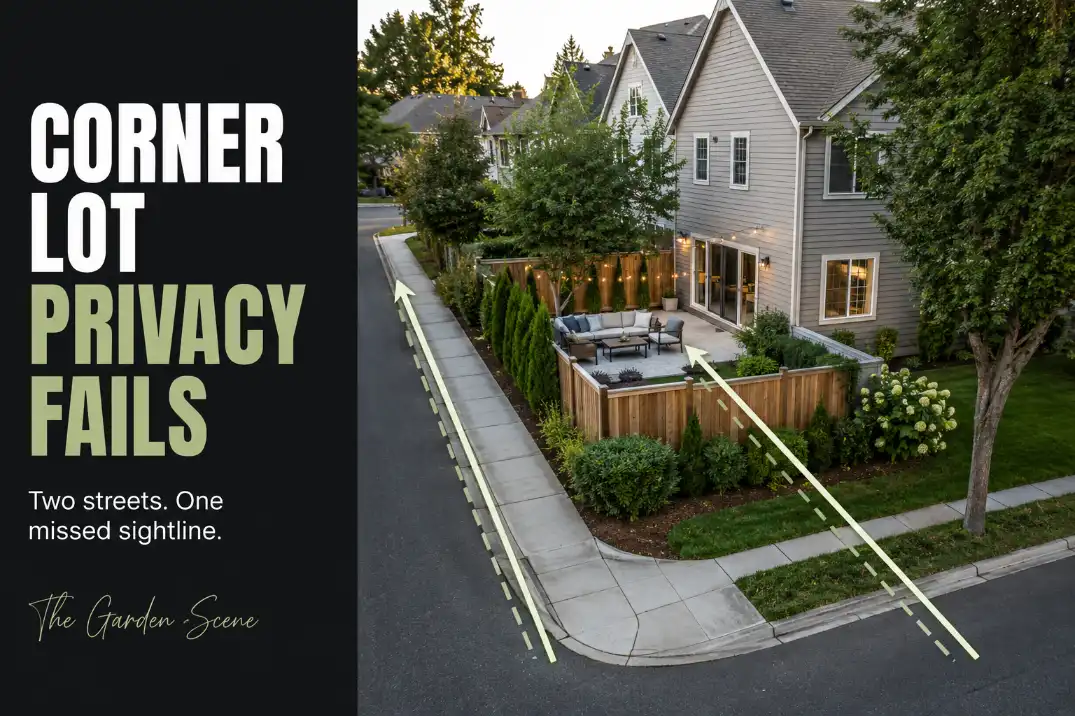
A corner-lot backyard privacy problem is rarely solved by simply covering more fence line. The real failure is usually geometric: two public edges create crossing sightlines, and one of those lines still reaches the place where people sit.
That is why a backyard can look private from the patio door and still feel exposed when someone walks along the side street. The rear fence may be taller. The shrubs may be healthier.
The screen may even be in the right general area. But if the side-street angle, driveway opening, fence end, or sidewalk corner still sees the patio, the privacy fix is working in the wrong place.
The first diagnosis is not “Do I need more height?” It is “Which view reaches the use zone first?” On a corner lot, the answer may come from the rear, the side street, the sidewalk corner, the driveway opening, or the diagonal line where two public edges meet.
Why Corner Lots Stay Exposed After a Standard Privacy Fix
A standard backyard privacy fix assumes one main viewing direction. On a corner lot, that assumption breaks quickly because the side edge is not just a property boundary. It is a second public viewing edge.
People may pass slowly on foot, pause near the corner, stop in a car, or approach from an angle that looks past the fence line rather than straight through it. A fence that seems solid from the patio may start too late or end too soon when judged from the street approach.
This is also where backyard and front-yard logic overlap without becoming the same problem. If your lot has two public sides, the backyard privacy issue is shaped by the same exposure pressure that affects corner lot two-street frontage constraints, but the target is different. You are not designing the whole frontage. You are protecting the backyard use zone.
The useful test starts outside the yard, not inside it.
Corner-lot exposure field check
- Stand on the rear approach and look toward the seating area.
- Stand on the side street and look diagonally toward the patio.
- Check the view from the sidewalk corner, not only from directly beside the fence.
- Look through gate, driveway, and fence-end openings.
- Sit in the main chair and identify which public edge feels most visible.
- Repeat the check in the evening if interior or patio lights make the seating area stand out.
If one of those checks reveals a clear view into the patio, fire pit, dining table, hot tub, or lounge chairs, the privacy failure is probably not lack of effort. It is a missed view path.
Mistake 1: Screening the Rear Fence While the Side Street Does the Damage
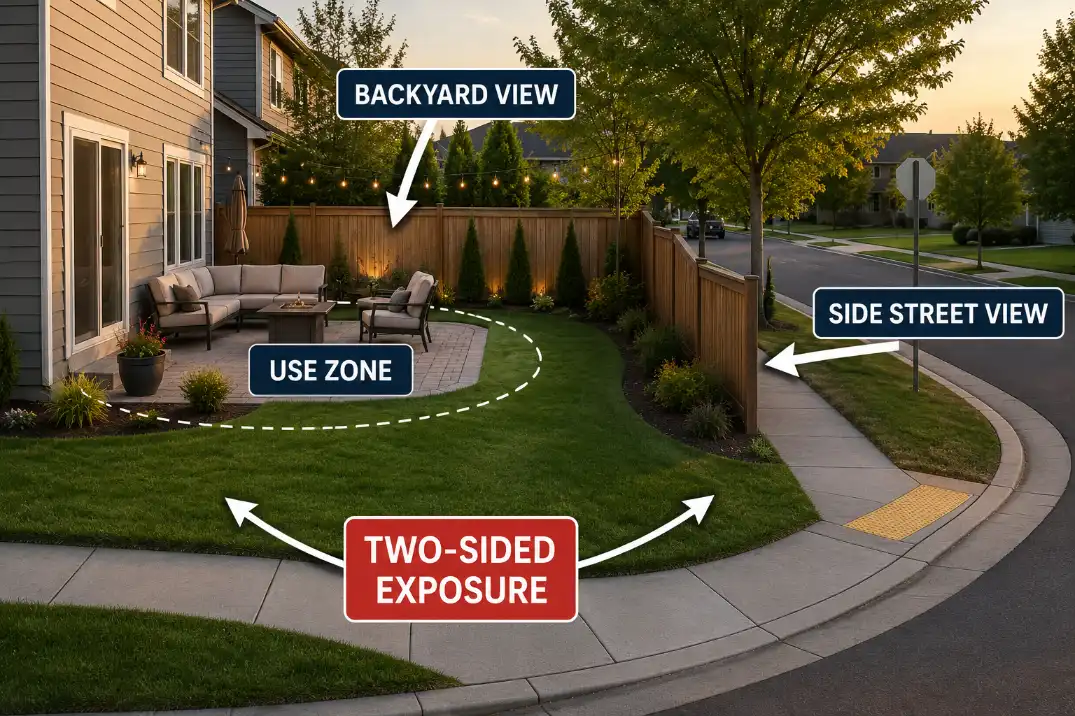
The first mistake is choosing the longest boundary instead of the most revealing boundary. A rear fence may be the easiest privacy line to understand, but it is not always the line that exposes the patio.
A side-street view behaves differently from a rear-neighbor view. It moves. A walker sees the yard for a few seconds from one angle, then a slightly different angle, then another. A driver stopped near the corner may look across the side yard or driveway opening.
A person approaching from the sidewalk may not see the whole backyard, but they may see the exact seat, table, grill zone, or hot tub that needs protection.
That means the “view boundary” is not always the property boundary. The view boundary is the line where someone’s eye can still reach the use zone. If that line cuts across the side yard before it reaches the back fence, the rear fence is solving the wrong edge.
This is why some corner-lot privacy fixes feel oddly disappointing. The fence is not useless. The planting is not wrong. The problem is that the most exposed side of the backyard was never the back line in the first place.
A better diagnosis starts with the side-street approach. Walk along the public edge and notice where the seating becomes visible. If the patio appears before the rear fence ever matters, the fix belongs closer to that side-street view path.
Mistake 2: Missing the Diagonal View That Bypasses the Screen
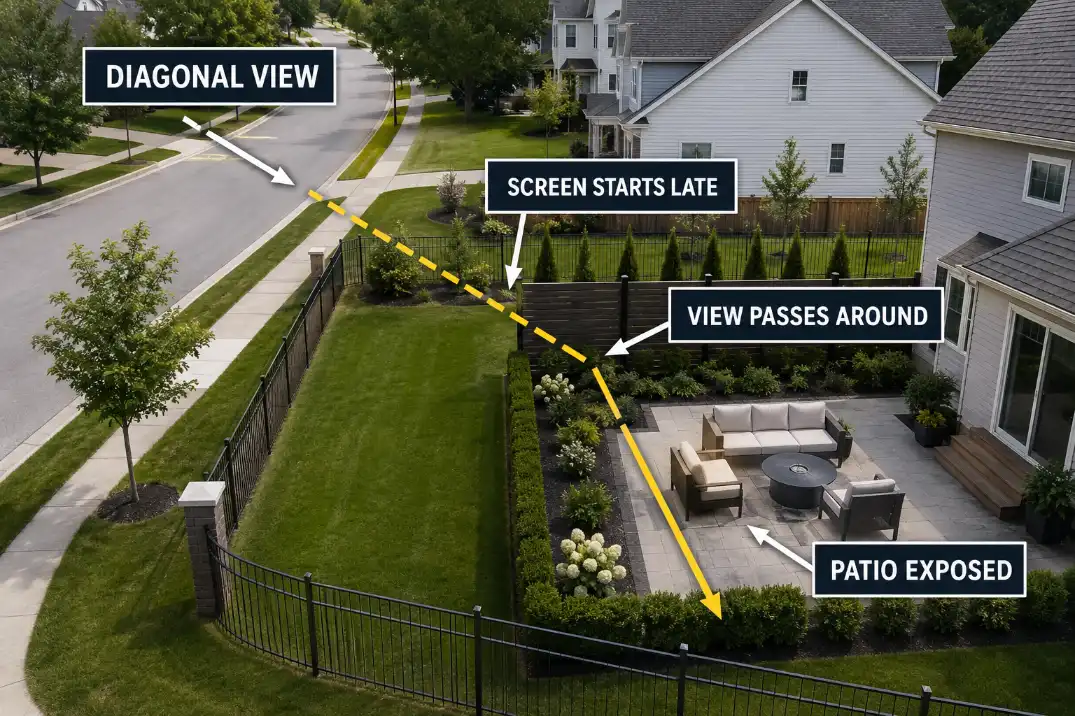
A diagonal view does not care that the screen looks centered from inside the yard. It only matters whether the screen crosses the line between the viewer and the seat.
The failure usually happens around the end of a fence, the side of a narrow panel, the gap between a gate and a hedge, or the open angle where the side yard meets the backyard. From the patio, the screen may look correct. From the sidewalk corner, the view may simply pass around it.
That is the difference between blocking an object and blocking a sightline. A screen placed behind the seating area may hide the chair from one direction, but if the diagonal approach sees around the side of the screen, the patio still reads as exposed.
Height does not automatically fix this. A taller screen in the same wrong place may only create a taller object that the view bypasses. The question is whether the screen interrupts the diagonal line before it reaches the chair.
For a deeper parent-level diagnosis of this type of failure, see how standard privacy fixes that fail when the angle is wrong often look reasonable from inside the yard while missing the actual view path.
Common mistake: extending the rear fence instead of closing the angle
The expensive mistake is adding more privacy along the rear fence while leaving the side-street diagonal open. A corner-lot backyard may not need a longer rear run first.
It may need a short return, offset screen, planting pocket, or seating adjustment that interrupts the diagonal view before it reaches the patio. The fix is smaller, but it has to be placed across the actual angle.
Editorial note
Judge the screen from where the stranger stands. If the patio chair, dining table, or hot tub appears from the sidewalk corner, that is the privacy problem. A screen that looks balanced from inside the yard can still fail if the public angle slips around its edge.
Mistake 3: Leaving Fence Ends, Gates, and Driveway Gaps as View Corridors
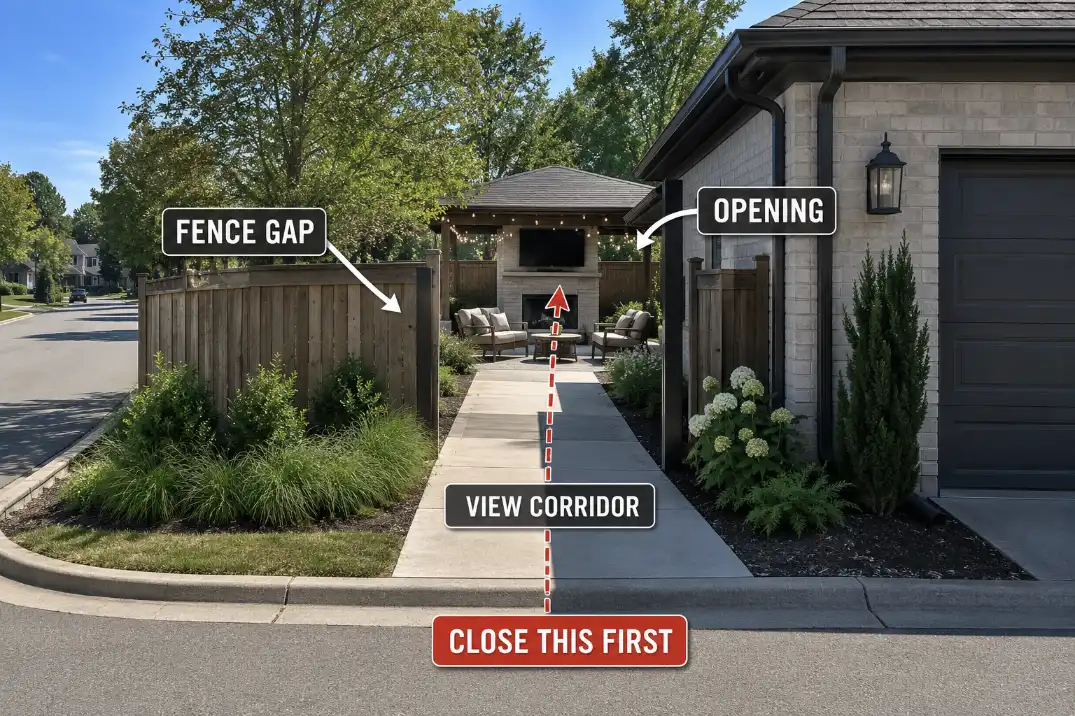
A gap becomes a privacy problem when it lines up with something personal: a chair, table, hot tub, grill station, or lounge area. On a corner lot, that alignment matters more than the gap size alone.
A long fence run can be defeated by one open end. A 20-foot privacy section may look substantial, but if someone can see through a 2-foot opening directly toward the seating area, that opening becomes the part of the yard people actually notice.
Fence ends are especially important. A fence that stops at the rear corner, garage edge, or driveway line may leave a clean diagonal opening. The eye does not need the whole yard to be open. It only needs a narrow lane to the main activity zone.
Driveway-side exposure creates the same problem. The driveway may be functionally necessary, but visually it can act like a channel from the street into the backyard.
If your corner-lot backyard is visible through the driveway side, the issue may resemble driveway opening exposure, even if the space you are trying to protect is behind the house.
The useful distinction is between a harmless gap and an aligned corridor. A small opening behind a shed or blank planting bed may not matter. A similar opening aimed at a patio table or lounge chair matters a lot.
Gaps wider than roughly 18–24 inches can read as privacy leaks when they align with a public view path. That does not mean every small gap needs to be sealed. It means the gap should be judged by what it reveals.
| Corner-lot privacy mistake | What is actually happening | Better first correction |
|---|---|---|
| Screening only the rear fence | The active view enters from the side street | Diagnose the side approach before adding rear height |
| Adding a narrow screen | The diagonal view passes around the edge | Shift, widen, or return the screen across the angle |
| Ignoring a gate or driveway opening | The opening becomes a visual corridor | Close or offset the most direct view lane first |
| Planting only along the property line | The use zone remains exposed before the planting matters | Protect the seating area as the real target |
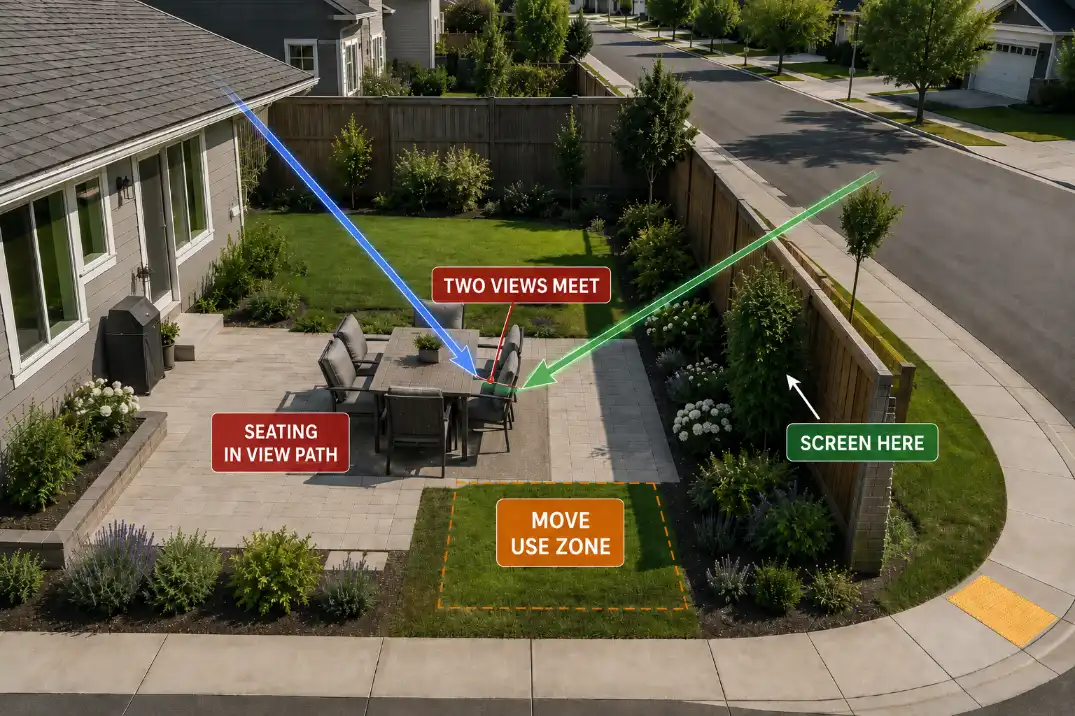
| Leaving seating in the crossing point | Two views meet at the chair, table, or hot tub | Move, rotate, or back the seating with a closer screen |
Mistake 4: Putting the Seating Area Where Two Views Meet
If two sightlines cross at the patio, the seating layout is part of the privacy failure. The fence can be reasonable and the plants can be healthy, but the chair may still be sitting in the wrong exposure pocket.
Corner-lot backyards often have one place where the rear view and side-street view overlap. If the patio table, fire pit chairs, hot tub, grill bench, or lounge area sits directly in that overlap, the yard will feel exposed even if the perimeter is partly screened.
This is why “screen the whole yard” can be the wrong instinct. The whole perimeter may not need equal treatment. The active use zone may need better placement.
A seating area usually needs privacy across the 8–14 feet where people actually sit, stand, eat, talk, or move around the table. If that zone is visible from two directions, adding a tall layer far away can feel less effective than moving the seating 4–6 feet, turning the chairs, backing the area with a partial screen, or creating an L-shaped pocket that interrupts the crossing views.
The privacy target is not the entire lot. It is the place where exposure becomes uncomfortable.
A layered privacy buffer can help once the view path is understood, but it works best when it supports the use zone instead of being spread evenly along every edge.
What to Fix First on a Corner-Lot Backyard
The first fix should be the leak that reaches the seating area most directly. If you start by adding material everywhere, the yard can get more enclosed without becoming more private.
- Check visibility limits near the corner. Before adding height near an intersection, driveway, or street corner, check local rules for sight triangles and driver visibility. Do not assume every tall screen or hedge is allowed at the corner edge.
- Map both public approaches. Stand where a walker, stopped car, or side-street approach actually sees the yard. Mark the first place where the seating area becomes visible.
- Close the most direct leak first. If a fence end, gate gap, or driveway opening points straight at the patio, fix that corridor before adding general planting elsewhere.
- Protect the seating area, not every inch of yard. Move the seating, rotate it, or add a close use-zone screen where the view reaches people, not just where the property line happens to be.
- Add planting for depth and softness. Plants are useful after the main sightline is controlled. They soften the edge, reduce the harshness of fencing, and help the yard feel less boxed in, but they should not be asked to solve a misplaced view path alone.
This order prevents the classic corner-lot mistake: spending most of the effort on the longest boundary instead of the most revealing angle.
When the Fix Should Be a Fence Return, Planting Layer, or Seating Move
Choose the correction by the leak, not by the material you hoped would solve everything.
A fence return makes sense when the view enters around the end of an otherwise useful fence or screen. It does not need to wrap the whole yard to work. It needs to interrupt the diagonal path that reaches the use zone.
A planting layer makes sense when the view is already partly controlled but still feels too open, hard, or exposed. That is a softening move, not the first answer to a direct sightline.
A seating move makes sense when the patio sits exactly where two views meet. In that case, even a modest shift can change the privacy equation more than another long run of fence.
A close screen makes sense when privacy is needed where people actually sit. On a corner lot, the most effective screen is often not the farthest one. It is the one that crosses the view before it reaches the chair.
The point is not to make a corner-lot backyard disappear from every possible angle. The point is to stop the first meaningful view from reaching the place where privacy matters. Fix that leak first, and the rest of the yard becomes easier to handle.
For broader safety context, the Federal Highway Administration notes that drivers entering a roadway from a driveway need a clear line of sight in each direction before entering traffic: Federal Highway Administration access management guidance.