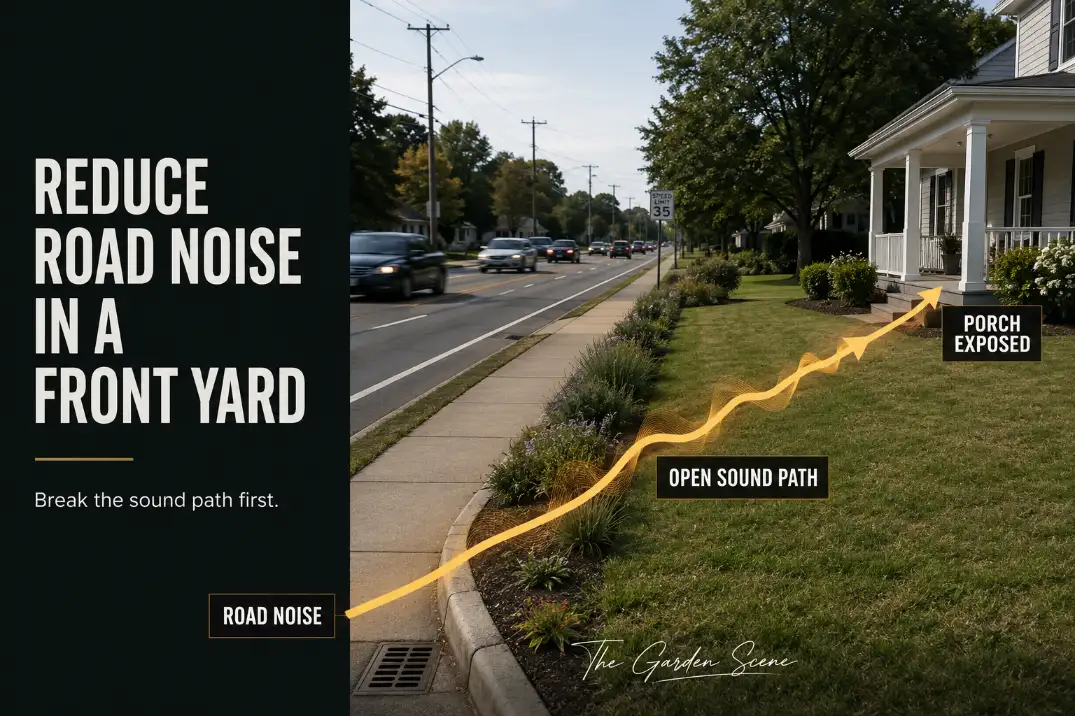
Road noise in a front yard usually feels worse when the yard has a direct route from the curb to the porch, front windows, or entry area.
The first fix is not simply adding taller plants. It is breaking the exposed line between traffic and the place where the noise lands. If the road is visible through low planting, open fence sections, bare mulch, or a wide lawn gap, the yard is still acoustically open.
A normal front yard should not be treated like a professional highway noise wall. In most residential yards, the realistic goal is not silence. It is reducing the sharpness of road noise, softening the exposed edge, and protecting the porch or windows that hear the most traffic.
If the road sits within about 20–40 feet of the house, low planting alone rarely changes enough. Dense layers, solid interruptions, and smart placement matter much more than decorative greenery.
The Street Edge Problem
Road noise starts at the street edge, but it becomes annoying where it lands. In a front yard, that usually means the porch, a front sitting area, a bedroom window, or the entry zone where people pause.
The mistake is trying to quiet the whole yard evenly. Most front yards only need one or two direct road-to-house lines interrupted.
Find the actual listening zone
Stand where the noise bothers you most. If that is the porch, look toward the road from a seated height. If it is a front window, look from inside the room. If you can see the road through the lower half of the yard, the front edge is probably too open.
This is where road-noise work overlaps with street-facing privacy, but the two are not identical. A thin screen can hide movement without doing much for sound. A dense screen works better because it reduces both the visual stress and the direct traffic corridor.
For yards where the street itself is the main exposure, Street-Facing Front Yard Privacy Landscaping supports the same edge-first thinking.
What actually changes the noise
There are four different ways to make a front yard feel calmer:
Blocking uses a solid fence, wall, berm, or tight structure to interrupt the direct path.
Softening uses dense planting to reduce the open, exposed feeling of traffic.
Masking adds a nearby sound source, such as moving water, close to where people sit.
Repositioning protects the porch, window, or entry instead of trying to treat the entire frontage.
The strongest front yard usually uses more than one of these. A low wall without planting can look harsh. Planting without density can look pretty but sound weak. A fountain far from the porch may sound nice from the sidewalk but do little where people actually sit.
Sound Moves Over Low Planting
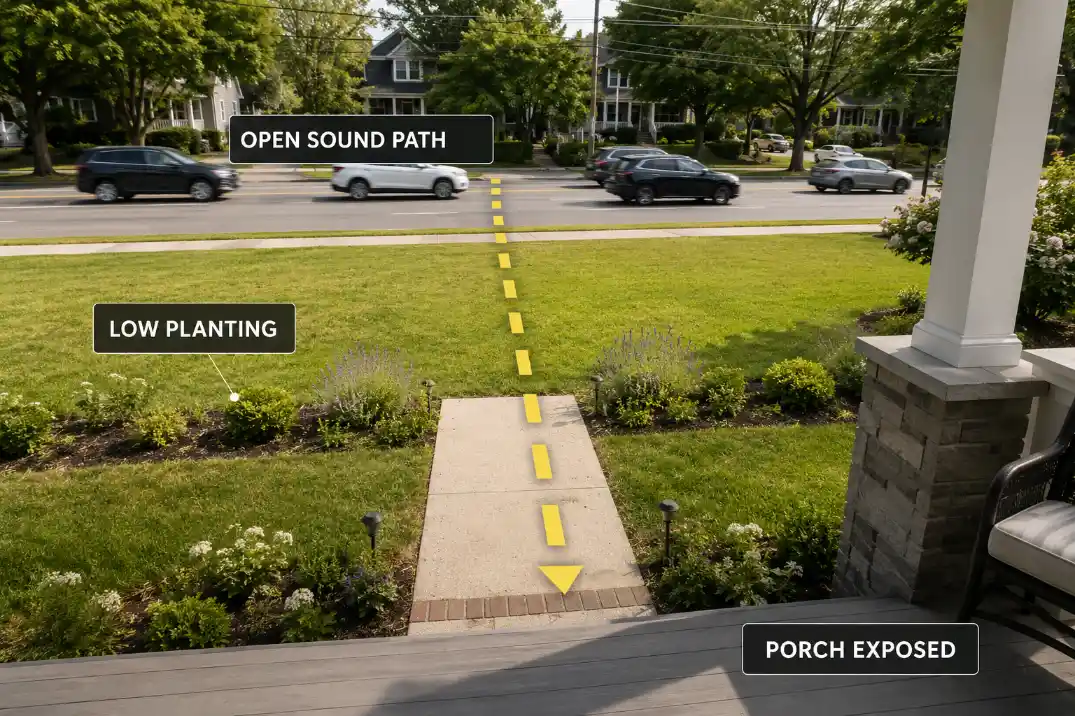
Low planting can make a front yard look finished without changing how road sound reaches the house. That is the condition many homeowners overestimate.
A 2-foot border of shrubs may hide the curb line from a quick glance, but car tires, engines, and road surface noise still move above and through that layer.
The lower gaps matter more than people expect
If the bottom 12–24 inches of the planting layer is open, the buffer is still weak. Sound does not only travel over the top. It also passes through gaps between trunks, open mulch, sparse grasses, and loose hedge bases.
A row of tall ornamental grasses can be especially misleading. It may create movement and partial privacy, but if you can see the street through the stems, it is not a strong sound buffer.
A mixed planting with lower filler, dense shrubs, and a middle layer usually performs better than a single tall row with empty space underneath.
Pro Tip: If headlights, tires, or curb movement are visible through the bottom half of the planting, the buffer is still acting more like curb appeal than noise control.
Planting near the house is usually the weaker fix
Foundation shrubs can make the house look softer, but they are often too late in the sequence. By the time road noise reaches the house wall, it has already crossed the open yard.
A stronger first move is usually closer to the street edge, sidewalk edge, or exposed side of the front yard.
This does not mean every front yard needs a tall hedge at the curb. It means the densest material should sit where it interrupts the direct route.
If the house is close to traffic, plant choice also matters because curbside heat, reflected pavement, road dust, and winter salt in northern states can thin out the exact plants that were supposed to create density.
For that reason, How to Choose Front Yard Plants for Busy Streets is more useful here than a purely decorative plant list.
Dense Planting Helps More Than Tall Gaps
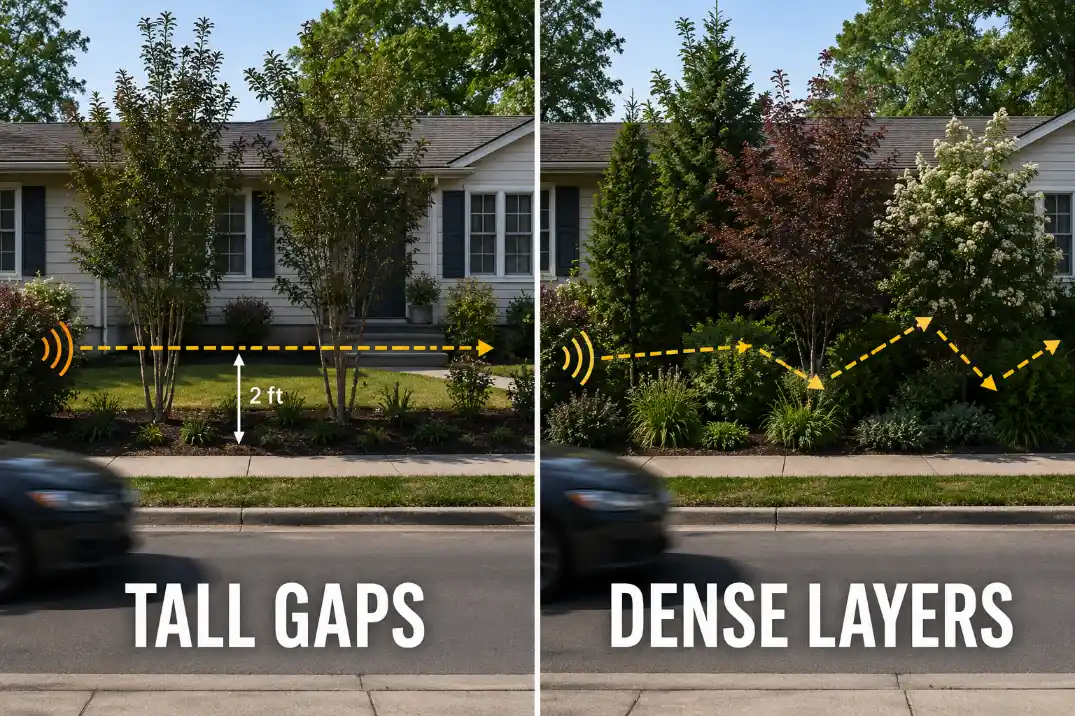
For road noise, density matters more than dramatic height. A tall but see-through row of plants can leave the front yard feeling almost as loud as before. A shorter but denser band can be more useful because it blocks the low and middle sight-and-sound route.
A useful density target
In a typical front yard, a meaningful planting buffer usually needs three parts: low filler in the first 12–24 inches, a dense shrub layer around 3–6 feet, and enough depth that the planting does not read as one thin line. A 3-foot-deep bed can soften the edge, but a 6–10-foot-deep layered bed has more room to reduce gaps.
That does not mean every yard has space for a deep buffer. In narrow lots, the better solution may be a low fence or wall with compact planting around it.
The point is not to force more plants. The point is to stop pretending that thin planting and dense buffering are the same thing.
The front yard condition should choose the fix
| Front Yard Condition | Best First Move | Skip This First |
|---|---|---|
| Road within 20–30 feet of house | Solid edge plus dense planting | Loose tall grasses alone |
| Planting strip only 4–6 feet deep | Low fence or wall with compact shrubs | Deep hedge plan that has no room |
| Front yard has 10–25 feet of usable depth | Layered evergreen and mixed shrub buffer | Foundation shrubs only |
| Road sits higher than the yard | Berm, wall, or solid interruption | Low planting by itself |
| Entry already feels tight | Offset screen with 36-inch clear path | Full hedge across the whole frontage |
| Porch is the main problem area | Targeted porch-facing buffer | Treating the entire lawn evenly |
This is the decision point where a routine fix stops making sense. If the planting bed is too shallow, the road is too close, or the traffic is constant rather than occasional, adding another row of pretty plants may only delay the real solution.
Fences, Hedges, Berms, and Mixed Layers
A solid fence, low wall, berm, or dense hedge works differently from loose planting. It interrupts the path. That does not make the front yard silent, and it does not remove reflected or distant traffic noise.
But it can reduce the sharpness of direct sound, especially when it sits between the road and the porch or window that needs relief.
When a fence makes more sense than more plants
A fence or low wall starts making sense when the front yard is shallow, the road is close, or the planting strip is too narrow to become dense. If you only have 4–6 feet between sidewalk and lawn, you may not have enough room for a deep hedge. A solid 3–4 foot edge with planting in front and behind it can do more than another loose row of shrubs.
The word “solid” matters. Open picket fencing, wide lattice, cable rail, and decorative metal panels may help define the yard, but they should not be treated as serious noise controls.
They still leave gaps. Before building any solid edge, check local height rules, corner visibility rules, and HOA restrictions so the fix does not create a compliance or safety problem.
If height rules or HOA limits apply, Privacy Fence Options for Suburban Homes can help separate visual screening from a stronger physical edge.
When a low berm belongs in the plan
A berm can help when the front yard has enough width to make it look natural. It does not need to be dramatic. Even a 12–24 inch planted rise can help lift the buffer and interrupt the lowest sound route better than flat planting alone.
But berms are not a magic fix. In a tiny front yard, a berm can look forced, steal usable space, and create drainage problems if it pushes runoff toward the sidewalk or house.
It belongs in wider yards where the slope can feather out gradually, the planting can stabilize the soil, and the entry path can remain clear.
Why mixed layers usually feel best
A bare wall may interrupt sound better than a thin hedge, but it can look harsh from the street. A hedge alone may look softer, but it may take 2–4 growing seasons to become dense enough to matter.
A mixed edge is often the strongest front-yard compromise: a low solid element where allowed, evergreen or semi-evergreen shrubs, low filler plants, and one or two small trees placed away from the main front-door view.
This also reduces maintenance risk. A fast hedge that needs monthly trimming during the growing season can become patchy after one neglected summer.
Slower, tougher shrubs often make a better long-term buffer than a quick screen that grows tall before it grows dense.
Keep the Entry Welcoming
Reducing road noise should not make the house feel hidden, defensive, or hard to approach. In a front yard, the entry still has to read clearly from the sidewalk or driveway.
The goal is not to build a green wall across the whole frontage. The goal is to block the loudest route while preserving the way people move to the door.
Leave the front path obvious
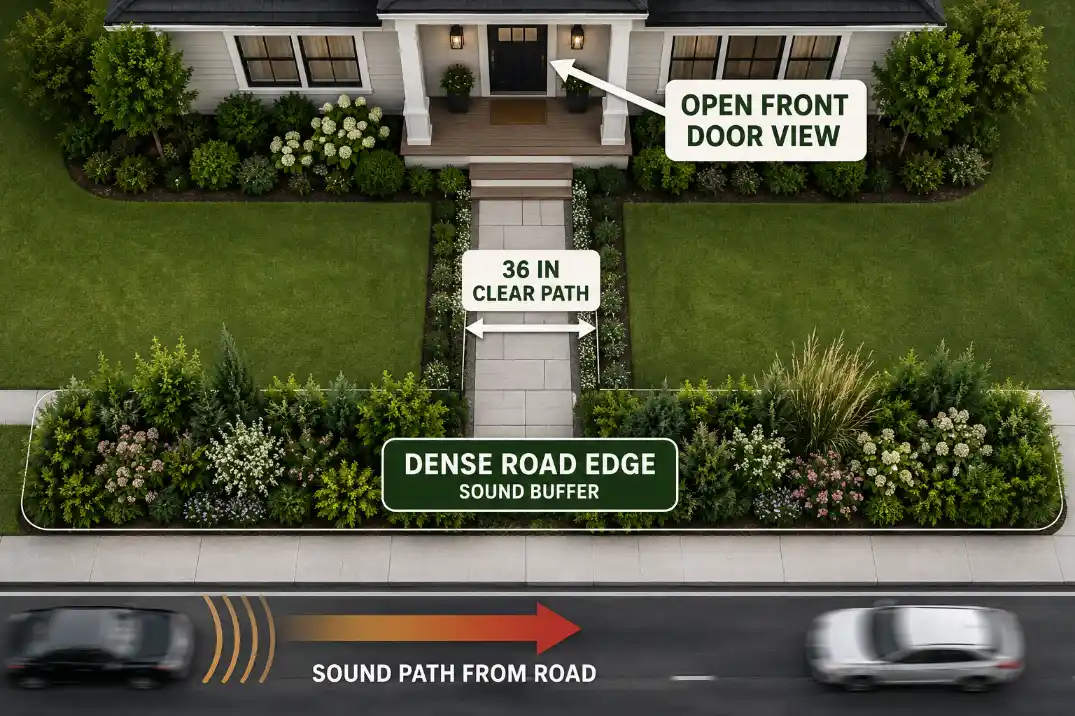
Keep at least a 36-inch clear walking path to the front door. Wider is better if the entry handles packages, guests, strollers, or snow removal. A dense buffer that crowds the walkway creates a different problem: the yard may feel more screened, but the entrance feels cramped and less safe.
A better layout usually has the strongest screen along the road-facing exposure and a lighter opening near the approach.
This lets visitors understand where to enter without exposing the whole porch or front window to the street. For this balance, Front Yard Privacy That Still Looks Welcoming is relevant because the same mistake appears in both privacy and noise work: solving exposure by closing off the front yard too aggressively.
Do not block the house just to block the road
The most common design overcorrection is a continuous hedge that hides the architecture, pinches the path, and makes the front door less visible. A front yard can feel quieter without turning into a wall.
Keep the tallest or densest material offset from the front door rather than directly in front of it. If the house sits close to the street, a staggered screen usually looks better than one long straight hedge.
Staggering also helps avoid the fortress effect that happens when every inch of the frontage is treated the same way.
Near driveways, corners, and sidewalk crossings, keep the buffer low enough or set back enough that drivers can still see pedestrians, cyclists, and approaching cars. A noise buffer that creates a blind spot is not a good front yard fix.
The strongest order of fixes
First, close the obvious gaps. Fill low openings under shrubs, avoid see-through planting rows, and stop relying on open lawn as the only space between traffic and the house.
Second, add density near the road-facing edge where it interrupts sound earlier. This may mean evergreen shrubs, a compact hedge, low filler planting, or a mixed bed that has real depth.
Third, add a solid interruption when the yard is too shallow or the road is too close. That may be a low fence, wall, berm, or fence-and-planting combination. In front yards, this usually works better when it is targeted rather than stretched across the whole house.
When water helps and when it does not
Water features can help in a specific way: masking. They do not block road noise, but they can make a porch or small sitting area feel calmer when the water sound is close enough to hear clearly.
A fountain placed within about 6–10 feet of the seating area can soften traffic perception better than a fountain placed far out in the yard.
This is not the first fix for an open front yard facing steady traffic. It is a comfort layer after the main traffic-to-porch line has been reduced.
If the goal is sound masking near a porch, sitting area, or small outdoor pause point, Best Outdoor Water Features for Softening Yard Noise fits that decision better than adding another plant row in the wrong place.
When the standard fix stops working
Planting alone becomes a weak answer when the road is higher than the yard, the house is within roughly 20–30 feet of the curb, the planting strip is under 6 feet deep, or the traffic is constant for most of the day.
It also becomes harder when driveway sight lines, local fence rules, or HOA limits prevent a continuous tall screen.
In those cases, the better question is not “Which hedge grows fastest?” It is “What can interrupt the direct road-to-house line without making the entry unsafe or closed off?”
The answer may be a low wall, a planted berm, a dense mixed edge, targeted porch screening, or a smaller buffer placed only where the noise actually lands.
For broader layout thinking beyond the front yard, Outdoor Noise Buffer Ideas can help compare buffers, screens, seating pockets, and sound-softening zones. The front yard version simply has a stricter rule: the house still has to look open, visible, and approachable.
Questions People Usually Ask
Can landscaping really reduce road noise in a front yard?
Landscaping can reduce the exposed feeling of road noise and soften the direct sound route, but normal front-yard planting rarely creates true soundproofing. Dense layers help most when they block the road view from the porch or window and fill lower gaps near the ground.
Is a hedge better than a fence for road noise?
Not always. A dense hedge can soften the yard and look natural, but a solid fence or wall interrupts sound more directly. In many front yards, the better answer is a mixed solution: a low solid edge with planting around it.
How long does a planted noise buffer take to work?
A planted buffer usually needs 2–4 growing seasons to become meaningfully dense, depending on starting plant size, spacing, climate, and watering. If the yard needs relief this year, combine planting with a more immediate solid or layout-based fix.
What is the cheapest first step for front yard road noise?
The cheapest first step is to identify the loudest road-to-porch or road-to-window line, then close the lowest visible gaps first. Add dense planting or a solid edge only where that exposed route actually reaches the house.
The reason greenery has limits is simple: traffic noise behaves like a barrier problem, and the Federal Highway Administration explains why height, width, density, and solid interruption matter more than plants alone.