Quick Solution Summary
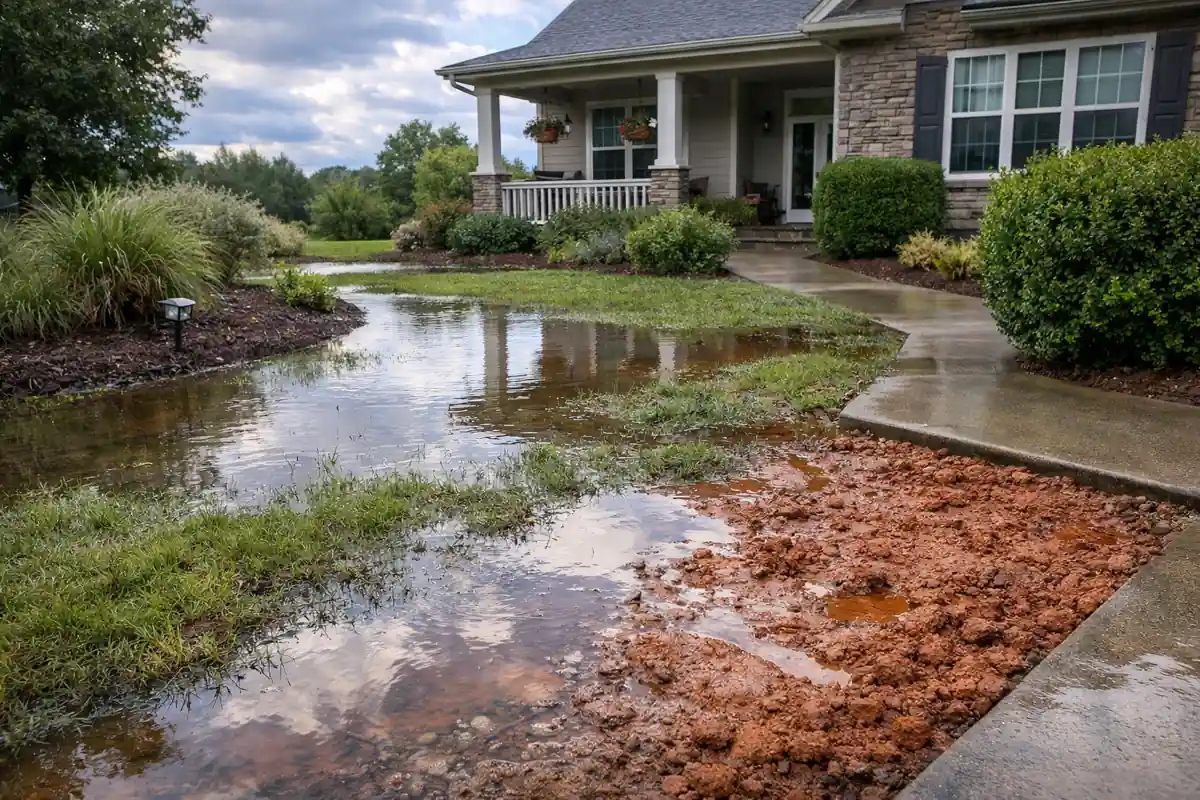
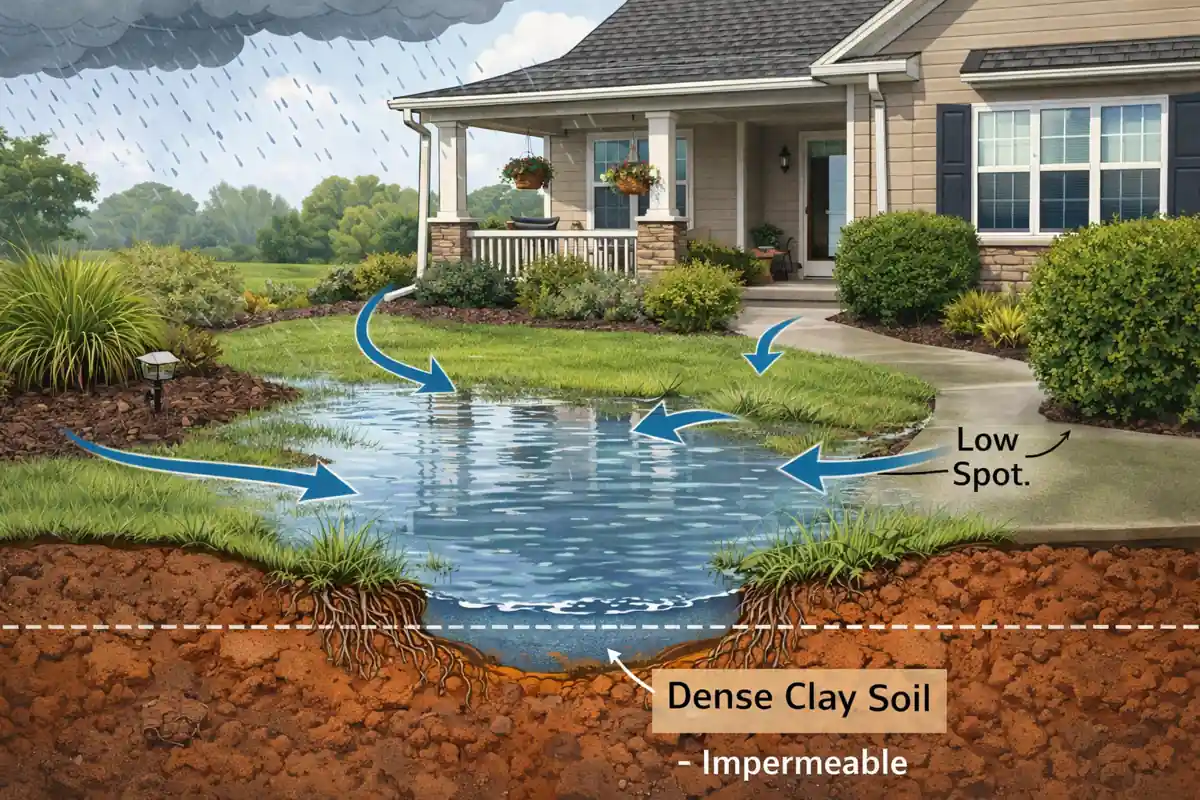
Persistent puddles in a front yard are often caused by dense clay soil that cannot absorb rainwater quickly enough. Clay particles are extremely small and compact tightly together, leaving very little space for water to move through the soil. During storms, rainfall may arrive faster than the ground can absorb it, causing water to pool on the surface.
In many parts of the United States, infiltration rates for clay soil may fall below 0.1–0.3 inches per hour. When storms deliver 0.5–1 inch of rain per hour, which is common in Midwest thunderstorms or summer storms in the Southeast, surface pooling becomes inevitable.
The most effective solution is rarely replacing the soil entirely. Instead, drainage improves when you combine three strategies:
-
redirect excess water from roofs and hard surfaces
-
reshape the yard slightly so water flows away from low areas
-
improve soil structure with organic material and deep-rooted plants
These changes increase infiltration and prevent standing water from damaging lawns, plants, or nearby walkways.
Why Clay Soil Holds Water Longer Than Other Soils
Clay behaves very differently from sandy or loamy soil. The particles are microscopic and shaped like flat plates. When wet, these particles slide together and create a dense layer that slows water movement dramatically.
Once saturated, clay may retain 30–40% water by volume, leaving very little air space for water to move downward.
Several conditions often make the problem worse:
-
Soil compaction from mowing or foot traffic
-
Low organic matter levels below 3%
-
Roof downspouts draining directly into lawn areas
-
Slight yard depressions that collect runoff
-
Hardscape surfaces that channel water into planting areas
These factors often interact. For example, heavy storms may send roof runoff into an already compacted lawn, overwhelming the soil’s ability to absorb water.
In yards where elevation slopes toward the house, drainage problems can intensify as runoff concentrates in specific areas. This pattern often appears in properties described in Sloped Front Yard Landscaping Problems and Drainage Issues, where grading and soil structure combine to create recurring puddles.
Quick Diagnostic Checklist
If you suspect clay soil is causing drainage problems, check for these signals:
-
Puddles remain 6–24 hours after rainfall
-
Soil feels sticky and dense when squeezed
-
Grass in wet areas becomes thin or yellow
-
Water accumulates near downspouts or walkways
-
The yard dries unevenly after storms
-
Soil forms cracks during hot summer periods
These symptoms often occur together because clay expands when wet and contracts when dry.
Environmental Conditions That Make Clay Drainage Worse
Drainage problems vary depending on regional climate conditions across the United States.
Midwest Storm Patterns
Spring thunderstorms in states like Indiana, Illinois, and Missouri may deliver 1–2 inches of rainfall within several hours. Clay soils cannot absorb this volume quickly enough, resulting in repeated pooling cycles.
Humid Southeastern Climates
In areas such as Florida or coastal Georgia, humidity levels often remain above 70–85%. Because evaporation slows in humid air, water may remain trapped in clay soil longer after storms.
Northern Freeze–Thaw Cycles
In colder states like Michigan or Minnesota, winter freezing can compact clay even further. When snow melts in early spring, partially frozen soil layers prevent water from draining properly.
Desert Monsoon Conditions
Even in dry regions like Arizona, clay drainage problems appear during monsoon storms. A storm delivering 1 inch of rain within 30 minutes can overwhelm hardened soil surfaces that formed during long dry periods.
How Water Accumulates in Clay Front Yards
Standing water usually forms in predictable places once clay soil becomes saturated.
Common accumulation zones include:
-
Low points in the yard
-
Areas near roof downspouts
-
Edges of driveways or walkways
-
Compact lawn sections
Hard surfaces accelerate runoff because they prevent water from soaking into the ground. Instead, water flows along concrete or stone surfaces until it reaches a depression in the lawn.
These patterns often appear around entry paths and sidewalks. Concentrated runoff near walkways is discussed in more detail in Front Yard Drainage Problems Near Downspouts and Walkways, where hard surfaces channel stormwater into limited soil areas.
How to Choose the Right Drainage Fix for Your Yard
Different drainage problems require different solutions. Identifying where water collects will help determine the most effective fix.
| Yard Condition | Likely Cause | Best Solution | Difficulty |
|---|---|---|---|
| Water pools near downspouts | concentrated roof runoff | extend downspout or add drainage pipe | Easy |
| Water pools in middle of yard | low soil elevation | create rain garden or shallow swale | Moderate |
| Soil feels extremely hard | lawn compaction | core aeration and compost | Easy |
| Water flows toward house | poor grading | regrade yard slope | Moderate |
| Entire lawn stays soggy | heavy clay saturation | soil amendment and drainage channel | Moderate |
This approach helps homeowners choose targeted solutions instead of attempting major landscape changes unnecessarily.
Practical Ways to Improve Drainage in Clay Soil
Most successful drainage improvements combine soil improvement and water redirection.
Add Organic Matter to Improve Soil Structure
Organic materials such as compost or shredded leaves help separate clay particles and create channels for water movement.
Increasing soil organic matter from 2% to about 6–8% can significantly improve infiltration over time.
Apply 2–3 inches of compost and mix it into the top 6–8 inches of soil during fall or early spring.
Install a Shallow Swale
A swale is a gently sloped channel designed to move excess water slowly across the yard.
Typical swale dimensions include:
-
depth: 4–8 inches
-
width: 2–4 feet
-
slope: 1–2% grade
Instead of pooling in one area, water spreads across a larger surface where it can soak into the ground gradually.
Redirect Roof Runoff
Roof drainage contributes large amounts of water during storms. A 1,500 square foot roof receiving 1 inch of rain can produce roughly 900 gallons of runoff.
Extending downspouts 6–10 feet away from the foundation or directing water toward a rain garden dramatically reduces lawn pooling.
Install a Rain Garden
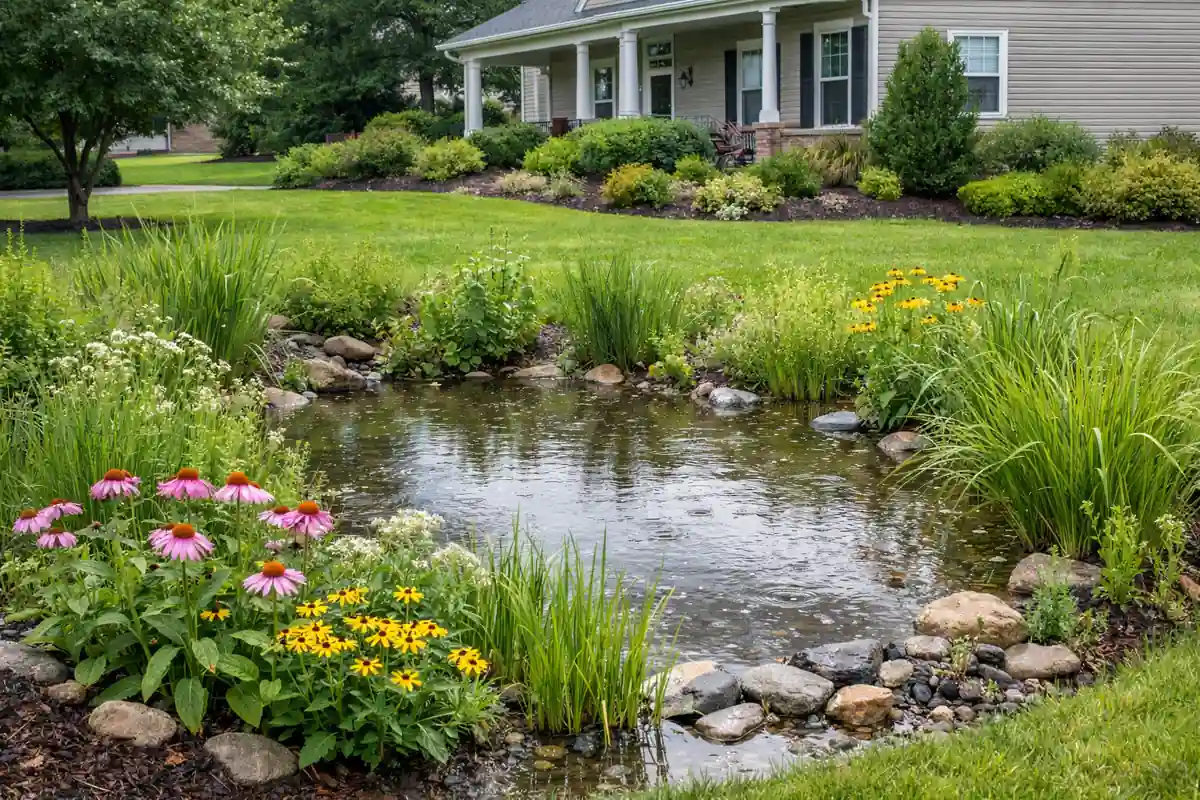
Rain gardens are shallow landscaped depressions designed to absorb stormwater gradually.
Plants often used in rain gardens include:
-
switchgrass
-
blue flag iris
-
black-eyed Susan
-
Joe-Pye weed
These plants tolerate temporary flooding while improving soil structure through deep root systems.
When You Need a French Drain for Clay Soil
A French drain becomes useful when water repeatedly collects in the same location and simpler fixes—such as soil amendments or redirecting downspouts—do not resolve the problem. Clay soil often slows water infiltration so much that surface improvements alone cannot move water away quickly enough.
A typical French drain consists of a gravel-filled trench containing a perforated drainage pipe that redirects water away from saturated areas. The pipe allows groundwater to enter through small openings while the surrounding gravel helps water move through the trench instead of remaining trapped in the soil.
French drains are most effective when drainage problems involve concentrated water flow rather than general soil moisture. In many residential landscapes, they are installed along walkways, near foundations, or at the lowest point of the yard where water naturally collects.
Common signs that a French drain may be necessary include:
-
Water pooling in the same location after every storm
-
Saturated soil remaining wet for 24–48 hours
-
Runoff flowing toward the foundation or driveway
-
Standing water forming near hardscape edges
A typical residential installation uses a trench about 12–18 inches deep and 6–12 inches wide, lined with landscape fabric and filled with gravel surrounding a 4-inch perforated drain pipe. The pipe then carries water to a lower area of the yard or a designated drainage outlet.
French drains should always slope slightly so water can flow naturally. Most installations use a slope of about 1 inch per 10 feet of pipe.
Because improper installation can redirect water toward the house or neighboring property, complex drainage issues may require evaluation by a landscaping professional or drainage contractor.
Long-Term Landscaping Changes That Improve Drainage
Clay drainage problems often improve when landscaping strategies encourage healthier soil.
Deep-Rooted Native Plants
Native grasses and perennials may extend roots 2–5 feet deep, forming natural channels that allow water to move through clay layers.
Mulched Plant Beds
A mulch layer 2–3 inches thick protects soil from surface crusting and reduces evaporation cycles that compact clay.
Reduced Lawn Coverage
Traditional lawns receive frequent mowing and foot traffic, which gradually compacts soil. Replacing some turf with planting beds improves soil structure and water absorption.
Many homeowners combine these strategies with sustainable landscaping techniques similar to those explored in Low-Water Front Yard Landscaping Practical Solutions That Last.
When Drainage Problems Affect Walkways or Patios
Waterlogged clay soil expands as it absorbs moisture. During dry periods, the soil shrinks again. This expansion–contraction cycle can destabilize nearby hard surfaces.
Common signs include:
-
uneven pavers
-
shifting patio stones
-
cracks forming between walkway joints
These issues occur because saturated clay pushes upward on hard surfaces before shrinking again as the soil dries.
Ground movement problems are closely related to the conditions explained in Uneven or Sloped Ground That Makes Patios Feel Unstable.
Preventing Future Drainage Problems
Clay soil drainage improves gradually when soil health increases and runoff is managed properly.
Long-term prevention strategies include:
-
aerating lawn areas every 1–2 years
-
maintaining organic matter levels above 5%
-
directing roof runoff away from planting beds
-
avoiding heavy foot traffic in wet areas
-
reshaping minor depressions before they become drainage basins
Ignoring drainage problems can lead to additional landscape damage. Standing water may eventually create issues similar to those described in Patio Drainage Problems Most Homeowners Notice Too Late, where persistent moisture begins affecting hardscapes and outdoor structures.
Frequently Asked Questions
Why does clay soil drain so slowly?
Clay particles are extremely small and pack tightly together, leaving very little space for water to move through the soil.
Should I add sand to clay soil?
Adding sand alone usually makes clay worse. The mixture can harden into a dense structure similar to concrete. Organic matter works much better.
How long should puddles remain after rain?
Healthy soil typically absorbs water within 2–4 hours after rainfall. Puddles lasting longer than 12 hours usually indicate poor drainage.
Are French drains necessary for clay soil?
French drains can help when water repeatedly collects in a single location. However, many drainage issues can be solved by improving grading and soil structure first.
Key Insight
Clay soil does not have to create permanent drainage problems. By combining soil improvements, proper grading, and controlled runoff, many front yards can significantly reduce standing water.
Even moderate changes such as compost amendments and redirecting downspouts may improve infiltration rates by 30–50% over several seasons.
For additional technical guidance on soil management and water infiltration, the USDA Natural Resources Conservation Service provides research-based resources:
https://www.nrcs.usda.gov