Last updated: July 5, 2026
A patio becomes part of daily life only when the small friction stays low. The first decision is not the style, the furniture set, or the number of seats. It is whether someone can open the door, step outside, sit down, reach a table, stay shaded, and reset the space without feeling like the patio needs preparation.
That is where many finished patios quietly fail. They look complete when empty, but the route narrows once a chair is pulled back. Shade lands on the slab instead of the person. The best-looking seat has nowhere to set a glass. Cleanup takes just enough effort that the patio becomes a weekend space instead of an everyday one.
Designing a patio for everyday use means treating comfort, access, shade, seating, and maintenance as one loop. Each choice should make the next ordinary moment easier: enter, move, sit, stay comfortable, set something down, clean up, and come back later.
Design for the Patio You Use on a Normal Day
Design the patio around the most repeated use, not the most impressive use. A dinner party, full guest setup, or staged photo can come later.
The daily version is usually simpler: one person with coffee, two people after dinner, a child crossing to the yard, a dog moving through the door, or someone carrying a plate outside for ten quiet minutes.
That ordinary loop is where the patio proves itself. If the seat is pleasant but hard to reach, it will be used less. If the shade is present but not where the body sits, the patio will still feel hot. If the surface looks clean but traps crumbs, pollen, or damp leaves under every object, the reset becomes a chore.
| Everyday-use lens | What it must make easy | What usually gets in the way |
|---|---|---|
| Comfort | Sitting long enough to relax | Hard seating, bad shade, no setdown spot |
| Access | Moving from house to patio and yard | Chairs, planters, storage, or tables in the route |
| Shade | Staying outside during real use hours | Shade placed over empty space instead of the seat |
| Seating | Choosing one seat people actually use | Too many chairs, poor support, no legroom |
| Maintenance | Resetting the patio after ordinary use | Clutter, dirt traps, wet edges, awkward storage |
Use that table as a pressure test, not a decorating checklist. A patio with great seating but poor access still feels annoying. A shaded patio with no setdown surface still feels temporary. A low-maintenance surface with no comfortable seat may stay clean mainly because nobody wants to sit there.
The strongest everyday patio is often not the one with the most features. It is the one with the fewest repeated interruptions.
Keep the Door Route Clear Before You Add Comfort
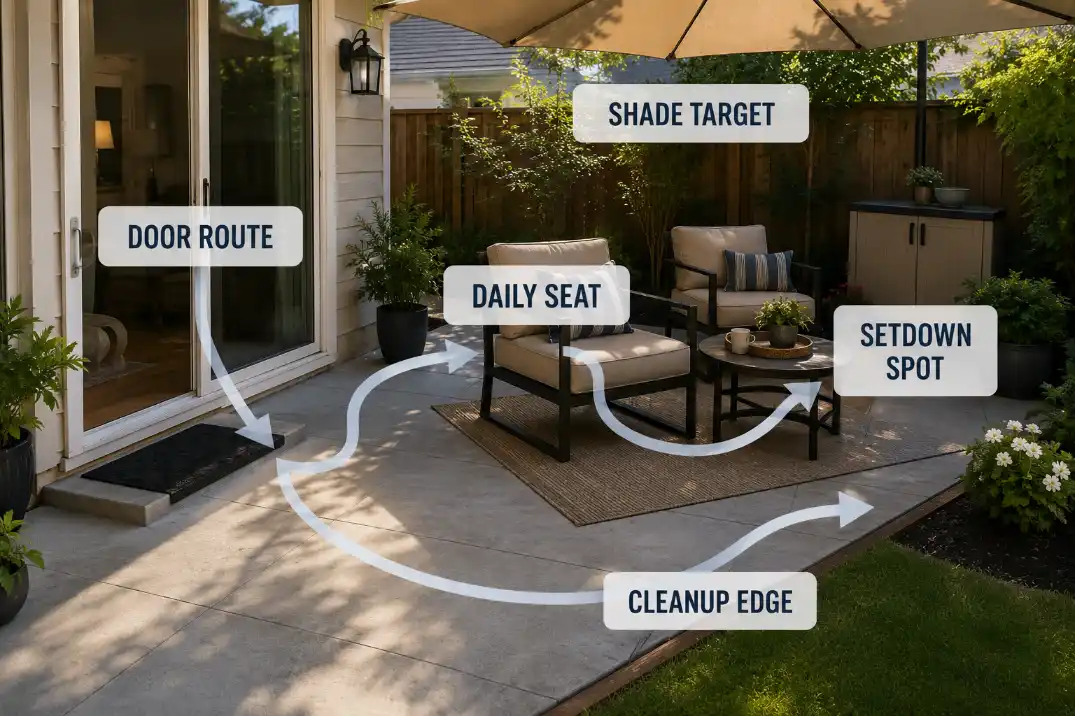
Protect the route before you choose the comfort pieces. If the path from the door to the main seat is awkward, the patio starts each use with friction.
This does not always look like a major layout problem. It may be a planter that makes someone step sideways. A chair that has to be pushed in before the door opens. A side table that sits exactly where someone turns toward the yard. A cushion box that seems practical until it becomes the thing everyone walks around.
A sliding glass door needs a landing area that stays open. A hinged door needs swing clearance. The route from the house to the most-used seat should feel obvious even when someone is carrying a drink, plate, book, or phone.
Where people regularly pass, roughly 30–36 inches of clear walking width is a useful target. The number matters only because it protects movement that happens every day.
Protect the first few steps
The first few steps outside the house do more work than most patio plans admit. That is where people pause, turn, check the weather, call a pet, carry food, or decide whether they are staying outside at all.
If that spot is crowded, the patio feels smaller before anyone sits down. The fix is not always more square footage. Often it is a stricter rule: nothing permanent belongs where people step, turn, or pass through every day.
The same logic applies if the patio connects to a grill, trash area, hose, side yard, or lawn. The whole patio does not need to be empty. The repeated route needs to stay dependable.
A deeper entry issue may need its own look at keeping the patio entry clear, but the everyday-use rule is simple: comfort pieces should not charge a movement tax.
A comfortable chair, attractive planter, or useful storage box becomes the wrong choice when it lives in the path people use five times a day.
Build the Main Seat Around Real Comfort, Not Just Capacity
Choose the daily seat before you plan for the occasional crowd. Capacity helps during gatherings, but everyday use is usually decided by one seat or one small seating pair.
This is where patios often get overbuilt. Four chairs may look balanced. A sectional may fill the corner. A dining set may make the space feel finished. But if the seat people actually use has poor back support, no nearby surface, harsh sun, or no room to pull back, the patio will not feel comfortable in normal use.
The main seat should support the body, allow natural leg position, keep a small surface within reach, and avoid blocking the walking line once someone sits down. That last part matters: a chair should be judged in use, not tucked neatly under a table.
Test the occupied position
Pull the chair out. Sit in it. Put your feet where they naturally go. Reach for the table. Then imagine someone walking behind you or moving from the door to the yard.
If the chair now blocks the route, the layout is not finished. If the table is too far away, the seat will feel temporary. If the seat is too low for easy standing or too upright for relaxed sitting, people may use it once and then drift back inside.
Seating height is one of those details that looks minor until the patio is used repeatedly. Very low lounge seating can be awkward for quick meals, older visitors, or anyone who wants to stand up easily. Very upright dining seating can work for dinner but feel stiff for casual sitting.
When the patio never feels quite right, outdoor seating height mistakes are often part of the hidden friction.

Guest seating can stay flexible. The daily seat should be protected. A patio that works beautifully for one or two people will usually adapt better than a patio arranged permanently for a crowd that only appears occasionally.
Put Shade Where the Body Sits, Not Where the Patio Looks Empty
Shade should be aimed at the use point, not the patio outline. A shaded slab can still produce an uncomfortable patio if the seat, table surface, or standing spot stays exposed during the hours people actually go outside.
This is especially common with afternoon patios. Morning shade may make the space look solved, but late-day sun can hit the seat right when the patio would otherwise be used after work or dinner prep. The question is not whether the patio has shade somewhere. The question is whether shade protects the body at the time the patio is expected to function.
The priority is usually the seated person first, then the table surface, then the most-used standing or waiting spot. Empty patio space does not need comfort. Shoulders, faces, hands, and touch surfaces do.
Watch the time of use
Shade changes faster than the furniture does. A seat that works at 9 a.m. may feel punishing at 4 p.m. A west-facing patio may need side protection more than overhead coverage. A covered patio may still feel hot if air cannot move under or around the shaded area.
Shade can also create its own friction. If the base, posts, tie-downs, or low canopy edge force people to duck, squeeze, or move the table into the route, the patio may trade heat discomfort for movement discomfort.
On a small or tight patio, the better decision is often not more coverage. It is shade that protects the actual sitting zone while keeping the route open.
When shade is the main reason the patio is unused, focus on shade options that keep a small patio open rather than simply covering as much hardscape as possible.
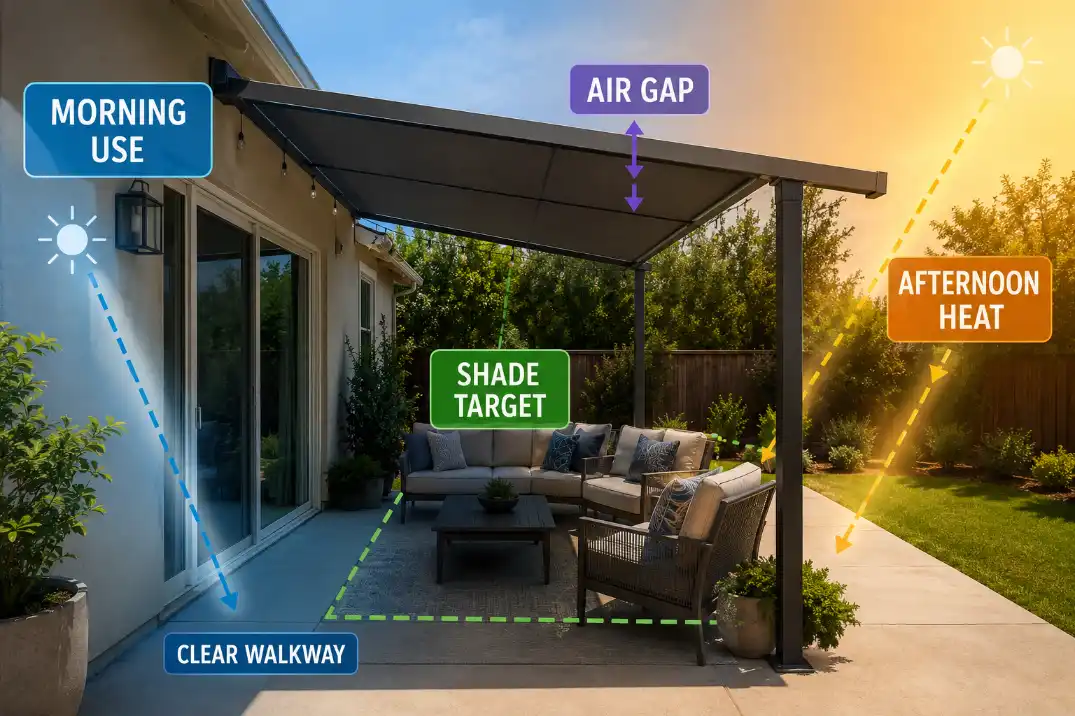
The useful shade is the shade that lets someone stay seated longer without making the patio harder to cross.
Make Cleanup and Storage Part of the Design
A patio becomes easier to use when the reset is built into the layout. If every ordinary use leaves pillows, crumbs, pollen, toys, wet cushions, or leaves with nowhere logical to go, the patio starts to feel like a task.
This is not about keeping the space spotless. It is about keeping cleanup casual. The patio should have a sweep path, a reachable storage spot, and a surface that does not trap everyday mess under every leg, pot, or decorative object.
Storage should support the next use, not occupy the best use area. A small cushion spot near the door, a broom within reach, a hose connection that does not drag through the seating zone, or a side storage area off the main route can make the patio feel easier to live with.
Store for the reset, not for the photo
Storage fails when it sits in the walking line, blocks a chair, crowds the door, or turns the patio edge into a pileup zone. A large box may seem practical until everyone steps around it to reach the yard.
The surface matters for the same reason. A patio that constantly holds dirt, stains, or damp edges may look acceptable at first but feel harder after a few weeks of real use.
If cleanup is already the reason people avoid the space, it may be worth looking at patio surfaces that become hard to clean before adding more furniture or decor.
Keep drainage in the right lane. If water routinely pools, sits against the house, or keeps the surface damp, that becomes a deeper patio drainage issue. For everyday design, the simpler test is whether the surface dries, sweeps, and resets easily enough for normal life.

The easier the reset, the more casual the patio becomes. A patio that needs a full cleanup before every use becomes an event space. A patio that can be used, swept, and left ready becomes part of the house.
Test the Patio With One Ordinary Use Loop
The simplest test is to act out one normal use before treating the design as finished.
Start at the door. Step outside while imagining a drink, plate, book, or phone in one hand. Walk to the main seat without turning sideways around furniture. Pull the chair out and sit down.
Check whether the chair now blocks the route behind it. Reach for the table without leaning awkwardly. Look at where the shade falls during the hour the patio is actually used.
Then test the end of the moment. Where does the cushion go if rain is coming? Where do crumbs or leaves collect? Can someone sweep without moving every chair? Is the hose, broom, or storage spot close enough that cleanup feels casual?
If the patio fails that loop, do not start by adding more features. Remove the friction first.
This same logic can extend beyond the patio. If the seating area works but the yard, side route, grill path, or storage zone still feels disconnected, the next layer is designing the whole backyard for everyday use, not forcing the patio to solve every outdoor problem by itself.
Know When This Becomes a Deeper Patio Decision
An everyday-use patio should stay focused. It does not need to solve every related patio question in one plan.
If the patio is very small and the main question is which setup can fit, that becomes a small-space idea decision. If the patio is physically hard to cross, the issue may be deeper access and layout behavior. If heat is the reason nobody stays outside, shade deserves its own decision.
If cleanup is the reason the space keeps getting abandoned, surface and storage choices need more attention.
The everyday-use framework tells you which deeper decision matters. A patio that fails at the door does not need more decor. A patio that fails at the seat does not need more capacity. A patio that fails at 4 p.m. may need better shade, not another chair. A patio that fails after every meal may need a better reset path, not another planter.
Designing for everyday use is mostly about making the ordinary moment easier: step out, sit down, stay comfortable, set something within reach, move through the space, and reset it without a production.
When those actions feel natural, the patio does not have to persuade anyone to use it. It simply becomes the easiest place to go.
For practical heat guidance related to outdoor activity, shade, and staying safer in hot conditions, see the CDC heat and health guidance.