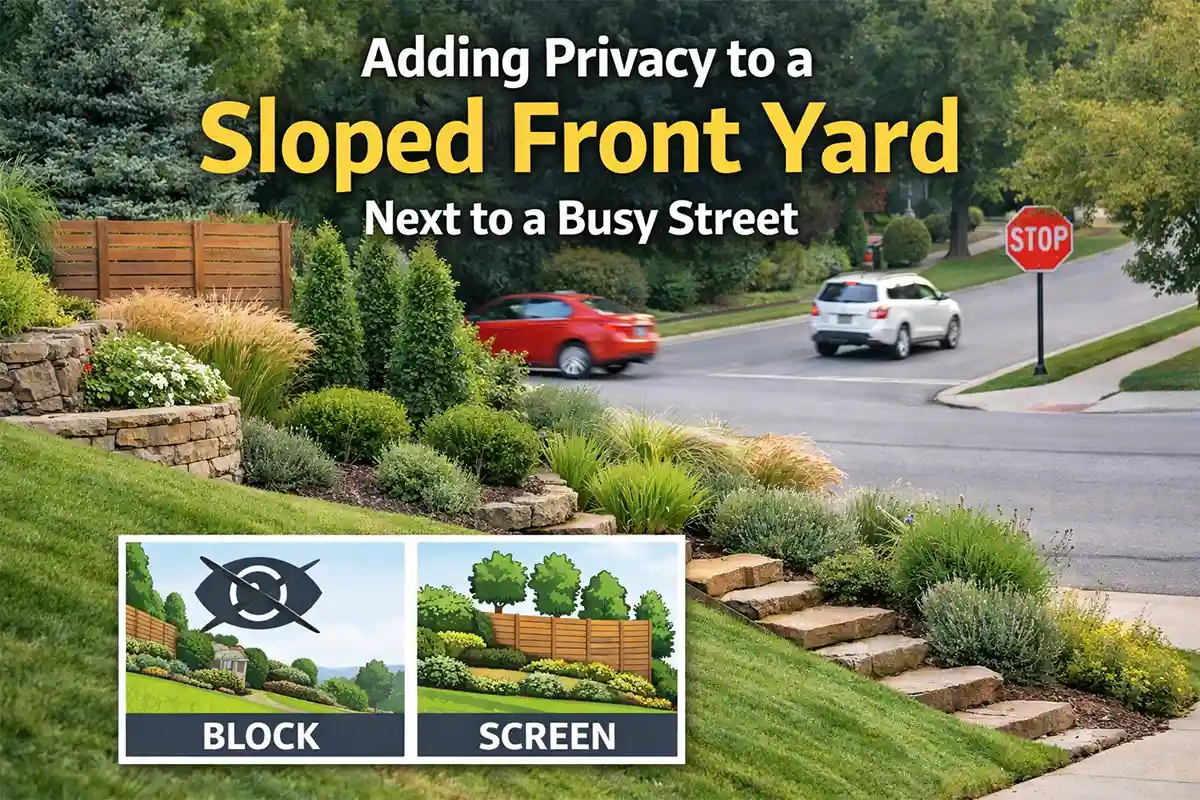
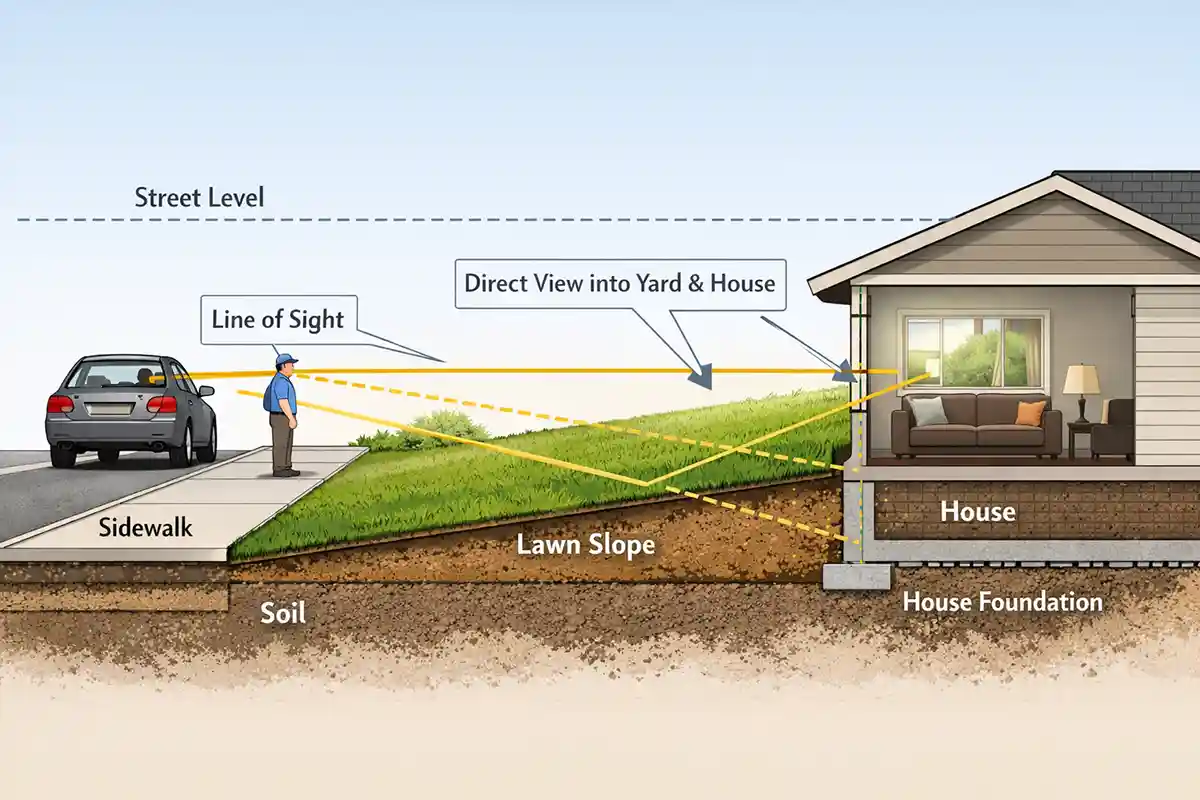
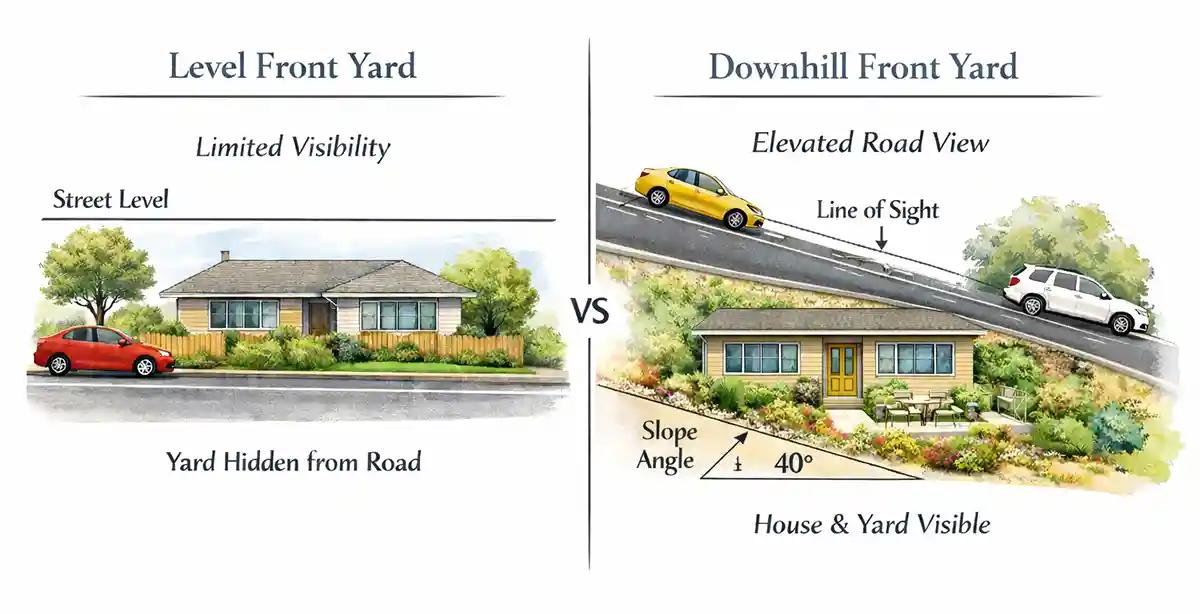
When a property slopes downward toward a road, visibility behaves differently than on level ground. Drivers, pedestrians, and even cyclists often sit at a higher viewing angle than the yard itself. Because of this elevation difference, sightlines can travel directly from the street into outdoor seating areas, porches, and front-facing windows.
What appears to be a simple lack of screening is often the result of several overlapping conditions. Terrain slope, road elevation, planting height, and the distance between the curb and the home all influence how easily views travel across a landscape.
Understanding which condition is responsible is essential before selecting a solution. A yard that drops three feet toward the curb requires a different strategy than one where the house sits well below street level. Likewise, the privacy challenges created by downhill terrain often overlap with other exposure situations such as properties facing pedestrian routes or high foot traffic.
Identifying the underlying condition first makes it easier to choose the most effective landscape strategy for restoring privacy.
Quick Diagnostic Checklist
The following observations help determine why a downhill front yard feels unusually exposed.
• The street sits noticeably higher than the lawn or porch level.
• Passing vehicles appear to look directly down into the yard.
• Outdoor seating areas feel visible from the road even when shrubs are present.
• A continuous slope runs from the house toward the curb without terraces or elevation breaks.
• Shrubs planted near the road remain below driver eye level.
• Windows or entry areas face downhill toward traffic.
• The distance between the curb and the house is less than 25–30 feet.
Landscape visibility studies conducted by several university extension programs show that sightlines on sloped terrain can extend 40–70 feet depending on the grade and observer height. Even modest slopes of 5–10 percent significantly increase how far views travel downhill.
Understanding the Possible Causes
Several physical conditions can create the visibility problem associated with downhill yards.
Elevated Road Level
When the road surface sits higher than the landscape surrounding the house, viewing angles shift downward into the property. Research in transportation engineering shows the average passenger vehicle driver sits roughly 42–52 inches above the road surface, while drivers in trucks and SUVs often sit significantly higher.
If the lawn or porch area sits below that height, direct views become possible.
Continuous Downhill Terrain
Lots built on steady slopes often lack intermediate elevation breaks. Without terraces, walls, or planting layers, sightlines move uninterrupted from the curb toward the home.
Landscape architects often recommend breaking slopes every 10–15 feet using planting terraces or grade transitions to disrupt these visual corridors.
Planting Height Mismatch
Plants placed on a downhill slope may appear tall when viewed from the house but remain below the viewing angle of traffic. Shrubs that reach four feet in height often fail to intercept sightlines from vehicles positioned above the yard.
Exposure to Pedestrian Traffic
Homes located along sidewalks or walking routes frequently experience extended visibility because pedestrians remain at nearly the same elevation as drivers. Similar exposure patterns appear in situations described in How to Create Front Yard Privacy on a Busy Walking Route.
Limited Setback Distance
Properties built close to the street have little horizontal space for layered landscaping. These conditions often mirror the structural constraints explained in Front Yard Privacy Solutions for Houses Built Close to the Road with No Setback.
Condition and Action Decision Table
Condition Decision Guide
| Condition | Signal | What It Means | Recommended Action |
|---|---|---|---|
| Road elevation higher than yard | Drivers appear to look downward into the yard | Viewing angle originates above property grade | Introduce berms or raised planting beds near the road |
| Continuous downhill slope | Lawn slopes directly from house to curb | Sightlines travel uninterrupted | Create terraces or grade breaks along the slope |
| Screening plants too low | Shrubs fail to block views from vehicles | Plant height below traffic eye level | Increase plant height or add layered vegetation |
| Exposure from slow traffic areas | Vehicles slow near the property | Drivers observe the yard for longer periods | Strengthen screening close to the street edge |
| Limited front setback | House sits close to road | Insufficient depth for layered landscaping | Use vertical screening elements such as hedges or trellis structures |
| Mid-slope open view corridor | Large lawn area without planting interruptions | Long sightline corridor toward the home | Install planting islands or shrub clusters mid-slope |
| Windows facing downhill | Interior spaces visible from road level | Sightline aligns with window height | Add layered vegetation or raised landscape beds |
Properties exposed to slow or stopped traffic often experience prolonged visibility similar to conditions described in Fixing Front Yard Privacy Issues for Homes Facing Constant Traffic at a Stop Sign or Intersection.
Practical Solutions Based on Diagnosis
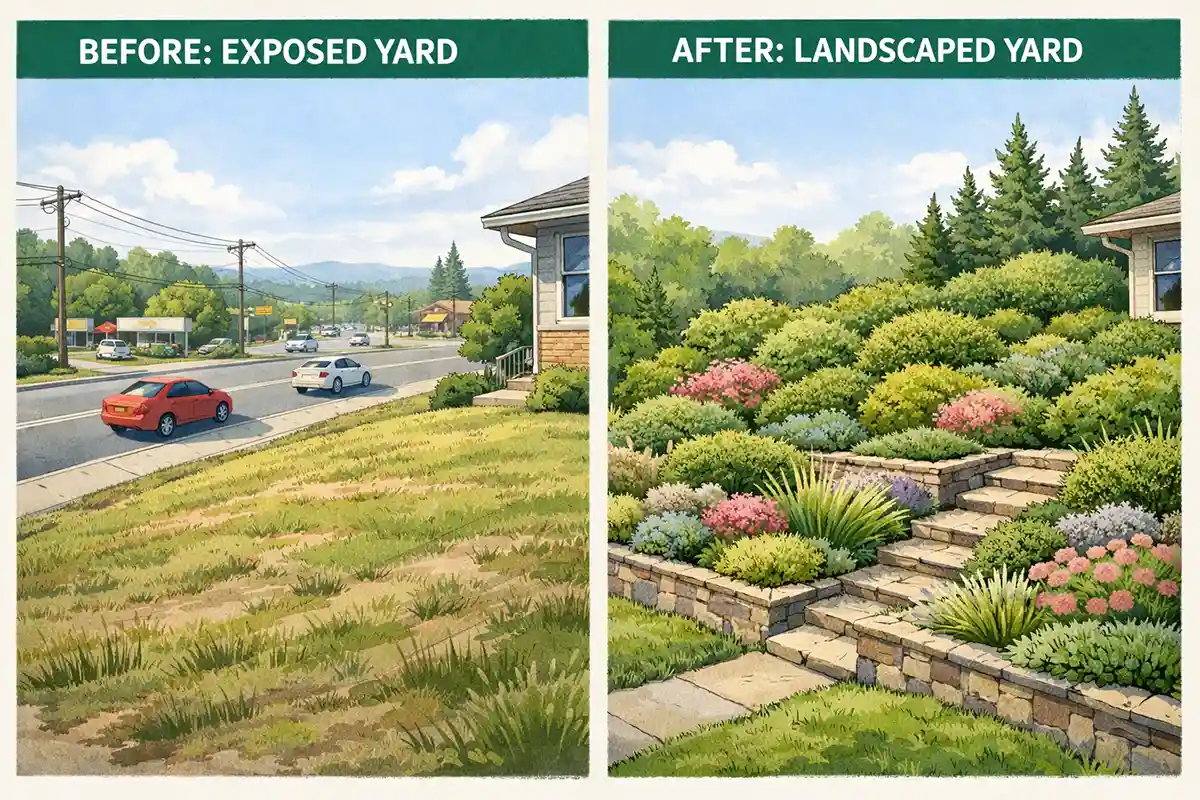
Once the terrain condition becomes clear, landscape strategies can redirect sightlines and significantly improve privacy. Most effective solutions combine elevation changes, vegetation layers, and visual barriers placed where sightlines originate.
Create a Berm for Downhill Front Yard Privacy
A landscape berm is one of the most effective ways to block views from a higher street. Berms are gently raised mounds of soil placed between the road and the yard.
Research from landscape design programs indicates that berms between 3 and 5 feet tall intercept most vehicle sightlines while maintaining a natural appearance.
Planting shrubs or ornamental grasses on top of the berm further increases screening height.
Break the Slope With Terraced Landscaping
Continuous slopes create long visual corridors. Terracing divides the grade into smaller steps that interrupt the line of sight.
Common approaches include:
• low retaining walls
• stepped planting beds
• stone landscape edges
• raised garden terraces
Even a 18–24 inch elevation break can disrupt the viewing angle traveling downhill from the street.
Add Layered Privacy Plantings
Instead of relying on a single hedge, layered planting uses multiple vegetation heights to create visual depth.
A common structure includes:
• low shrubs near the curb
• medium-height plants along the berm or terrace
• small ornamental trees closer to the house
This layered structure prevents straight sightlines through the landscape.
Homes near pedestrian activity often rely on similar layered approaches to reduce visibility, a situation frequently seen in Front Yard Privacy Problems Near Schools, Parks, or Bus Stops.
Use Mid-Slope Landscape Islands
Large open lawns allow sightlines to travel unobstructed. Planting islands placed halfway down the slope interrupt this corridor and redirect views upward.
Clusters of shrubs, grasses, or small trees can create visual breaks while preserving open yard space.
Combine Structural and Plant-Based Screening
In many downhill properties, the strongest privacy results from combining terrain modification with vegetation.
Examples include:
• raised planters along the street edge
• hedges planted on top of retaining walls
• decorative privacy screens integrated with landscaping
These approaches create both height and density at the point where street-level visibility begins.
Design strategies similar to these are frequently incorporated into broader landscape layouts such as those featured in 15 Beautiful Front Yard Privacy Ideas for a Stylish, Private Yard.
Decision Questions
Does every sloped yard require a fence to create privacy?
Not necessarily. Terrain adjustments such as berms, terraces, and layered plantings often interrupt sightlines effectively without installing solid barriers.
Where should screening begin in a downhill yard?
Privacy elements work best near the origin of the viewing angle, usually within 8–15 feet of the curb or sidewalk.
Can planting alone solve the visibility issue?
In mild slopes, dense vegetation may be sufficient. Steeper terrain usually benefits from combining plantings with elevation changes such as terraces or berms.
Final Insight
Front yards that slope toward busy streets often feel exposed because traffic views originate above the landscape. The interaction between road elevation, slope geometry, and plant height allows sightlines to travel directly toward the home. By identifying the specific condition responsible—whether continuous slope, low planting height, or limited setback—landscape strategies such as berms, terraced planting beds, and layered vegetation can redirect those views and restore privacy.
For additional research on slope management, landscape grading, and residential planting strategies, resources from the University of California Agriculture and Natural Resources provide useful science-based guidance for homeowners and landscape planning.