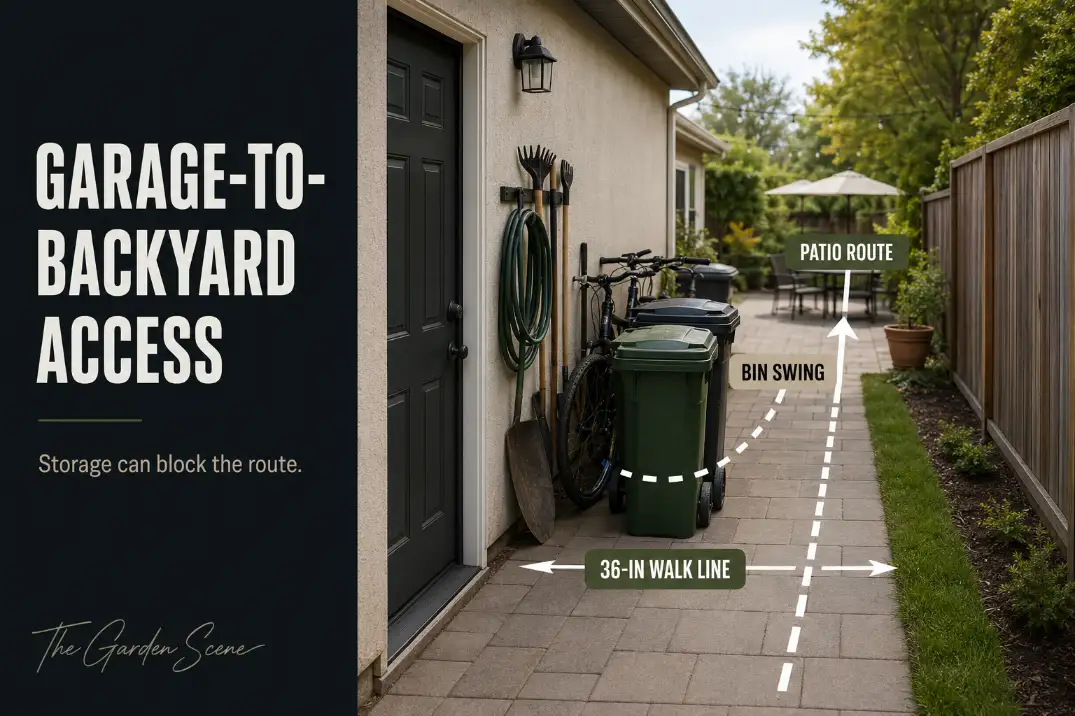
Garage-to-backyard access usually fails when storage, trash movement, bike parking, and patio entry all share the same narrow strip.
The best fix is not hiding everything first. It is protecting one clear service route from the garage door to the backyard before adding cabinets, screens, hooks, bins, or decor.
Start with three checks: whether the door can open without stepping around objects, whether the narrowest point stays close to 36 inches, and whether the route dries within 24 hours after normal rain.
A path that still holds water after 48 hours has a surface or drainage problem, not just a clutter problem. A route that drops below 30 inches may still look passable, but it starts failing when someone rolls a trash bin, carries a cooler, pushes a mower, or walks through with both hands full.
The Daily Service Route
Give the Route Priority Before Storage
A garage-to-backyard route is a working lane. It carries trash bags, recycling bins, bikes, garden tools, patio cushions, bags of mulch, grill trays, wet shoes, and sometimes a mower or wheelbarrow.
If that line is not protected first, every storage idea slowly becomes another obstacle.
For normal daily walking, keep a 36-inch clear line. If trash bins, bikes, a mower, or a wheelbarrow regularly move through the same route, 42 inches is a better comfort target.
The extra 6 inches matters because handles, pedals, elbows, and bin lids need side clearance that a simple footpath measurement does not show.
If the garage already works as the outdoor utility hub, Garage Backyard Utility Zone Ideas is the closest supporting layout because it separates daily-use access from seasonal storage instead of letting everything collect near the door.
What People Usually Misread
The most common misread is assuming a tidy storage wall means the route is fixed. A cabinet, bike rack, wall hook, or trash screen can look organized and still steal movement space.
The path has to work while a door is open, a bin is rolling, a bike handlebar turns, and a person is carrying something awkward.
That is why the route should be tested in motion. Mark the intended walking line with painter’s tape, a hose, or a few small cones for one weekend. Open the garage door fully.
Pull the bins out. Move a bike. Carry a patio cushion or laundry basket toward the backyard. If you have to turn sideways more than once, the idea is not solving access yet.
Where the Path Gets Blocked
Door Swing Fails First
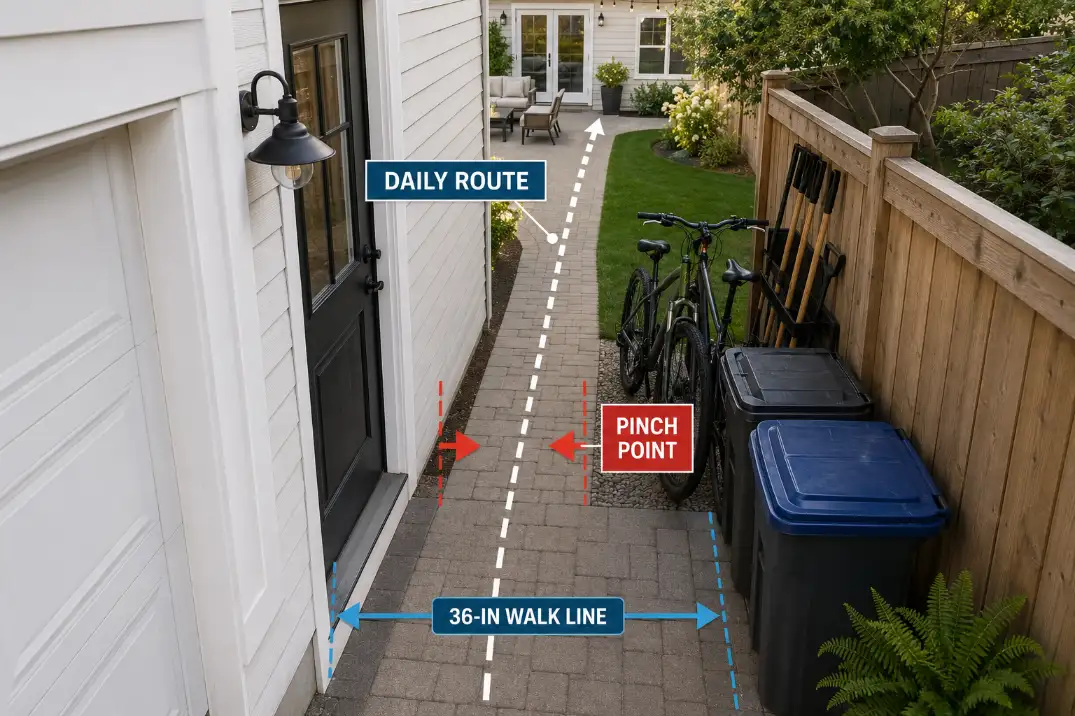
The first problem is usually right outside the garage or side door. A 30- to 36-inch door needs a landing area that stays clear while the door opens and while a person steps through.
If the door technically opens but immediately forces you around boots, tools, bins, or a bike tire, the access route has already failed.
Keep the first 3 feet outside the door as a transition zone, not a storage edge. This space is where people turn, set a foot down, shift a load, or step aside when someone else comes through.
It is also where loose items tend to collect because the spot feels convenient for “just for now” storage.
Pro Tip: Do not place tall hooks, tool handles, or bike handlebars at shoulder height beside the first step out of the garage. A route can measure 36 inches on the floor and still feel cramped if objects project into the upper walking space.
Turns Need More Room Than Straight Runs
Straight paths are forgiving. Corners are not. A bin or bike needs more space at a 90-degree turn because wheels, pedals, handles, and lids swing wider than the object’s parked footprint.
That is why a side-yard route can look fine when empty but feel awkward on trash day.
For wider chore movement, Side Yard Access for Mowers and Wheelbarrows gives the better access logic because it treats turns and clearance as movement problems, not just path-width problems.
Use this quick threshold: below 30 inches at a turn, the path may work for walking but will often fail for chores. Around 36 inches works for most daily access.
Around 42 inches gives bins, bikes, and garden carts a much better chance of moving without scraping the wall, fence, or stored items.
Tools, Bins, and Bikes
Put Daily Items Near the Route, Not In It
The useful goal is not to push every object far away. Daily-use items should stay reachable, but their parked position should not interrupt movement.
Trash bins, recycling, bikes, scooters, garden tools, and outdoor shoes need assigned zones along the route, not random positions inside it.
| Access Problem | Better Fix | Avoid This |
|---|---|---|
| Bins block the first turn | Move bins beside the route with lid and roll-out clearance | Parking bins in the walking line |
| Bike pedals catch the path | Wall-mount or park bikes beyond the main turn | Judging only by tire width |
| Tools lean near the door | Use a vertical rack parallel to the wall | Angled handles sticking into shoulder space |
| Patio cushions pile near entry | Store in a bench or shelf outside the route | Dropping soft storage beside the door |
| Wet shoes spread dirt | Use a small tray near the landing | Creating a bulky mud zone in the path |
The biggest overestimated condition is how much space bikes need when parked neatly. The tires may sit tight against the wall, but pedals and handlebars can steal 6 to 12 inches from usable route width. A bike that looks compact in a garage photo can still make a side route annoying every day.
Trash Bins Need Roll-Out Logic
Trash bins are often treated as a hiding problem, but they are really a movement problem first. A bin enclosure, screen, or fence panel only works if the bin can roll out without crossing the main walking line.
If the lid opens into the path or the wheels have to pivot across the narrowest point, the storage looks better but functions worse.
Where bins are already the main side-yard problem, Trash Bins in a Narrow Side Yard is a stronger supporting guide because bin placement needs lid access, roll-out space, odor control, and wet-ground logic, not just visual screening.
The practical test is simple: roll the fullest bin through the route on pickup day. If you bump the wall, clip a bike, or have to move another object first, the bin zone is not finished. A clean bin setup should work without a second step.
Side Door to Patio
The Patio Arrival Should Stay Open
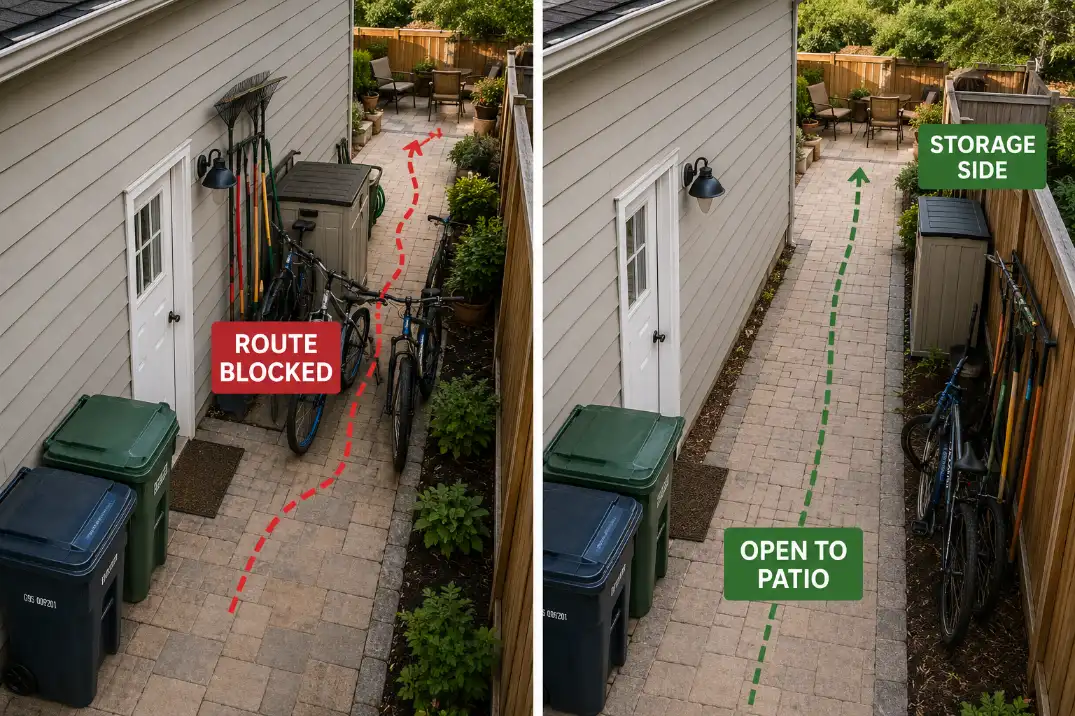
A side door route should land at a usable patio edge, not into the back of a chair, planter, grill cart, or storage bench. The first 36 inches where the garage route meets the patio should stay readable as a walking path.
If dining chairs pull into that line during use, measure the chairs pulled out, not tucked in.
The route should still read clearly after chairs are pulled out, not only when the patio is staged. This is where homeowners often underestimate real use.
A patio may look spacious when furniture is neat, but the access route gets tested when someone carries food outside, brings cushions in before rain, walks a bike through, or moves trash back from the curb.
If the patio entry itself feels awkward, Keep Patio Entry Clear fits naturally because the first few feet of arrival space often decide whether the whole backyard feels easy or irritating.
Do Not Let Furniture Become the Final Blockage
Patio furniture is harder to question than clutter because it looks intentional. A side table, bench, planter, or storage box may seem like part of the design, but if it sits where the garage route empties into the patio, it works like a blockage.
The better approach is to treat the garage-to-patio route as a thin traffic lane that remains visible even after chairs are pulled out.
A small patio can still work, but the access lane cannot depend on furniture being perfectly tucked away every time someone walks through.
Keep the Route Dry
Water Changes the Walking Line
A wet garage-to-backyard route creates a different problem from clutter. People do not simply walk through puddles forever.
They step around them, drag dirt onto the patio, cut across lawn edges, or start using storage zones as alternate footing. Once that happens, the route spreads instead of staying contained.
A healthy hard-surface route should be usable again within about 24 hours after normal rain.
If the same low strip stays wet after 48 hours, especially near the garage wall, fence base, downspout corner, or patio edge, the issue is water movement. Mats, loose gravel sprinkled on top, and prettier storage will not fix that.
For patio-side water problems, Patio Drainage Layout Problems is more useful than another storage fix because the symptom is puddling, while the mechanism is where water is being sent.
Fix Water Before Organizing Around It
A slight slope of about 1/4 inch per foot away from the house is often enough to help hard surfaces shed water. The trouble starts when the route falls toward the garage wall, a fence line, or the patio corner.
Then the access lane becomes the low point, and every object placed nearby collects dirt, splash, or algae faster.
This is where a routine fix stops making sense. If you have cleaned the same strip twice in a month and it still turns slick, stained, or muddy after rain, the route does not need another mat.
It needs a better exit for water, a corrected surface pitch, a raised walking surface, or a redirected downspout before storage decisions will hold.

Access Without Clutter
Use the One-Trip Test
The final layout should pass the one-trip test before it gets decorated. Could someone carry a full laundry basket, cooler, bag of potting soil, or patio cushion from the garage to the backyard without setting it down, turning sideways, or moving another object first? If not, the access route is still too dependent on careful behavior.
This test is better than standing back and judging whether the area looks clean. Outdoor access fails during ordinary movement, not during a photo moment.
The route has to work when people are tired, when it is raining, when bins are full, and when patio furniture is in use.
Where clutter keeps returning to the same patio edge, Reduce Patio Clutter Without Losing Function can help separate useful outdoor storage from items that only feel convenient because they were left near the route.
When a Bigger Change Is Worth It
Small fixes work when the route is already dry, mostly wide enough, and only blocked by loose items. Bigger changes make sense when the physical layout keeps failing no matter how often it is cleaned up.
Watch for three signals: the tightest point stays below 30 inches, the same strip remains wet after 48 hours, or the garage door opens directly into stored items. Those are not simple tidying problems. They are layout signals.
The bigger fix may be a slimmer storage system, a shifted bin pad, a better side-yard path, a changed gate swing, a raised paver strip, or a patio furniture reset.
The goal is not to make the garage-to-backyard route beautiful first. It is to make it reliable. Once the walking line stays open, the door swing clears, the surface dries, and the patio arrival feels natural, the area usually looks cleaner with less decorating.
Questions People Usually Ask
How wide should a garage-to-backyard access route be?
Use 36 inches as the basic target for normal walking. Use 42 inches if bins, bikes, a mower, or a wheelbarrow regularly move through the same route. Below 30 inches, the route may still work visually but often fails during chores.
Should trash bins stay near the garage?
They can stay near the garage if they do not block the door swing, the first 3 feet outside the door, or the main walking line. If bins sit at a turn or need to roll across the narrowest part of the route, move them to a side position with cleaner roll-out space.
Should I fix clutter or drainage first?
Fix drainage first if the route stays wet after 48 hours. Fix clutter first if the route dries normally but objects keep narrowing the walk line. Mixing those up is how homeowners end up organizing around the wrong problem.
For broader official guidance on accessible route clearances, see the U.S. Access Board accessible routes guide.