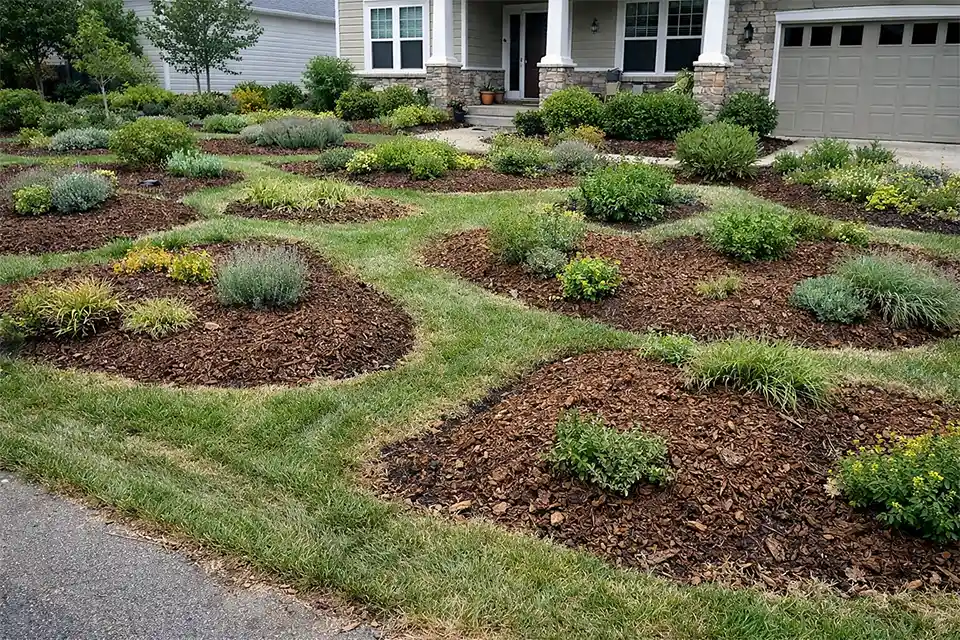
If a front yard constantly needs trimming, touch-up mulching, spot weeding, and edge cleanup, the issue is often not plant choice. It is bed count. Too many small plant beds create a fragmented layout with excessive edge length, leftover turf strips that are too narrow to mow cleanly, and multiple small zones that each need their own correction cycle.
The first checks are practical: lawn strips narrower than 3 feet, total bed edging that climbs past about 80 to 100 linear feet in an average suburban front yard, and mulch that needs to be pushed back or topped up more than twice during the growing season.
That pattern is easy to misread because the yard can look detailed and intentional right after cleanup. The real problem is that it stays tidy for only a short window before the same work starts again.
This is what separates a full front yard from a high-maintenance one. A densely planted layout can still be efficient if beds are broad, connected, and easy to service. A yard broken into too many small islands usually is not.
Why too many small beds create more work than people expect
The main cost is not the plants themselves. It is the amount of perimeter they create.
Every small bed adds a trimming line, a weed-entry zone, a mulch-containment problem, and another transition between turf and planting. That is why six small beds can demand more time than one or two larger beds with the same total planted square footage. The maintenance load is being driven by edge, not area.
That is also where homeowners often misjudge the layout. They see only the planted space and assume the yard should be manageable because the beds are small. In practice, small beds are often harder to maintain precisely because they multiply interruptions.
A useful threshold is edge-to-area balance. Once a front yard has roughly 1 linear foot of bed edge for every 2 to 2.5 square feet of planted area, upkeep often starts feeling excessive for the visual return.
Another threshold shows up in turf. When grass sections between beds drop below about 36 inches wide, mowing becomes awkward. When they fall below about 24 inches, they usually stop functioning like real lawn and become narrow strips that need constant trimming, scalp easily, and decline faster than the surrounding yard.
That is the first thing most people underestimate: tiny leftover spaces are not charming details. They are recurring labor.
Quick diagnostic checklist
This front-yard layout is usually maintenance-heavy for structural reasons if most of these are true:
-
There are 6 or more separate plant beds in the front yard
-
Two or more grass strips are narrower than 3 feet
-
Edging takes longer than mowing during a normal maintenance cycle
-
Mulch needs re-leveling, sweeping back, or replenishing more than 2 times per season
-
Beds within 10 to 15 feet of each other dry at noticeably different rates
-
Tight mower turns happen every few feet because of bed shape or placement
A yard like this often gets described as one that “never stays neat.” That description is accurate, but it points to the symptom rather than the mechanism. The deeper problem is that the layout keeps generating maintenance resets. That is one reason front-yard landscaping mistakes that lower home value often show up first as visible upkeep strain rather than dramatic design failure.
What people usually misread first
The most common mistake is blaming weeds as the root cause. Weeds are part of the problem, but in fragmented front yards they are usually a consequence of too many exposed edges and too many small disturbed surfaces. More bed lines mean more places for weed seeds to settle, more points where turf runners move in, and more spots where mulch thins out.
The second mistake is thinking sharper edging solves the issue. It improves appearance for a short period, but it does not reduce the amount of maintenance the design creates. In fact, edging can become a trap in this kind of yard: the cleaner you make it, the more often you notice how quickly it falls apart again.
The third mistake is assuming that switching to lower-maintenance plants fixes the layout. It usually does not. A tough evergreen or drought-tolerant shrub still sits inside a small isolated bed that has to be edged, weeded, mulched, and watered on its own terms.
Pro Tip: If a bed only looks distinct when the edging is freshly cut and the mulch was just corrected, the bed is probably too small or too isolated to justify itself.
People also tend to overestimate the design value of multiple tiny islands. In most front yards, especially on typical suburban lots, scattered beds rarely create lasting elegance. More often, they create visual interruption that starts to read as clutter as soon as maintenance slips.
The maintenance mechanics that matter most
Four things usually drive the workload.
The first is edge failure. Turf creeps inward, mulch kicks outward, and bed lines soften after rain, irrigation, mower traffic, or routine foot traffic. Even 2 to 4 inches of edge creep over one growing season is enough to make the whole front yard look less controlled.
The second is watering mismatch. Small beds are often placed for visual rhythm, not irrigation logic. One bed can dry in 2 to 3 days while another only 10 feet away stays damp for 5 to 7 days because of shade, tree roots, reflected heat, or runoff. That leads to overcorrection: extra hand watering in one zone, overwatering in another, and no stable routine that works across the yard.
The third is access inefficiency. A simple mowing path turns into a series of stops, pivots, and hand-finished passes. That burden gets worse in front-yard maintenance problems in small yards with no equipment access, where there is already very little room for clean movement.
The fourth is debris capture. Every little recess around a bed edge collects something: leaves, seed litter, road grit, blown mulch, or clippings that never clear cleanly. In exposed sites, especially along active streets, this buildup happens faster and makes the yard look tired before the plants themselves are failing. A similar pattern shows up in front-yard maintenance problems on busy roads with dust and debris, where the visible mess is less about planting health and more about how easily the layout traps material.
Why the obvious fix usually wastes time
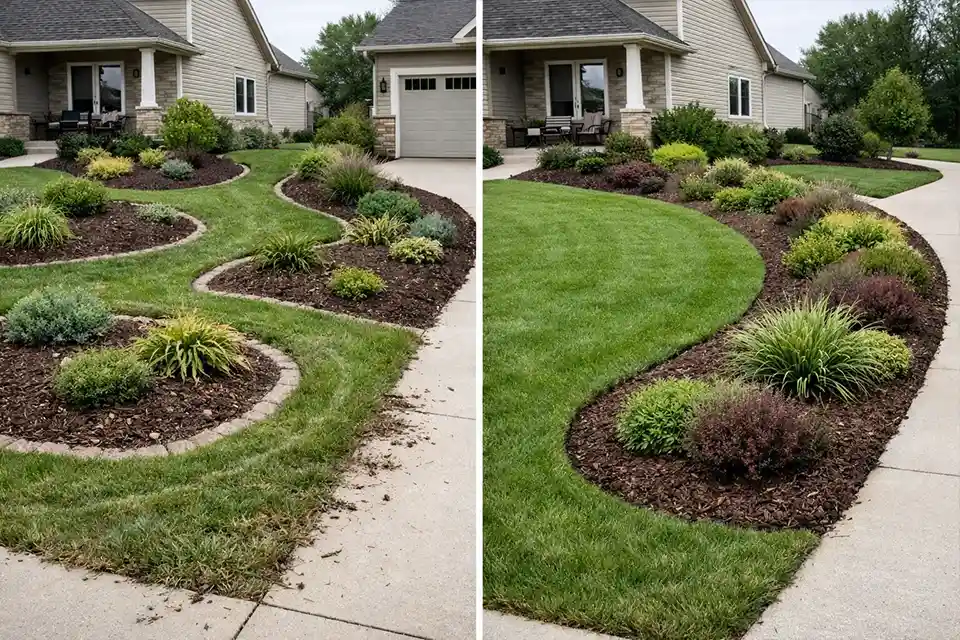
The most common wasted fix is refreshing every small bed while keeping the same layout. Homeowners add fresh mulch, swap a few plants, sharpen the edge lines, and expect the yard to become easier to manage. It almost never does.
The beds may look cleaner for a week or two, but the same geometry is still there: too many borders, too many interruptions, and too many narrow spaces that break maintenance flow.
The next wasted fix is trying to solve the problem through plant toughness alone. Hardier plants may reduce replacement frequency, but they do not reduce bed count, border length, or cleanup frequency. That is why the yard can still feel exhausting even when the plants are technically performing better.
This is also where the issue can get confused with front-yard flower beds that keep needing replanting. Replanting problems usually point to plant selection, exposure, or soil mismatch. Multiple small beds are more often a maintenance-structure problem. The visible symptom can look similar, but the repair logic is different.
When routine upkeep stops being the real problem
There is a point where the layout itself becomes the maintenance problem.
In many front yards, that point arrives when about 25% to 35% of the visible surface is tied up in mini-islands, narrow turf leftovers, decorative cutouts, and small beds that interrupt the main mowing or cleanup path. At that stage, regular maintenance still improves appearance, but only briefly. The design is now asking for repeated correction, not ordinary care.
A simple test works well here: if edging, trimming, and cleanup regularly take longer than mowing, watering, and plant care, the yard is no longer just high-effort. It is structurally inefficient.
That is also where people often overestimate discipline. A more consistent routine can help for a while, but it cannot turn an over-fragmented layout into a low-maintenance one.
| Layout pattern | How long it usually stays tidy | Maintenance pressure | Better long-term move |
|---|---|---|---|
| Many small beds with narrow turf gaps | 1–3 weeks | High | Consolidate into fewer larger beds |
| Medium beds with moderate spacing | 3–6 weeks | Moderate | Simplify shapes and reduce edge count |
| One or two broad connected beds | 4–8 weeks | Lower | Improve layering and plant grouping |
| Small decorative islands away from entry or walkway | Briefly after cleanup | High | Remove or merge unless they solve a real purpose |
| Turf strips under 24 inches wide | Rarely | Very high | Eliminate the strip and join spaces |
How to simplify the yard without making it look flat
The best fix is usually consolidation, not stripping the yard down. Start by identifying which beds actually do something useful. In most front yards, the beds that earn their place are the ones that frame the foundation, anchor the entry, support a corner condition, or handle a visible grade transition. Beds that exist only as scattered decoration are usually the weakest performers both visually and practically.
When two beds are separated by only 3 to 5 feet of turf and that grass does not function as meaningful open space, merging them usually improves maintenance immediately. Those gaps look intentional on a plan more often than they work well in real life.
Shape matters too. Broad curves, longer sweeps, and cleaner lines are easier to maintain than small bumps, sharp insets, and repeated notches. Every extra contour creates another trimming pocket and another place where the edge starts to break down.
Planting should become simpler as the layout becomes cleaner. Repeating 3 to 5 dependable plant types across larger connected beds usually gives a front yard a more controlled look than assigning each small island its own mix of textures, bloom times, and care needs.
Where soil conditions are inconsistent, consolidation also makes repair more realistic. It is far easier to amend and irrigate one larger bed correctly than several isolated ones. That is especially true in yards already dealing with poor soil that causes patchy grass and weed takeover, where small separate fixes tend to fail because the surrounding conditions never changed.
Pro Tip: Sketch the yard as maintenance zones, not as planting features. If you would not want to service each zone separately every week, the layout is already too fragmented.
What changes under different site conditions
In humid climates, fragmented beds break down faster because damp edges invite quicker weed germination and mulch shifts more easily after storms. In dry climates, the same layout tends to fail through uneven watering and dry edge stress, with isolated beds needing repeated spot correction.
In northern areas with freeze-thaw cycles, small bed borders can lift, separate, and look ragged by late winter, which makes the yard appear neglected even before spring growth starts.
Shade changes the equation again. Small beds under mature trees often sit between root-heavy dry spots and weak lawn that never fills in properly. In those cases, preserving every little turf strip usually creates more work than combining the area into one broader bed designed for shade conditions.
The real decision
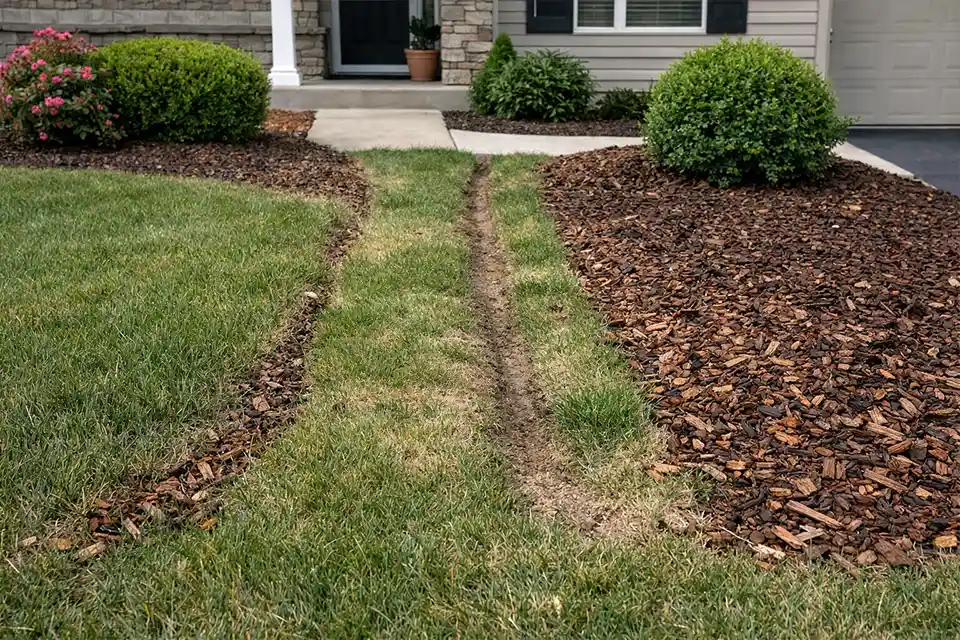
Small plant beds are not automatically a mistake. The problem starts when they multiply chores without adding clear structure, function, or visual payoff.
If a bed does not frame the house, guide the entry, solve a transition, or support the overall composition in an obvious way, it may just be creating another border to trim, another mulch pocket to refresh, and another place where the yard starts looking worn ahead of schedule.
That is the key distinction. The visible symptom is a front yard that never stays clean for long. The underlying mechanism is a fragmented layout that turns routine care into repeated correction work. In most cases, fewer beds, broader planting zones, and fewer leftover turf strips do more to reduce maintenance than another round of cosmetic touch-ups ever will.
For practical guidance on planning a more functional home landscape, see Mississippi State Extension.