Last updated: July 1, 2026
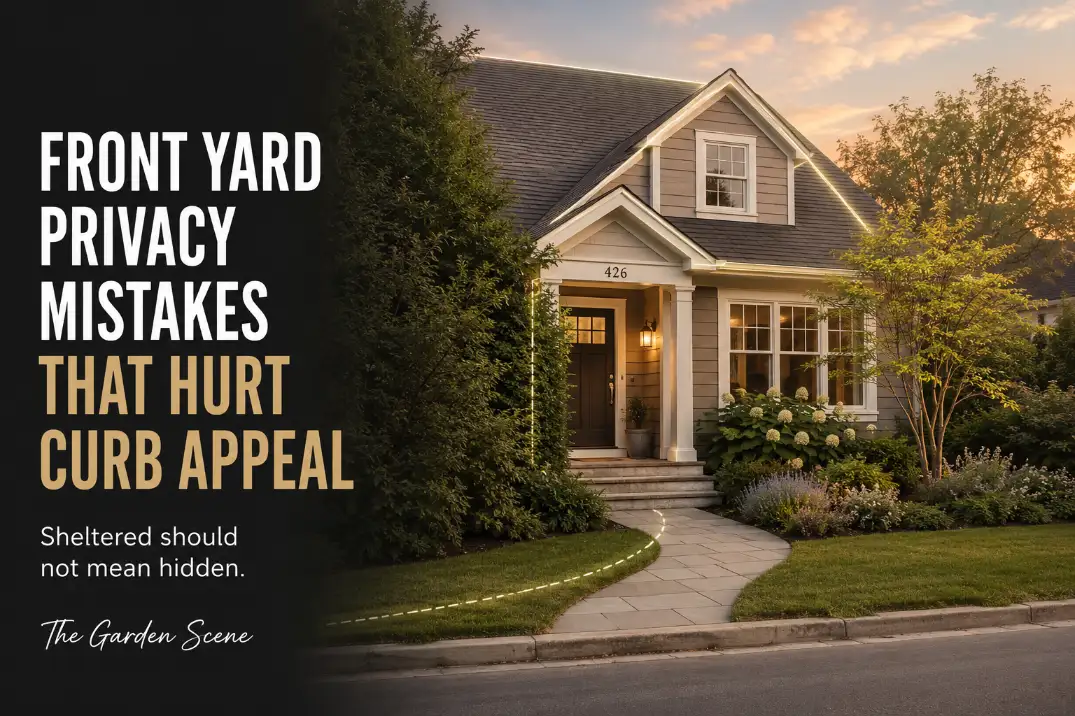
A front yard privacy mistake usually shows up when the screen becomes the first thing the curb reads.
The problem is not simply “too many plants.” It is a yard where the house stops explaining itself. The front door takes longer to find. The walkway feels squeezed. The lower facade disappears behind a hedge. Planters look like a temporary barricade.
Beds that once softened a view now make the frontage look overdue for trimming.
That is the diagnostic line: privacy should interrupt the uncomfortable view, not take over the public face of the house.
A good front yard can feel sheltered and still be readable. The door, route, facade, house number, porch light, and maintained planting edges all need to remain part of the curb view.
When one privacy layer starts hiding those cues, the yard may be more private from inside but weaker from the street.
This page is not a list of more privacy solutions. It is a curb-view diagnosis of the privacy choices that most often damage curb appeal: wrong hedge height, blank wall effect, blocked entry, mismatched planters, and overgrown beds.
Read the Yard From the Curb Before You Blame the Plants
The first diagnosis is not plant health. It is what the curb can still understand.
Stand across the street or at the curb and read the front yard in the same order a guest, delivery driver, or neighbor sees it. The house should still explain where the door is, how to reach it, what part of the facade belongs to the entry, and where the private view is being softened.
When that reading fails, the privacy solution has moved from useful screening into curb appeal damage.
The front door should remain the easiest destination to understand. The walkway should still feel open enough to use. The house number, porch light, and entry trim should not be swallowed by foliage or containers. If those cues disappear, the yard can feel closed off even when the planting is neat.
A practical curb test is simple: can someone identify the door and walking route within a few seconds without guessing? If they can see the shrubs before they understand the entry, privacy is probably dominating the front yard instead of supporting it.
Quick curb test: Look at the yard without focusing on the plants first. If the clearest shape is a hedge, screen, planter row, or dark planting mass instead of the door and approach, the privacy layer is carrying too much visual weight.
The strongest front yard privacy plans usually protect one uncomfortable view, not the entire public face of the house. For broader no-fence approaches, the useful next step is usually a separate privacy framework, such as front yard landscaping for privacy without fences, not adding more material to the same problem spot.
Wrong Hedge Height Makes the House Look Smaller
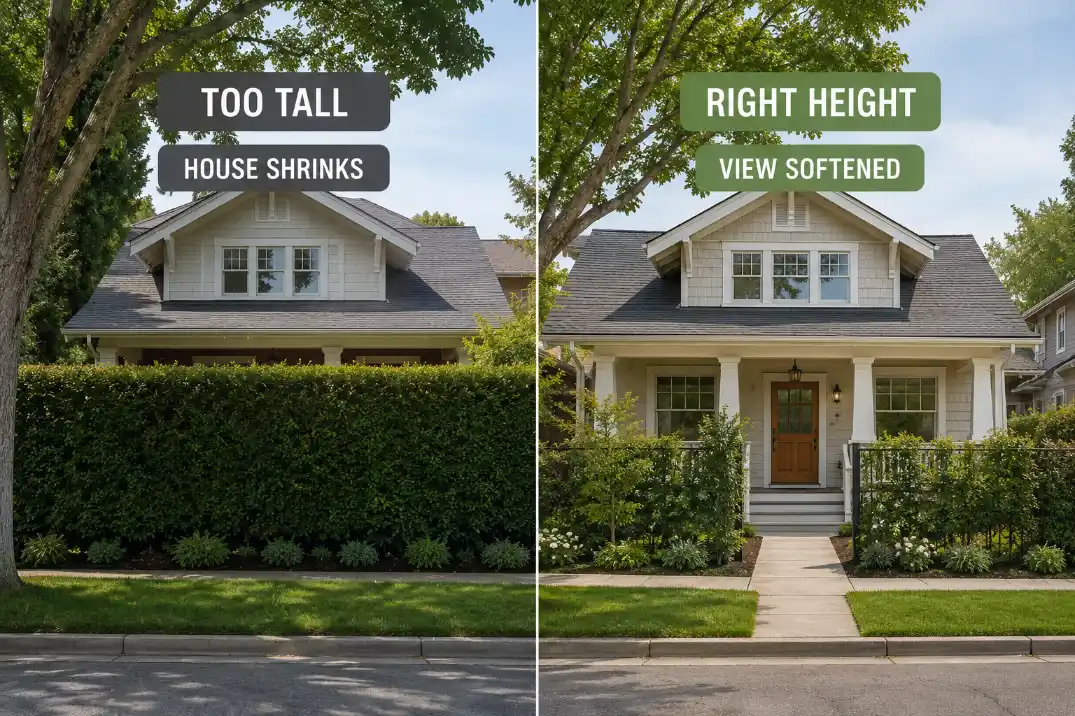
The height is wrong when the hedge solves a view but shrinks the house.
That is the trade-off many front yards miss. Homeowners often choose hedge height from the window side of the problem: they see the sidewalk, street, or neighbor view and decide the screen must be tall. From the curb, that same height can erase the lower facade and make the house look shorter, darker, or pushed back behind a green mass.
A 3- to 5-foot layer may soften a low window or seated view without covering the whole lower facade. A 4- to 6-foot screen can be useful in some exposed front yard conditions, but it starts to become risky when it runs across the main face of a small house, a low porch, or a short front walk.
These are not universal design rules. They are diagnosis ranges: the question is whether the hedge is interrupting the actual sightline or hiding the architecture.
The mature size matters more than the nursery size
A young hedge often looks polite when it is installed. The problem arrives after 2 or 3 years, when the plant reaches a fuller width and the top line sits higher than the original sightline needed. At that point, the hedge may still be healthy, but it starts making the house look compressed behind it.
The visible warning sign is a lower facade that disappears. If more than half of the lower front elevation is hidden from the curb, the hedge may be creating the feeling of a smaller, darker house. That is especially true when the roofline remains visible but the windows, porch base, steps, and lower wall are lost behind one green mass.
The first fix is not always cutting it flat
Cutting the hedge into a shorter rectangle can solve height but make the wall effect worse. Before shearing, check whether the screen could be lowered only near the entry, opened at the ends, or broken into shorter sections. If the plant species naturally wants to be taller and wider than the space allows, replacement may make more sense than years of forced trimming.
A deeper hedge-specific diagnosis belongs in privacy hedge wrong front yard, but the curb appeal test here is simpler: if the hedge makes the house read smaller before it makes the view read softer, the height is wrong for the frontage.
The Blank Wall Effect Flattens the Front Yard
A privacy screen becomes a blank wall when every part of it has the same job.
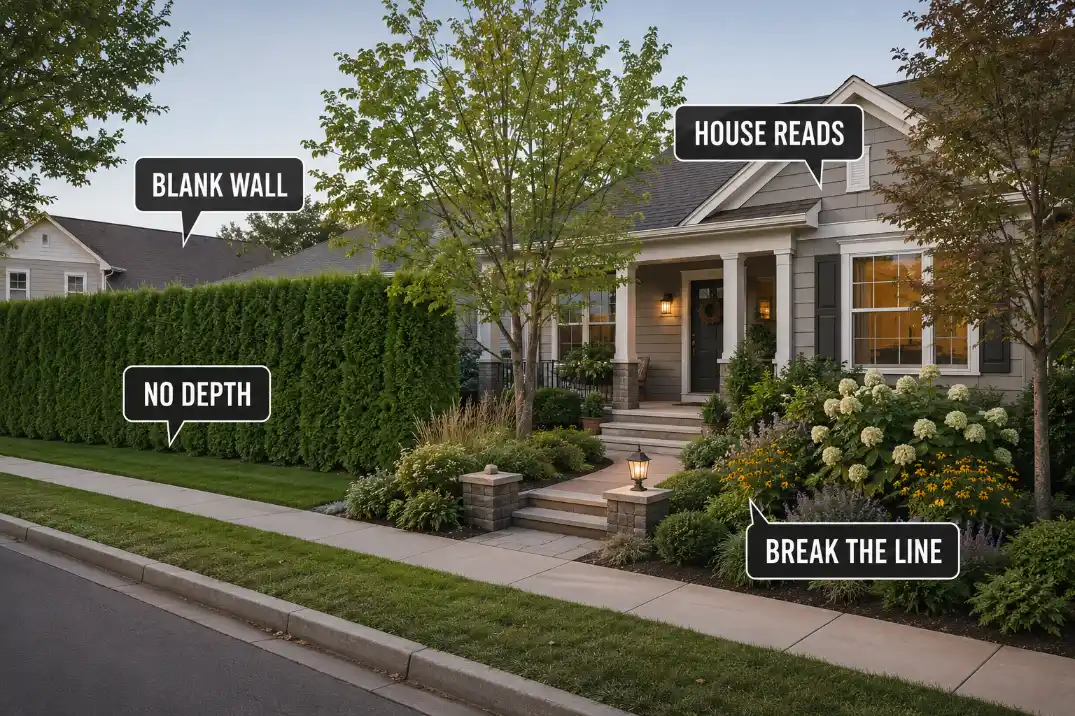
This is a different failure from height. A screen can be the right general height and still make the yard feel defensive if it runs as one continuous line: same texture, same spacing, same top edge, same density across the whole frontage. It may look tidy up close, but from the street it reads as a flat barrier rather than a designed landscape.
The diagnostic clue is lack of depth. There is no lower foreground layer, no visual pause near the entry, no offset planting, and no moment where the house comes forward again. The eye hits one long green face and stops.
Look for breaks. Does the planting step down near the walkway? Does the line pause where the door needs to read? Is there a lower layer that makes the screen feel planted rather than installed? If not, the yard may have privacy but no rhythm.
What most guides miss: The problem is not always density. Sometimes the screen is too equally dense everywhere. Front yard privacy needs selective opacity. The exposed window may need more cover, while the entry side usually needs a lighter touch.
A blank wall also changes the mood of the house. A layered front yard says, “This view is softened.” A flat wall says, “Do not look in.” That difference matters because curb appeal depends on controlled openness, not maximum closure.
If the front yard needs privacy without becoming fence-like, break the longest line before adding more material. A gap, lower foreground, offset shrub, or staggered screen can make the same planting feel more intentional. The goal is not to expose the uncomfortable view again. It is to stop treating the entire frontage as if every inch needs the same level of cover.
Blocked Entry Privacy Makes the House Feel Unwelcoming
Privacy near the entry fails faster because it interferes with arrival, not just appearance.
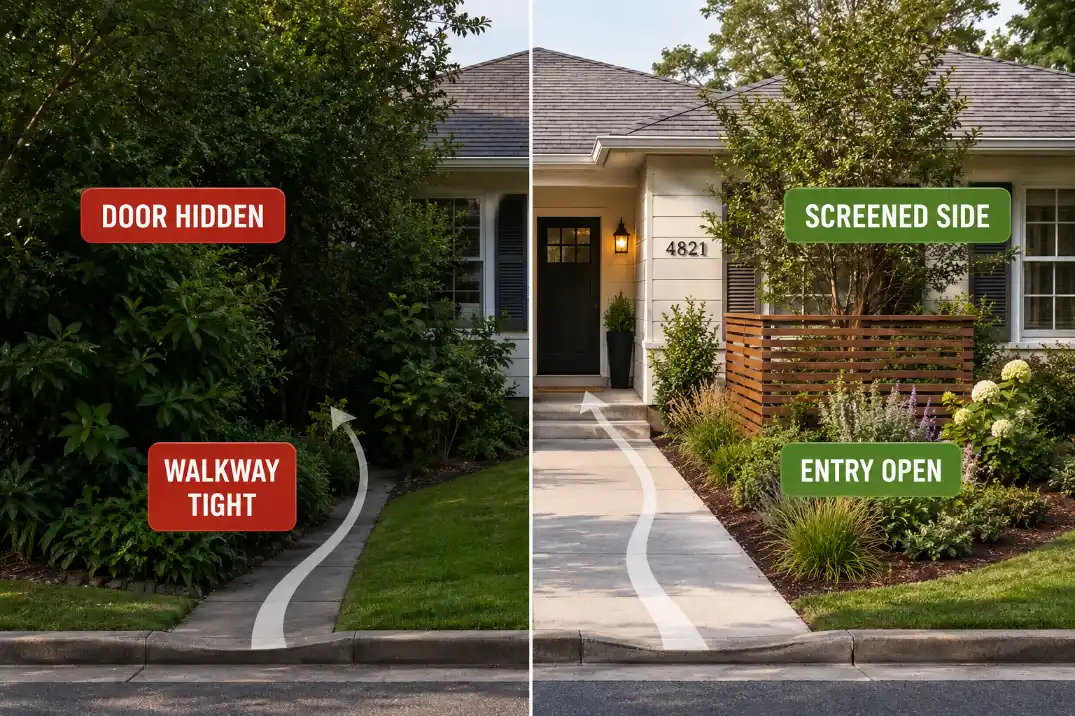
A dense shrub, tall planter, or screen can work well beside a street-facing window, but the same object near the front walk may make the house feel unwelcoming. The symptom is not just a hidden door. It is a weakened arrival sequence: the walkway feels narrower, the porch light disappears, the house number is harder to see, or the visitor cannot tell whether the path leads to the main entrance.
The entry should remain the public-facing signal of the house. Even when the front yard needs privacy, the door should still read from the curb. The path should not feel like it is passing through a hedge tunnel. As a practical minimum, a front walk needs enough clear width for comfortable passage; around 3 feet is a useful lower boundary in many residential settings, and more feels better where deliveries, guests, or kids use the route often.
Watch the mature spread beside the walk
A plant that sits outside the walkway on planting day can still become an entry problem later. Branches lean after rain, evergreens thicken toward the path, and informal shrubs can spread into the walking zone after one strong growth season. If the plant only works when it is freshly clipped, the layout is too tight for daily curb appeal.
Privacy near the entry should usually be offset rather than centered in front of the approach. Let the exposed side of the yard carry more screening. Keep the door side lighter, lower, or more open. That is why front entry privacy not closed off is a different decision from general front yard screening: the entry has to protect privacy and still invite movement.
The first correction is usually to restore the entry cue before changing the entire yard. Open the view to the door. Clear the house number. Let the porch light be visible again. Then decide whether the privacy layer still needs height, width, or only a better position.
Mismatched Planters Can Make Privacy Look Temporary
Planters hurt curb appeal when they read as equipment instead of landscape.
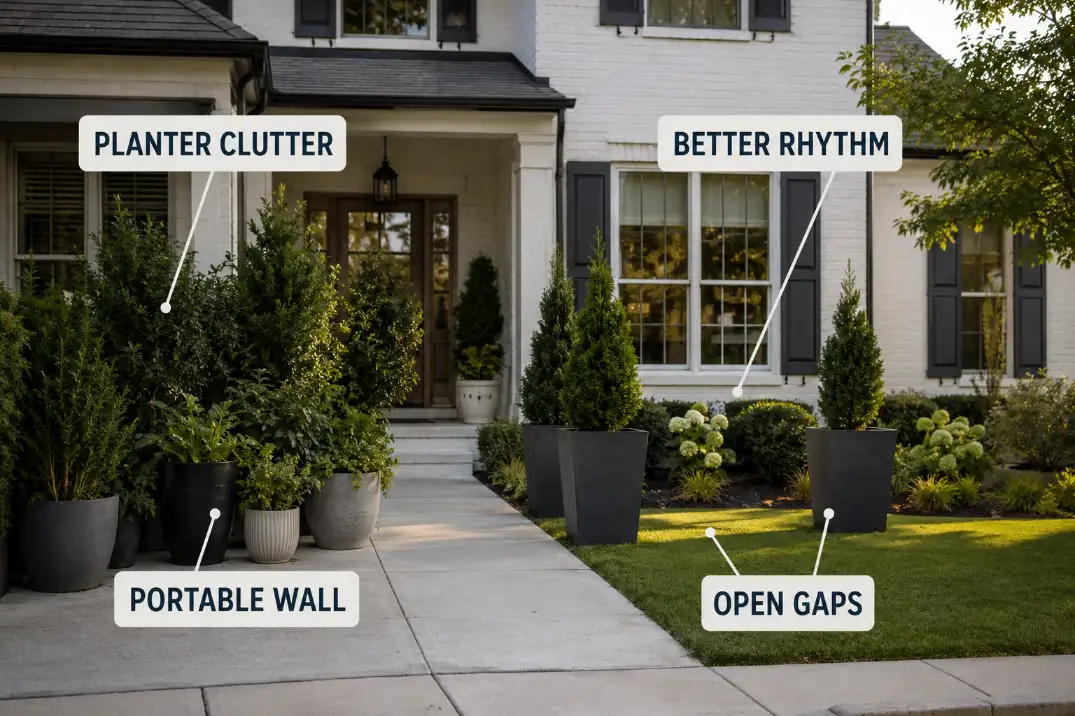
That usually happens through rhythm before it happens through style. Too many identical boxes can look like a barricade. Several unrelated container styles near the entry can make the yard feel patched together. Small pots with tall plants look top-heavy. Oversized rectangular planters along a short frontage can feel commercial or defensive.
The diagnosis is whether the containers relate to the house or only to the view they are trying to block. Do they line up with the walkway, porch, steps, or window rhythm? Are there open gaps? Is there one clear reason for each planter, or does the row continue past the problem view just because more privacy felt safer?
Planters need to look like they belong to the landscape, not like they were placed in a line to stop a view.
Container privacy should not become a portable wall
A planter wall often starts as a reasonable fix: one planter blocks a window view, then another fills the next gap, then a third is added for balance. From inside the house, the setup may feel better. From the curb, it can start to look like storage, staging, or a temporary screen.
That does not mean planters are wrong. It means the privacy job needs design discipline. Fewer containers with better spacing often look more permanent than a full row. If the issue is choosing plant-and-container combinations that feel integrated, a deeper support article like plant and planter combinations for front yard privacy can help after the curb diagnosis is clear.
For this page, the correction is not “buy better planters.” It is to reduce visual clutter before adding more containers. Remove the weakest piece first. If the yard immediately looks calmer and the uncomfortable view is still partly softened, the problem was planter rhythm, not lack of privacy.
Overgrown Beds Turn Privacy Into Visible Maintenance Pressure
Overgrowth is a design diagnosis when the bed only looks right immediately after trimming.
This often happens after the first season of success. The bed fills in, the window feels less exposed, and the yard looks more finished. Then, 2 or 3 years later, the same planting starts pressing into the siding, leaning over the walk after rain, swallowing the porch light, covering the house number, or crowding the lower windows. At that point the issue is no longer simple growth. It is a plant-space mismatch.
A privacy bed should not depend on constant correction to remain presentable. If every normal growth flush makes the bed look too wide, too tall, or too crowded, trimming is only hiding the wrong diagnosis.
When trimming is not the real fix
Repeated shearing can make an overgrown bed look neater for a short time, but it can also create a boxy green mass that repeats the blank wall problem. If the plant naturally wants more width than the bed allows, pruning will become a maintenance cycle instead of a solution.
Look at what the growth is touching. Branches brushing a window are one warning. Growth blocking the path, house number, porch light, or entry trim is stronger evidence that the planting is affecting curb appeal and usability. If the bed looks acceptable only immediately after pruning, the design is asking maintenance to solve a placement problem.
This is where mature size matters more than the plant label’s appeal. A shrub that can mature wider than the bed depth may be healthy and still wrong for that front yard. A hedge that needs hard pruning every season to avoid hiding the house may be doing the privacy job but failing the curb appeal job.
The first fix is to identify the one plant or section that constantly fights the space. Removing or replacing one over-scaled shrub can do more for curb appeal than trimming every plant into a smaller version of itself.
If the broader issue is that the yard is small and every privacy layer competes with the entry, small front yard privacy ideas should be treated as a separate space decision, not solved by squeezing larger shrubs into smaller beds.
Diagnose the First Fix Before You Redesign the Yard
The first fix should correct the first failed curb cue, not the most obvious plant.
That is where many privacy repairs go wrong. A homeowner sees a heavy hedge and trims everything. Or sees an exposed window and adds another planter. But if the real failure is entry readability, wall effect, or planter rhythm, the yard may still feel wrong after the work is done.
| Visible curb symptom | Likely diagnosis | First correction to test |
|---|---|---|
| Door is hard to find | Entry privacy is too heavy | Reopen the door cue and clear the approach |
| House looks shorter or darker | Hedge height is covering the facade | Lower or break the screen where it hides architecture |
| Yard looks like a green wall | Privacy line is too continuous | Break the longest flat run with gaps or depth |
| Planters look temporary | Container rhythm is cluttered | Remove the weakest planter before adding anything |
| Beds look messy right after growth | Mature width does not fit | Replace the plant that constantly fights the space |
| Privacy still feels exposed after changes | Wrong sightline was diagnosed | Recheck the actual view from sidewalk, curb, or driveway |
This matrix is not a full design plan. It is a way to avoid the most expensive wrong move: adding more screening to a yard that already has too much visual weight.
If the privacy issue comes from a driveway or side exposure rather than the main facade, do not force the front planting to solve it. A driveway-facing view often needs its own placement logic, as in front yard privacy when the driveway is open to the street. The same is true when the core problem is not privacy at all, but entry readability, house number visibility, or visitor movement.
A good first fix usually does one of four things: restores the entry, lowers the foreground, breaks the longest wall line, or removes the plant that can never stay in scale. Those are smaller moves than a full redesign, but they change how the house reads from the curb.
The Best Front Yard Privacy Looks Sheltered, Not Hidden
The best front yard privacy does not make the house disappear. It softens the uncomfortable view while keeping the home readable.
That means the front door still explains where to go. The walkway still feels usable. The lower facade still gives the house shape. Planters look intentional rather than temporary. Beds look sized for the space instead of permanently overdue for trimming.
If the diagnosis points to height, do not automatically add denser planting. If it points to wall effect, do not keep shearing the same flat line. If it points to the entry, do not solve privacy by hiding the most important public cue on the property. And if overgrowth is the recurring symptom, do not let constant pruning disguise a plant that was never the right scale.
The curb-view model is simple: restore the entry first, reduce the visual mass second, break the wall line third, and preserve only the privacy that still lets the house read clearly.
A front yard can feel protected without looking sealed off. That is the standard that separates useful screening from privacy that quietly hurts curb appeal.
For mature-size and pruning guidance when privacy shrubs start outgrowing their space, see the University of Minnesota Extension guide to pruning trees and shrubs.