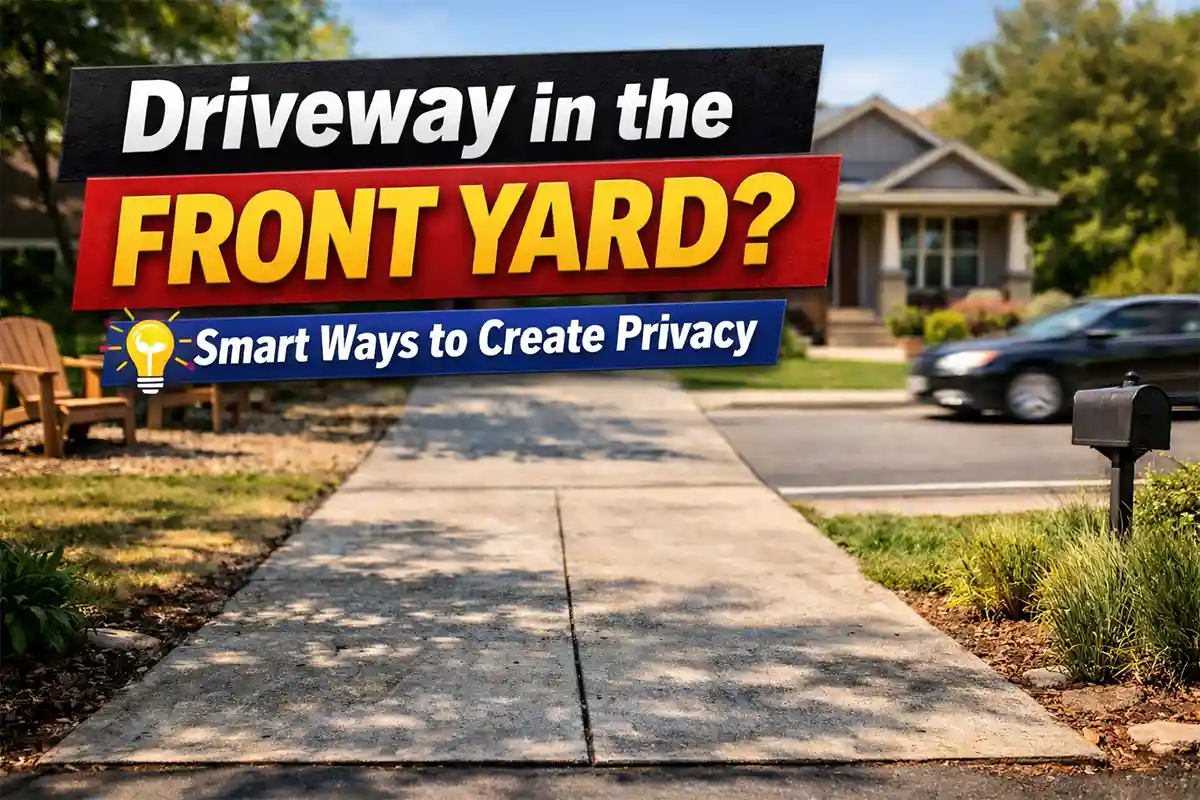
When a driveway occupies a large portion of the front yard, it often eliminates the natural landscaping buffer that normally separates a home from the street. Instead of lawns and planting beds softening the view, the driveway forms a clear visual corridor leading directly toward the house.
In many suburban areas across the United States, driveways typically range between 10 and 20 feet wide, sometimes covering 35–50% of the front yard width. This open paved surface allows pedestrians, cyclists, and drivers to see straight toward the porch, windows, and front entrance.
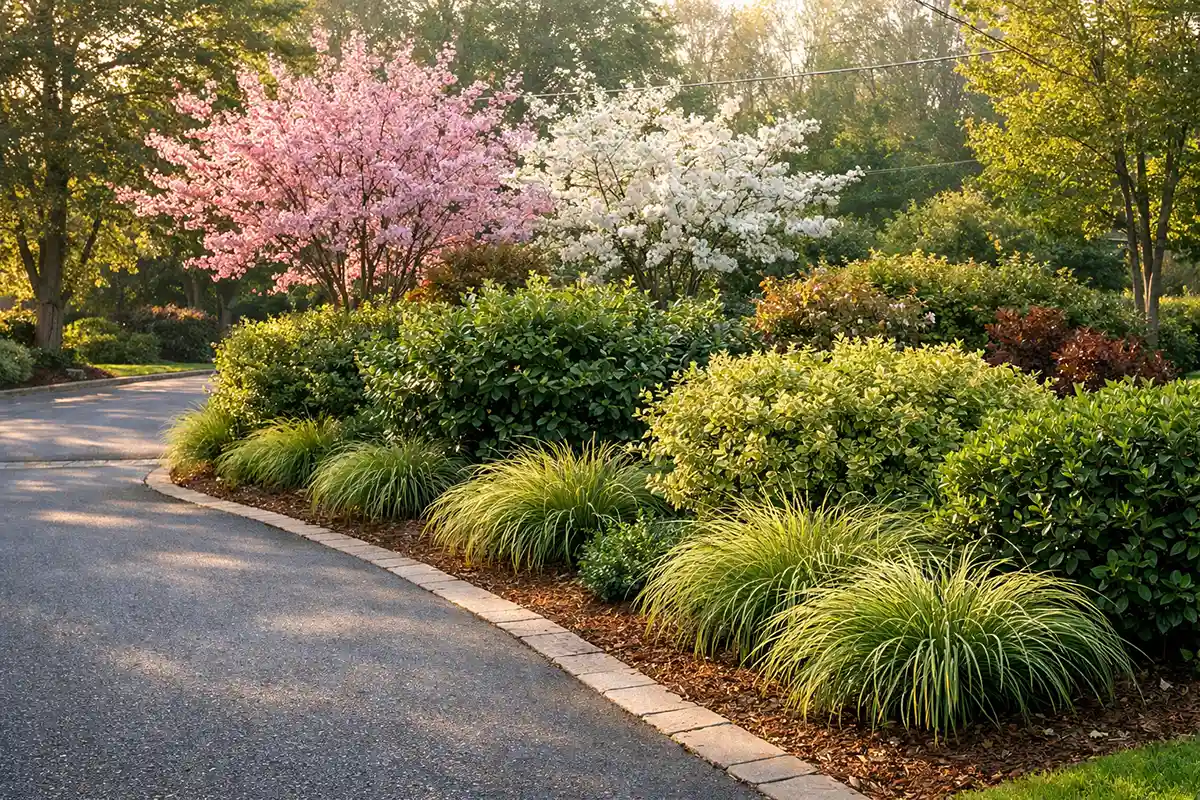
The most effective solution is not blocking the driveway itself, but building privacy along the driveway edges and near the street boundary. Layered planting beds with shrubs, ornamental grasses, and small trees can interrupt sightlines without interfering with vehicle access.
In most landscapes, shrubs reaching 4–6 feet tall block the primary viewing angle from sidewalks and streets. When combined with small trees and dense planting layers, visibility from the street can decrease by 60–80 percent, restoring a sense of separation between the home and public space.
Why Driveways Often Eliminate Front Yard Privacy
Traditional front yards were designed to create a gradual transition between public and private space.
Street → lawn → landscaping → house.
This layered layout softened visibility and reduced the feeling of exposure. Trees, shrubs, and planting beds created depth, preventing direct sightlines toward the front door or windows.
Wide driveways disrupt this pattern.
Instead of landscape layers absorbing attention, the driveway creates a straight open channel that directs the eye toward the house.
Several design factors make the issue worse:
-
Driveways wider than 14–16 feet
-
Garage doors facing directly toward the street
-
Minimal planting space beside the driveway
-
Straight driveway alignment with no curves
-
Front porches positioned directly next to the driveway
When these conditions combine, the driveway becomes a visual funnel that exposes the home to passing traffic and pedestrians.
Homes located near sidewalks or bike routes often experience even stronger exposure. Similar privacy challenges appear in Front Yard Privacy Problems Near Sidewalks and Bike Lane Traffic, where continuous pedestrian movement increases visibility toward front yards.
Understanding Street Sightlines
Most people underestimate how easily sightlines travel across open spaces like driveways.
Adult pedestrians typically observe the environment from an eye level of about 5–6 feet above ground. Drivers in passenger vehicles usually sit slightly lower, with eye heights around 4–5 feet.
When a driveway slopes upward toward the garage, this angle becomes even more favorable for viewing into the yard.
Landscape designers often use a simple rule:
If someone standing on the street can see the base of your porch, your yard will feel exposed.
Blocking that mid-level viewing angle is usually enough to restore privacy. This is why shrubs reaching 4–5 feet in height often work better than tall trees alone. Trees provide overhead coverage but rarely stop the direct sightline.
Homes facing heavy vehicle traffic may experience similar visibility problems through front-facing windows. Solutions for that scenario are explained in Fix Front Yard Privacy When Windows Face a Busy Road.
Quick Diagnostic Checklist
You can quickly determine whether your driveway is the primary cause of privacy problems by checking a few conditions.
Signs that driveway placement is exposing the yard:
-
The driveway occupies more than one-third of the front yard width
-
There is less than 4 feet of planting space beside the driveway
-
The front porch is visible from the street at 30 feet or less
-
Seating areas or windows face directly along the driveway
-
Existing landscaping remains under 3 feet tall
If several of these factors apply, the driveway likely acts as a direct visual corridor between the street and the house.
Core Strategy: Driveway Edge Privacy Landscaping
The most reliable way to restore privacy is by installing driveway edge landscaping that interrupts sightlines.
Instead of trying to hide the driveway, the goal is to soften and filter views along its edges.
A typical driveway privacy buffer includes three planting layers.
| Plant Layer | Height Range | Function |
|---|---|---|
| Ground layer | 12–24 inches | Softens driveway edge |
| Mid-level shrubs | 4–6 feet | Blocks pedestrian sightlines |
| Small ornamental trees | 12–20 feet | Breaks upper-level visibility |
The shrub layer is usually the most important. Plants reaching 4–5 feet block the most common viewing angles from the street.
For effective coverage, planting beds along the driveway should ideally be 4–8 feet wide. Even narrow strips of 3 feet can support dense shrubs when arranged correctly.
Many homeowners looking for screening solutions without fences use similar planting strategies. Additional examples appear in Front Yard Landscaping for Privacy Without Fences, where layered planting is used as a natural privacy barrier.
Effective Driveway Privacy Layout Patterns
Landscape designers rarely plant privacy screens in perfectly straight lines. Instead, they use layouts that create thicker visual coverage.
Parallel Hedge Buffer
A hedge planted parallel to the driveway edge is one of the simplest solutions. Shrubs spaced 3–4 feet apart gradually grow into a dense green wall that blocks views from the street.
This layout works well for homes with narrow planting strips between the driveway and lawn.
Staggered Shrub Screen
Shrubs arranged in a zigzag pattern create overlapping foliage layers. Plants offset by 18–30 inches prevent gaps between branches and produce stronger visual screening.
This layout looks more natural than a single straight hedge.
Tree and Shrub Combination Screen
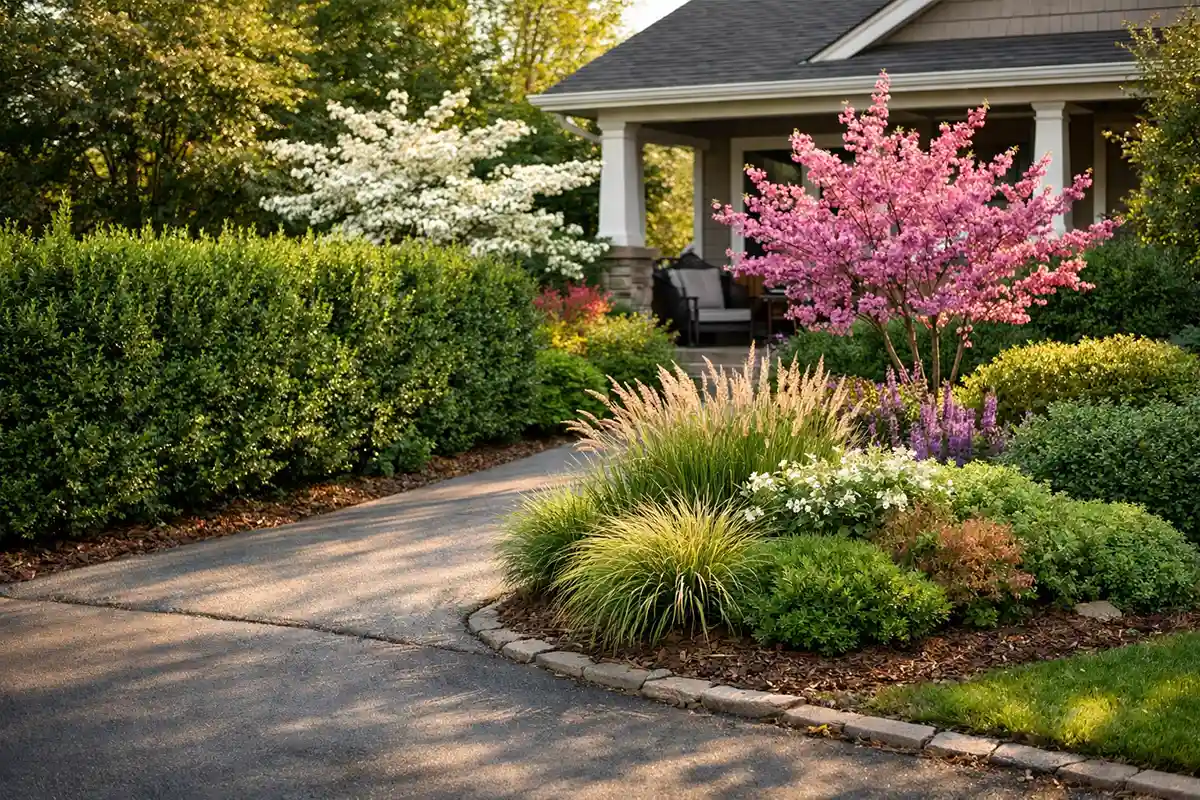
Another effective option combines small ornamental trees with shrubs beneath them. Trees spaced 10–15 feet apart provide vertical structure, while shrubs block mid-level sightlines.
This layered approach prevents the yard from feeling overly enclosed while still improving privacy.
In homes located very close to the street, similar strategies are often needed to address limited setback distance. These situations are discussed in Front Yard Privacy Problems When Homes Have No Setback.
Best Plants for Driveway Privacy Screens in the U.S.
Selecting dense, adaptable plants significantly improves how quickly privacy develops.
| Plant Type | Mature Height | Screening Strength |
|---|---|---|
| Skip Laurel | 10–18 ft | Dense evergreen hedge |
| Viburnum varieties | 6–12 ft | Thick foliage screen |
| Wax Myrtle | 8–15 ft | Fast-growing privacy shrub |
| Boxwood | 3–6 ft | Compact hedge structure |
| Switchgrass | 4–6 ft | Seasonal screening layer |
| Miscanthus grass | 5–8 ft | Tall ornamental grass barrier |
In humid climates like Florida and the Gulf Coast, fast-growing shrubs such as Wax Myrtle may reach effective screening height within 12–18 months.
In drier climates such as Arizona or Nevada, similar plants may take 2–3 years depending on irrigation and soil conditions.
Growth rates and plant survival across regions are strongly influenced by temperature zones described in the USDA Plant Hardiness Zone Map, widely used by landscape professionals across the United States.
Research from the University of Florida IFAS Extension also emphasizes the importance of selecting dense evergreen species when designing landscape privacy screens in residential areas.
Common Mistakes When Adding Privacy Near a Driveway
Homeowners sometimes try quick landscaping fixes that fail to block visibility effectively.
| Mistake | Result | Better Approach |
|---|---|---|
| Planting only low plants | Sightlines remain open | Use shrubs reaching 4–6 ft |
| Using a single tree row | Mid-level gaps remain | Combine trees and shrubs |
| Blocking the driveway entrance | Limits vehicle access | Screen along edges instead |
| Spacing plants too far apart | Privacy develops slowly | Plant shrubs 3–4 ft apart |
| Choosing sparse ornamental plants | Thin foliage coverage | Select dense hedge species |
Privacy landscaping should focus on density and height at the mid-level sightline zone rather than purely decorative planting.
Another common mistake is prioritizing aesthetics without considering maintenance. Overly decorative landscapes sometimes become difficult to maintain, a problem discussed in Low-Maintenance Garden Design Mistakes Homeowners Regret.
How Long Driveway Privacy Landscaping Takes to Work
One of the first questions homeowners ask is how quickly landscaping can restore privacy once plants are installed along a driveway.
The timeline depends mainly on plant growth rates, climate conditions, and planting density. Fast-growing shrubs can create noticeable screening fairly quickly, while trees typically take longer to form full canopy coverage.
| Plant Category | Typical Growth Rate | Time to Effective Privacy |
|---|---|---|
| Fast-growing shrubs (Wax Myrtle, Viburnum) | 2–3 ft per year | 12–24 months |
| Moderate hedges (Boxwood, Laurel) | 1–2 ft per year | 2–3 years |
| Ornamental trees (Serviceberry, Redbud) | 1–2 ft per year | 3–5 years |
| Ornamental grasses (Miscanthus, Switchgrass) | 2–4 ft per season | 1 growing season |
In warm regions such as Florida or coastal California, shrubs may reach 4–5 feet in height within 14–18 months when properly irrigated and fertilized.
In colder northern states, privacy landscaping usually develops more slowly because plants remain dormant during winter. In those climates, homeowners often need two to three growing seasons before shrubs create a dense visual screen.
Plant spacing also matters. Shrubs planted 3–4 feet apart typically merge into a continuous hedge much faster than plants spaced 5–6 feet apart.
Structural Features That Improve Driveway Privacy
Plants alone can significantly reduce visibility, but combining landscaping with small structural elements often produces stronger results.
Landscape designers frequently integrate subtle built features that reinforce privacy while maintaining curb appeal.
Raised Planting Beds
Raised planting beds elevate shrubs and grasses above driveway level. Even a height increase of 12–18 inches can improve screening because plants begin blocking the viewing angle sooner.
This method is especially useful when homes sit slightly below street level.
Landscape Berms
A berm is a gently raised mound of soil, typically 12–24 inches high, running along the driveway edge. When shrubs grow on top of a berm, their effective screening height increases.
Berms also create natural visual separation between pavement and planting beds.
Decorative Screens and Trellises
In narrow spaces where planting areas are limited, decorative panels or trellises can interrupt direct sightlines along the driveway corridor. Climbing plants can soften these structures while maintaining airflow and natural light.
These structural elements are particularly helpful for homes located along busy pedestrian routes, where privacy solutions must balance screening with visual openness. Comparable challenges appear in How to Create Front Yard Privacy on a Busy Walking Route.
Balancing Privacy and Curb Appeal
One concern homeowners often have is whether adding privacy landscaping will make the front yard feel closed off or unattractive.
When designed correctly, privacy landscaping can actually improve curb appeal rather than reduce it.
Several principles help maintain balance:
-
Avoid overly tall hedge walls directly at the street edge
-
Use layered planting instead of a single dense barrier
-
Combine shrubs with ornamental trees for vertical variation
-
Maintain clear sightlines toward the front walkway
A well-designed driveway privacy screen should soften views without making the property feel isolated. In many cases, layered planting adds depth and visual interest that improves the overall appearance of the yard.
Homeowners seeking additional ideas for natural privacy barriers often explore approaches similar to those described in Front Yard Landscaping for Privacy Without Fences.
When Driveway Privacy Problems Are More Severe
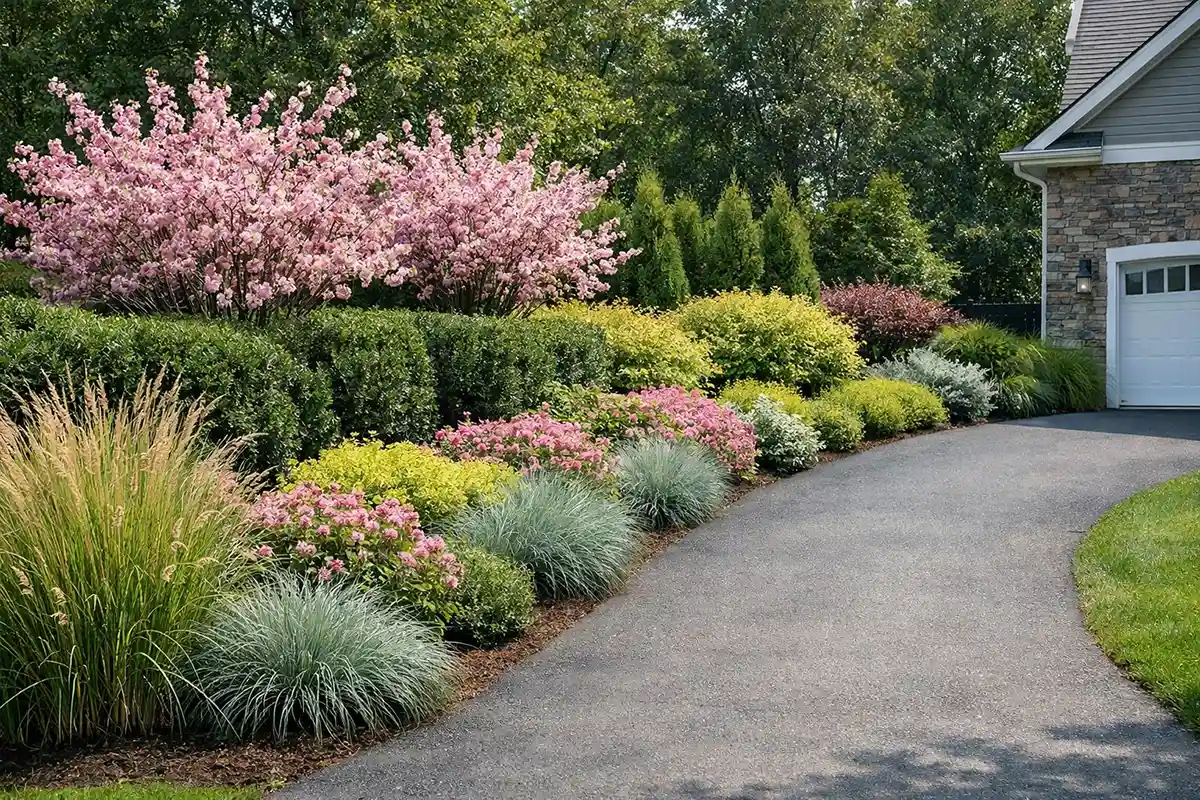
Some property layouts amplify the visibility problems created by driveways.
In these situations, combining multiple strategies often produces better results.
| Condition | Why It Increases Exposure | Recommended Solution |
|---|---|---|
| Corner lots | Two street viewing angles | Dual planting screens |
| Downhill driveways | Sightlines slope toward house | Raised beds or berms |
| Homes close to street | Limited landscape buffer | Dense hedge rows |
| Large front windows | Interior spaces visible | Layered shrub screening |
| Straight driveway alignment | Direct visual corridor | Offset planting layout |
Homes positioned near intersections or stop signs may experience additional exposure because vehicles remain stationary nearby. These situations resemble the privacy challenges discussed in Fixing Front Yard Privacy Issues for Homes Facing Constant Traffic at a Stop Sign or Intersection.
Frequently Asked Questions
Can you create privacy if the driveway covers most of the front yard?
Yes. Even when the driveway occupies a large portion of the yard, privacy can still be improved by installing dense landscaping along the driveway edges and near the street boundary.
What plant height works best for driveway privacy?
Shrubs reaching 4–6 feet tall usually block the main pedestrian viewing angle from sidewalks and streets.
Are trees enough to create privacy?
Trees alone rarely block visibility at eye level. Combining small trees with dense shrubs produces stronger screening.
How wide should driveway planting beds be?
Ideally 4–8 feet wide, though even 3 feet of planting space can support effective privacy shrubs when arranged correctly.
Key Takeaways
Wide driveways often remove the natural landscape buffer that front yards traditionally provide. Because paved surfaces create direct sightlines from the street toward the house, homes with driveway-dominated yards frequently feel exposed.
However, privacy can be restored through thoughtful landscape design. Layered planting beds, dense shrubs, ornamental trees, and subtle elevation changes interrupt sightlines while preserving vehicle access.
When these elements are combined effectively, homeowners can significantly reduce visibility from the street while still maintaining an attractive and welcoming front yard.