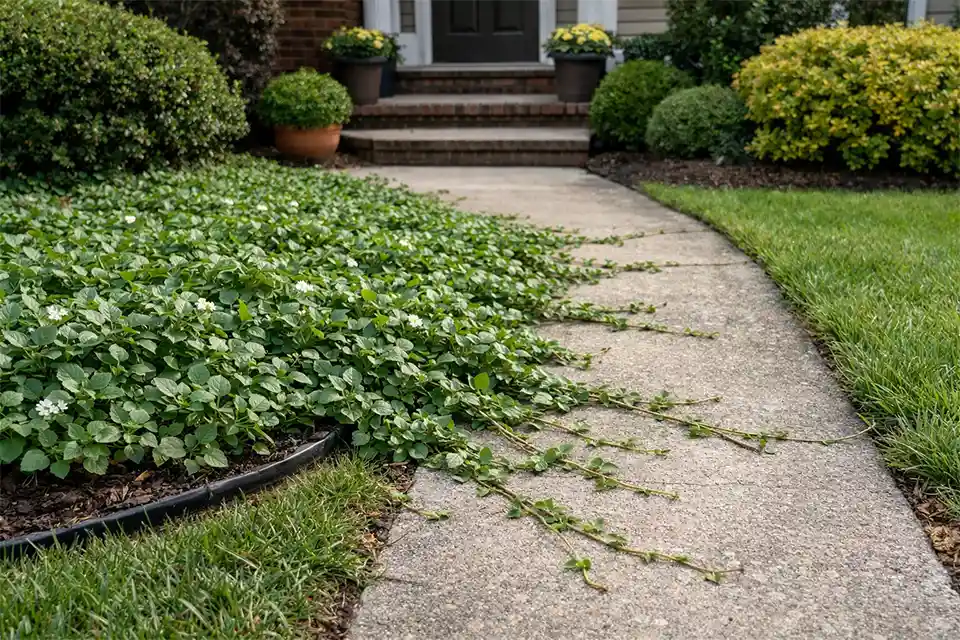
When groundcovers start spreading into a front walkway and lawn, the problem is usually not just vigorous growth. It is a failed boundary. In most yards, one of three things is happening first: the plant spreads by runners or shallow rhizomes, the bed edge is too low or too soft to hold a line, or irrigation keeps the lawn-side soil wet enough for stems to root as they creep.
The first checks that matter are straightforward: measure how far the plant has moved past the bed edge, look for rooted nodes in turf or between pavers, and track how fast it comes back after trimming. If new growth reappears in the walkway or lawn within 2 to 3 weeks, the issue has moved beyond routine grooming.
That is different from an ordinary overgrown bed. A shaggy edge can often be cleaned up with periodic shearing. A runner-forming groundcover that roots every 4 to 8 inches along moist soil is a different maintenance problem entirely, because the visible spread is only the symptom. The mechanism is repeated re-establishment at the boundary.
Quick Diagnostic Checklist
-
Regrowth reaches the walkway or lawn again in under 3 weeks after trimming
-
Stems are rooting where they touch soil instead of only hanging over the edge
-
The bed edge is flush with grade or buried under 1 inch or more of mulch
-
The planted strip is narrower than 18 to 24 inches
-
Sprinklers wet both the lawn edge and the planting bed in the same cycle
If three of those are true, the fix is usually not more trimming. It is a layout and control problem.
What People Usually Misread First
Most homeowners overestimate plant aggression and underestimate site design. Yes, some groundcovers spread fast. But in front yards, the bigger issue is usually that the bed was never given enough separation from turf or pavement to absorb normal seasonal growth. A plant that behaves acceptably in a wide bed can become a constant cleanup job when it sits right against a walkway.
That is why this issue often starts looking minor and then turns repetitive. A bed can be planted with young material spaced 12 to 18 inches apart and still look tidy for the first season. By the second growing season, the canopy closes, the mulch line softens, and outer stems begin searching for the easiest place to root. If the top 1 to 2 inches of soil stay moist near the edge, that place is usually the lawn or the walkway seam.
This is also why “low maintenance” claims break down in real yards. Once a planting asks for correction more often than the owner’s routine can support, the maintenance promise is gone. That same pattern shows up in Why Low-Maintenance Front Yards Often Become High-Maintenance, where the underlying problem is not neglect but a design that keeps generating extra work.
Why the Obvious Fix Fails
The most common time-wasting fix is trimming without resetting the edge.
It feels effective because the bed looks cleaner for a short stretch. But if the plant spreads by stolons, shallow rhizomes, or rooting stems, trimming only removes the visible overrun. It does not remove the growth mechanism. In some cases it actually makes diagnosis harder because the edge looks neat while rooted pieces remain hidden in turf. A mower then tears through them, spreading fragments or leaving ragged patches along the lawn line.
Mulch is another fix people commonly overrate. A fresh 2- to 3-inch mulch layer helps with weeds and appearance, but it does not stop a groundcover that is already crawling over the bed line. Sometimes it makes the problem worse by burying an edge that only stood 1 to 2 inches above grade in the first place. Once that happens, the physical boundary disappears and the bed begins behaving like it has no edge at all.
That is one reason small front beds get messy faster than people expect. There is very little room for a planting to mature without pushing into circulation space. Front Yard Small Plant Beds Upkeep is relevant here for exactly that reason: tight beds leave almost no buffer between healthy fill-in and constant spillover.
Pro Tip: If you are edging or trimming the same groundcover more than once a month during active growth, stop calling it a maintenance routine and start treating it as a plant-location mismatch.
The Distinction That Actually Matters
The key decision is whether you are dealing with overhang or invasion.
| Condition | What you see | What it really means | Best response |
|---|---|---|---|
| Simple overhang | Foliage droops over the edge but is not rooted | Mostly a width issue | Light shearing and a wider setback next season |
| Edge creep | Stems cross the line and begin rooting at the edge | Boundary is failing | Re-cut edge and create a physical buffer |
| Lawn invasion | New patches appear 6 to 12 inches into turf | Spread mechanism is established | Remove runners or rhizomes and reset watering |
| Joint colonization | Growth enters walkway or paver joints | Moisture and open seams are enabling spread | Clear joints, tighten edging, reduce overspray |
| Fast rebound | Regrowth returns in under 2 weeks | The plant is wrong for this site | Replace with a clumping or slower-spreading option |
That table is more useful than arguing over whether the species is “too aggressive.” A plant can be acceptable in one location and completely impractical in another. In front yards, the real test is not how attractive it looks at peak fill-in. It is whether the bed can hold a readable line without constant correction.
How to Fix It Without Rebuilding the Whole Yard
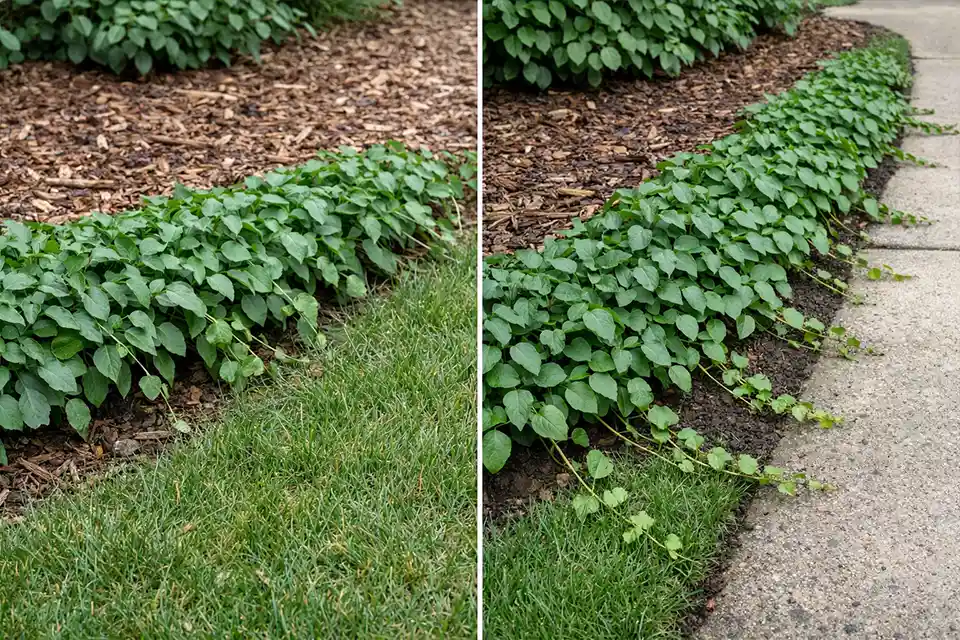
Start by removing all established growth outside the intended bed line. That means following runners back to the crown and pulling or cutting out rooted sections, not just clipping the top growth. If rooted nodes stay behind, the spread resumes quickly.
Then rebuild the boundary in a way that creates real separation. In most front yards, the most practical options are:
-
a trench edge about 4 to 6 inches deep
-
a mow strip or hard border 8 to 12 inches wide
-
a reset planting line that pulls the mature foliage at least 6 inches back from pavement
That setback matters more than decorative edging material. A narrow planting strip packed tight against a walkway almost always turns routine spread into a constant cleanup problem, especially where sprinkler coverage overlaps the lawn edge. The same boundary logic shows up with loose materials too, which is why Front Yard Gravel or Rock Spreading Into Lawn is more closely related than it sounds. Once the edge stops functioning, the maintenance burden rises regardless of whether the material spreading is organic or not.
Next, fix the water pattern. If spray heads are wetting the first 12 to 18 inches of lawn and the edge of the planting bed in the same cycle, surface rooting will keep happening. Shorter run times, better nozzle direction, or drip irrigation in the bed often matter more than another round of trimming. In humid parts of Florida, that moist surface zone can stay active for much of the warm season. In drier Arizona conditions, the same spread may show up less in turf but more in irrigated joints or shaded walkway edges where moisture lingers longer.
Pro Tip: After cleanup, watch the edge for 14 days before making the fix bigger. If new rooting shows up that quickly, irrigation and plant habit are still overpowering the boundary.
When the Standard Fix Stops Making Sense
There is a point where better edging stops being a real answer. If you are re-cutting the edge every 2 to 4 weeks, pulling rooted spread at least twice a season, and still losing lawn definition or walking width, the plant is wrong for that site.
This becomes especially obvious when the bed is narrower than 2 feet, the walkway is the main route to the front door, or a clean mower pass is necessary to keep the yard looking intentional. In those settings, a clumping perennial, compact shrub, or slower-spreading groundcover usually performs better over the long term, even if the original planting looked fuller and cheaper early on.
That is where many homeowners waste a full season. They keep trying to make a mismatch behave because replacement feels like overreaction. In practice, repeated corrective labor is usually the more expensive choice. The logic is similar to what shows up in Low-Maintenance Garden Design Mistakes Homeowners Regret: the regret often comes from forcing the wrong planting strategy to work rather than changing the one decision that keeps creating labor.
A practical threshold helps here. If the bed can hold a clean line for 6 to 8 weeks during active growth, the system is probably workable. If it cannot, you are no longer tuning a maintenance routine.
You are compensating for a design or plant-selection problem. That is also why How to Design a Low-Maintenance Front Yard matters at the planning stage: true low maintenance is usually built through spacing, boundaries, and irrigation discipline, not by hoping a spreading plant will stay where it was first installed.
For broader official guidance, see the University of Wisconsin-Madison Extension guide to lawn alternatives and groundcovers.