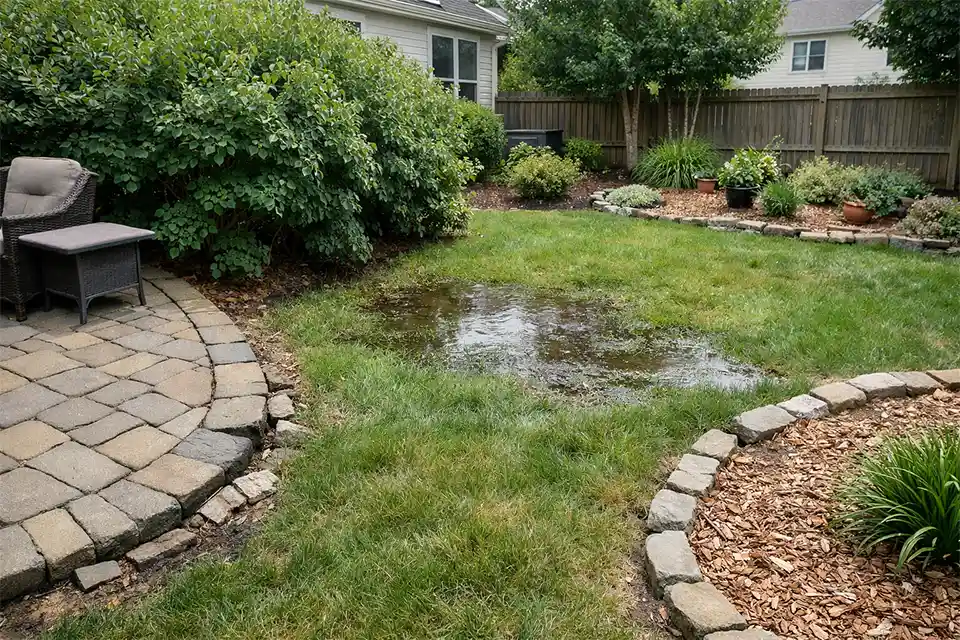
The backyard mistakes that get expensive are usually not the dramatic ones. They are the decisions that force repeated pruning, repeated replanting, repeated irrigation, or repeated repairs to surfaces and beds that never stabilize. If water still sits for more than 24 hours after a normal rain, if shrubs are already within 2 to 3 feet of a patio or walkway, or if you are fixing the same zone every season, the problem is probably built into the design rather than caused by bad luck.
That distinction matters. A few stressed plants after a heat wave is a performance issue. A backyard that needs mulch replaced every spring, turf repaired every fall, and drainage touched up after every heavy storm is a cost pattern. The expense usually starts in one area, then spreads into labor, replacement, and cleanup. The most expensive yards are often not the worst-looking ones. They are the ones designed around choices that keep failing on schedule.
The Backyard Mistakes That Usually Cost the Most
Not every landscaping mistake deserves the same attention. The ones that usually create the highest long-term cost are:
-
Poor drainage and grading
-
Plants that outgrow their space
-
Too much high-input lawn in the wrong areas
-
Loose surface materials without proper containment
-
Overcomplicated bed and edge layout
That order matters because drainage damages multiple systems at once. Plant-size mistakes mostly create pruning, crowding, and replacement costs. Lawn overuse drives irrigation, mowing, fertilizer, and repair costs. Decorative material mistakes become truly expensive when slope, runoff, or bad edging keep moving them out of place.
What homeowners often overestimate is the cost of correcting the problem properly. What they underestimate is the total cost of repeating smaller fixes for 3 to 5 years.
Quick Diagnostic Checklist
If several of these are true, your backyard is probably set up to cost more over time than it should:
-
Water remains on the surface 24 hours after moderate rainfall.
-
The same shrubs need pruning every 3 to 4 weeks during peak growth.
-
Mulch depth falls below about 2 inches soon after topping up because of washout or drift.
-
Lawn needs irrigation more than 2 to 3 times per week in summer just to stay presentable.
-
Paver edges, stepping stones, or gravel lines shift after storms or freeze-thaw cycles.
-
Plants in the same bed show opposite stress because they do not share the same moisture needs.
-
The same patch of lawn, mulch, or planting bed gets repaired at least twice per year.
That last point is one of the clearest thresholds. A repeated fix is a symptom. Repeated failure at the same speed usually points to the real mechanism underneath.
Mistake 1: Treating Drainage as a Minor Cleanup Issue
This is the mistake that usually gets expensive first, and it is the one people most often underestimate.
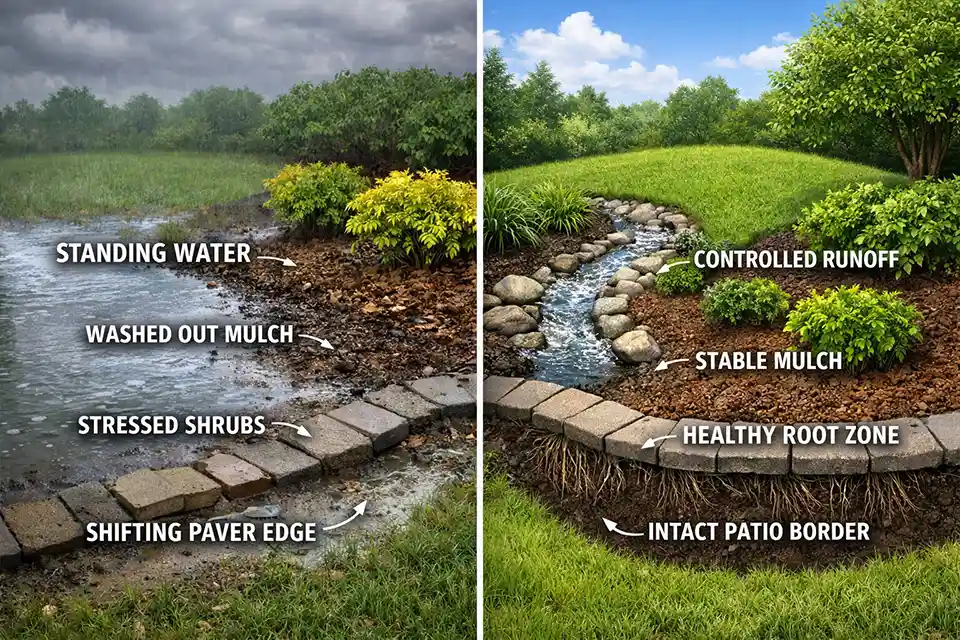
Most homeowners notice the visible symptom first: muddy turf, washed mulch, a slippery corner near the patio, yellowing plants, or a puddle that lingers after rain. But those are not separate problems. They are signs that water is moving badly through the yard. Once drainage is wrong, the yard does not just stay wet. Roots lose oxygen, weeds move in, edges soften, surfaces shift, and repairs stop lasting.
A simple field test is more useful than guessing. Dig a hole about 12 inches deep and fill it with water. If most of the water is still there 12 to 24 hours later, drainage is poor enough to affect plant selection and surface stability. If the water disappears very quickly but the surrounding soil dries hard within 24 to 48 hours, the site may have low water-holding capacity instead, which often leads to overwatering and summer stress.
That is why drainage usually costs more than plant choice alone. One bad shrub can fail in one bed. Bad drainage quietly weakens the lawn, planting areas, hardscape edges, and maintenance routine at the same time. On slopes, the problem accelerates because runoff adds speed to the failure pattern, which is why Sloped Backyard Problems: Drainage, Erosion, and Safety connects so directly to long-term backyard cost.
Mistake 2: Choosing Plants for Install Day Instead of Mature Size
This is the most predictable labor mistake in backyard landscaping.
People buy shrubs and ornamental trees at nursery size, place them where they look balanced on day one, and assume occasional pruning will handle the rest. That usually fails faster than expected. A shrub that matures to 6 feet wide but is planted in a 3-foot bed is not a plant that needs maintenance. It is a plant that never fit.
The long-term cost pattern is consistent:
-
pruning becomes frequent
-
airflow drops
-
inner growth thins out
-
hardscape edges get crowded
-
plant shape declines
-
replacement becomes more likely
A useful rule is simple: if a planting bed gives a shrub less than about half of its mature width, you are usually designing a pruning burden rather than a stable bed. Fast-growing privacy shrubs are a common example. They look efficient because they fill space quickly, but if they need repeated cutting every season, the low upfront cost is not really low. It has just been shifted into labor. The same logic shows up in Why Low-Maintenance Backyards Become High-Maintenance, where easy early choices become expensive mature ones.
Pro Tip: Mark mature spread on the ground with a hose before planting. A 6-foot footprint usually feels much larger in the yard than it looks on a plant tag.
Mistake 3: Using Lawn Where the Site Keeps Fighting It
Lawn is not automatically a mistake. It becomes a costly one when it is placed where it struggles, wears out fast, or demands more water than the rest of the backyard.
That usually happens in three places: shaded areas, hot exposed areas that dry too fast, and circulation routes near patios, gates, or play zones. In those spots, turf often enters a repair loop. Irrigation increases, rooting stays shallow, stress shows faster in summer, weeds move into thin areas, and reseeding becomes seasonal.
The issue is not that lawn is inherently high-maintenance. It is that many backyards give lawn the wrong job. A narrow strip that receives less than 4 to 6 hours of useful sun, takes daily traffic, and dries unevenly is almost always more expensive than it first appears.
This is also where people overestimate fertilizer. Fertilizer can improve color. It does not fix compaction, recurring wear, poor sun exposure, or water moving across the surface the wrong way. Greener turf is not always healthier turf.
Mistake 4: Installing “Low-Maintenance” Materials Without Containment
Gravel, decorative stone, mulch, and simplified hardscape can reduce work, but only when the site keeps them where they belong.
Loose materials on mild slopes, mulch in runoff paths, or pavers without stable edge restraint all create the same long-term problem: movement. Once surfaces start drifting, the yard begins charging small repair fees over and over. Cleanup, re-leveling, top-ups, weed removal, and edge repair rarely look severe in a single season, but they stack up year after year.
This is where homeowners often misread the word low-maintenance. Gravel does not stop leaves and debris from building up. Weed barrier does not prevent windblown seed from sprouting in decomposed surface matter. Mulch does not fail because mulch is bad. It fails when the bed design and water movement keep relocating it.
The same principle applies to patio size and placement. A patio that is too small for actual use pushes traffic into adjacent lawn and beds, which changes wear patterns and raises cleanup and repair needs. Patio Design Mistakes That Cause Long-Term Problems becomes relevant here because unstable or undersized hardscape rarely stays a surface-only issue.
Mistake 5: Designing Too Many Small Beds and Decorative Edges
This is rarely the most catastrophic mistake, but it is one of the most reliable labor multipliers.
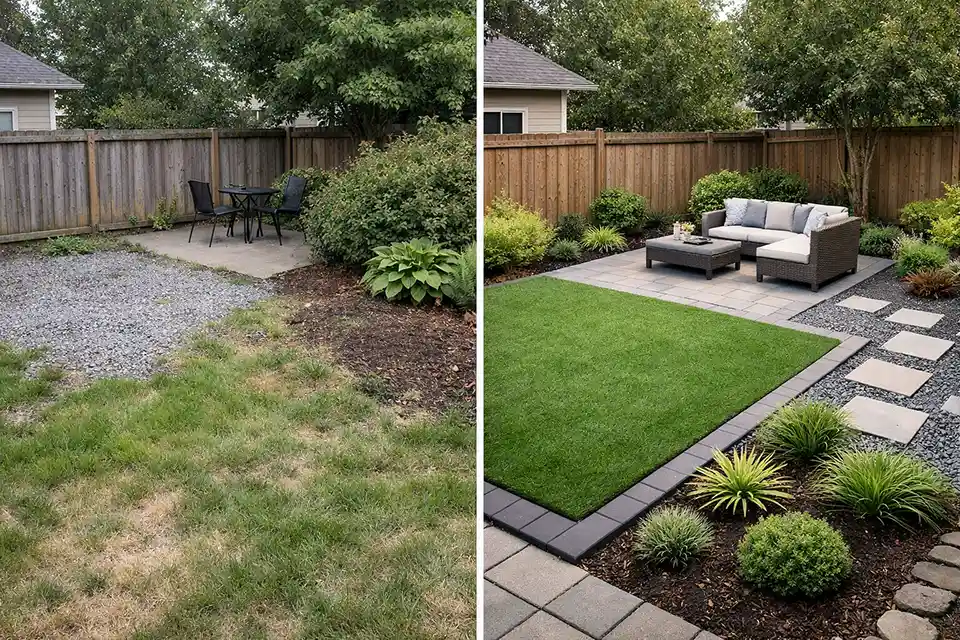
Small island beds, narrow side strips, tight curves, decorative pockets, and too many transitions often look detailed and custom right after installation. Over time, they increase edging time, trimming time, mulch use, irrigation complexity, and plant mismatch. Every extra edge is another place where grass creeps, stone spills, mulch migrates, or a tool has to be used carefully.
This is how some backyards become expensive without ever looking obviously damaged. They are not paying for one major failure. They are paying in small maintenance increments all season long.
One well-scaled bed with adequate soil depth and sensible plant grouping is usually cheaper to maintain than three small decorative pockets that all dry differently and need separate attention. That same mismatch often appears in Backyard Layout Problems That Make Spaces Hard to Use, where awkward layout becomes a maintenance problem later.
Cost Comparison: Which Choices Usually Age Better
| Decision Area | Usually More Expensive Over Time | Usually More Cost-Stable Over Time | Why the Cost Changes |
|---|---|---|---|
| Water management | Repeated patching after storms | Drainage correction or regrading in the problem zone | Stops the same washout and root stress from returning |
| Plant sizing | Fast growers packed for instant fullness | Mature-size spacing with slower fill-in | Reduces pruning, crowding, and premature replacement |
| Lawn planning | Large lawn in shade, heat, or heavy traffic | Lawn only where sun and use patterns support it | Cuts reseeding, irrigation, and wear recovery |
| Surface choice | Loose materials without containment | Stable edges and surfaces matched to slope | Prevents migration, cleanup, and frequent resets |
| Layout | Many narrow decorative beds | Fewer, larger, simpler zones | Lowers trimming, edging, mulch, and irrigation complexity |
The key comparison is not attractive versus practical. It is install-cheap versus keep-cheap. Those are different decisions, and confusing them is one of the main ways backyard costs quietly grow.
When Routine Fixes Stop Making Sense
There is a point where maintenance stops being maintenance and becomes evidence.
If you are adding mulch every spring because runoff strips it away, reseeding the same worn turf area every fall, or cutting the same oversized shrubs back several times each season, you are not maintaining a working design. You are financing a failing one.
A good threshold is this: if the same zone needs the same correction for 2 to 3 consecutive seasons and the problem returns at roughly the same speed, redesign is usually more rational than another patch. That does not always mean rebuilding the whole backyard. More often, it means changing the specific assumption that keeps failing: grading, bed width, material choice, traffic path, irrigation pattern, or plant selection.
Pro Tip: Keep a simple note of what you have repaired twice in the same year. Repetition is often easier to spot on paper than in memory.
What Actually Lowers Long-Term Backyard Costs
The most effective way to reduce long-term cost is not stripping the yard down to the bare minimum. It is making each area do a job it can actually sustain.
Start with the zone that triggers other expenses. In many backyards, that is drainage. A grade of roughly 1% to 2% away from structures is often enough to move water without turning runoff into erosion. Then look at soil depth in planting areas. Adding 4 to 6 inches of functional topsoil where roots are struggling can change water retention, summer stress response, and plant survival more than another round of fertilizer.
Next, group plants by real light and moisture needs. Beds that mix drought-tolerant plants with thirstier shrubs often end up being watered badly for both. Then simplify extra edges and decorative complexity. Finally, resize lawn areas to match how the backyard is actually used instead of how the original install plan looked on paper.
In practice, the cheapest backyard to keep is usually not the one with the fewest plants. It is the one where water, space, sun, and use patterns are aligned well enough that the yard stops fighting itself. That is also why Low-Maintenance Garden Design Mistakes Homeowners Regret fits this topic so well: a backyard only stays affordable when the original “easy” choices are still sustainable after the first season.
Questions People Usually Ask
What is usually the single most expensive backyard landscaping mistake?
Poor drainage, because it affects plants, soil stability, surfaces, and maintenance time at the same time. Most other mistakes stay more localized.
When does pruning become a design problem instead of normal upkeep?
When the same shrubs need heavy correction every 3 to 4 weeks in the growing season just to stay off patios, paths, or circulation zones. At that point, the plant is usually wrong for the space.
Is replacing lawn with gravel always cheaper?
No. Gravel can reduce mowing, but if it migrates, collects debris, grows weeds through surface buildup, or sits on weak edges, it creates a different recurring maintenance bill.
When should patching stop and redesign begin?
Usually when the same area needs the same fix for 2 to 3 consecutive seasons and the failure pattern keeps returning at the same pace.
For a broader university-backed framework on planning a more durable, lower-maintenance yard, see the University of Florida IFAS guide to sustainable landscaping practices.