Last updated: July 5, 2026
Grass under a front yard shade tree usually fails in a pattern. The lawn may look acceptable outside the canopy, get thinner as it moves inward, then disappear near the trunk or exposed roots. After reseeding, the area may green up for a few weeks, only to thin again by summer or after normal mowing.
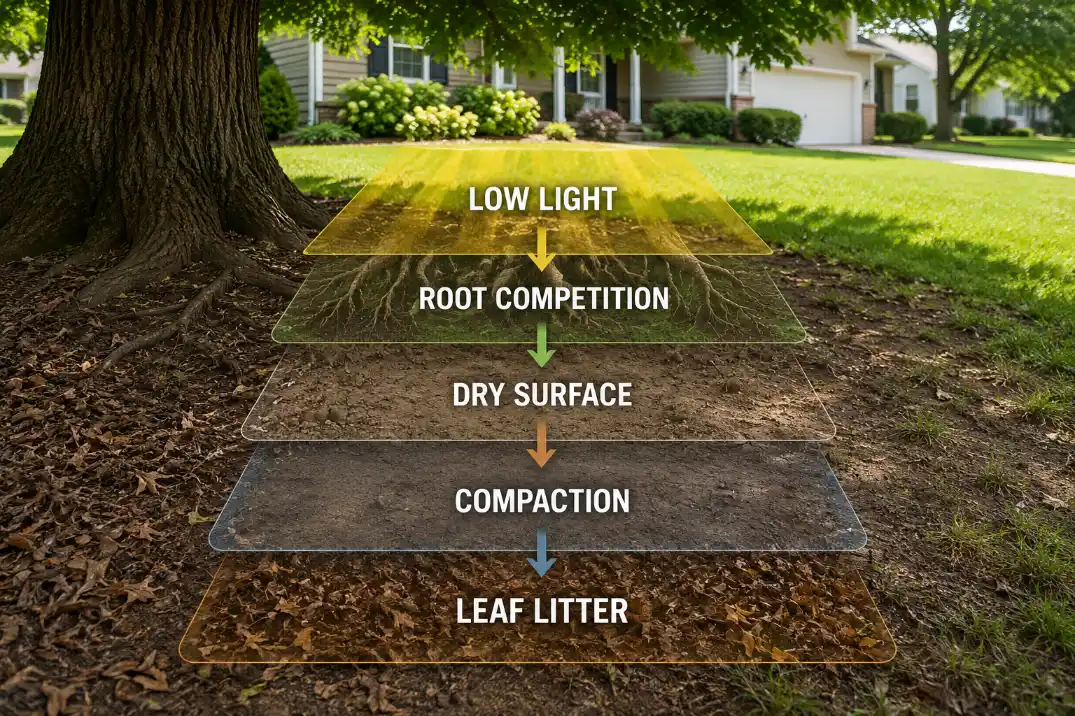
That pattern is the real clue. It means the problem is probably not one bad bag of seed, one missed watering day, or one small lawn-care mistake. Under a mature shade tree, grass is competing in a zone where light, water, soil space, surface level, leaf litter, and mowing pressure all work against it at the same time.
The useful decision is not simply “How do I grow grass here?” It is “Does this spot still behave like a lawn area, or has it become a tree-dominated surface that needs a different standard?”
Why Grass Fails Under Front Yard Shade Trees
The first thing to read is the shape of the failure. If the outer edge of the canopy still has decent turf but the area closer to the trunk stays thin, the lawn is showing you a pressure gradient. The farther inward you move, the less the area behaves like open lawn.
A temporary weak patch usually responds to ordinary correction. It fills after overseeding, holds through the growing season, and blends back into the surrounding lawn. A structurally difficult tree zone behaves differently.
It may sprout after seeding, but it does not thicken. It may look better in spring, then collapse once the canopy fills out. It may stay green only where sunlight reaches the outer edge.
That is why recurring bare patches under trees should be treated as a site condition, not just a turf condition. The grass is growing below a living canopy, above a dense root system, and across a surface that may be drier, more uneven, and harder to mow than the open lawn nearby.
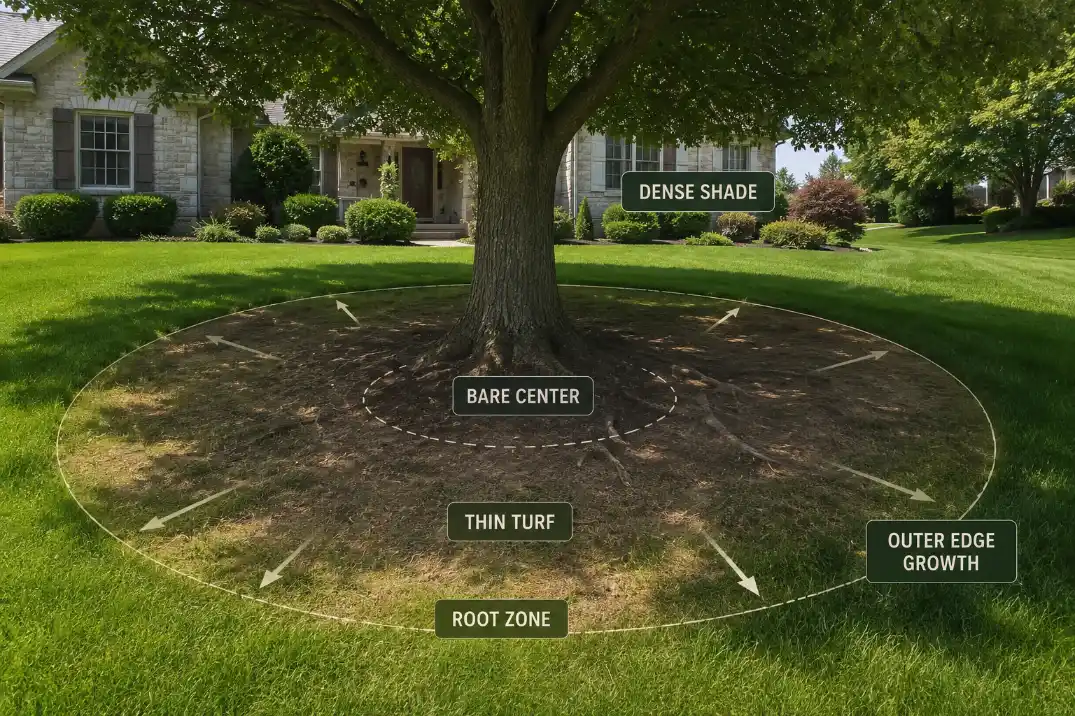
A useful first test is to compare the area under the tree to the same lawn just beyond the canopy. If the open lawn is reasonably healthy but the tree zone keeps thinning, the tree area is not simply “bad lawn.” It is a different growing environment sitting inside the front yard.
That distinction protects you from wasting effort. You can still improve some shaded turf areas, especially along the outer canopy where there is filtered light and fewer surface roots. But the inner zone under a mature tree often has a lower ceiling. It may support a thinner, softer lawn look, but not the same dense carpet you expect in full sun.
The Problem Is Usually Not Just Shade
Shade is visible, so it gets blamed first. But the more useful diagnosis is this: shade weakens the grass, then the rest of the tree zone finishes the job.
Grass needs enough light to produce energy, recover after mowing, and keep a dense crown. When light is limited, turf becomes less vigorous. It stretches, thins, and recovers more slowly. That weaker grass then has to compete with tree roots for water and nutrients in the same upper soil zone.
Shade weakens the grass before roots finish it
Under a mature canopy, the grass usually loses density before it disappears. The blades become thinner. The soil starts showing between them. Small bare spots appear where traffic, mowing, leaves, or dry weather hit hardest.
That is when the second layer of the problem shows up. Weak turf has less ability to recover from normal front yard use. A mower turn that would barely affect sunny grass can scalp or bruise weak grass under a tree.
A few days of leaf cover can smother young seedlings. A delivery shortcut, kids crossing the yard, or repeated foot traffic from the driveway can break up the area faster than it would in open sun.
The soil surface may be drier than it looks
Tree shade can make the ground feel cool, but that does not mean the soil is comfortably moist for grass. Tree roots can remove moisture quickly from the upper soil, especially during warm weather. Rain may also be intercepted by the canopy before it reaches the ground evenly.
This is why the area can look confusing. It may not feel hot. It may not look sun-baked. Yet the grass roots may still be growing in a dry, crowded surface layer.
If the whole front yard is shaped by a large canopy, that broader design problem belongs in a mature-tree front yard plan. But for this page, stay focused on the failing turf surface: where the grass thins, what pressure is strongest there, and whether the area is still acting like lawn.
| Visible lawn symptom | Likely pressure behind it | First check to make |
|---|---|---|
| Grass grows at the canopy edge but disappears closer to the trunk | Light and root pressure increase inward | Compare inner canopy, mid-canopy, and outer edge in summer |
| New seed sprouts but never thickens | Weak light plus root competition | Watch whether seedlings survive past the first mowing cycle |
| Soil looks bare and dry even after rain | Canopy interception and tree-root moisture use | Check the surface one day after rain or watering |
| Grass is cut too low over raised roots | Uneven surface and mower scalp | Look for shaved turf, exposed roots, or mower marks |
| Thin grass gets worse after leaf drop | Leaf litter smothers already weak turf | Note whether leaves sit in the same low-light area |
| The patch returns every year in the same shape | Structural site pressure, not a one-time lawn problem | Compare the patch outline to the tree canopy and root zone |
How Tree Roots Change the Lawn Surface
Tree roots matter here because they change the lawn’s working surface. This is not about root repair or sidewalk damage; it is about whether grass still has enough usable soil, moisture, and mowing clearance to function.
Grass roots and tree feeder roots often occupy the same shallow soil area. When the tree is mature, the grass is trying to live in a soil layer the tree already uses heavily. Water does not remain available to grass for as long. Nutrients are not sitting in an open, empty soil profile. The surface may become uneven where roots rise or where soil settles between them.
The most visible warning sign is mower scalp. If the mower blade catches raised roots or high spots, it can shave weak grass down to the crown or soil. In a sunny lawn, turf may recover from an occasional low cut. Under a shade tree, recovery is slower because the grass already has less stored energy.
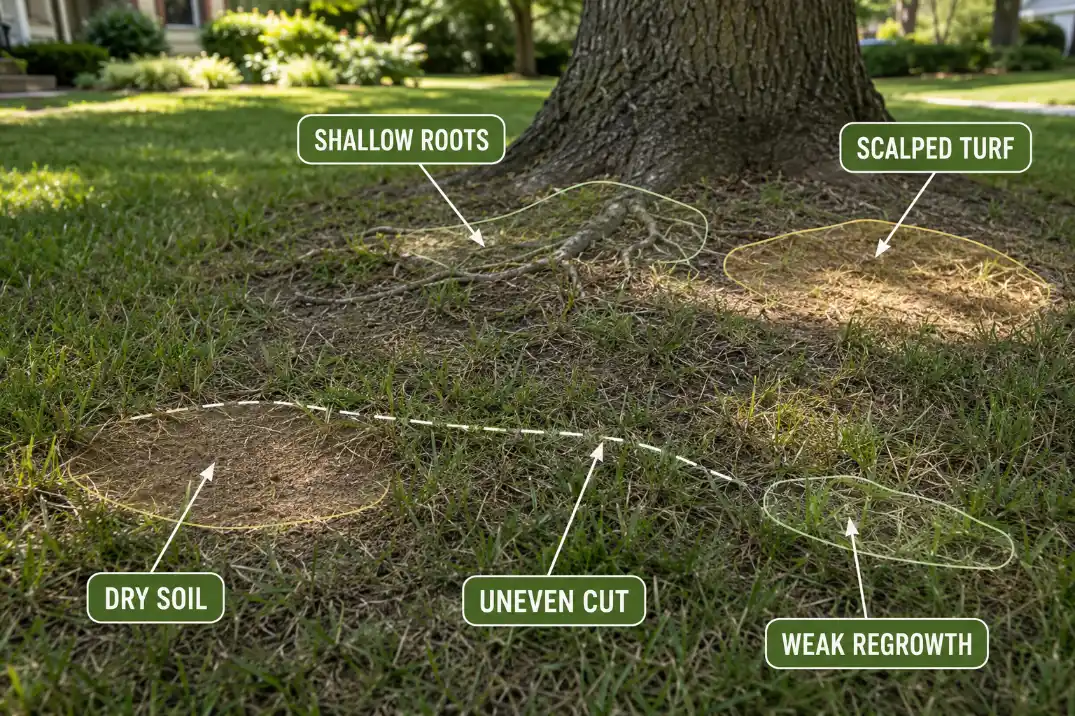
Exposed roots are also a boundary signal. They do not automatically mean the tree is in danger, and they do not mean the whole yard needs redesign. But they do tell you the surface is no longer a simple lawn surface. If grass has to grow over roots, through dry soil, in shade, and under mower stress, “just reseed it” becomes a weak answer.
This is where many homeowners accidentally make the problem worse. They try to smooth the area by piling soil over roots or cutting roots that interfere with mowing. That can create tree-health problems and still may not create enough light for grass.
The safer diagnostic move is to read the surface first: raised roots, thin turf, recurring bare soil, and mower marks all point to a lawn area that is losing its normal function.
Why Watering More Often Usually Does Not Fix It
Water helps only if water is the main missing input. Under a shade tree, it usually is not. Watering may improve the outer canopy edge, but it cannot replace sunlight, remove root competition, flatten raised roots, or make weak turf recover from scalping.
Light, frequent watering can also mislead you. The surface may look damp for a short time while the actual root zone remains inconsistent. In root-filled soil, moisture may not move or hold the way it does in open lawn. If the water runs off, beads on compacted soil, or disappears quickly, the grass is not getting the stable growing environment it needs.
There is also a front yard judgment issue. If you keep adding water to force grass under a tree, the surrounding lawn may become soft, messy, or more maintenance-heavy while the problem area remains thin. That is not a real fix. It is a sign that the site is asking for a different standard.
The better question is not “How much more should I water?” It is “After reasonable watering or rain, does this spot still dry out, thin out, or scalp out faster than the open lawn?” If the answer is yes, the limiting factor is probably not water alone.
How to Tell If the Area Still Has a Real Grass Chance
The decision point is not whether grass can sprout. Grass can often sprout under a tree for a short time. The better test is whether it can survive the full pressure cycle: summer shade, root competition, mowing, leaf litter, and normal front yard traffic.
Signs grass still has a chance
Grass has a better chance if the area gets several hours of filtered or broken light during the growing season, especially when the canopy is fully leafed out. Do not judge only in early spring, when branches are more open and the sun angle may make the area look more promising than it will be in summer.
The grass also has a better chance where the surface is fairly level, roots are not exposed at mowing height, and the soil does not dry immediately after rain or irrigation. If the outer canopy edge stays green while the center fails, you may be able to keep a softer lawn edge and stop expecting the inner area to match it.
Signs the site is telling you to stop forcing turf
The warning signs are more obvious when you look at pattern instead of hope. If the bare area returns in the same shape every year, the yard is not forgetting to grow grass. It is repeating the same site conditions.
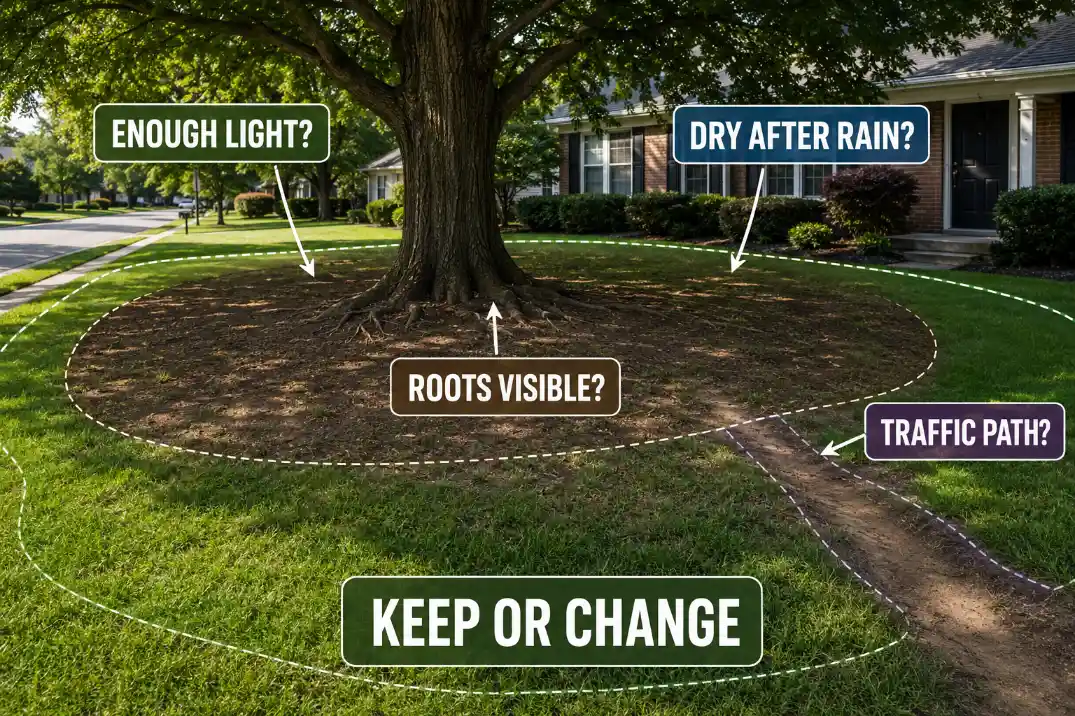
Use this compact field check before reseeding again:
- Check the area in late spring or summer, when the canopy is full, not only in early spring.
- Compare grass near the trunk, mid-canopy, and outer canopy edge.
- Look for surface roots, mower scalp marks, or uneven cut lines.
- Check whether the soil surface feels dry one day after rain or watering.
- Notice whether leaves, foot traffic, or mower turns collect in the same weak zone.
- Ask whether new seed survives past the first few mowings or only gives a short green flush.
This is also the right moment to connect the tree zone to the rest of the yard. If the canopy affects the front walk, entry view, or main lawn shape, the grass problem may be part of designing a front yard around mature tree shade, not just a small turf repair.
Still, keep the diagnosis narrow. A tree-shade grass problem does not automatically mean the whole front yard should lose its lawn. It may mean the inner zone needs a different treatment while the outer lawn remains intact.
When to Stop Fighting for Perfect Grass
Stop fighting for perfect grass when the same pressure pattern keeps returning after reasonable care. If shade, roots, dryness, and mower stress all point to the same inner tree zone, the more practical move is to change the standard for that zone, not repeat the same lawn repair.
A wider tree ring, a cleaner bed edge, or a restrained shade-tolerant ground layer can look more intentional than a weak patch of turf that keeps failing. The point is not to cover the problem with random planting. It is to stop pretending the most tree-dominated part of the yard has the same growing conditions as the open lawn.
Editorial Note: A patchy tree zone is not always a lawn failure. Sometimes the real failure is judging that part of the front yard by the wrong surface standard. If the tree is mature, healthy, and visually important, the better design move may be to let the area under it become a deliberate transition instead of a repeatedly repaired lawn scar.
This is where the article should stay disciplined. The next move might involve mulch, a broader edge, or plants that can handle tree roots and limited soil, but this page does not need to become a plant list. The decision here is simpler: if grass cannot survive the actual light, root, moisture, and mowing conditions, stop treating the area like a normal lawn repair.
A good front yard solution should make the tree look intentional, keep maintenance realistic, and avoid damaging roots. A thin, half-alive patch of grass does none of those things well.
What This Means for the Rest of the Front Yard
Once you stop treating the tree as the enemy, the grass problem becomes easier to solve. The tree is the condition-setter. The lawn line, planting edge, and maintenance expectations should respond to it.
If the outer canopy still supports turf, keep that as the lawn transition and lower your expectations near the trunk. If shade is the main issue and the soil surface is still workable, the next decision may be choosing front yard plants for house shade or similar low-light conditions. If root pressure and thin soil dominate, the planting or surface strategy needs to respect that tougher zone.
For some yards, the cleanest answer is a partial no-lawn adjustment rather than another round of seed. A controlled edge, a clear tree zone, and a lawn boundary that follows the actual growing conditions can make the yard feel more settled than a perfect-grass attempt that fails every season.
If the tree area is large enough to change the whole front yard composition, a broader front yard garden design without lawn may be the more useful next decision.
Before reseeding again, read the site in full summer conditions. Look at light, roots, dryness, mowing marks, and where the grass actually survives.
The answer is usually written on the surface already: keep turf where the yard still supports it, lower expectations where it only survives thinly, and stop forcing grass where the tree has clearly taken over.
For horticultural background, Penn State Extension explains how shaded turf loses vigor and density in growing turf under shaded conditions.