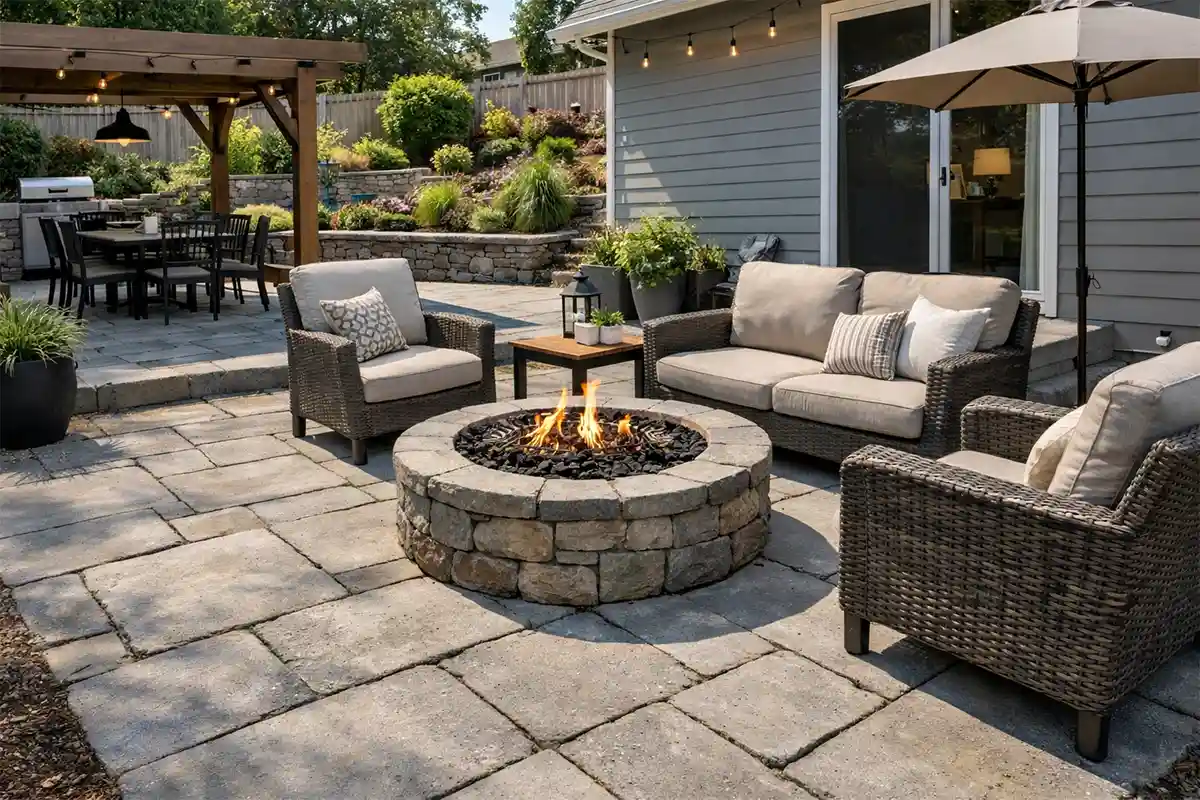
The patio can look perfectly fine from the doorway, but your foot tells the truth when it lands near the outside edge. You feel a tiny dip—maybe a quarter inch—right where the pavers meet the lawn line. That small change usually shows up before any crack, stain, or obvious tilt.
A lot of patios on sloped yards don’t “break.” They drift. You notice it when a chair leg starts rocking on one corner, or when a table feels level in the morning and slightly off by dinner, even though nothing moved on top.
Here’s the part that makes this confusing: the surface can still look straight, the joints can still look clean, and the edge can still look tight from ten feet away. The early stage is mostly a feel-and-sound stage—light tapping under one paver, a faint wobble near the downhill border.
Most people don’t call it “ground movement” at first. They land on a simpler explanation because it sounds easier.
-
“The pavers are just a little uneven from install, and that’s all it is.”
-
“It’s just the sand washing out because we had one hard rain.”
-
“It’s the furniture feet or the shoes—some spots just feel weird.”
| Observable Symptom | Common Assumption | Structural Reality |
|---|---|---|
| A slight rock near the edge ● | “One paver is defective” | The base is settling unevenly on the downhill side |
| Joints open by a thin line | “Sand didn’t get swept in well” | Movement is pulling units apart over time |
| One strip stays darker after rain ⚠ | “Shade makes it damp” | Moisture is lingering under the surface in one zone |
| A hollow tap in one spot | “The paver is cracked underneath” | A small void formed below the bedding layer |
| Border looks straight, but feels lower ✓ | “It’s just my shoes” | Compression is higher along the lower perimeter |
You can see this play out in real life: you step out barefoot, and the cool spot is always the same strip along the downhill edge. You shift your weight, hear a faint crunch, and the surface feels firm again two feet over. That “same spot, same feel” pattern is a clue, not a coincidence. Expert insight: when the feel changes in one repeatable line, the problem is usually under the base, not on the surface.
The Ground Is Moving Even When You Can’t See It
On a slope, gravity is always working, even if the patio looks flat from the street. Soil can creep downhill a tiny amount after each heavy rain, especially along a 2–5% grade where water runs in a thin sheet. The first clue is often a slight height change where the patio meets the grass edge, not a big visible shift.
A common but incorrect belief is that a thicker paver automatically prevents movement. Thickness helps the stone resist cracking, but it doesn’t stop the ground from settling in one spot and staying higher in another. If the soil below expands and shrinks through seasons, the patio can still end up with a low corner that feels softer under a heel.
Water Always Finds the Weakest Path
After a storm, you might notice water sliding toward one side and disappearing along the patio border instead of drying evenly across the top. That tells you the water isn’t just on the surface—it’s finding an entry point at the uphill seam or along a low joint line. Once water gets into the base, it can carry fine material downhill, leaving the upper area firm and the lower area slightly looser.
A deeper look at how runoff patterns affect hardscapes can be found in Patio Drainage Problems Most Homeowners Notice Too Late. Understanding these drainage signals helps explain why instability often begins long before visible cracking appears.
The Base Layer May Be Level, but the Subgrade Isn’t
A patio can be set on a level base layer while the soil beneath it still follows the slope in a subtle way. You don’t see that layer from above, but you feel it when one section responds differently under the same step. The giveaway is consistency: the “soft” feeling shows up in the same two- to three-foot zone, often closer to the downhill edge.
If the subgrade wasn’t shaped to support the load evenly, the base can settle in pockets. That’s why a patio can look tidy, with straight joint lines, but still have one strip that feels slightly lower when you roll a grill across it.
Gravity Creates Pressure at the Lower Edge
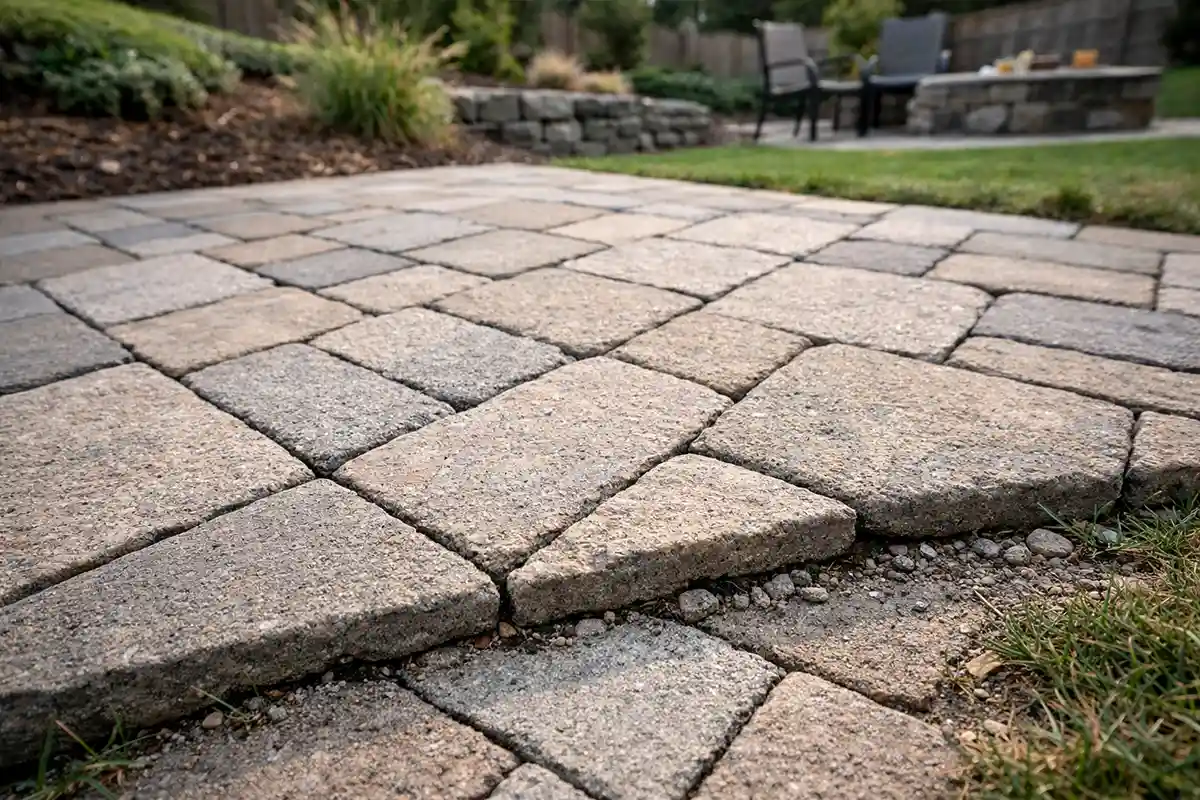
The lower edge carries more stress because it’s holding the “push” from everything above it. Over time, that pressure can show up as a border that feels a touch lower, or as joints that open slightly right along the downhill line. You might also notice edging that looks straight from five feet away but has a faint bow when you sight down it at knee height.
Seasonal Freeze and Thaw Amplify the Instability
In colder areas, freeze-thaw can make the uneven feel more noticeable by late winter. One section may lift slightly—just enough that a straight board laid across two pavers shows a small gap on one side. When it thaws, it often settles back differently, leaving a repeatable low spot.
Subtle landscape grading decisions in the surrounding yard can also influence how water approaches the patio structure. Broader slope management strategies are explored in Sloped Front Yard Landscaping Problems and Drainage Issues, where terrain behavior is analyzed beyond hardscape boundaries.
Surface Materials React Differently to Slope Stress
When a patio sits on a 4–6° slope, gravity does not treat every material the same. A poured concrete slab often shows a thin crack that runs straight from the upper corner down toward the lawn edge. Individual pavers, on the other hand, may stay uncracked but begin to separate by an eighth of an inch along one joint line. Natural stone can tilt slightly, so one corner sits higher than the opposite edge when you place a 4-foot level across it.
A common but incorrect belief is that “stone is stone,” meaning all hard surfaces respond the same way under pressure. They do not. Flexible systems such as pavers allow small movement between units, which can hide early slope stress. Rigid slabs transfer stress across the entire surface, making cracks more visible but sometimes more predictable.
If you stand near the downhill border and tap the surface with your heel, the sound difference between the upper and lower sections often reveals how the material is reacting. A hollow tone in one 2-foot strip suggests base migration beneath that material type, not just surface wear.
Edge Restraints Quietly Determine Long-Term Stability
Look closely at the downhill edge where the patio meets the grass or mulch bed. If the border line bows outward by even a quarter inch across a 10-foot span, lateral pressure is building. Edge restraints are not decorative trim; they are structural containment for sideways movement.
Many homeowners assume edging is only there to keep pavers neat. In reality, on a slope, it resists the constant downhill creep of compacted aggregate. When edging is under-anchored or installed at a shallow depth, the lower perimeter becomes the first point of failure. You may notice tiny gaps forming between the last row of pavers and the restraint after heavy rain.
Correcting this begins with geometry. The restraint must sit firmly below the bedding layer and tie into compacted base material at a consistent depth. When the lower edge is properly contained, joint spacing across the surface stops widening in a diagonal pattern from top left to bottom right.
Compaction Depth Is Often Underestimated
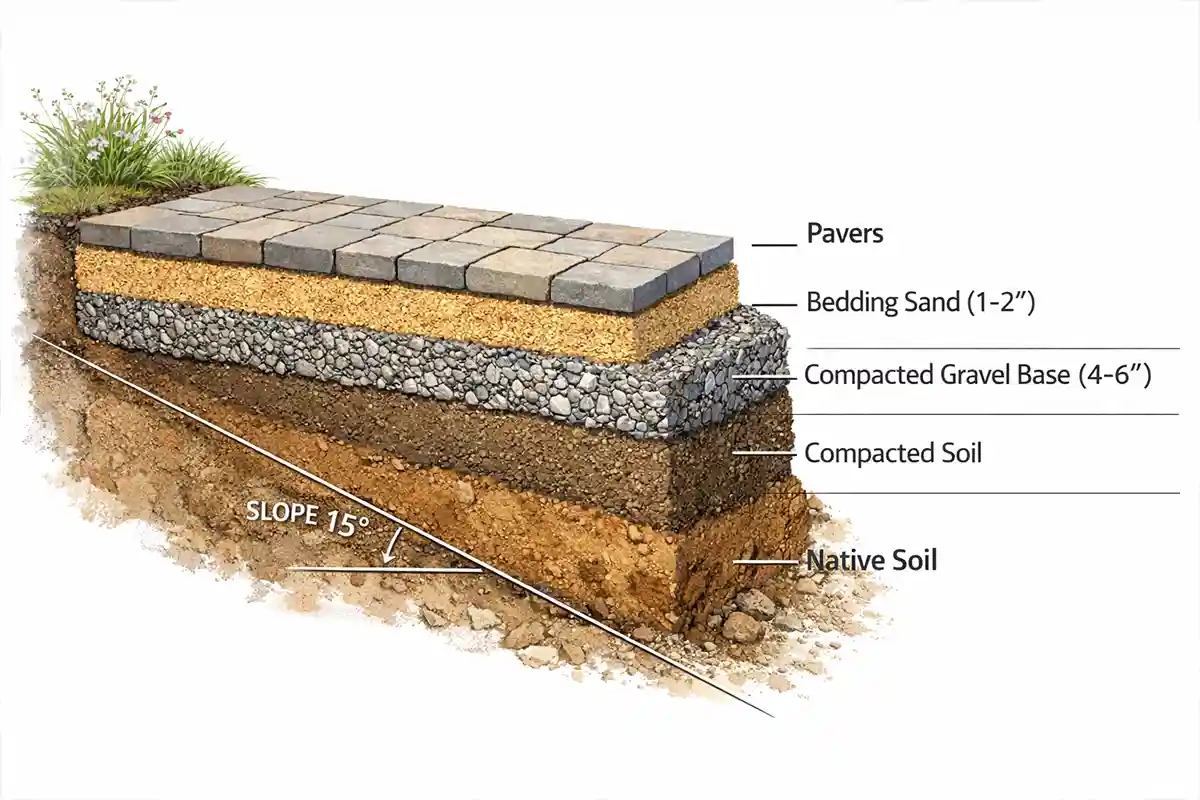
Under the surface, the true contact plane sits between the compacted gravel base and the native soil below. If that contact layer is uneven or loosely compacted along the downhill third, compression will concentrate there. You may see this when the lower 3–4 feet of the patio feel softer than the section closer to the house siding line.
In places like Colorado, where freeze-thaw cycles are strong and soil moisture shifts seasonally, insufficient compaction depth amplifies movement. A base that is only a few inches deep on a slope may look flat on top but lacks resistance against downward force. Deepening and properly compacting the base redistributes pressure so the lower edge does not carry a disproportionate load.
Water From Surrounding Areas Changes the Equation
Water rarely arrives only from above. It often enters from the uphill side, especially if the yard slopes toward the patio at a 3–5° angle. You might notice rainwater flowing along the siding line or collecting near a window well 60 inches above the patio before spilling downward.
A frequent misdiagnosis is blaming the patio surface when the true issue is external runoff. Downspouts that discharge within a few feet of the upper patio edge introduce repeated saturation. That repeated wetting weakens the base and increases movement along one strip.
Managing this requires redirecting flow paths. Adjusting grading so water moves away from the patio, not toward it, changes how often the base becomes saturated. When runoff is controlled, the pattern of recurring joint separation along the same downhill seam begins to diminish.
Terrain planning principles discussed in Front Yard Landscaping Ideas for Sloped Yards illustrate how broader grading decisions influence hardscape performance over time. Slope control is never isolated from the rest of the yard.
Load Concentration Accelerates Movement
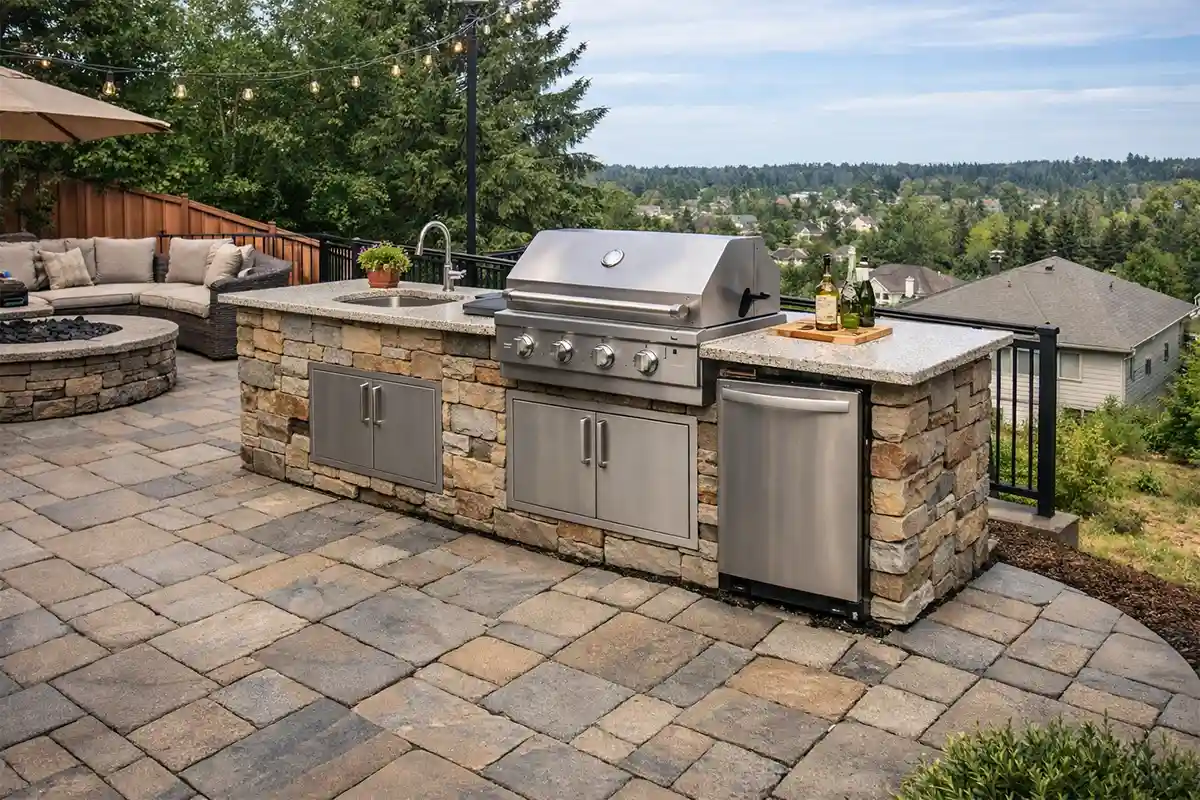
Place a heavy outdoor kitchen island near the downhill border and you shift the compression map instantly. The contact pressure under that 5-foot-wide section increases, especially if the base beneath it is thinner than the upper half. You may observe grout lines widening directly under the appliance footprint while the rest of the patio remains stable.
The structural change required here is redistribution. Moving heavy elements toward the center or reinforcing the lower third with deeper base and geogrid reduces concentrated settlement. Once the load spreads evenly, the diagonal separation pattern often stops progressing.
Freeze Depth and Moisture Retention Interact on Slopes
In colder regions, frost penetration can vary across the patio footprint. The lower edge, which retains moisture longer after a storm, may freeze deeper than the upper section near the siding. You might see one strip rise slightly during late winter, creating a visible shadow line when sunlight hits from the side.
A mistaken belief is that frost heave affects the entire patio equally. On slopes, moisture distribution is uneven, so lifting is uneven. Correcting moisture entry points and reinforcing the base reduces differential heave, making spring settling less dramatic.
Quick Diagnostic Questions
Why does only one corner feel soft underfoot?
Because compression is uneven at the downhill contact plane.
Why do joints open diagonally instead of randomly?
Slope-driven pressure moves material in a consistent downhill direction.
Can thicker pavers fix movement?
No, thickness resists cracking but does not stop soil migration.
Why does water disappear along one edge?
It is entering the base from the uphill seam.
Does edging really matter that much?
Yes, it resists lateral creep and maintains surface geometry.
Why does winter make it worse?
Freeze-thaw exaggerates existing weak zones.
Can moving heavy furniture help?
Yes, reducing concentrated load slows localized settlement.
Why does the surface look level but feel uneven?
The base layer may be shifting while the top remains visually aligned.
Through proper geometric correction, controlled water flow, and balanced compaction, the cycle shifts from repeated drift to gradual stabilization.
Subtle Warning Signs Most Homeowners Overlook
Early instability rarely looks dramatic. Instead, it shows up as repetition in one narrow zone. You might notice that the same 3-foot strip near the downhill edge feels slightly lower each time you step on it. A straight board laid across two pavers may reveal a small gap on one side, even though the overall surface still looks level from the patio door.
The key difference is between stable repetition and expanding imbalance. Stable repetition means the soft spot stays in the same place and does not grow wider over the seasons. Expanding imbalance means that what started as a 12-inch section slowly stretches into a 3- or 4-foot area, and joint gaps begin appearing farther upslope.
A common but incorrect belief is that “if it hasn’t cracked yet, it’s fine.” Cracks are late-stage signals. Earlier signs include sand washing out of the same joint after each heavy rain, or a border that feels one-quarter inch lower than the center when you roll a grill across it.
Why Quick Surface Fixes Rarely Work
If you lift and reset a few pavers without addressing the slope-driven pressure beneath them, the pattern usually returns. You may see the joint look tight for a few weeks, only to open again along the same diagonal line from the upper left corner down to the lower right edge. That repeat pattern is the giveaway that the base contact plane is still shifting.
Adding more joint sand often creates a temporary improvement. The surface looks clean and firm, and the pavers sit flush with the adjacent row. But after the next storm, the same low strip near the lawn edge may feel slightly spongy under your heel. The underlying compression imbalance has not changed, so the behavior returns.
Partial fixes can also shift the problem. Tightening the downhill border without improving drainage might move stress toward the center of the patio. You then notice a faint hollow sound when tapping two feet inside the edge. The location changes, but the mechanism remains active.
When Structural Reinforcement Becomes Necessary
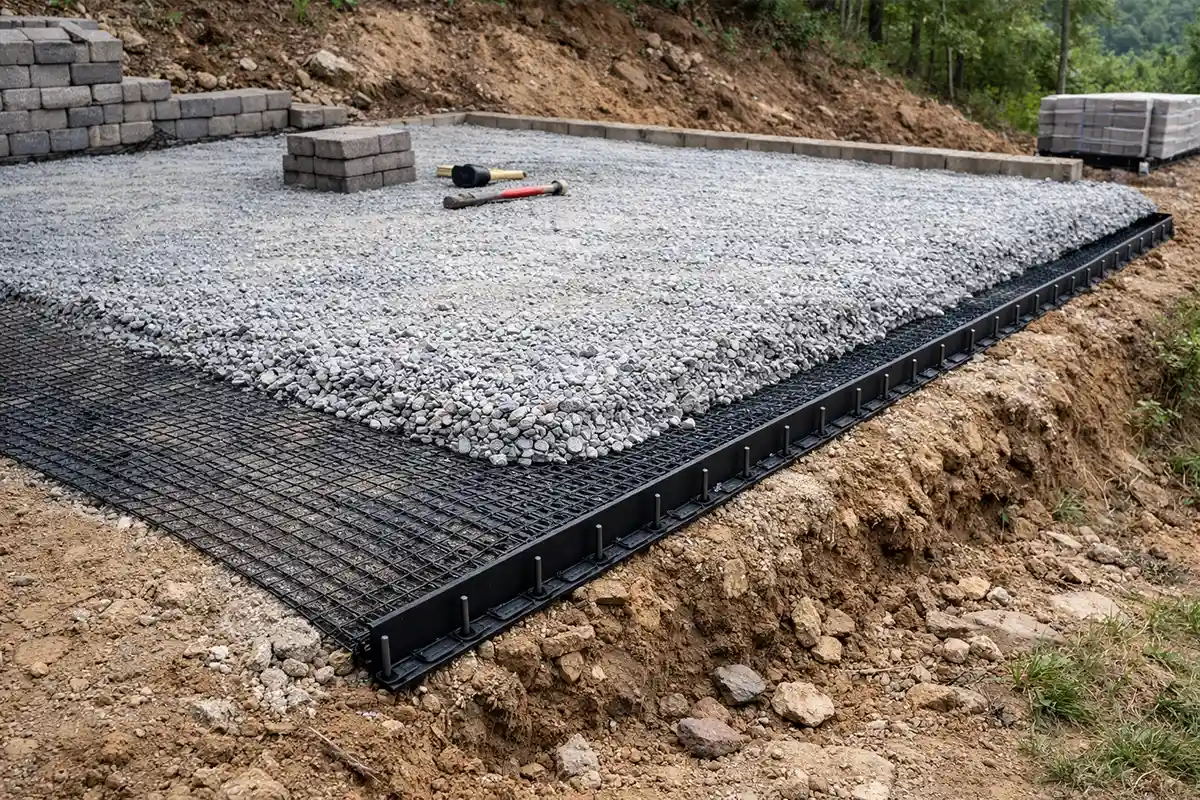
There is a decision threshold between monitoring and rebuilding. If the low area expands beyond a few feet or the height difference approaches half an inch across a 4-foot span, the issue is no longer cosmetic. At that point, reinforcement of the base layer or installation of geogrid stabilization may be required to rebalance pressure along the slope.
Structural reinforcement changes the contact relationship between gravel and soil. Instead of allowing the lower third to compress more than the upper section, the load distributes across a wider area. After reinforcement, you should observe consistent joint spacing and even drying patterns across the full patio width.
Drainage Corrections That Protect Long-Term Stability
Drainage adjustments can prevent stable repetition from becoming expanding imbalance. If downspouts discharge within a few feet of the uphill edge, redirecting that flow alters how often the base becomes saturated. After correction, rain should move across the surface in a thin sheet and exit evenly, rather than disappearing along one border.
You can often measure improvement visually. The darker damp strip near the lawn edge should shrink in width. Joint sand should remain in place after storms instead of collecting at the driveway edge or in mulch beds. When water behavior changes, compression behavior follows.
The interaction between slope and runoff is explored in Patio Drainage Problems Most Homeowners Notice Too Late. Recognizing these patterns helps determine whether monitoring is enough or structural action is required.
Designing With the Slope Instead of Fighting It
Trying to force a perfectly flat plane onto a 5° grade often creates hidden stress points. A stepped layout or segmented zones can break the slope into manageable sections, reducing concentrated pressure at the lower border. You might notice that multi-level designs show fewer diagonal joint gaps because load distributes more evenly.
Design alignment matters too. When patio edges run parallel to the natural contour lines of the yard, water flows more predictably. When they cut sharply across the slope at a steep angle, runoff tends to concentrate along one corner.
Observable Stability Checklist
-
The height difference across 4 feet is less than 1/4 inch.
-
Joint gaps do not widen season to season.
-
Border alignment remains straight when sighted at knee height.
-
No single 2–3 foot strip feels softer than the rest.
-
Rainwater drains evenly without pooling along one edge.
-
Sand does not repeatedly wash out from the same joint line.
-
Heavy furniture leaves no permanent depression marks.
When these conditions hold steady over time, the patio is likely in a stable state rather than entering expanding imbalance.
Guidelines on slope management and ground stability are outlined by the American Society of Civil Engineers.